Two Taj visits. One tight overnight.
This Mumbai-to-Agra tour is built around sunrise and sunset at the Taj Mahal, so you get two very different looks without having to plan anything yourself. I like how the schedule pairs the big-ticket sights with smart “in-between” stops like Itmad-ud-Daula and a riverside Taj viewpoint, which helps the day feel full instead of rushed.
I also like the practical details that reduce stress: airport-to-hotel transfers, a clean AC car for sightseeing, and professional tour guidance at the key monuments. One possible drawback to note is that lunch and dinner are not included, and the timing is intense because you’re mixing flights with early-morning Taj visits and an Agra Fort stop before heading back.
In This Review
- Key highlights you’ll feel right away
- How the Mumbai–Delhi–Agra overnight route really works
- Day 1: Itmad-ud-Daula, the riverside Taj viewpoint at sunset, and a real art stop
- Day 2: The sunrise Taj Mahal visit that actually changes the photos
- Agra Fort: red sandstone palaces and the named halls of the Mughal era
- Hotel Atulyaa Taj and meals: what you truly get versus what you’ll pay
- Handicrafts in Agra: marble inlay with live work, plus carpets and jewelry
- Price and value: is $250 per person actually fair for this plan?
- Who this tour suits best (and who may feel it’s too tight)
- Practical advice before you go (based on what the tour emphasizes)
- Should you book this Mumbai to Agra sunrise and sunset tour?
- FAQ
- Is pickup and drop-off included from Mumbai?
- Do I get a tour guide and monument entry tickets?
- Are breakfast and hotel accommodations included?
- Does the tour include Taj Mahal at both sunrise and sunset?
- Is lunch and dinner included?
- Are return flight tickets included?
- What other sights are included besides the Taj Mahal?
Key highlights you’ll feel right away
- Sunrise Taj Mahal plus a second Taj Mahal moment at sunset, for two color moods and better photo angles
- Itmad-ud-Daula (Noor Jahan’s family tomb) with white marble and inlay work, plus clear context from your guide
- Agra Fort after breakfast and checkout, including well-known palace areas like Diwan-a-khas and Diwan-a-am
- Marble inlay handicrafts with a live demonstration, plus carpets, jewelry, and local textile/leather industries
- 4-star hotel base (Atulyaa Taj) with breakfast included on twin sharing (when that option is selected)
How the Mumbai–Delhi–Agra overnight route really works
This is not a slow, stop-and-stay trip. The flow is straightforward: you’re picked up in Mumbai and transferred to the airport to board a flight to Delhi, then you connect quickly to Agra by road. The drive from Delhi to Agra is about 200 km, typically around four hours, so you’re trading comfort for momentum.
The big value of the overnight format is that it lets you do both sunrise and sunset at the Taj Mahal. Instead of choosing one “maybe I can wake up early” option, you’re scheduled to see the Taj at the best light windows the tour promises. And because the tour uses an AC car for the sightseeing portion, you’re not piecing together local transport right after landing.
There’s also a useful flexibility element: it’s a private tour/activity for your group, and the provider offers group discounts. So if you’re traveling with friends or family, the experience can be smoother than a typical bus tour while still holding together as a packaged plan.
You can also read our reviews of more evening experiences in Mumbai


Day 1: Itmad-ud-Daula, the riverside Taj viewpoint at sunset, and a real art stop
After you arrive in Agra and check into Hotel Atulyaa Taj, you’re guided through the city in a way that builds the story of the Mughal-era monuments. Lunch is on your own, so I suggest planning for a simple meal rather than trying to squeeze in a long sit-down.
Your first major cultural stop is Itmad-ud-Daula, a tomb built by Mirza Gyas Beg and commissioned by his daughter Noor Jahan. The guide context matters here because it’s not just a pretty building: it’s tied to the Mughal court through Mirza Gyas Beg’s role and death in 1621, and then the tomb’s construction window of 1622 to 1628. It’s described as white marble with inlay work, and that detail helps you look at what you’re seeing instead of treating it like a quick photo stop.
Next comes the Taj Mahal view point for sunset, timed so you can see the mausoleum from across the river. This is a smart pairing: Itmad-ud-Daula gives you a close-up marble-and-inlay feel, while the sunset viewpoint gives you scale and atmosphere. If you’re trying to photograph, you’re getting the kind of different angles that often take extra time on DIY trips.
Then you get an “Agra beyond monuments” interlude: Marble Handicrafts Agra. The tour notes that families have worked in marble inlay since around the 16th century, and you can see live demonstration of the art. You’ll also see related crafts like hand-knotted carpets and jewelry, and you’ll learn that Agra is known for textiles and the leather industry. Even if you don’t shop, this stop adds texture and shows you the local economy behind the famous marble look.
One thing to consider: this is only about 30 minutes. So if you’re someone who wants lots of time to browse and compare items, go in knowing it’s a taste, not a long market day.
Day 2: The sunrise Taj Mahal visit that actually changes the photos
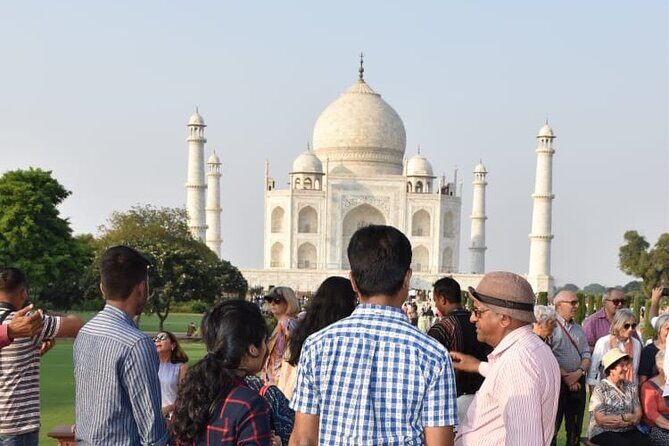
Day 2 is the reason this tour exists. You start with an early-morning sunrise Taj Mahal visit. The Taj Mahal is presented as the memorial that draws people worldwide, and the tour specifically highlights sunrise as one of the best times to visit for color effects and photography. That matters because sunrise isn’t just about being early—it’s about light that shifts how the building reads from different positions.
Your visit is guided, so you’re not just moving between ticket gates and crowd currents. You get sightseeing with a guide, and then you return to the hotel for breakfast and checkout. The structure is important: it keeps the sunrise visit protected from the rest of the day’s logistics, so you’re not trying to run to the Fort with your energy tank empty.
After breakfast, you’re off to Agra Fort with the tour guide. This sequencing is nice because it turns the morning into a strong “two-monument hit”: first the Taj at its most dramatic time, then the Fort right after you’ve re-fueled.
Agra Fort: red sandstone palaces and the named halls of the Mughal era
Agra Fort is one of those places where you’ll either love it or feel it’s too large. In this tour, you’re guided through a focused set of highlights, including named areas you can recognize later and map in your head.
The tour describes Agra Fort as the city’s second World Heritage site, and notes it as one of the oldest and largest forts in India. It also gives you the key timeline: originally built in the 10th century by Hindu Rajput King Badal Singh, later rebuilt by the third Mughal emperor Akbar, and then expanded with notable additions by Shahjahan.
The materials detail is especially useful for visualizing the layers. You’re told about palaces built in red sandstone under Akbar, and then white marble buildings added by Shahjahan. The tour specifically calls out palaces and halls such as:
- Jahangir Palace
- Diwan-a-khas
- Diwan-a-am
- Khas Mahal
You get about one hour here with admission included, which means you’ll walk enough to feel the scale but not so long that you’re exhausted. Still, one consideration: if you want a slow, unhurried exploration with time to wander into every corner, this is probably too tight. But as a guided “best-of” Fort visit, it fits the overall pace of the sunrise-and-sunset package.
Hotel Atulyaa Taj and meals: what you truly get versus what you’ll pay
On the hotel side, the tour is set up with comfort in mind. It includes a 4-star hotel with breakfast on twin sharing basis when that option is selected, and the listed base property is Hotel Atulyaa Taj. Breakfast is included on the travel days, and lunch and dinner are not included.
That means your real budget math is simple:
- You’ll plan your own lunch on day 1
- You’ll plan your own dinner on day 1
- Breakfast is handled for you
- Your monument entry fees are included
If you’re the type who likes to eat early and keep moving, this structure works well. If you like long dinners with full restaurant service, you’ll need to add that cost yourself. The tour also notes that reservation in the same hotel is subject to availability, so I’d treat the hotel as an included base, not a guaranteed exact room assignment you can lock in months ahead.
A few more Mumbai tours and experiences worth a look






Handicrafts in Agra: marble inlay with live work, plus carpets and jewelry
A lot of Taj and Fort trips stop at monuments. This one adds a short cultural and economic look at how Agra’s craft tradition supports the city.
The Marble Handicrafts Agra stop is built around marble inlay. The tour highlights a few things that make this more interesting than a typical quick shopping stop: it references that the craft has been practiced for centuries, and it points out that you can see a live demonstration of the work. The message is clear: you’re not just buying a souvenir; you’re watching the skill process.
You’ll also see other related trades:
- Hand-knotted carpets
- Jewelry
And the tour mentions that Agra is famous for textiles and the leather industry. Even if your main goal is the Taj Mahal, I think this craft time makes your photos feel more grounded, because you start noticing marble-and-detail design across monuments and everyday products.
Time-wise, it’s about 30 minutes, and the admission is free according to the tour info. So this is a light add-on, not a full detour.
Price and value: is $250 per person actually fair for this plan?
At $250 per person for an about two-day package, you’re paying for more than just transport. You’re paying for:
- Air travel from Mumbai to Delhi (return flights are only included if you select that option)
- Ground transfers and AC car sightseeing time in Agra
- Monument entry fees
- A professional tour guide for the included sites
- A 4-star hotel base with breakfast when selected
The main reason the cost can feel worthwhile is that sunrise and sunset Taj Mahal visits are hard to pull off casually. They require careful timing, and that’s exactly where DIY plans often wobble. Here, the schedule is doing the heavy lifting.
You should also factor in what’s not included. Lunch and dinner are on you, and gratuities are not stated as included. So if you’re comparing to a cheaper “driver only” option, this is the difference:
- You’re buying guidance, entry fees, and organized timing
- You still budget for your own meals
If you like structure, hate hunting for tickets, and want two Taj Mahal sessions without the stress, this price starts to look like practical value. If you’re cost-first and comfortable DIY planning around sunrise and sunset, you might be able to build something cheaper, but it won’t be as tidy.
Who this tour suits best (and who may feel it’s too tight)
This experience is best for you if:
- You want sunrise and sunset Taj Mahal without planning the logistics
- You like guided context at monuments like Itmad-ud-Daula and Agra Fort
- You travel as a group and can benefit from the group discount element
- You prefer an AC car for sightseeing rather than figuring local transport
It may be less ideal if:
- You prefer slow travel with long unstructured breaks
- You don’t want early mornings tied to a sunrise visit
- You want meals fully included (since lunch and dinner are not part of the package)
The “private for your group” setup can be a plus if you don’t enjoy the friction of mixed schedules. At the same time, it also means your guide time is still capped by the overall two-day plan.
Practical advice before you go (based on what the tour emphasizes)
The tour’s strongest promise is timing, so treat your mornings and evenings as part of the sightseeing, not just travel. The Taj Mahal sunrise session is specifically called out for color effects and photography from different points, so arrive with a mindset of looking, not just rushing.
For the sunset Taj Mahal viewpoint, you’re viewing from across the river, which is a great chance to compare scale and mood against the sunrise look. Don’t expect these to feel like two identical visits. If anything, they’re designed to make the building feel different.
At the monuments, the guide time is included. That’s your chance to ask questions about the places that have built-in stories, like Itmad-ud-Daula’s connection to Noor Jahan and the timeline of construction from 1622 to 1628. For Agra Fort, use the named highlights—Jahangir Palace, Diwan-a-khas, Diwan-a-am, Khas Mahal—to anchor what you’re walking through.
Finally, remember that the craft stop is short. If you’re hoping to buy something big, you’ll likely need extra browsing time elsewhere. If you want inspiration and a brief “see how it’s made” moment, the 30 minutes fits perfectly.
Should you book this Mumbai to Agra sunrise and sunset tour?
Book it if you want a high-impact Agra visit where the Taj Mahal is the whole point and the rest of the schedule supports that goal. The two lighting sessions are the big win, and the add-ons—Itmad-ud-Daula, Agra Fort, and the marble inlay craft demonstration—make the trip feel like more than a single monument day.
Skip it or look for another option if meals being included matters most to you, or if you know you struggle with early starts. This tour is designed for efficient sightseeing, not lingering.
If you’re traveling from Mumbai and you’d rather have flights, car transfers, guides, and entry fees lined up for you, this is the kind of package that lets you spend your energy where it matters: watching the Taj shift under sunrise light, then seeing it again in sunset glow.
FAQ
Is pickup and drop-off included from Mumbai?
Yes. The tour includes pick up and drop in Mumbai.
Do I get a tour guide and monument entry tickets?
Yes. Monument entry fees and a professional tour guide are included.
Are breakfast and hotel accommodations included?
Breakfast is included, and the tour lists a 4-star hotel with breakfast on twin sharing basis if that option is selected.
Does the tour include Taj Mahal at both sunrise and sunset?
Yes. You visit the Taj Mahal for an early sunrise session and also for a sunset viewpoint.
Is lunch and dinner included?
No. Lunch and dinner are not included.
Are return flight tickets included?
Return flight tickets are included only if you select that option.
What other sights are included besides the Taj Mahal?
You’ll also visit Itmad-ud-Daula, Agra Fort, and a marble handicrafts stop in Agra.