REVIEW · NEW DELHI
4 Days Golden Triangle Tour
Book on Viator →Operated by Creative India Holidays · Bookable on Viator
Four days, three icons, almost zero stress. This Golden Triangle plan is built for people who want Delhi, Agra, and Jaipur highlights without spending your whole trip figuring out trains, taxis, and ticket lines.
I really like that you’re not on your own for transit. The air-conditioned vehicle handles the between-city hops and between-site drives, so your day stays focused on monuments instead of logistics.
One thing to consider: Taj Mahal is closed for all visitors on Fridays, so the day order may shift (and entrance fees for major sites are not included).
In This Review
- Key things that make this tour work well
- Golden Triangle in 4 Days: What You Really Get for $146
- Day 1 in Delhi: Old Delhi Mosque Energy to Qutub Minar Views
- Jama Masjid and the Old Delhi rhythm (about 1 hour)
- Raj Ghat and India Gate for perspective (about 1 hour + 30 minutes)
- Lutyens landmarks: Parliament and the President’s House area
- Qutub Minar and Humayun’s Tomb: UNESCO power couple (2 hours + 1 hour)
- Overnight in Agra (about 4 hours drive)
- Day 2 Agra and Fatehpur Sikri: Taj Mahal Timing, Agra Fort, and the Drive to Jaipur
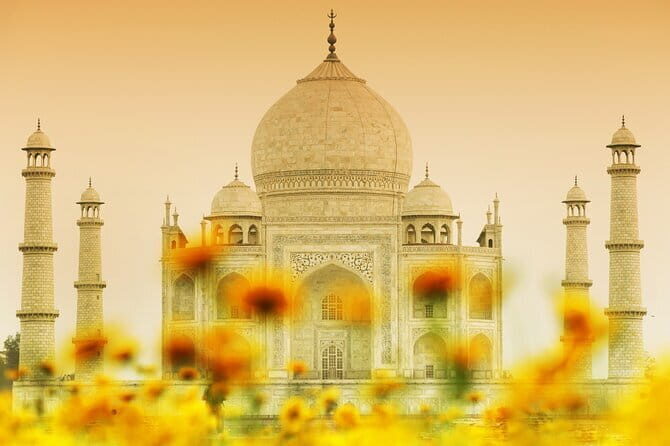
- Taj Mahal (about 2 hours)
- Agra Fort (about 1 hour)
- Fatehpur Sikri: the Mughal “what-if” city (about 2 hours)
- Overnight in Jaipur (after driving from Fatehpur Sikri)
- Day 3 Jaipur Highlights: Hawa Mahal, Amber Fort, City Palace, Jantar Mantar, Free Time
- Hawa Mahal (about 1 hour)
- Amber Fort (about 2 hours)
- City Palace (about 2 hours)
- Jantar Mantar (about 1 hour)
- Evening free for shopping
- Hotel and Meal Reality Checks: What’s Included vs What Costs Extra
- Comfort, Crowds, and Entry Help: How You’ll Keep the Day Moving
- Taj Mahal on Friday: How the Tour Adjusts the Order
- Who This Tour Fits Best (and Who Might Want Something Else)
- Should You Book This 4-Day Golden Triangle Overview Tour?
- FAQ
- What time does the tour start?
- Are entrance fees included?
- What’s included in the price besides sightseeing?
- Is pickup available from Delhi and Gurugram?
- What happens if my travel dates include a Friday?
- How are rooms handled during the tour?
Key things that make this tour work well
- AC transfers + pickup in Delhi/Gurugram: you start with a handoff, not a scramble
- Guide-managed entry: your guide helps you buy entrance tickets so you’re not stuck at counters
- UNESCO-heavy itinerary: Taj Mahal, Humayun’s Tomb, Qutub Minar, and more
- Real time for each stop: you get set blocks for Jama Masjid, Taj Mahal, Amber Fort, and Jantar Mantar
- Private feel, not a mega-group: it’s only your group during the tour
- Breakfast is included (4 days): you can plan the day with fewer meals to worry about
Golden Triangle in 4 Days: What You Really Get for $146
At $146 per person, this tour is priced like a value-focused “see the classics” package. You’re paying for guided sightseeing, pickup/drop-off, an air-conditioned ride between dispersed sites, and breakfast for 4 days—the pieces that usually eat time and planning energy on your own.
Another practical win: it’s described as a private tour/activity for only your group. That doesn’t mean it’s luxury-level on-board comfort, but it usually means your schedule is less chaotic than big group tours.
What’s not included is also important. Food and drinks aren’t included, and some monument entry tickets are listed as not included. So you’ll want to budget extra for lunches, dinners, water, and the tickets your guide helps you purchase.
A few more New Delhi tours and experiences worth a look


Day 1 in Delhi: Old Delhi Mosque Energy to Qutub Minar Views
Delhi can feel split into zones: Old Delhi for Mughal-era lanes and grand mosques, and New Delhi for wide boulevards and imposing government buildings. This day stitches those together fast, then finishes with two of the city’s biggest UNESCO hits before transferring to Agra.
Jama Masjid and the Old Delhi rhythm (about 1 hour)
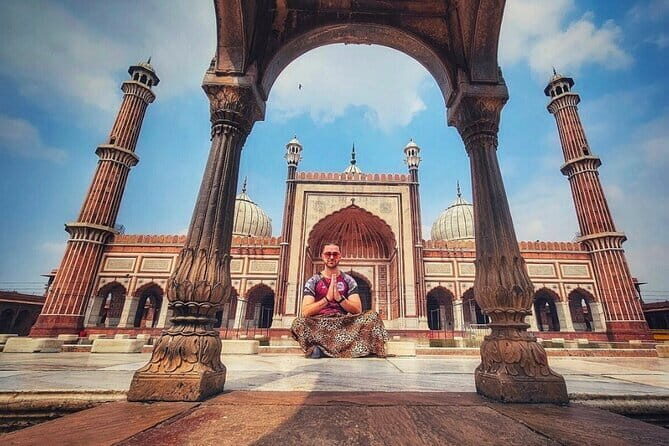
You’ll start with Jama Masjid, built in the 1600s under Shah Jahan. Even if you just take in the scale and the court space, it’s easy to understand why this is a top stop. The visit time is tight enough to feel efficient, but long enough to absorb the setting rather than just pose and go.
Consideration: this area can be busy, and you’ll want comfortable shoes. If you’re sensitive to crowds, the early part of the day is the moment to lean into it calmly.
Raj Ghat and India Gate for perspective (about 1 hour + 30 minutes)
Next comes Raj Ghat, Mahatma Gandhi’s memorial site on the Yamuna’s banks. It’s a quieter pause after the mosque energy, and it helps you connect the trip to modern Indian history rather than only Mughal monuments.
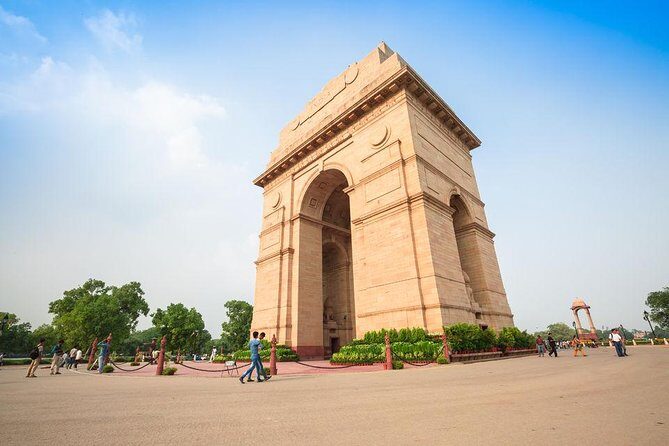
Then you shift to India Gate, a British-era landmark that commemorates soldiers of the former British Indian Army. It’s a shorter stop, but it’s useful for getting your bearings in central Delhi.
Lutyens landmarks: Parliament and the President’s House area
You also stop at the Parliament House (Sansad Bhavan) area and the Rashtrapati Bhavan inspired by Imperial architecture. The itinerary lists time for the Parliament building area, and the Rashtrapati Bhavan is included as a stop as well.
Why I like this: it adds variety. After forts and tombs, you get architecture tied to governance and the city’s colonial-era planning—different mood, same big-scale visuals.






Qutub Minar and Humayun’s Tomb: UNESCO power couple (2 hours + 1 hour)
The day ends with Qutub Minar (a towering red sandstone minaret, listed as about 2 hours) and then Humayun’s Tomb (about 1 hour). These two stops are the “seriously iconic” portion of the itinerary.
Qutub Minar gives you vertical drama—details and height you can’t really fake with photos. Humayun’s Tomb offers the more balanced, garden-and-mausoleum feeling, with UNESCO gravitas behind it.
Overnight in Agra (about 4 hours drive)
By the end of Day 1 you drive to Agra for the night. That timing matters: you’ll wake up in Agra already positioned for Taj Mahal and the Agra Fort without adding extra day-to-day travel.
Day 2 Agra and Fatehpur Sikri: Taj Mahal Timing, Agra Fort, and the Drive to Jaipur
Day 2 is the “big two” in Agra plus one stop on the way to Jaipur. It’s a classic setup: morning Taj Mahal, then Agra Fort, then Fatehpur Sikri as a Mughal highlight before you reach Jaipur.
Taj Mahal (about 2 hours)
The Taj Mahal is the headline. You’re given roughly 2 hours, which is a realistic window to see it from different angles, walk the main areas, and still have time to sit for a minute instead of rushing.
Since the tour notes that entrance is not included, you’ll want to plan for paying the entry fee on site (your guide helps with that so you’re not hunting tickets alone).
Agra Fort (about 1 hour)
After Taj Mahal, you move to Agra Fort, built in the 1500s with red sandstone and later decorated by Shah Jahan-era additions. You get about 1 hour, which is enough to notice the ramparts’ structure and the fort’s connection to the river side setting (the itinerary notes it sits on the Yamuna bank).
Practical note: forts can feel long if you’re not into walking. Still, 1 hour is short enough to keep it satisfying rather than tiring.
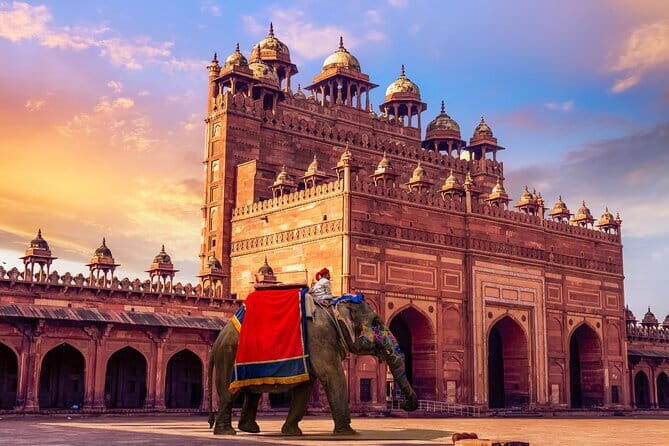
Fatehpur Sikri: the Mughal “what-if” city (about 2 hours)
Then the itinerary includes Fatehpur Sikri (Panch Mahal listed as part of the stop). This is around 40 km west of Agra and tied to Akbar’s time when the Mughal empire briefly shifted its capital here.
You get about 2 hours at Fatehpur Sikri. That’s valuable because it gives you time to understand why people call it a dramatic, story-heavy place—rather than just passing through for a quick look.
Overnight in Jaipur (after driving from Fatehpur Sikri)
You’ll then drive to Jaipur for your evening. This keeps the tour tight: you don’t reach Jaipur too late to miss the city vibe.
Day 3 Jaipur Highlights: Hawa Mahal, Amber Fort, City Palace, Jantar Mantar, Free Time
Jaipur is the day of “Rajasthan style” visuals: palace facades, fort walls, and city-level landmarks that turn architecture into the main attraction.
Hawa Mahal (about 1 hour)
You start with Hawa Mahal (Palace of Wind), a five-storey facade built in 1799. Even if you just look at the honeycomb-like windows, it communicates the idea of ventilation and street-level viewing.
This is a great warm-up stop before heavier sightseeing, because you get a big visual hit without needing to walk a fortress-sized distance.
Amber Fort (about 2 hours)
Next is Amber Fort (Amer), listed as about 2 hours. The itinerary notes it’s around 11 km from Jaipur and connected to its earlier role as the state’s capital, built in the late 1500s era.
Why 2 hours works here: it’s enough time for you to explore courtyards and ramps without feeling like you’re trapped in a “one photo every five seconds” loop.
City Palace (about 2 hours)
Then comes City Palace, in the heart of the Pink City. You’re given about 2 hours, and the itinerary mentions key parts like Chandra Mahal and Mubarak Mahal as included structures.
City Palace matters because it connects architecture to rule and ceremony—so you’re not only seeing walls; you’re seeing how power was staged in everyday space.
Jantar Mantar (about 1 hour)
Jantar Mantar is your final major stop. The itinerary lists it as an astronomical observation site with fixed instruments. It’s surprisingly satisfying if you like details, because it’s the intersection of science and stone.
If you’re not a “numbers person,” you’ll still enjoy it. Big instruments are hard to ignore, and it’s an easier stop to pace than forts.
Evening free for shopping
You end with an evening free for shopping. That’s one of the best little gifts in this itinerary because it lets you absorb Jaipur at your own tempo, not just a schedule tempo.
Hotel and Meal Reality Checks: What’s Included vs What Costs Extra
The tour includes breakfast for 4 days, which is huge for a whirlwind itinerary. You’re not guessing what time to eat or lining up for a first coffee while you’re also trying to be ready for monument entry.
Rooms are generally twin-sharing. If you book a group of 3, rooms default to triple-sharing unless you pay extra to get two rooms. This matters because it can affect comfort and privacy.
For food, the tour explicitly lists food and drinks as not included. That means your day budget should assume lunch and dinner. In places like Agra and Jaipur, you can find options at many price levels, but you’ll want to plan so you’re not making decisions under time pressure.
Comfort, Crowds, and Entry Help: How You’ll Keep the Day Moving
This is where the tour earns repeat praise. The itinerary clearly builds a lot of ground into four days, so any friction hurts. Here, the friction is reduced in two ways: a guide in your corner and structured transfer time.
Your guide helps you buy entrance fees at monuments so you won’t be stuck in lines just to pay. That sounds small, but when you’re juggling multiple major sites, it can make the difference between seeing everything you expected and “missing one because the queue swallowed the day.”
You also start at 8:00 am, which is practical in Delhi and helps you reach early entrances before the midday rush. Transfer times are listed as approximate and depend on traffic, which you should take seriously. In these cities, “about” can become “a bit longer,” so leaving time buffers in your expectations is smart.
One more practical note: the itinerary says you’ll be back to Delhi by around 2 pm on Day 4. If you want an easy last day, plan flights or onward plans for later in the afternoon. If you need it tighter, ask to adjust timing when possible.
Taj Mahal on Friday: How the Tour Adjusts the Order
This tour includes a clear heads-up: Taj Mahal remains closed for all visitors on Friday. If your start day creates a Friday visit, the itinerary can shift order (the tour notes a Thursday start produces a Delhi–Jaipur–Agra–Delhi pattern).
So if you’re picking dates, check your calendar first. If you’re flexible, you may get a smoother flow and avoid feeling like a key stop is being reshuffled.
Who This Tour Fits Best (and Who Might Want Something Else)
This tour is best for you if:
- You want a first Golden Triangle overview with minimal planning
- You’d rather pay for driver + guide than spend time researching routes
- You like classic, UNESCO-labeled highlights rather than niche stops
- You want breakfast included and clear daily structure
You might prefer a different style of trip if:
- You hate packed days and want slower pacing with longer stays per site
- You’re hoping all major monument entries are included in the price (they’re not)
- You’re visiting on a Friday and want zero itinerary changes around Taj Mahal
Still, even with that drawback, the structure is solid: each day covers a logical geographic cluster, and the transfers keep you moving without constant decision-making.
Should You Book This 4-Day Golden Triangle Overview Tour?
I think this is a smart booking for most first-timers with limited time. The combination of AC transfers, a guide who helps manage entry fees, and a tight UNESCO-focused route makes the $146 price feel like you’re paying to buy back your time.
If you want maximum value, do two things:
- Budget extra for food and monument tickets you’re responsible for
- Choose your dates with the Friday Taj closure in mind
If you like your travel straightforward—big sights, clear pacing, and less day-to-day stress—this is the kind of tour that helps you get the highlights you came for, without turning your vacation into a part-time research project.
FAQ
What time does the tour start?
The tour start time is listed as 8:00 am.
Are entrance fees included?
The tour notes that entrance tickets are not included for some monuments. Your guide helps you buy entrance fees so you’re not stuck waiting in ticket lines.
What’s included in the price besides sightseeing?
Included features list guide services, pickup and drop off, an air-conditioned vehicle, and breakfast (4 times).
Is pickup available from Delhi and Gurugram?
Yes. Pickup is offered from the airport or any location in Delhi/Gurugram.
What happens if my travel dates include a Friday?
The tour states the Taj Mahal is closed for all visitors on Friday, and the itinerary may adjust accordingly.
How are rooms handled during the tour?
Rooms are generally provided on a twin-sharing basis. For bookings of 3 people, rooms are generally triple-sharing by default, and you can request 2 rooms for an additional charge.