Four days, three icons, and one tiger quest. This private tour knits together Delhi, Agra, Jaipur, and Ranthambore with round-trip transport and city-by-city guides, so you get momentum instead of chaos. I especially like the planned Taj Mahal sunrise visit, timed to feel more magical than the daytime crowds.
What I like most is the pairing: history in the morning, then big-cat country in the afternoon. In Ranthambore, you’ll ride out with an English-speaking naturalist for a shared safari in search of Bengal tigers. One drawback to plan for: monument entrance tickets aren’t included, so you’ll want money set aside for sights where entry fees apply.
In This Review
- Key highlights worth noting
- Why this 4-day Golden Triangle plus Ranthambore mix works
- Private pickup in Delhi NCR: what you actually gain
- Day 1 in Delhi: Qutub Minar, Lotus Temple, Old Delhi streets
- Small Day 1 considerations
- Day 2 in Agra: sunrise Taj Mahal, then Agra Fort and Baby Taj
- Watch-outs for this day
- Day 3: Ranthambore National Park safari with an English-speaking naturalist, then Jaipur
- Day 4 in Jaipur: stepwell, forts, observatory, and Hawa Mahal
- One timing note
- Price and value: what you’re really paying for
- Guides that can make the difference: names, languages, and real care
- Who should book this tour (and who might not)
- Should you book? My straight answer
- FAQ
- How long is the Golden Triangle & Ranthambore tour?
- What cities are included in the tour?
- Is pickup and drop-off included?
- Are entrance tickets included for monuments?
- Do I get a guide in each city?
- What’s the safari format in Ranthambore?
- Is breakfast included?
- What about lunch during the tour?
- What if I travel on a specific day like Monday or Thursday?
- Is cancellation free?
Key highlights worth noting
- Taj Mahal at sunrise with a guided visit, then time for Agra Fort and the Baby Taj area
- Ranthambore safari with an English-speaking naturalist, plus a realistic tiger-viewing chance (it’s never guaranteed)
- Private air-conditioned car for all sightseeing, sized to your group (sedan for 1–2; wagon for 3–5; van for 6–12)
- Three different private guides across Delhi, Agra, and Jaipur, each covering their city’s details
- Entrance-ticket help from your guides, aimed at avoiding long queue time at monuments
Why this 4-day Golden Triangle plus Ranthambore mix works
If you’ve got limited time in India and you want the big-name places without spending half your vacation figuring out logistics, this route is built for you. The Golden Triangle loop is the classic sweep—Delhi to Agra to Jaipur—then it adds Ranthambore to give your trip a wildlife pulse, not just sightseeing checkboxes.
What makes it work well in practice is the rhythm. You start early on the Taj Mahal day, you see the key Agra monuments in a sensible order, and then you shift gears to the park area and the next city. With a private car and guides moving you along, you’re not stuck playing bus roulette between sites.
The other real win is the variety of guides and styles. In the reviews, you’ll see names like Vimal Mathur in Delhi, Sadiq Hussain in Agra, and Brajesh Sain in Jaipur. People talk about clear English, lots of photo help, and guides who adjust when conditions get tough—like heat making someone feel sick. That kind of flexibility is what turns a route into a trip you remember.
You can also read our reviews of more private tours in New Delhi


Private pickup in Delhi NCR: what you actually gain
This is a private tour, which means you’re not sharing your day with strangers or waiting around for a group to assemble. You get pickup from anywhere in Delhi NCR and drop-off back to your chosen area in Delhi NCR. Even better, you’re in a private air-conditioned car for sightseeing days, so the “how do we get there” problem disappears.
Vehicle size is matched to your group: a four-seater sedan for one or two people, a six-seater wagon for three to five, and a twelve-seater van for six to twelve. That matters when you’re moving between Delhi’s spread-out monuments and Old Delhi markets. Less squeezing, less frustration.
Also, this tour includes parking fees, tolls, fuel, and taxes. Those small costs often creep into your budget on self-booked days. Here, you know what you’re paying for, and you can focus on timing at the sights.
If you’re prone to feeling travel-worn after a long day in the heat, the car time is also your recovery valve. One review specifically called out a guide staying patient and respectful and adapting when a guest felt sick from the heat, with the person viewing the rest from the vehicle. That’s the kind of practical care you hope for on an intense itinerary.
Day 1 in Delhi: Qutub Minar, Lotus Temple, Old Delhi streets
Delhi day can go two ways: either it’s a blur of stops you barely remember, or it’s a guided route where each place adds a piece of the city picture. This itinerary leans toward the second option.
You begin at Qutub Minar, the UNESCO-listed tower complex linked to the early Delhi Sultanate era. It’s a great first stop because it instantly frames the scale of Delhi’s layered past. From there, you move to the Lotus Temple, known for its flower-like shape and free entry (and yes, it’s closed every Monday, so check your day of travel).
Next you hit major landmarks along the Rajpath area: India Gate, Parliament House, and Rashtrapati Bhavan. These are quick stops, but they’re worth it if you want the modern capital visuals without losing daylight. Then you shift to history closer to the ground with Agrasen Ki Baoli, a protected stepwell site.
After that comes the Old Delhi portion: Chandni Chowk with a traditional rickshaw ride, plus Jama Masjid for a big, imposing sense of Mughal-era architecture. One review noted a small tuk-tuk experience arranged downtown, which is the kind of extra flavor your guide can sometimes add to keep the day feeling fun rather than strictly scheduled.
You finish the day with Agra travel and an overnight in the Agra area. That’s an efficient choice, because it sets you up for the sunrise Taj Mahal the next morning.
Small Day 1 considerations
- Some entrance tickets are not included, so you’ll want to be ready for monument fees later.
- Delhi traffic can slow things down. The private car helps, but time still matters.
Day 2 in Agra: sunrise Taj Mahal, then Agra Fort and Baby Taj
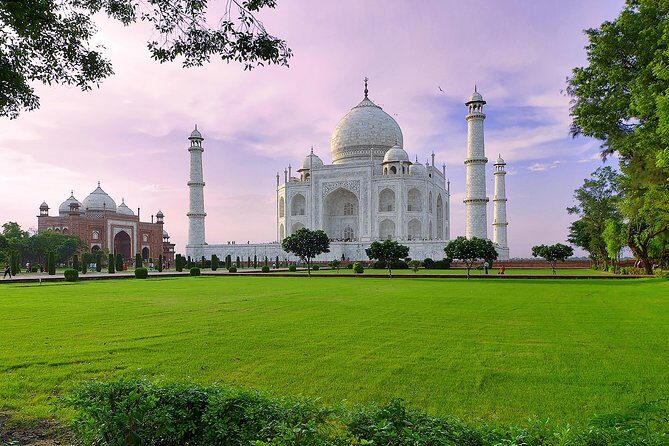
Agra is all about pacing, and this day is paced well. You start early with a sunrise Taj Mahal tour, including a guided visit inside the UNESCO World Heritage site. The Taj Mahal built in Shah Jahan’s era is already a jaw-dropper, but sunrise timing usually gives it a more serene feel and helps you avoid the most chaotic flow of daytime visitors.
After the Taj Mahal, you go back for breakfast, then check out and proceed to Agra’s fort area. Agra Fort is the next key stop—UNESCO listed and tied to Mughal imperial life. You get a feel for how rulers lived and moved through power structures, not just how they made monuments.
Then you visit Itmad-ud-Daula, often called the Baby Taj. This mausoleum is smaller than the Taj, but it’s famous for the intricate details that show Mughal craftsmanship at a more intimate scale. It’s a smart choice to include it after the Taj, because it gives your eye something to focus on when the main highlight has already landed.
Finally, you head toward Ranthambore and check into your hotel for the night. That transition day matters, because you’re not forcing yourself to do Ranthambore activities on the same afternoon you finish Agra. You can actually rest before the safari.
A few more New Delhi tours and experiences worth a look




Watch-outs for this day
- The itinerary includes guided times for Taj and Agra Fort, but entry tickets aren’t included, so budget for those fees.
Day 3: Ranthambore National Park safari with an English-speaking naturalist, then Jaipur
Day 3 is where the tour stops being only about monuments and turns into wildlife time. You rise early and head to Ranthambore National Park for a safari with a trained naturalist.
Your safari is listed as a shared jeep or canter experience, and you’ll spend around 2 to 3 hours exploring the park on routes chosen for spotting. The big detail here is the naturalist role: the guide reads the park patterns and helps you look in the right places at the right time. That’s the difference between simply riding out and actively searching with local expertise.
Now, the truth you should know: tiger sightings depend on luck. Even the best tiger safari doesn’t promise a tiger photo. But the tour sets up a realistic chance by using different zones and routes, and tigers can roam throughout the park, so your best option is to focus on the experience instead of treating it like a guaranteed checklist item.
After the safari and breakfast, you drive on to Jaipur. The remaining time on your arrival day is leisure, and you spend the night in Jaipur. This is helpful because Jaipur walking and visiting days can add up quickly; having a flexible afternoon means you can reset.
Day 4 in Jaipur: stepwell, forts, observatory, and Hawa Mahal
Jaipur day is a full platter, and it works best if you keep your expectations realistic. You’re seeing a lot in a limited window, but each stop has a specific job in the city’s story.
You begin at Panna Meena ka Kund, a stepwell near Amber Fort. Stepwells are one of those things people overlook until they see one in person. Here, it adds a practical angle to Jaipur’s design and water management.
Next comes Jaigarh Fort, famous for overlooking Jaipur and for the Jaivana canon described as the largest canon in the world (according to the tour details). Even if you’re not a cannon fanatic, the fort’s scale and setting help you understand how defensible the Amer area was.
Then you go to Jal Mahal, the palace sitting in the middle of Man Sagar Lake. It’s a quick stop, but it gives your eyes a softer, scenic break after the fort structure.
After lunch time, you visit City Palace of Jaipur, originally the seat of the Maharaja, now home to a museum. The city palace stop adds context for the royal story behind the architecture you’ve been seeing.
Next is Jantar Mantar, the UNESCO observatory built by Sawai Jai Singh II. This one changes the vibe from monuments to science. You get a view of how people measured the sky with tools you can actually stand in front of.
Finally, you close with Hawa Mahal, the Palace of Wind. The lattice façade is the main event, and it’s a strong ending image for the Pink City.
At the end of the day, you either return to Jaipur for drop-off options or ride back to Delhi for your Delhi NCR drop-off, depending on your selection.
One timing note
If your tour date creates itinerary variations, the order of cities may shift (the tour provides alternate sequencing for certain start days). The main monuments remain the focus, but the overnight locations can change.
Price and value: what you’re really paying for
At $313.32 per person, this isn’t a budget-only tour, but it also isn’t a luxury-price maze. The main value comes from bundles you’d otherwise piece together:
- Private air-conditioned transport across Delhi, Agra, and Jaipur
- Private live guides in Delhi, Agra, and Jaipur
- Naturalist guide in Ranthambore for your safari
- Accommodation with breakfast (rooms are generally twin-sharing)
- Parking, tolls, fuel, and taxes
- A safari in a shared canter/jeep format (not a private vehicle inside the park)
What’s not included is equally important: monument entrance tickets and lunch. Since the itinerary includes both major fee sites and some free entry places (like Lotus Temple and several landmarks), your actual spending will depend on which paid entrances apply to your exact route and the tickets you choose.
If you compare this to planning the Golden Triangle plus Ranthambore on your own, the time savings are significant. You’re paying for someone to handle the driving, guide coordination, and ticket assistance. And the reviews back up that guide support is a big part of the experience: guides like Arham in Agra are praised for making Taj Mahal history easy to follow, while people highlight photo help and clear explanations from guides such as Maahi, Maria, Nasir, and Sadiq Hussain.
Guides that can make the difference: names, languages, and real care
This tour leans on the human layer. City guides handle the historical storytelling and site flow. In Ranthambore, the naturalist adds wildlife interpretation. You’ll notice a pattern in the reviews: people remember the guide, not just the landmarks.
In Delhi, reviews mention Vimal Mathur and Naved. Vimal is described as patient and good at tailoring the day, even adding a small tuk-tuk style ride for an extra taste of the downtown vibe. In Agra, guides like Sadiq Hussain, Arham, Maahi, Nasir, and Maria show up repeatedly, with comments about excellent English, strong command of details, and guides who take photos.
Jaipur guides are also specifically named, including Brajesh Sain. The common thread is organization and communication. One review praised Sadiq’s professionalism and another highlighted Maahi’s English clarity and family-friendly approach.
A practical bonus: the guides assist you with purchasing entrance tickets, which helps you avoid wasting time queued up at the monuments. That matters when you’re on a tight schedule with early starts.
Who should book this tour (and who might not)
Book it if you want an efficient Golden Triangle plan that still leaves room for a genuine wildlife moment. It’s especially suitable for first-time visitors who don’t want to manage intercity transport, guide hiring, and park logistics.
It’s also a good fit if you care about narrative. The Taj Mahal sunrise visit plus fort stops plus observatory day in Jaipur gives you different “angles” on the region—architecture, imperial history, and science.
If you’re the type who hates early starts, you might feel squeezed on the Taj and safari days. Also, if you prefer total freedom with no guided structure, this itinerary may feel like a lot of planned movement in four days.
Should you book? My straight answer
Yes, if your priority is maximum value: private transport, guided highlights, breakfast-included accommodation, and a Ranthambore safari that’s planned with an English-speaking naturalist. The price makes more sense when you consider what’s bundled—especially because monument entry fees and lunch would add up quickly if you were doing it yourself.
I’d say choose it with confidence if you want to see the big icons in a sensible order: Qutub Minar and Old Delhi in Delhi, Taj Mahal sunrise plus Agra Fort and Itmad-ud-Daula in Agra, then forts, observatory, and Hawa Mahal in Jaipur, capped by a tiger-focused morning in Ranthambore.
Before you book, do one simple thing: budget for monument entrance tickets and decide how important sunrise Taj Mahal and early safari timing are to you. If those two priorities matter, this tour’s structure is built to deliver.
FAQ
How long is the Golden Triangle & Ranthambore tour?
It runs for about 4 days.
What cities are included in the tour?
The route covers Delhi, Agra, Jaipur, and Ranthambore.
Is pickup and drop-off included?
Yes. Pickup and drop-off are included from anywhere in Delhi NCR.
Are entrance tickets included for monuments?
No. Monument entrances are listed as not included, though your guides can help you purchase tickets.
Do I get a guide in each city?
Yes. There is a private live tour guide in Delhi, Agra, and Jaipur, plus an English-speaking naturalist for the Ranthambore safari.
What’s the safari format in Ranthambore?
You go on a shared safari ride in the park, listed as shared canter (and also described as shared jeep or canter) for about 2 to 3 hours.
Is breakfast included?
Yes. Accommodation comes with breakfast for three mornings.
What about lunch during the tour?
Lunch is not included.
What if I travel on a specific day like Monday or Thursday?
The itinerary can change depending on the tour start day. Also, Lotus Temple in Delhi is closed every Monday.
Is cancellation free?
Yes, free cancellation is offered up to 24 hours in advance for a full refund.