REVIEW · NEW DELHI
Full Day Delhi Sightseeing Tour by Public Transport
Book on Viator →Operated by Reality Tours & Travel Pvt Ltd · Bookable on Viator
Delhi moves fast when you’re not guessing. This full-day loop uses public transport and a guide to link major sights with local neighborhoods, so your day feels purposeful instead of random. It’s a small-group format, and you get the practical win of riding like a local—metro, buses, tuk-tuks, and pedicabs—while still having someone to keep things on track.
I love the local English-speaking guide angle. It matters because Delhi’s landmarks come with context, and the guide helps you read what you’re seeing as you move. I also like that the route balances big-ticket stops like Khan Market vibes with spiritual and historical sites, from Gurudwara Bangla Sahib to Gandhi Smriti.
One consideration: the day is packed, and entrance fees aren’t fully covered. Humayun’s Tomb is specifically marked as not included, and meals are not included either—so you’ll want cash/card ready for a few essentials.
In This Review
- Key Points I’d Plan Around
- Why This Delhi Day Works: Public Transport Meets Real Sightseeing
- Meeting at Connaught Place (Rajiv Chowk): Start With the Right Energy
- India Gate: The Memorial Moment That Doesn’t Need a Long Detour
- Humayun’s Tomb: Mughal Architecture and the One Entry Fee to Expect
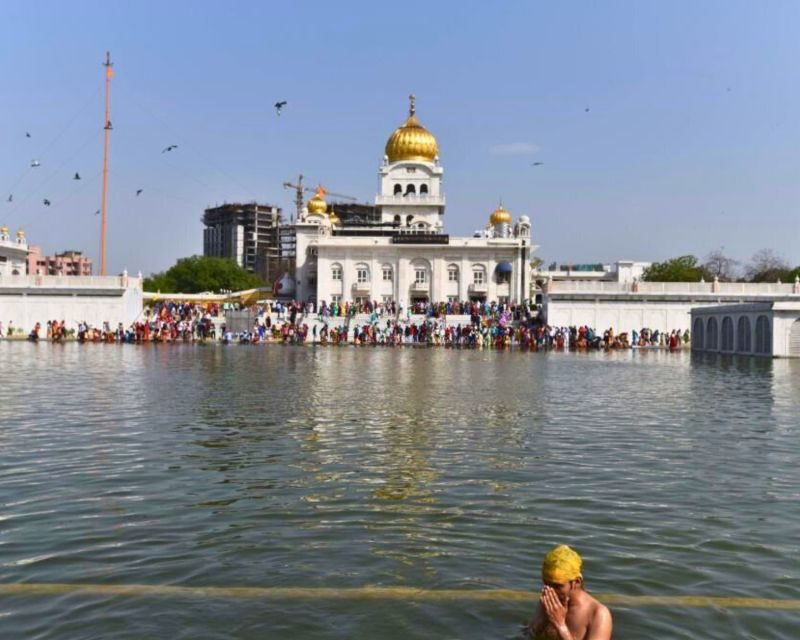
- Gurudwara Bangla Sahib: Free Food, Big Peace, and People Watching
- Hazrat Nizamuddin Aulia: A Short Stop With a Strong Atmosphere
- Agrasen ki Baoli: The Stepwell You Can See in Minutes
- Khan Market: Food Time in a High-Style Neighborhood
- Gandhi Smriti: A Final-Day Perspective Shift
- The Transport Mix: Metro, Bus, Tuk-Tuk, and Pedicabs
- Price and Value: What You’re Actually Buying for $43.12
- Who Should Book This Tour (and Who Should Rethink It)
- Should You Book This Full Day Delhi Public Transport Tour?
- FAQ
- How long is the Full Day Delhi Sightseeing Tour?
- Where does the tour start?
- What time does the tour start?
- What sights are included on the route?
- Is metro and local transport included?
- Are entrance fees included?
- Is food included?
- Is the tour suitable for families?
- What is the group size?
- Is free cancellation available?
Key Points I’d Plan Around

- Small group size (max 18) makes it easier to stay together during crowded stretches.
- Metro + local rides (tuk-tuks and pedicabs) turn “how do I get there?” into a solved problem.
- Humayun’s Tomb is the main paid entry flag on the schedule.
- Bangla Sahib Gurudwara includes the free communal kitchen experience (this is a standout part of the day).
- You stop for food time in Khan Market, but food itself isn’t included, so you choose what fits your budget.
Why This Delhi Day Works: Public Transport Meets Real Sightseeing
Delhi can overwhelm you fast. Roads are busy, distances feel longer than they look on a map, and walking between major sights can turn into a long slog. This tour solves that with a clear plan and a transport mix that feels normal—metro for the big connections, then local rides and walking for the close-in parts.
The best part is the pacing. You’re not just dropped at a monument and pushed along. Instead, the guide helps you move between sites efficiently, which is exactly what you want on a 7-hour sightseeing day. If you’re the type who likes structure (but still enjoys the streets), this is a strong match.
And since it’s a small group, you’re less likely to get lost in the shuffle. A group cap of 18 travelers keeps the logistics manageable, especially when you’re switching between metro stations, buses, and short walks.
A few more New Delhi tours and experiences worth a look


Meeting at Connaught Place (Rajiv Chowk): Start With the Right Energy

Your day starts at Rajiv Chowk Metro Station (Connaught Place), specifically Inner Cir, Block B. This is a smart starting point because you’re already in a central hub, and you can feel the city’s rhythm immediately.
Connaught Place also gives you an early “orientation moment.” Before you jump into tombs and temples, you get time to settle into the day’s flow. In a city like Delhi, that matters. You’ll likely spend your first stop watching how your guide handles movement—meeting time, regrouping, and how they guide you through busy areas.
Practical note: the tour lists the Connaught Place stop with an admission ticket of free. In other words, you’re not paying to be there—you’re using the area as a kickoff point.
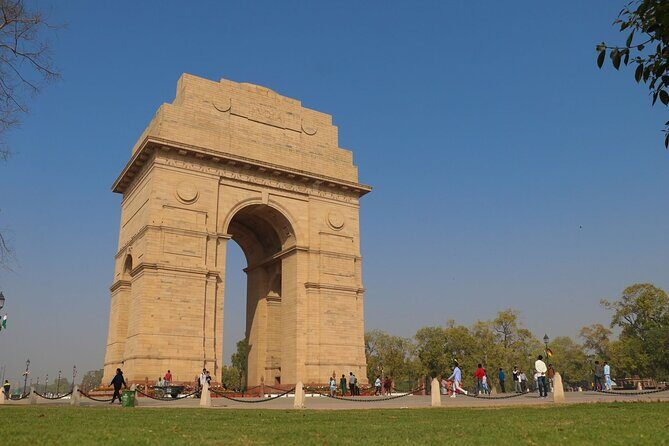
India Gate: The Memorial Moment That Doesn’t Need a Long Detour
After Connaught Place, you’ll head to India Gate, with about 30 minutes on the site. This is one of those places where you can get something meaningful without eating up your whole day.
India Gate works well on a guided route because you’ll understand what you’re looking at beyond a quick photo. Even with limited time, the guide can point out the symbolism and the scale, which helps you feel the place rather than just pass by it.
The big upside here is time efficiency. A half-hour is enough to see the monument area and take a few photos while still keeping momentum for the next stops. The only downside is obvious: if you prefer long museum-style stops, you’ll want to plan extra time elsewhere on a separate day.
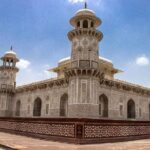
Humayun’s Tomb: Mughal Architecture and the One Entry Fee to Expect
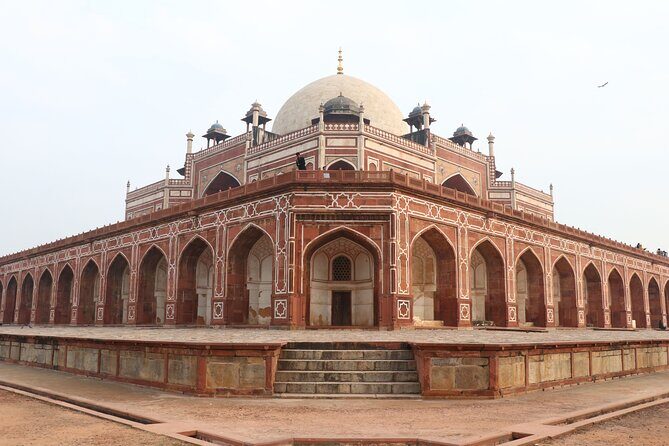
Humayun’s Tomb is scheduled for 45 minutes, and it’s the earliest large-scale example of Mughal architecture noted on the tour description. It’s also a UNESCO World Heritage Site, and that UNESCO label is basically your shorthand for: plan to look closely, because the design details are the point.
One key thing: admission is not included for this stop. That means you should budget for entry fees even though many other stops are free or listed as included. If you want to avoid surprises, set aside a little extra money for this segment alone.
Why this stop is worth the effort: the tomb complex isn’t just a single monument. The description highlights a garden complex feel—so you’re not only seeing stone, you’re seeing a designed space meant to be walked through. Forty-five minutes gives you enough time to move at a relaxed pace, notice the architecture, and still stay on schedule.
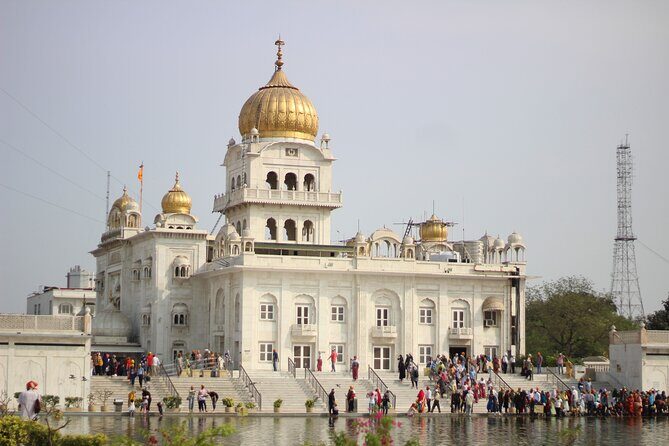
Gurudwara Bangla Sahib: Free Food, Big Peace, and People Watching
Then you shift from architecture and memorial space into spiritual life at Gurudwara Bangla Sahib, with 30 minutes. This stop is special for two reasons.
First, the tour description flags learning about Sikhism as part of the visit, which means you’re not just observing from the outside. Second—and this is the standout detail—the communal kitchen is free and volunteer run, and it allows anybody to eat for free.
When you’re on a tight itinerary, this kind of experience can feel more real than yet another “look but don’t touch” stop. You’ll see how faith shows up in everyday action: people helping people, and a shared routine that’s bigger than sightseeing.
Possible drawback: Gurudwaras can be active and crowded. If you’re sensitive to noise or close contact, it helps to go in with a calm mindset. Also bring modest comfort—this is a place where you’ll want to dress respectfully and follow any on-site guidance.




Hazrat Nizamuddin Aulia: A Short Stop With a Strong Atmosphere
Next is Hazrat Nizamuddin Aulia, scheduled for about 15 minutes. The tour frames it as a chance to soak up the chaos of the Nizamuddin area, then step into the dargah complex with more than 70 graves and regular Muslim pilgrimage activity.
Fifteen minutes is short. So you’ll want to use this stop like a “sensory snapshot.” Look around, notice how people move, and spend your time where the guide focuses attention. The guide’s job here is crucial: with limited minutes, you don’t want to waste energy figuring out what matters most.
This is also where the transport-and-walking rhythm becomes important. You’ll likely spend more time transitioning than you expect, especially if the area is busy. Go in ready to move.
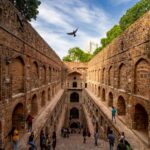
Agrasen ki Baoli: The Stepwell You Can See in Minutes
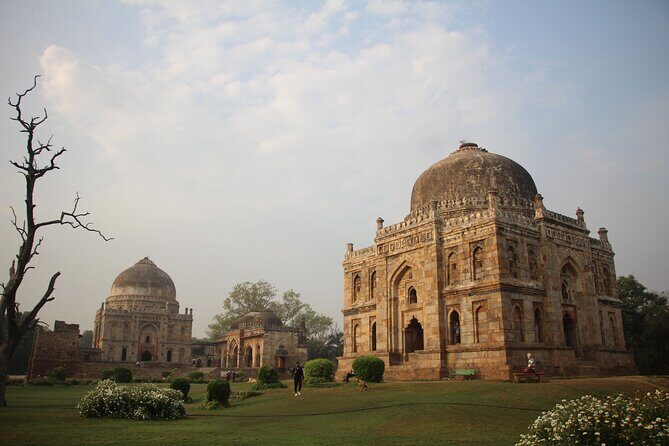
Agrasen Ki Baoli is scheduled for only 10 minutes, but the stop is packed with atmosphere. The tour notes it’s an ancient stepwell, rumored to have been built in the 10th century and rebuilt in the 14th, with 103 steps and about 60 meters in length.
This is a quick hit, but it’s the kind of quick hit that leaves an imprint. Stepwells aren’t common on most first-time Delhi routes, and that makes this feel like a mini detour into a different chapter of the city.
The admission is listed as included, so you’re not paying extra for this one. Your job is simple: slow down once you’re there, look upward and downward, and take in how the structure pulls your attention. If you rush, you’ll miss the geometry and scale that make it memorable.
Khan Market: Food Time in a High-Style Neighborhood
After the quieter moments, you’ll get your break at Khan Market, with 20 minutes. The tour describes it as one of Delhi’s poshest hangouts—people come to eat, talk in cafes, and shop trends.
Here’s the practical reality: the tour says admission is included, but food is not included. So think of Khan Market as your “you choose your own lunch/snack” window, not a fixed meal.
Why it’s valuable: it lets you taste a modern side of Delhi without losing the day’s momentum. It also gives you a chance to reset—bathroom break, water refill, and a quick bite you can time to your energy level.
If you’re planning what to do with your time: don’t try to cover the whole market. Pick one or two options nearby, order quickly if you can, and get back to the meeting point before the group starts moving again.
Gandhi Smriti: A Final-Day Perspective Shift
Your last stop is Gandhi Smriti, scheduled for 30 minutes, with admission listed as included. The focus here is simple and emotional: this is where Gandhi spent the final days of his life, and the house visit gives you a structured way to understand his late period rather than just reading about it.
Why this fits at the end: after temples, tomb architecture, and city bustle, you finish with a quieter, reflective stop. It gives your day a bookend feeling—less about walking through landmarks and more about absorbing a story.
Because the time is fixed at 30 minutes, you’ll want to listen carefully to what the guide highlights. If you read every plaque slowly, you may run behind the group. If you prefer depth, plan a separate revisit on a slower day.
The Transport Mix: Metro, Bus, Tuk-Tuk, and Pedicabs
One of the tour’s strongest promises is how you’ll move. It’s not only metro. The experience is built around a mix: metro, buses, tuk-tuks, and pedicabs.
This matters because each mode shows a different Delhi. Metro helps you cover distance efficiently and arrive less tired. Tuk-tuks and pedicabs help on shorter stretches where walking is too slow or where traffic patterns can make buses frustrating. Buses (when used) add a more local feel.
Also, you’re not stuck translating everything. The guide handles route flow and the “where do we go next” part, which is the biggest mental load when you travel independently.
One caution: Delhi traffic and crowding can slow things down. If your top priority is arriving at every stop exactly on time for photography, build flexibility into your expectations. The tour is designed to get you to the highlights, not to guarantee every minute in a perfect photo angle.
Price and Value: What You’re Actually Buying for $43.12
At $43.12 per person, this tour can be good value if you compare it to the cost of getting around plus paying for a guide. The reason is in what’s included.
Included items:
- A local English-speaking guide
- All transport, including metro and rickshaw rides
- Water/cold drink
Not included items:
- Food
- Entrance fees (with Humayun’s Tomb specifically marked as not included)
So you’re mostly paying for guided movement and transport coverage, plus the time spent seeing multiple major sights in one organized day. If you were doing this on your own, you’d still pay for metro rides and local transport, and you’d spend extra time figuring out how to link the stops efficiently.
Group discounts and a mobile ticket also help, but the real value is the day structure. You get an itinerary that reduces decision fatigue, which is a bigger deal in Delhi than many other cities.
Who Should Book This Tour (and Who Should Rethink It)
This is a strong fit if you:
- want a first Delhi day that covers major landmarks without planning
- like using public transport as part of the experience
- prefer a guided route where someone handles logistics and timing
- enjoy mixing big sights (like India Gate and Humayun’s Tomb) with places that show how locals live and worship
It might be less ideal if you:
- want long stays at a few places instead of hitting many stops in one day
- hate tight schedules (a 7-hour day with multiple transitions can feel compressed)
- plan to spend most of your time reading every exhibit and plaque without moving on
One nice detail from guide feedback you can benefit from: guides such as Kavita and Tavrej have been noted for being friendly, knowledgeable, and efficient, with flexibility for interests like photography. Even if your guide isn’t the same person, that tells you the guiding style tends to focus on making the time feel well used.
Should You Book This Full Day Delhi Public Transport Tour?
I’d book it if this is your first time in Delhi and you want confidence fast. The combination of guided direction, transport included, and a route that mixes iconic landmarks with more local stops is the right formula for a first-day win.
I’d think twice if you’re hoping for a slow, museum-style day. This tour is designed for movement and multiple sights, not deep lingering. Also, go in expecting to pay at least one notable entrance fee (Humayun’s Tomb is the one clearly flagged), and plan your own food budget.
If you want a practical Delhi intro—metro in the morning, temples and monuments in the middle, Gandhi Smriti to close—you’ll likely feel satisfied by day’s end.
FAQ
How long is the Full Day Delhi Sightseeing Tour?
It runs for about 7 hours.
Where does the tour start?
The meeting point is Rajiv Chowk Inner Cir, Block B, Connaught Place, New Delhi, Delhi 110001, India.
What time does the tour start?
The start time is 9:00 am.
What sights are included on the route?
The scheduled stops include Connaught Place, India Gate, Humayun’s Tomb, Gurudwara Bangla Sahib, Hazrat Nizamuddin Aulia, Agrasen Ki Baoli, Khan Market, and Gandhi Smriti. The tour overview also mentions other major Delhi sights like Red Fort, Lodi Gardens, Presidential Palace, and Jama Mosque.
Is metro and local transport included?
Yes. Transport is included, including metro and rickshaw rides, along with other local rides described as part of the experience.
Are entrance fees included?
Not fully. Entrance fees are not included overall, and Humayun’s Tomb is specifically marked as not included. Other stops are listed as free or with admission ticket included.
Is food included?
No. Food is not included, though you do stop at Khan Market for a food break.
Is the tour suitable for families?
Children must be accompanied by an adult. The tour states most travelers can participate.
What is the group size?
The maximum group size is 18 travelers.
Is free cancellation available?
Yes. You can cancel up to 24 hours in advance for a full refund. If you cancel less than 24 hours before the start time, you don’t receive a refund.