REVIEW · NEW DELHI
Best of India – 4 Days Golden Triangle Private Trip
Book on Viator →Operated by Kaimur Holidays · Bookable on Viator
Golden Triangle runs fast, but this version feels controlled. You get a chauffeured, air-conditioned private car and local guides in each city so you’re not just ticking boxes. The big thing to budget for is that many major sights have entry fees not included.
I like that the trip is built around classic highlights with enough time to actually look, not just pose and move on. The pace is busy, though, so if you hate early mornings or long car days, this schedule may feel tight.
If you want comfort, clear logistics, and a guide’s voice during the key sights, this is a strong fit for a first Golden Triangle run.
In This Review
- Key things that make this trip work well
- Golden Triangle in four days: what the schedule really feels like
- Price and what you’re really buying for $299
- The private A/C car: how it changes your Golden Triangle day
- Day 1 in Agra: Agra Fort, Itmad-ud-Daula, and the Taj at golden hour
- Agra Fort: Mughal power you can feel
- Itmad-ud-Daula (Baby Taj): quieter, more intimate Mughal details
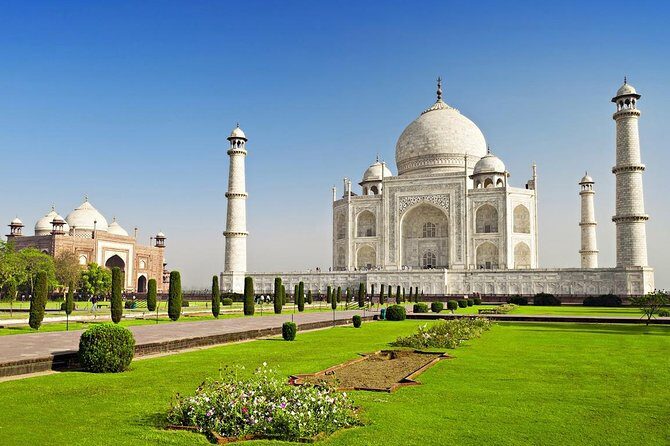
- Taj Mahal viewpoint at sunset: panoramic without the crowds crunch
- Day 2: Taj Mahal sunrise, then Agra crafts, then Jaipur via Chand Baori
- After Taj: check out, breakfast rhythm, and Agra arts and crafts
- Drive to Jaipur: about 5 hours with an en-route lunch break
- Chand Baori, Abhaneri: the stepwell stop that’s worth the detour
- Day 3 Jaipur: Amber Fort, Hawa Mahal photos, and City Palace under one roof
- Amber Fort: the big fort-palace stop
- Hawa Mahal: wind palace, quick stop, great photo angle
- Jewels Lake Palace: small time window, practical photo time
- City Palace of Jaipur: where the royal story overlaps with daily life
- Lunch and Jaipur crafts: shopping time without the forced hard sell
- Back to Delhi: about 4 hours, one more night
- Day 4 in Delhi: Jama Masjid with rickshaw ride, then Mughal and modern landmarks
- Jama Masjid and Old Delhi market time: Spice market and Chandni Chowk
- Pasar Chandni Chowk: one more market-focused stop
- Gandhi Smriti: a focused history stop
- Humayun’s Tomb: a Mughal masterpiece with a guide’s explanation
- Lotus Temple: a calm contrast
- India Gate and the Lutyens zone drive-by feel
- Gurudwara Bangla Sahib: community kitchen and Sikh worship
- Who this private trip suits best
- Practical tips to make the most of this 4-day route
- Should you book this Golden Triangle private trip?
- FAQ
- Is this a private tour or a group tour?
- How long is the Golden Triangle trip?
- Which cities are included?
- Do you get pickup in Delhi?
- What transportation is included?
- Are local guides included?
- Are tickets for all attractions included in the price?
- What group size does the car support?
- Is the Taj Mahal included, and when is it visited?
- What happens on the Old Delhi day?
- Can the tour be customized?
Key things that make this trip work well
- Private A/C car door-to-door keeps Delhi–Agra–Jaipur travel predictable
- Taj Mahal at sunrise plus a sunset viewpoint gives two different moods
- Local guides in each destination for fort, palace, and monument context
- Agra includes the Baby Taj stop (Itmad-ud-Daula) for a softer side of Mughal art
- Jaipur hits the must-sees: Amber Fort, Hawa Mahal, City Palace
- Old Delhi day 4 focuses on real market time with a rickshaw ride
Golden Triangle in four days: what the schedule really feels like

The Golden Triangle is famous for speed. This tour is also fast, but the difference is that your chauffeur-driven private vehicle reduces the annoying parts: finding rides between sights, dealing with transport delays, and losing time to backtracking.
You’ll spend roughly four days moving between three cities—New Delhi, Agra, and Jaipur—with local guides assigned to help you interpret what you’re seeing. In practice, that means less guessing. Mughal architecture is a lot easier to appreciate when someone explains what you’re looking at before you’re standing in front of it.
Comfort is a major value here. You’re not switching between buses or trains mid-trip. Instead, the car stays with you from arrival to departure, and the itinerary is structured with breaks (hotel check-ins, lunch breaks, and timed sightseeing windows).
The one caution: since the tour price doesn’t include accommodations or most entry tickets, your true budget depends on how many monuments you plan to pay for on the spot. Also, the route is action-packed—so plan to travel light and keep your energy steady.
You can also read our reviews of more private tours in New Delhi


Price and what you’re really buying for $299
At $299 per person, this tour is best understood as a bundle of three things:
1) Private transport in an A/C car with a driver for the whole loop
2) Local guide service in each destination
3) A guided sequence of major sights from the Golden Triangle
That’s often where value comes from. Ticket costs and meals can add up fast in India, but the tour’s biggest expense—getting you efficiently between Delhi, Agra, and Jaipur—is handled.
Your biggest cost add-ons are not huge surprises because the schedule marks many admissions as not included. You should be ready for entry fees at places like Agra Fort, Itmad-ud-Daula, Taj Mahal (sunrise tour), Amber Fort, Hawa Mahal, City Palace, and several Delhi monuments on day 4 (including Jama Masjid and Humayun’s Tomb, plus stops like Lotus Temple and Gurudwara Bangla Sahib).
What’s included helps you avoid hidden friction:
- All taxes, parking, toll & fuel charges
- Airport transfers and water bottles
- A car sized for your group: sedan for 1–2 people and 7-seater MPV for 3–5
- A mobile ticket
So the value question isn’t just cost. It’s what you get for the money: less logistics stress, guide context, and comfort during long drives.
The private A/C car: how it changes your Golden Triangle day
Between Delhi and Agra, you’re looking at about a 3-hour drive, then later around 5 hours toward Jaipur and another 4 hours back to Delhi. Those are normal travel times for this circuit—but doing them in a private, air-conditioned vehicle is a different experience than trying to stitch together public transport.
Here’s what I think you’ll notice first:
- You can keep your day moving even if you want a quick stop for coffee or photos. The tour notes that the car stays with you for sightseeing stops as you want.
- Your driver can handle local navigation while you focus on the sights and the timing.
- You don’t lose time with repeated pickups and drop-offs.
This matters most on days with multiple stops, like Jaipur day (fort, wind palace, palace-lake photos, City Palace) and Old Delhi day (Jama Masjid area, spice markets, Gandhi Smriti, Humayun’s Tomb, Lotus Temple, India Gate, and Gurudwara Bangla Sahib).
One more practical point: your group size determines the vehicle. If you’re traveling as two people, you’ll likely be in a four-seater sedan. If you’re 3–5, you’ll be in a 7-seater MPV, which usually helps if you have luggage or want a bit more room.
Day 1 in Agra: Agra Fort, Itmad-ud-Daula, and the Taj at golden hour
Day 1 starts in Delhi and quickly moves into Agra. You’ll be picked up from any location in Delhi after breakfast, then driven to Agra in about 3 hours. The tour keeps the first portion gentle: you’ll check in to your hotel, then have time to relax and take lunch wherever you prefer.
From there, the sights get more interesting.
Agra Fort: Mughal power you can feel
Agra Fort is a 1-hour stop guided by a local expert. This is one of those places where explanation really helps, because it’s easy to miss the logic of the space—who lived where, why the fort mattered, and how Mughal rule shaped the architecture.
A few more New Delhi tours and experiences worth a look




Itmad-ud-Daula (Baby Taj): quieter, more intimate Mughal details
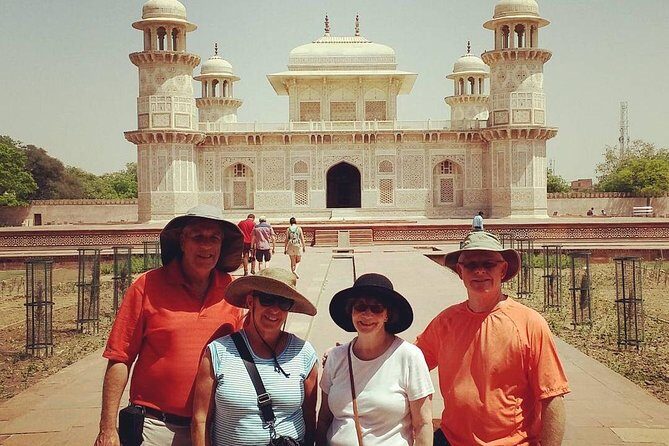
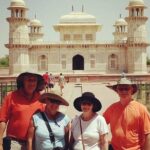
Next is Itmad-ud-Daula, also called the Baby Taj Mahal. You get about 45 minutes here, and this stop is described as a must-do. The best part of this kind of stop is that it slows the day down. Instead of rushing big-picture monuments, you get a chance to appreciate the finer ornamental work and the story that connects the site to the Mughal dynasty.
Taj Mahal viewpoint at sunset: panoramic without the crowds crunch
The day ends with a Taj Mahal viewpoint on the bank of the Yamuna River, timed for sunset. You’re given about 45 minutes, and the tour notes the viewpoint is open from sunrise to midnight.
This is a smart pairing: you get the Taj as a landscape of light and reflection, then you return later for the sunrise version. If sunrise is your only Taj time, you’ll miss this softer, more dramatic evening angle.
Day 2: Taj Mahal sunrise, then Agra crafts, then Jaipur via Chand Baori
Day 2 is the early-morning day. You’ll do a sunrise tour of the Taj Mahal for around 2 hours with a local guide. Sunrise matters because the monument looks different when the air is cooler and the light is more forgiving. It also tends to feel calmer than later hours, which helps if you want to slow down and really read the details.
After Taj: check out, breakfast rhythm, and Agra arts and crafts
After the sunrise Taj, you go back to the hotel area, grab breakfast, then check out. The schedule includes an Agra arts and crafts stop—about 2 hours—positioned as time to explore work made locally. This is where you can get a sense of Agra beyond monuments, and it can be a useful break before the long drive to Jaipur.
Drive to Jaipur: about 5 hours with an en-route lunch break
You’ll then head to Jaipur with an en-route lunch break, reaching Jaipur for the night. Think of this as your transition day: monument intensity in the morning, then road time with a planned pause.
Chand Baori, Abhaneri: the stepwell stop that’s worth the detour
On the way, there’s a 40-minute stop at Chand Baori in Abhaneri. This is a stepwell that drops roughly 30 meters into the ground. Even in a short time window, stepwells are memorable because the architecture creates its own visual rhythm: repeating steps, changing shadows, and that sense of depth that’s hard to fake with photos.
Short stops like this are a balancing act. You might wish for more time, but 40 minutes is usually enough to walk the key areas and get that wow moment without scrambling.
Day 3 Jaipur: Amber Fort, Hawa Mahal photos, and City Palace under one roof
Jaipur day is packed with classic Pink City architecture, but it’s also structured so you’re not stuck in only one type of sightseeing.
Amber Fort: the big fort-palace stop
You’ll spend about 2 hours at Amber Fort, guided by a local expert. This is the major attraction of Jaipur in this itinerary, and it’s not hard to see why. Forts like Amber are where you can feel the Rajput connection between power and art: sweeping views, courtly spaces, and buildings designed to command attention.
Hawa Mahal: wind palace, quick stop, great photo angle
Then it’s Hawa Mahal, the Palace of Wind. Your time here is about 30 minutes, including guidance and photo stops. Because the time is short, you’ll want to focus on angles and facade details rather than trying to over-plan. If you’re the type who likes to soak in a place, this stop can feel swift—but it’s also timed so you don’t lose the day.
Jewels Lake Palace: small time window, practical photo time
You’ll stop at Jewels Lake Palace for about 30 minutes. The schedule specifically frames it as a place to walk and click photos. That’s exactly how to treat it here: short visit, good vantage points, and then move on before it becomes a time sink.
City Palace of Jaipur: where the royal story overlaps with daily life
Next is City Palace, with about 1 hour. The tour describes it as a place where a king’s family still lives with family in the Pink City. Even if you don’t go deep into royal history, a guided hour is enough to understand why this complex mattered and how it functions as living space rather than only a museum.
Lunch and Jaipur crafts: shopping time without the forced hard sell
After City Palace, there’s a lunch break and then 2 hours for local arts and crafts in Jaipur. Since the tour doesn’t include shopping, this “craft” time is helpful because it gives you a real place to look rather than wandering aimlessly.
Back to Delhi: about 4 hours, one more night
To finish the loop, you’ll drive back to Delhi for around 4 hours and spend the night in Delhi. This sets up day 4 as your big Old Delhi and monument day.
Day 4 in Delhi: Jama Masjid with rickshaw ride, then Mughal and modern landmarks
Day 4 starts at 9 am from your hotel. The day is built like a story arc: Old Delhi first, then Mughal-era highlights, then a final sweep through some major modern/religious landmarks.
Jama Masjid and Old Delhi market time: Spice market and Chandni Chowk
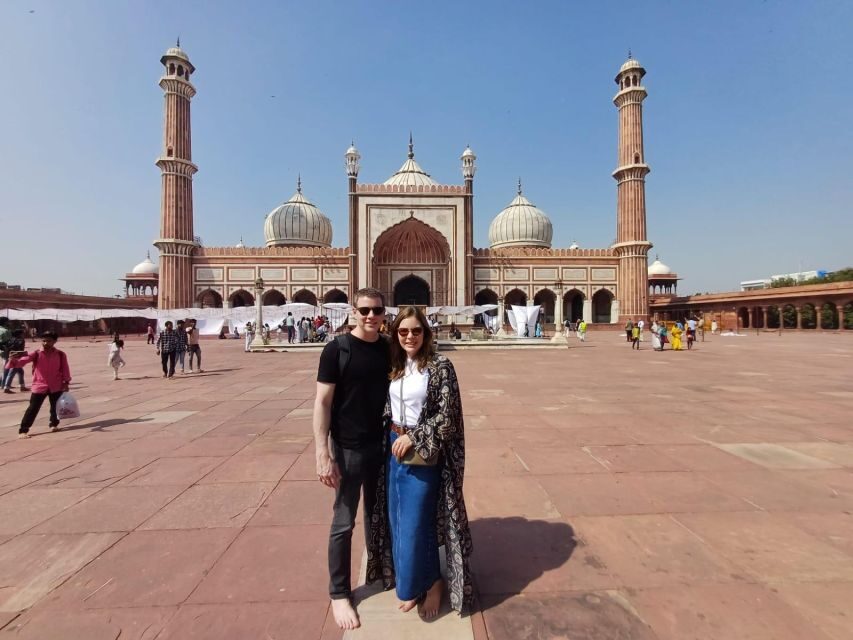
You’ll visit Jama Masjid and spend time in Old Delhi at the Spice Market and Chandni Chowk area with your guide. The tour also includes a rickshaw ride, which is one of those experiences that’s short but very memorable because it moves you through the energy of the area.
This is also where you should wear comfortable shoes and keep your phone protected. Market areas can be crowded, and you’ll be walking more than you might expect.
Pasar Chandni Chowk: one more market-focused stop
There’s an additional 30-minute stop for Pasar Chandni Chowk, framed again around the spice market experience. This double market time is a clue that the tour really wants you to see the Old Delhi texture, not just stand outside one landmark.
Gandhi Smriti: a focused history stop
Next is Gandhi Smriti, about 45 minutes. The tour describes it as Gandhi’s house where he spent his last days and where he was shot dead, now turned into a museum. If you like grounding a day of big monuments with real political history, this stop helps.
Humayun’s Tomb: a Mughal masterpiece with a guide’s explanation
Then it’s Humayun’s Tomb for about 1 hour. It’s labeled a World Heritage site, and the tour notes it as one of the most beautiful Mughal buildings built by great Mughals, with a story connected to a wife building it for her husband. A guided hour is a good match for a site like this because the architecture rewards looking carefully.
Lotus Temple: a calm contrast
Lotus Temple takes about 40 minutes. It’s described as a Bahai Faith temple open to all, and your guide will take you inside. It’s also compared to the Sydney Opera House in shape, which is helpful if you need a mental image. This stop works as a reset after Old Delhi and the tomb complex.
India Gate and the Lutyens zone drive-by feel
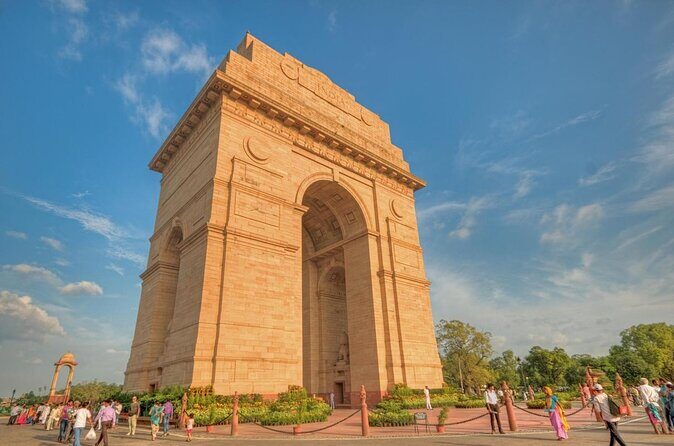
After that you’ll see India Gate and then the Lutyens Zone area. The tour also mentions a drive by the President Estate. Your time at India Gate is listed at 30 minutes, so think of it as a quick but scenic checkpoint.
Gurudwara Bangla Sahib: community kitchen and Sikh worship
Finally, you’ll visit Gurudwara Bangla Sahib for about 1 hour. The schedule highlights the community kitchen where everyone gets free food. This is a meaningful capstone because it shifts the day from monuments to lived community practices.
Then you’ll be dropped off anywhere in New Delhi you want, including the airport.
Who this private trip suits best

This tour is a good match if you:
- Want a first-time Golden Triangle that’s structured and comfortable
- Prefer local guides for context at forts, palaces, and key monuments
- Travel in a group of up to five and want to share costs for a private car
- Like having both Taj Mahal moments: sunrise and a sunset viewpoint
It may be less ideal if you:
- Hate early starts (sunrise Taj Mahal is non-negotiable here)
- Want a slow, unhurried vacation with lots of downtime
- Don’t want to plan for entrance fees at multiple major sites
One standout detail: in a high-rating report I saw, the driver named Raza didn’t just drive. He was also described as especially helpful with information and advice. That kind of extra care matters a lot when days are packed.
Practical tips to make the most of this 4-day route
- For Taj Mahal sunrise, keep your morning routine simple. You’ll have a tight window and you’ll want to be ready to move fast.
- Bring cash for things not included (meals, tickets, small purchases). Since admissions are frequently not included, a card-only plan might feel annoying.
- If you’re going to Chand Baori or fort-heavy days, wear shoes that work on uneven stone.
- On Old Delhi day, keep expectations realistic: you’re walking through Chandni Chowk and the spice market and doing a rickshaw ride, so expect crowds and close quarters.
- Pack a small bag for water and personal essentials. Water bottles are provided in the car, but having your own backup never hurts.
Should you book this Golden Triangle private trip?
I’d book it if you want a private, guide-led Golden Triangle where the biggest friction points—transport and navigation—are handled for you. The combination of A/C comfort, local guides in each city, and the dual Taj Mahal experience (sunrise plus a viewpoint) gives you more than the typical checklist loop.
I’d think twice if you want to minimize extra spending or if you’re looking for a relaxed pace. Because many key sights have entry fees not included and the itinerary is packed, you’ll need to plan a realistic total budget and keep an eye on energy levels.
If you’re flexible, like guided explanations, and want the classic Delhi–Agra–Jaipur arc without the stress, this is the kind of private tour that makes a first Golden Triangle trip feel simple.
FAQ
Is this a private tour or a group tour?
It’s a private tour/activity, meaning only your group will participate. The price is per group of up to five passengers.
How long is the Golden Triangle trip?
The duration is 4 days (approx.).
Which cities are included?
The tour covers New Delhi, Agra, and Jaipur.
Do you get pickup in Delhi?
Yes. Pickup is offered from any location in Delhi (as well as Noida or Gurugram), and also from the airport, railway station, or hotel.
What transportation is included?
You get an air-conditioned private car with a driver for the whole trip, plus airport transfers.
Are local guides included?
Yes. Local tour guides are included in each destination.
Are tickets for all attractions included in the price?
Not all of them. Several stops list admission tickets as not included, while some parts of the schedule show admission ticket free.
What group size does the car support?
For 1–2 people, the car type is an air-conditioned four-seater sedan. For 3–5 people, it’s an air-conditioned seven-seater MPV.
Is the Taj Mahal included, and when is it visited?
Yes. Day 2 includes a sunrise tour of the Taj Mahal, and Day 1 includes a Taj Mahal viewpoint at sunset.
What happens on the Old Delhi day?
You start at 9 am and visit Jama Masjid and the Spice Market/Chandni Chowk area, with a rickshaw ride included, plus stops such as Gandhi Smriti, Humayun’s Tomb, Lotus Temple, India Gate, and Gurudwara Bangla Sahib.
Can the tour be customized?
It can be customized as per your requirements after booking the tour.