REVIEW · NEW DELHI
3 Days Private Golden Triangle Tour Delhi, Agra and Jaipur
Book on Viator →Operated by Agra Trip Packages · Bookable on Viator
Golden Triangle, compressed into three days. This private tour strings together Delhi’s Mughal and imperial sights, Agra’s grand icons, and Jaipur’s royal landmarks with transport that keeps you moving without constant logistics headaches.
What I like most is how much entrance-related hassle gets handled for you. You’ll see big names like Humayun’s Tomb, Jama Masjid, Taj Mahal, Agra Fort, City Palace, Jantar Mantar, and Amber Palace, with several admission fees marked as included and bottled water always there.
One thing to consider: the schedule is full, and you’re on the road between cities. Expect long stretches in the car (Delhi to Agra uses the Yamuna Expressway and is listed as about 3 hours), so it’s not the slow, sit-and-stare kind of trip.
In This Review
- Key Things That Make This Tour Worth Your Time
- Why This Golden Triangle Mix Works in Just Three Days
- Day 1 in Delhi: India Gate to Old Delhi Markets
- Humayun’s Tomb: Mughal Planning You Can Feel
- Jama Masjid: Scale and Stonework, Up Close
- Chandni Chowk: The Street-Level Payoff
- Heading to Agra for Your Overnight
- Day 2 in Agra: Taj Mahal at First Light
- Agra Fort After Breakfast: A Strong Complement to the Taj
- Transfer to Jaipur: Sleep, then Sightsee
- Jaipur Day 3: Amber Palace, City Palace, Jantar Mantar, Hawa Mahal
- Amber Palace: The Big Hilltop Icon
- City Palace: Royal Power in a Smaller, Smarter Package
- Jantar Mantar: Rajput Science That Feels Practical
- Hawa Mahal: A Quick Icon With Real Meaning
- Price and What You Really Get for About $25.60
- Who This Tour Fits Best (and Who Might Want a Different Plan)
- Practical Tips So the Days Don’t Feel Like a Sprint
- Should You Book This Private Golden Triangle Tour?
- FAQ
- What cities are included in this Golden Triangle tour?
- How long is the tour?
- Is pickup included?
- Are admission tickets included?
- What type of vehicle is used?
- Is this tour private?
- Is bottled water included?
- FAQ
- Can I cancel and get a full refund?
Key Things That Make This Tour Worth Your Time
- Private touring with your group only, so the pacing can match how your crew likes to move
- Air-conditioned transport plus bottled water, which matters when you’re doing multiple major sites in a row
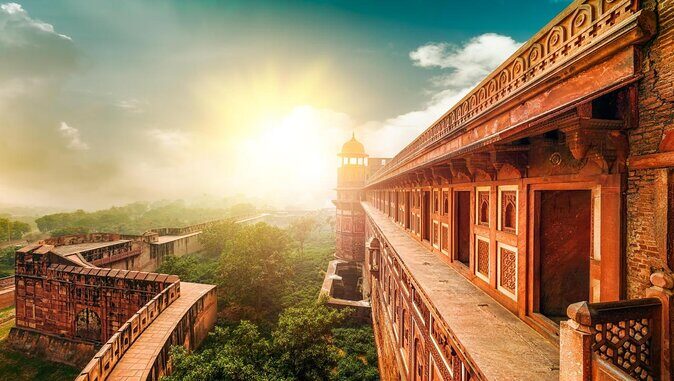
- Major monuments across three eras: Lutyens Delhi, Mughal architecture, and Rajput royal landmarks
- Many admissions handled (several stops are marked ticket included or included as fees and taxes)
- Strong guide feedback, including English-speaking hosts like Mohammed, Riz, Monis, and Anjum who tailor timing
- Old Delhi adds texture, especially around Chandni Chowk after the formal monuments
Why This Golden Triangle Mix Works in Just Three Days
The Golden Triangle is famous for a reason: it’s where India’s big architectural styles keep colliding—imperial-era planning in Delhi, Mughal grandiosity in Agra, and Rajput symbolism in Jaipur. The value of this particular tour is that it doesn’t treat those styles like separate vacations. It treats them like one story you can actually finish in three days.
You also avoid one of the most common Golden Triangle traps: spending half your time figuring out how to get from Point A to Point B while you’re already tired. This tour builds in an air-conditioned car, and it’s set up to run on a tight sightseeing rhythm. For many people, that means you spend more daylight looking at monuments and less time staring at maps.
And yes, you still get the “classic hits.” Taj Mahal, Humayun’s Tomb, Jama Masjid, Amber Palace, City Palace, Jantar Mantar, Hawa Mahal—the itinerary is basically an ideas board for first-time India architecture. The difference is the structure: you’re not wandering randomly. You’re moving site to site with a guide who can explain what you’re seeing in plain terms (and the guide feedback I saw includes people praising guides like Mohammed and Riz for adapting the day to their interests).
You can also read our reviews of more private tours in New Delhi


Day 1 in Delhi: India Gate to Old Delhi Markets

Delhi Day 1 gives you two moods: ceremonial and then street-level.
You start with India Gate, a war memorial built to honor Indian soldiers from World War I. Around it, you get that classic Delhi sightline—wide lawns, a sense of scale, and the feeling that this city was designed with authority in mind. If you’re adjusting to new altitude, new traffic, and new sensory input, India Gate is a good first stop. It’s big, open, and not too exhausting compared with crawling through Old Delhi right away.
Next up is the President House Museum main building. It’s an official estate, and the value here is less about a museum crawl and more about understanding how Delhi’s modern capital was shaped. You’ll get the architectural framing for what you’ll see in other government-era buildings later.
Then you move into Mughal Delhi with two anchor stops:
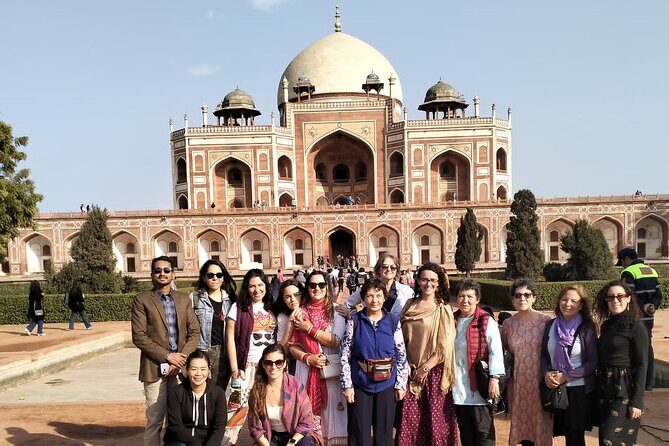
Humayun’s Tomb: Mughal Planning You Can Feel
Humayun’s Tomb is a UNESCO World Heritage Site and one of the best “before you go to Agra” Mughal lessons. The gardens and the overall layout teach you how Mughal architecture wasn’t just about buildings. It was about symmetry, water, and a carefully staged approach to power.
This stop is listed at about 1 hour, with admission marked as included. In practice, that time is about right if you want photos plus enough time to actually look at the details rather than rushing through.
Jama Masjid: Scale and Stonework, Up Close
Jama Masjid is one of the largest mosques in India, built by Shah Jahan. It’s scheduled for about 1 hour, with admission marked as included. You’ll likely notice the mix of red sandstone and white marble immediately, plus the way crowds naturally funnel toward the main areas.
A balanced expectation: this is a major religious site, so you’ll want to dress appropriately and plan for some flow of people. It’s not the moment for a quick stop-and-go checklist. Go in ready to slow down a bit.
Chandni Chowk: The Street-Level Payoff
Finally, you end Day 1 with Chandni Chowk—and not the vague version. This tour specifically calls out the Spice Market area. That’s the fun part. Delhi doesn’t just look impressive; it smells like something. Spices, sweet treats, snacks, and shopfront life are all part of the experience.
Chandni Chowk is scheduled for about 2 hours, and admission is free. That matters because it gives you time to wander in a way that feels like Old Delhi, not a forced photo line. If you’re curious about what everyday shopping looks like here, this is where you’ll feel it.
A few more New Delhi tours and experiences worth a look





Heading to Agra for Your Overnight
After Delhi, you transfer to Agra via Yamuna Expressway, listed around 3 hours on the road, with the overall block showing about 8 hours until you check into your overnight hotel in Agra. The takeaway for you: build in rest time. By the time you reach Agra, you’re not gaining much by squeezing extra sightseeing that evening. Let the next morning do the heavy lifting.
Day 2 in Agra: Taj Mahal at First Light
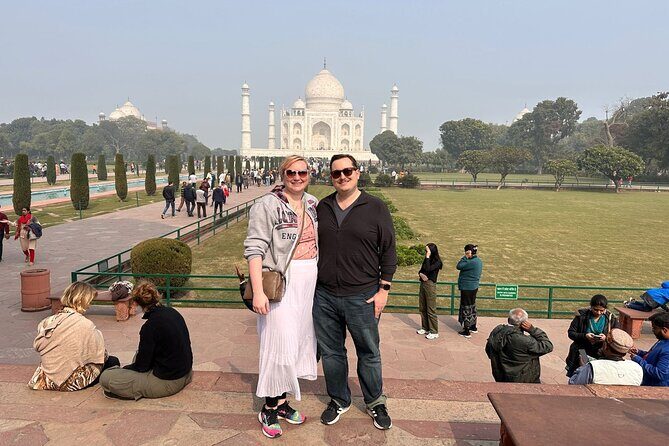
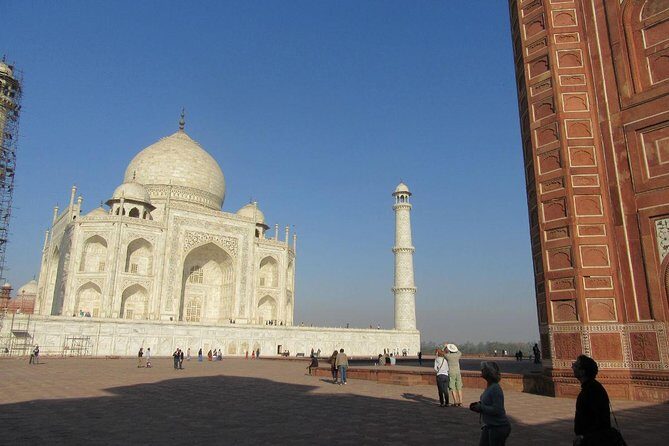
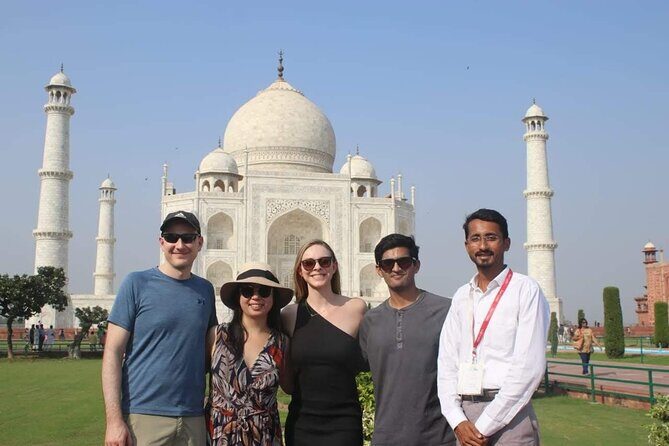
Agra’s Day 2 is all about timing, because the itinerary points you toward seeing the Taj Mahal in the morning light. The tour description frames it as a dawn experience, and that’s the best way to approach it if you care about atmosphere, not just photos.
The Taj Mahal stop is listed for about 2 hours, with admission included. Two hours is usually enough for a full circuit at a comfortable pace: looking at the marble surfaces, taking in the symmetry, and still having time to step back and just watch how the light changes.
If you’ve seen Taj Mahal photos before, here’s what you might not expect: your brain keeps trying to measure it as a single view, but it’s more interesting when you treat it as a whole composition—approach, framing, reflection, and the way the grounds organize your movement. A guide helps because you can understand what you’re seeing rather than only photographing it.
Agra Fort After Breakfast: A Strong Complement to the Taj
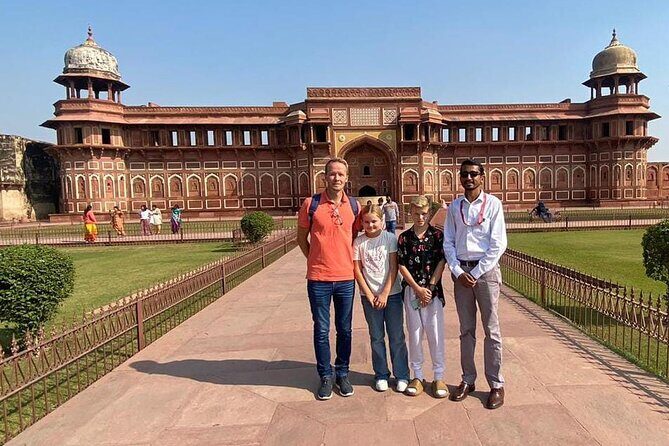
After breakfast, you visit Agra Fort, scheduled for about 40 minutes, with admission included.
This is the “balance” stop. The Taj Mahal is romance and perfection. Agra Fort is military planning and rule. You’ll get a different perspective on Mughal power—more functional, more defensive, and still packed with detail.
Fort time is shorter here, so I’d recommend prioritizing what you’re most drawn to. If you’re fascinated by architecture and scale, spend time looking at the fortress walls and the internal layout. If you’re more into story, ask your guide to connect what the fort represents to the era that built the Taj.
Transfer to Jaipur: Sleep, then Sightsee
After Agra, you head to Jaipur, with arrival and hotel check-in for an overnight stay. The schedule labels the travel block as part of a larger 8-hour window. That’s a clue: plan on a travel day that is mostly transit, not wandering.
If you’re the kind of traveler who likes to keep a little momentum, you might feel restless during the drive. If you’re okay with downtime, treat it as the reset your legs need before Jaipur’s royal stops.
Jaipur Day 3: Amber Palace, City Palace, Jantar Mantar, Hawa Mahal
Jaipur is where the tour becomes very “walk-and-look.” Day 3 is packed, but it’s packed with landmarks that each feel distinct.
Amber Palace: The Big Hilltop Icon
You start with Amber Palace for about 2 hours, and it’s marked free in the schedule.
Amber is your classic Jaipur moment—fort-palace energy, viewpoints, and all the visual drama you associate with Rajput architecture. Because the time is about two hours, it’s a sweet spot: long enough to see major areas without turning it into an all-day grind.
If you want the best experience, dress comfortably and expect to be standing and moving a fair bit. Forts are not built for slow sitting.
City Palace: Royal Power in a Smaller, Smarter Package
Next is City Palace of Jaipur, scheduled for about 45 minutes with admission included.
City Palace is the tour’s “this is how ruling worked” stop. You’ll see royal spaces and the architectural feel of a palace complex that still has connection to the royal family’s legacy. The time here is tight, so the real value is to focus on key rooms and design elements, not trying to see every single nook.
Jantar Mantar: Rajput Science That Feels Practical
Then you go to Jantar Mantar, a UNESCO World Heritage Site. Scheduled for about 1 hour, with admission included.
This is one of the most interesting contrasts in the whole trip. Jaipur isn’t only about forts and palaces. Jantar Mantar is about measuring the sky with stone instruments. It’s the kind of site that makes you rethink what “science” looked like historically. You don’t need to be an astronomer to enjoy it—your guide can point out what the instruments were designed to do.
Hawa Mahal: A Quick Icon With Real Meaning
Finally comes Hawa Mahal, the Palace of Wind, for about 30 minutes, marked free.
Hawa Mahal is famous, and it’s famous for a reason: those honeycomb windows and the pink sandstone shape make it instantly recognizable. The short time is fitting because the value is mostly in seeing the facade and understanding the idea behind it—how it ties to daily life and movement inside the palace complex.
Price and What You Really Get for About $25.60
At $25.60 per person for a 3-day private Golden Triangle tour, the best way to judge value is not the sticker price. It’s what’s included.
This tour covers an air-conditioned vehicle, and it lists all fees and taxes plus bottled water. It also marks multiple monument admissions as included across the route. When you price that out for yourself—transport between cities plus paid entry at major attractions—the tour starts to look like a serious bargain rather than a budget compromise.
Is it perfect value for everyone? If you want a slow, flexible pace with lots of extra meals, downtime, and optional add-ons, a packed route like this may not feel “bargain-y.” But if you want to cover Delhi, Agra, and Jaipur with minimal friction, this pricing is hard to beat.
Also, it’s explicitly private. That usually means you’re not getting stuck with a random crowd tempo. Your guide can adjust the schedule—people mention guides tailoring timing to what they wanted to see, and that matters on a tight itinerary.
Who This Tour Fits Best (and Who Might Want a Different Plan)
This is a smart fit if:
- You’re first-time in India and want the “top sights” in a logical order
- You prefer a guide to handle the explanation, ticketing expectations, and timing
- You travel as a small group or family and want private pacing
- You like structure but still want time to wander a bit in places like Chandni Chowk
It might be less ideal if:
- You dislike long travel days between cities
- You prefer spending more time at one site rather than collecting several in quick succession
- You want lots of free time for spontaneous detours (this route is planned tightly)
Practical Tips So the Days Don’t Feel Like a Sprint
A schedule this full can work well when you prepare for it.
- Plan for early mornings. The Taj Mahal is framed for morning light, so sleep matters.
- Wear comfortable shoes. You’ll be in palaces, forts, and major sites with lots of standing.
- Keep a water habit. Bottled water is provided, but you’ll still want to sip regularly.
- Use your guide’s timing brain. Since guides like Mohammed, Riz, Monis, and Anjum are praised for adapting, ask what order makes sense for your interests—especially on photo-focused stops like the Taj Mahal and Amber Palace.
- Be respectful in religious spaces. Jama Masjid and similar places require appropriate behavior and clothing choices.
Should You Book This Private Golden Triangle Tour?
If your goal is a high-impact first Golden Triangle with private transport, handled fees, and major monuments in a three-day window, I think this is a strong yes. The price feels like a real value play, and the mix of Delhi’s modern-imperial vibe, Mughal landmarks, and Jaipur’s royal-and-science mix makes the route feel complete rather than repetitive.
I’d book it if you like having a plan and want a guide to keep it moving. I’d skip or compare alternatives if you want long unstructured afternoons, slower travel, or lots of optional detours. This tour is built for people who want to see the headline sights and understand what they’re looking at.
FAQ
What cities are included in this Golden Triangle tour?
You’ll visit Delhi, Agra, and Jaipur over 3 days.
How long is the tour?
It runs for about 3 days.
Is pickup included?
Yes. Pickup is offered (starting from IGI Airport), and on the final day you’ll be dropped off to the airport or hotel in Delhi.
Are admission tickets included?
Some stops include admission tickets (for example Humayun’s Tomb, Taj Mahal, Agra Fort, City Palace, Jantar Mantar). Other listed stops are marked as free in the schedule. The tour also includes all fees and taxes.
What type of vehicle is used?
The tour includes an air-conditioned vehicle.
Is this tour private?
Yes. It’s a private tour/activity, meaning only your group participates.
Is bottled water included?
Yes. Bottled water is included.
FAQ
Can I cancel and get a full refund?
You can cancel up to 24 hours in advance for a full refund. Less than 24 hours before start time isn’t refunded.