REVIEW · GOA
Heritage walk in Old Goa to relive the golden age of Velha Goa
Book on Viator →Operated by 5 Senses Walks · Bookable on Viator
Velha Goa feels like time travel on foot. This 3-hour heritage walk strings together the big names and lesser-seen details of 16th-century Portuguese Goa, so you’re not just looking at churches—you’re learning how this city became a global stage. UNESCO sites and major landmarks are all part of the route, and the group stays small enough for real conversation.
I especially like the story-led guiding. People have specifically noted guide Ram and guide Sawani for keeping things clear, answering questions, and staying engaging without rushing. I also like that you get included entrance charges and a simple coffee or tea moment along the way, so the trip stays smooth and not constantly money-and-paperwork focused.
One thing to plan around: there’s no pick-up or drop-off. You’ll start at the Basilica of Bom Jesus and end outside the Church of Our Lady of the Rosary, so you’ll want to have your way back arranged ahead of time.
In This Review
- Key highlights worth showing up for
- Walking Into 16th-Century Velha Goa Without Getting Lost
- Entering Through Viceroy’s Arch (1599): The Portuguese Gateway
- St. Catherine of Alexandria Chapel: Portuguese Window Details and a 1510 Turning Point
- Church of St. Francis of Assisi: A Mixed Build That Explains Style Changes
- Se Cathedral: Victory Messaging, Feast Day Meaning, and the Golden Rose
- Basilica of Bom Jesus (UNESCO): Where Baroque Meets St. Francis Xavier
- St. Augustine’s Tower and the Oldest Rosary Church Finish
- Timing, Pace, and Group Size: How to Plan Your Half-Day
- Price and value: Is $48 worth it for Old Goa?
- Practical tips so your churches visit feels smooth
- Should you book the Old Goa heritage walk?
- FAQ
- How long is the Old Goa heritage walk?
- What is the price per person?
- What’s included in the ticket price?
- Where does the tour start and end?
- Is pick-up or drop-off included?
- What is the cancellation policy?
Key highlights worth showing up for

- Viceroy’s Arch (1599): a ceremonial gateway that marks how Portuguese entry into Old Goa was staged.
- St. Catherine Chapel (UNESCO): the St. Catherine of Alexandria story plus Old Portuguese window details.
- Bom Jesus (UNESCO): Baroque architecture and the resting place of St. Francis Xavier.
- Se Cathedral: Portuguese victory symbolism tied to Saint Catherine’s feast and the Golden Rose.
- Small group size (max 15): easier pace, more questions, and better sightline control in church spaces.
- Coffee or tea included: a small but real reset during the walk.
Walking Into 16th-Century Velha Goa Without Getting Lost

Old Goa can look like a cluster of impressive churches from a distance. On this walk, that same area turns into a connected story of power, faith, and Portuguese influence, stitched together by dates, rulers, and battles. It’s the difference between snapping photos and actually understanding why each place exists where it does.
The format matters. You’re walking in a compact window—about 3 hours—with a guided route that hits the must-sees and keeps you from wandering in circles. Because the group stays capped at 15, you should feel less like you’re in a herd and more like you’re moving with a plan.
Value-wise, you’re not only paying for someone to talk. The experience includes a guide, entrance charges, and coffee or tea. That mix tends to make the day feel complete, especially when you’re trying to fit Old Goa into a tight schedule.
You can also read our reviews of more walking tours in Goa



Entering Through Viceroy’s Arch (1599): The Portuguese Gateway
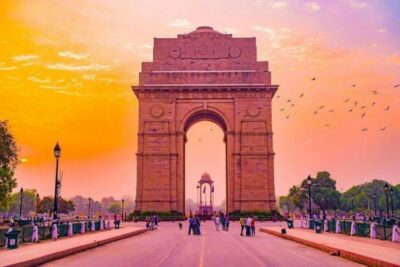
Your walk starts at the Viceroy’s Arch, erected in 1599 by Viceroy Francisco da Gama. The big idea here is that this wasn’t just a nice-looking structure; it was once the main street entry point into Old Goa.
It was built as a memorial to Vasco da Gama’s achievements. And here’s a fun factual thread you can carry with you: Francisco da Gama was Vasco da Gama’s great-grandson. That family connection helps the architecture feel less abstract and more like it’s tied to real people making real political claims.
Practical notes:
- Expect this stop to be short—around 20 minutes.
- Admission ticket is listed as free for this stop, which keeps the schedule steady.
- It’s a good place to ask your guide to set the frame for what you’ll see next, because the rest of the walk builds on this Portuguese entry story.
St. Catherine of Alexandria Chapel: Portuguese Window Details and a 1510 Turning Point
Next up is the Chapel of St. Catherine of Alexandria, a UNESCO World Heritage Site. It was built in 1510 by Afonso de Albuquerque after defeating local Muslim ruler Adil Shah on St. Catherine’s Day, which falls on 25 November 1510.
The chapel’s details are where the stop becomes memorable. You’ll see rectangular window panes in the older Portuguese style, described as being dressed in mica shells. Even if you’re not an architecture nerd, that kind of specific craft detail is exactly what helps you feel the place instead of just passing through it.
You’ll be at this stop for about 30 minutes. Admission is listed as free here as well, so you can focus on the architecture and the story rather than timing your own entry.
Why this stop is worth it:
- The date-driven story links the battle, the calendar, and the building.
- The materials detail helps explain the Portuguese influence in a concrete way.
Church of St. Francis of Assisi: A Mixed Build That Explains Style Changes
The Church of St. Francis of Assisi is next, tied to the arrival of Portuguese Franciscan friars in 1517. According to the route info, eight Franciscan friars landed in Goa and established this church.
The standout here is the mix of architectural styles. The exteriors apply a Tuscan order, while the main altar is described as rich Baroque, with Corinthian features. That contrast is a helpful lesson: churches weren’t built as one uniform idea. They absorbed changing tastes, priorities, and craftsmanship over time.
Plan on about 30 minutes at this stop. Like the others early in the walk, admission is listed as free, which supports the tour flow.
If you like places where you can spot changes in style, this church gives you a chance to practice that eye. You’ll likely leave thinking: okay, this is not one era froze in stone. It’s a long, human process.
Se Cathedral: Victory Messaging, Feast Day Meaning, and the Golden Rose
The Se Cathedral is built in Manueline style, and it’s presented here as a monument to Portuguese victory over an invading Muslim army in the early 16th century. That victory is celebrated as the Feast of Saint Catherine, tying the cathedral’s symbolism to the same saint story that shows up in St. Catherine’s chapel.
There’s also a 20th-century touchpoint. The Pope Pius XII presented an honorary Golden Rose to the cathedral, and it’s now placed on the tomb of Saint Francis Xavier inside the cathedral.
The stop runs for about 30 minutes. Admission is listed as free, which keeps you from feeling nickeled-and-dimed during a day that already includes multiple sites.
How I’d frame this cathedral for your expectations:
- Think of it as political messaging wrapped in religious architecture.
- The Golden Rose detail is the kind of “later chapter” fact that makes the building feel like it kept mattered long after the 1500s.
You can also read our reviews of more historical tours in Goa





Basilica of Bom Jesus (UNESCO): Where Baroque Meets St. Francis Xavier
If you want one stop that anchors the entire walk, it’s the Basilica of Bom Jesus. It’s a UNESCO World Heritage Site and described as one of the finest examples of Baroque architecture in India.
The name matters too. Bom Jesus means Good Jesus, referring to the infant Jesus. But the emotional center for many visitors is what it houses: the mortal remains of St. Francis Xavier. He co-founded the Society of Jesus along with St. Ignatius Loyola.
There’s also a note about the Blessed Sacrament. Earlier it was kept on the main altar under the statue of St. Ignatius, and it’s now preserved in a gold tabernacle. That shift is the kind of detail that makes the church feel lived-in, not museum-still.
You’ll spend about 30 minutes here. Admission charges are listed as free on the route, and the tour includes entrance charges overall, so you should be able to enter without extra hassle.
Why this is a great payoff stop:
- You get UNESCO status plus a major Christian relic story.
- The gold tabernacle detail gives you a focal point even if you’re not reading every label or explanation.
St. Augustine’s Tower and the Oldest Rosary Church Finish
The walk then moves toward the final stretch.
First is St. Augustine’s Tower (built in 1600). It’s one of four towers of the old St. Augustine Church that once stood at the site. The tower’s role was a belfry, and the church complex is described as having eight richly adorned chapels and four altars, plus a convent with numerous cells. Even if the rest of the church is no longer standing the way it once did, the tower still signals how built-out the complex was.
This stop is about 20 minutes, with admission listed as free.
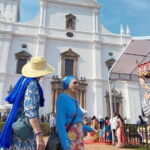
Then you end at the Church of Our Lady of the Rosary, described as the oldest surviving church in Goa. The route links its origin to Afonso de Albuquerque, who took a vow to build this church as a gratitude token to Our Lady of Victory while fighting the Islamic army of the Deccan Sultanate.
What makes it easy to picture is the fortress-like look: high altitude windows and round towers. The route info paints it as more defensive in shape than many travelers expect from a church.
You’ll spend about 20 minutes here, and the tour ends outside the church. That ending matters: you’ll want to line up your next step nearby since there’s no pick-up or drop-off listed.
Timing, Pace, and Group Size: How to Plan Your Half-Day
A 3-hour walking tour sounds simple until you’re doing it in a hot climate with church interiors and uneven sightlines. The reason this one works is the structure: short stops (about 20 to 30 minutes), a guided route, and a small group capped at 15.
You can also expect a steady rhythm because the tour includes entrance charges and coffee or tea. That reduces the usual friction where one delay turns into a chain reaction for the rest of your day.
Weather matters. The experience notes it requires good weather, and if it’s canceled due to poor weather, you’ll be offered another date or a full refund. So if you’re planning this around the rest of your Goa days, keep a flexible slot when you can.
Mobile ticket is included, which is helpful if you prefer not to manage printouts.
Price and value: Is $48 worth it for Old Goa?
At $48 per person for about 3 hours, this is the kind of price where you should ask: what am I gaining beyond self-guiding?
Here’s the value case that makes sense from the details you get:
- Entrance charges included: you’re not paying separately at each stop.
- Guide included: the route is designed around interpretation—dates, Portuguese rulers, and architecture changes—so you’re buying context.
- Small group size (max 15): you’re more likely to get your questions answered than in large tours.
- Coffee or tea included: not a huge cost item, but it makes the day feel thoughtfully paced.
If your goal is to get the basic highlights, you could theoretically piece together churches on your own. But if you want the meaning behind each site—Viceroy Francisco da Gama’s memorial connection, the St. Catherine battle date, the Golden Rose detail—this format typically saves you time and keeps you from missing the best points.
Practical tips so your churches visit feels smooth
A few things I’d do to get the best experience from this kind of route:
- Wear comfortable walking shoes. You’re on your feet for roughly three hours.
- Bring a hat and water if you’re going in warmer months. The tour is short, but Goa sun adds up fast.
- Have your phone ready for the mobile ticket. It’s included, so this is usually an easy win.
- Plan your transport back to the end point. The tour ends outside the Church of Our Lady of the Rosary, and pick-up/drop-off isn’t included.
For the church stops themselves, I’d keep things respectful and simple—quiet voices, slow steps, and give yourself extra seconds if the space is busy.
Should you book the Old Goa heritage walk?
Book it if you want a high-signal Old Goa visit: the big Portuguese-era sites, explained in a way that connects one stop to the next. It’s also a strong choice if you value UNESCO sites plus architecture details you can actually picture, like the mica-shell window description at St. Catherine Chapel or the gold tabernacle at Bom Jesus.
Skip it (or at least think twice) if you hate walking between multiple religious sites or you’re counting on pick-up and drop-off. This one is a meeting-point-and-go structure, with no dedicated transfer—so it works best when you can handle getting to Basilica of Bom Jesus and continuing from the final church.
If you’re trying to make Old Goa feel coherent in a few hours, this is a tidy way to do it.
FAQ
How long is the Old Goa heritage walk?
The tour lasts about 3 hours.
What is the price per person?
The price is $48.00 per person.
What’s included in the ticket price?
It includes a guide, entrance charges, and coffee and/or tea. A mobile ticket is also provided.
Where does the tour start and end?
It starts at the Basilica of Bom Jesus on Old Goa Road, Goa 403402. It ends outside the Church of Our Lady of the Rosary at GW23+PX9, Old Goa, Goa 403402.
Is pick-up or drop-off included?
No. Pick up and drop are not included.
What is the cancellation policy?
You can cancel for a full refund up to 24 hours before the experience starts. If you cancel less than 24 hours before, the amount paid is not refunded. If the tour is canceled due to poor weather, you’ll be offered a different date or a full refund.