REVIEW · GOA
Private 3-Day Tour to Delhi, Agra,Jaipur from Goa with one-way Commercial Flight
Book on Viator →Operated by Nikita Holidays · Bookable on Viator
Delhi to Jaipur in three days sounds crazy—until it works. This Golden Triangle sprint strings together Delhi’s landmarks, the Taj Mahal and Agra Fort, then Jaipur’s main sights with a professional guide and all the key transfers handled for you. I also like that you get real hotel comfort for two nights, not just ticket-stuffing. The trade-off: it’s a tight schedule with early starts and some long on-the-road stretches.
The best part for many people is how the trip handles the big logistics. You fly one-way from Goa to Delhi on your schedule, then you use a superfast air-conditioned train for the Delhi–Agra jump, which helps you spend your daylight where it counts. One consideration is that lunch and drinks are on you, and a few stops include time spent at craft/showroom-style places where you may feel a sales push.
In This Review
- Key things to know before you go
- Why Goa to Delhi makes this Golden Triangle feel easier
- Day 1 in Delhi: India Gate, passing Sansad Bhavan, and time to breathe
- The 6am superfast train to Agra: Taj Mahal in the morning
- Visiting the Taj Mahal
- Agra Fort right after
- Fatehpur Sikri en route to Jaipur: a ghost town stop you may pay extra for
- Jaipur in one day: Amber Fort, Jal Mahal photos, Hawa Mahal, and City Palace
- Amber Fort and the mirror room effect
- Jal Mahal photo stop
- Hawa Mahal for the facade shots
- City Palace and observatory time
- Shopping time that doesn’t feel like an afterthought
- Craft demonstrations: where included time can either delight or distract
- Hotels and guide teamwork: the comfort and coordination factor
- Price and what you actually get for $604
- Practical tips: timing, smart casual dress, and meal planning
- Should you book this 3-day Golden Triangle tour from Goa?
- FAQ
- How long is the tour?
- What is included for transportation between Delhi and Agra?
- Do I fly from Goa to Delhi as part of the tour?
- Where does the tour start and where do you end?
- Are hotel rooms included, and how many nights?
- Is lunch included?
- What are the key Jaipur sights included on Day 3?
- Is the Taj Mahal sunrise visit guaranteed?
- Is there free cancellation?
Key things to know before you go
- One-way flight from Goa means you control when you land in Delhi, then the tour staff takes over from there.
- Superfast AC train between Delhi and Agra is a big time-saver and keeps the plan realistic in just 3 days.
- Two nights in four-star comfort gives you enough recovery to actually enjoy the sites, not just survive them.
- Early starts are part of the deal, especially on Day 2 when you’re up before sunrise hours.
- Hands-on craft demonstrations (marble work, Zardozi embroidery, carpet weaving, and stone cutting/polishing) are included, so you’ll see how things are made.
- Your pace is flexible in Delhi on Day 1, with an afternoon plan plus free time until the next morning.
Why Goa to Delhi makes this Golden Triangle feel easier
Most Golden Triangle tours start in Delhi, which can mean extra stress to get there. Starting with a one-way commercial flight from Goa solves that. You arrive in Delhi around 11am, check in, and you’re not immediately dumped into a full day of sightseeing.
Then the tour swaps chaos for structure: private air-conditioned transfers inside cities, plus the Delhi-to-Agra movement by superfast train. For a 3-day package, that’s the difference between a trip that feels rushed and one that feels organized.
You can also read our reviews of more private tours in Goa



Day 1 in Delhi: India Gate, passing Sansad Bhavan, and time to breathe
Day 1 begins with a 6am pickup in Goa, plus an airport transfer and your flight to Delhi. If you like starting early, great. If you don’t, try to think of Day 1 as the “travel + settle-in” day, not the “see everything” day.
Once you land (around 11am), you transfer to your Delhi hotel and the schedule loosens. In the afternoon you’ll visit India Gate, a memorial for Indian soldiers who were martyred during the Afghan war. After that, you’ll drive past major government buildings, including Parliament House (Sansad Bhavan) and the President’s House.
What I like about Day 1 is the balance. You get one iconic stop that’s easy to understand, then you’re not forced to cram in a dozen monuments before dinner. You can walk, rest, and get your bearings fast.
Practical note: you’ll want comfy shoes. Even with guided sightseeing, Delhi is easiest when you can step out and navigate small distances comfortably.
The 6am superfast train to Agra: Taj Mahal in the morning
Day 2 starts early: you’re picked up at 5am and taken to Delhi Railway Station for the superfast air-conditioned train to Agra. Breakfast is served on the train, and the train departs at 6am from New Delhi Railway Station. You arrive in Agra at about 8am, which is exactly the kind of timing you need for a monument-heavy day.
Visiting the Taj Mahal
The Taj Mahal is the star, and the tour builds the morning around it. You’ll spend about 2 hours here, with admission included. This isn’t a quick photo grab; it’s enough time to appreciate the scale and the details—plus the story the Taj is tied to: it was built in honor of Shah Jahan’s beloved wife, and 20,000 men worked for over 17 years to create the memorial.
One more thing: the tour notes that a Taj Mahal sunrise visit is subject to weather conditions. In practice, that means you shouldn’t plan your whole trip around a guaranteed sunrise scene, but you can still expect an early-morning feel.
Agra Fort right after
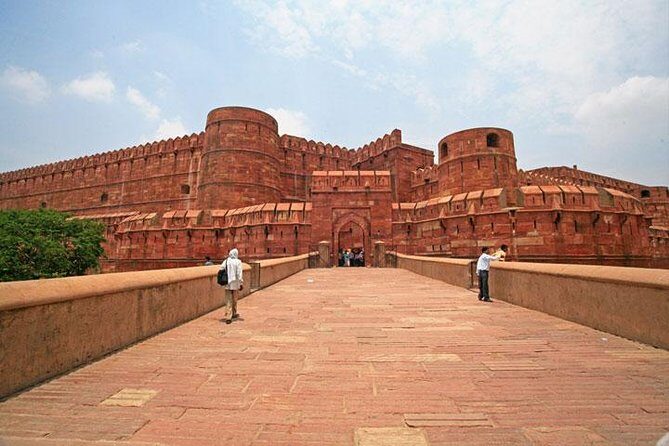
After Taj Mahal, you’ll head to Agra Fort for about 1 hour, also with admission included. The fort is described as a red-sandstone stronghold on the Yamuna River, started by Emperor Akbar in 1566. It’s one of those places where you can feel the power without needing a guide to hold your hand through every doorway.
A practical tip: heat and crowd energy usually build through the late morning. With this plan, you’re hitting the big sights early, which helps.
A few more Goa tours and experiences worth a look

Fatehpur Sikri en route to Jaipur: a ghost town stop you may pay extra for
After lunch, you’ll drive for about 4 hours toward Jaipur. Along the way, there’s an optional stop at Fatehpur Sikri, the well-preserved red-sandstone “ghost town.” It was the estranged capital of Mughal emperor Akbar, built in 1569, then deserted when the water supply failed.
Here’s the key detail for your planning: Fatehpur Sikri is listed as an own-expense stop in the schedule. So even though much of the tour is ticket-inclusive, this is the one place where you should be ready to cover something additional if you want to go inside and see what you can.
Time-wise, you’ll have around 2 hours mentioned for the stop, plus additional driving time to reach Jaipur after. If you’re the type who hates spending time in transition, Fatehpur Sikri might feel like a bonus. If you love a stop that feels different from forts and palaces, it can be a memorable change of pace.
Jaipur in one day: Amber Fort, Jal Mahal photos, Hawa Mahal, and City Palace
Day 3 is built like a best-of playlist for Jaipur, with private air-conditioned vehicle support and included admissions at most major stops.
Amber Fort and the mirror room effect
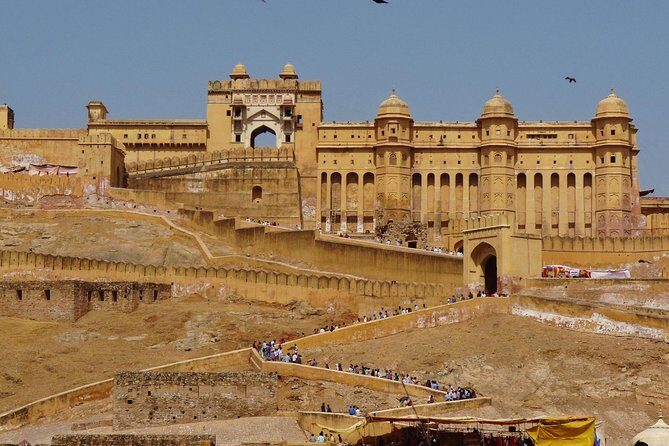
After breakfast and check-out at 8am, you’ll visit Amber Fort. Expect around 2 hours here, with admission included. The fort sits on a ridge just outside Jaipur and reflects in a lake below. Inside, the tour highlights Jai Mandir and the world-renowned Sheesh Mahal, the hall of mirrors. The walls and ceiling are covered with mirrors that reflect light and brighten the room as the light shifts. It’s the kind of detail you notice more when you can slow down, so the 2-hour block is a good match.
Jal Mahal photo stop
Around 11am you’ll do a photo stop at Jal Mahal, the Rajput “Water Palace” sitting in the center of Man Sarobar lake. The schedule notes that the lake is often dry in summer, while winter monsoons can turn it into a lake with water hyacinths. So your photos depend on season and conditions, which is normal for an outdoor landmark.
This stop is short—about 30 minutes—but it’s worth it if you want that signature palace-on-water look.
Hawa Mahal for the facade shots
Next up is Hawa Mahal (Palace of Wind) for about 30 minutes, with time made for photos. It’s a pink sandstone five-story structure built in 1799 along the main street of the old city, with semi-octagonal windows and a delicate, honeycombed design.
Even if you’ve seen pictures before, it’s one of those facades that can feel more intricate in person.
City Palace and observatory time
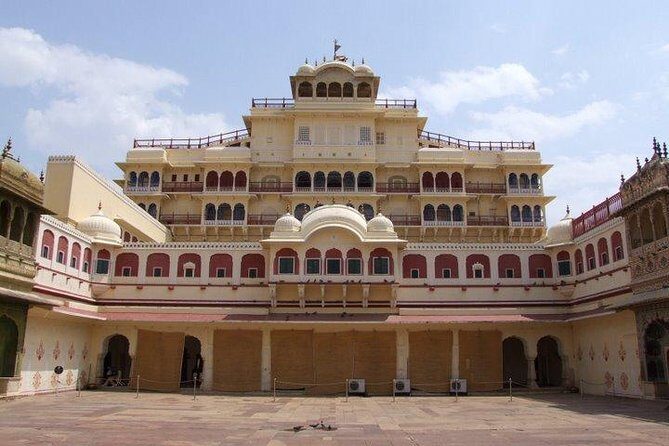
Then you’ll spend about 2 hours at the City Palace and Observatory, located in the heart of the old city. It was once the royal residence, built using a blend of Rajasthani and Mughal styles. The tour points out carved arches, intricately crafted columns, and two carved marble elephants that guard the entrance.
For me, City Palace is the payoff after the “pretty exterior” stops. You’re more likely to notice craftsmanship and layout, not just scenery.
Shopping time that doesn’t feel like an afterthought
The schedule includes an hour at a Carpet and Textile House, designed for time permitting shopping. You’ll see items such as precious stones, silver jewelry, bangles, clothes, blue pottery, and textiles. If you shop, this is a practical window. If you don’t, you may still enjoy watching the displays and talking through materials with staff.
Craft demonstrations: where included time can either delight or distract
One of the included extras isn’t another monument. It’s skill.
The tour includes live demonstrations of:
- Marble craftsmanship
- Handmade embroidery (Zardozi)
- Hand-knotted carpet weaving
- Cutting and polishing of precious stones
This is a big deal for two reasons. First, it turns “shopping stops” into something you can learn from, even if you don’t buy. Second, it gives you a break from walking and driving while still being “culture time,” not downtime.
The trade-off is simple: these demos are also part of a sales ecosystem. You can be polite, watch what you came to see, and set a budget in your head before you’re offered anything. You’ll enjoy it more if you treat it like a museum with shopping nearby.
Hotels and guide teamwork: the comfort and coordination factor
The package includes two nights in four-star hotels on twin sharing with breakfast. That matters in a 3-day sprint because you’ll sleep harder if your bed is good and your room is comfortable. It also helps that transfers and sightseeing are done via air-conditioned private vehicle for city driving.
The guide experience seems to be a standout. In top-rated feedback, guide names like Vishnat, Rajesh, and Anoosh show up alongside comments about helpful guidance and strong site knowledge. Another consistent theme is that drivers and guides met people as promised, which is exactly what you want in a route that crosses airports, stations, and multiple cities.
A lot can go wrong in India logistics when coordination is weak. Here, the structure is the selling point.
Price and what you actually get for $604
At $604 per person, this tour costs less than many “flight + train + guide + hotel + admissions” bundles because it includes several expensive moving pieces.
What’s covered:
- One-way commercial flight Goa to Delhi
- One-way train ticket Delhi to Agra in AC chair car
- Air-conditioned private vehicle transfers in Delhi and Jaipur areas
- Two nights of four-star style accommodation with breakfast
- Professional live tour guide
- Monument entrance fees
- Included craft demonstrations
- Pickup in Goa and drop-off in Delhi
What’s not included:
- Lunch
- Drinks
- Gratuities
- Any additional costs linked to Fatehpur Sikri being marked as own expense
So the value comes from “you don’t have to stitch it together.” If you’d otherwise book flights, train tickets, and private guides separately, you’d likely spend more time coordinating and more money paying for separate transport and admissions.
The best way to judge value for yourself: add up your likely spending on flight + hotel + tickets + paid guides. If you’d end up booking most of that anyway, this package stops looking like a splurge and starts looking like a time-saving deal.
Practical tips: timing, smart casual dress, and meal planning
A few details will help you enjoy the trip without stress:
- Start times are real. Day 2 pickup is at 5am, and the train leaves at 6am. Plan an early night on Day 1.
- Dress code is smart casual. You don’t need formal wear, but skip beach flip-flops and plan for light layering.
- Lunch isn’t included. You’ll need to budget for it. If you’re sensitive to spicy food, carry a small comfort snack on transfer days.
- Taj timing depends on weather. The tour mentions sunrise timing is weather-dependent, so don’t build your expectations around a single magical minute.
- Expect long drives on transition days. Day 2 includes significant travel after Agra Fort, and Day 3 ends with transfer back toward Delhi for your next destination.
If you go in with that mindset, you’ll feel less “rushed” and more “efficient.”
Should you book this 3-day Golden Triangle tour from Goa?
Book it if you want a smooth, structured taste of Delhi–Agra–Jaipur without spending your trip managing tickets and transfers. It’s a strong fit for first-timers who want the big-name sights—Taj Mahal, Amber Fort, Hawa Mahal, and City Palace—plus included craft demonstrations that add something practical to the day.
Skip it (or consider a slower version) if you hate early mornings, don’t like any shopping-style stops at all, or prefer lots of downtime between major monuments. This tour packs a lot into three days, and the schedule won’t “spread out” for your comfort.
If you’re okay with a well-run whirlwind and you like being guided, this one makes sense. You’ll see the headlines, ride the efficient transport, and come away with enough context to understand what you just walked through.
FAQ
How long is the tour?
The tour is listed as approximately 3 days.
What is included for transportation between Delhi and Agra?
It includes a one-way train ticket AC Chair Car from Delhi to Agra.
Do I fly from Goa to Delhi as part of the tour?
Yes. The package includes a one-way commercial flight ticket from Goa to Delhi.
Where does the tour start and where do you end?
Pickup starts in Goa. The tour ends in New Delhi, with drop-off to your hotel or airport in Delhi.
Are hotel rooms included, and how many nights?
Yes. The tour includes 2 nights of accommodation on twin sharing with breakfast (when booked with the option including hotels).
Is lunch included?
No. Lunch is not included, and drinks are also not included.
What are the key Jaipur sights included on Day 3?
You’ll visit Amber Fort, a photo stop at Jal Mahal, Hawa Mahal, and the City Palace and Observatory. There is also time for shopping at a Carpet and Textile House.
Is the Taj Mahal sunrise visit guaranteed?
The schedule says sunrise timing is subject to weather conditions.
Is there free cancellation?
Yes. Free cancellation is offered, and you must cancel at least 24 hours in advance of the start time for a full refund.