REVIEW · MUMBAI
1-Day Trip to Taj Mahal and Agra from Mumbai with Both Side Commercial Flights
Book on Viator →Operated by Nikita Holidays · Bookable on Viator
In This Review
- Mumbai’s 4am dash makes the Taj day feel easy
- Key highlights you’ll care about
- A one-day Taj Mahal plan that actually works
- What the 4:00am pickup really means for your body clock
- Airport coordination: where tours shine, or stumble
- The Delhi-to-Agra drive: time on the road, plus a view break
- Taj Mahal time: how to get the best viewing without rushing
- Your priorities inside the Taj Mahal complex
- Morning light vs. practical reality
- Agra Fort: what you get besides the postcard
- Shopping stop: the part to handle with clear boundaries
- What’s included in the $550 price, and what isn’t
- Who this trip is perfect for (and who should be careful)
- A quick tip on guide assignment
- The small practical checklist that saves your day
- Should you book this Taj Mahal day trip?
Mumbai’s 4am dash makes the Taj day feel easy
This flight-and-drive plan is built for people who want the Taj Mahal experience without the whole-India logistics. I like that you get both-side commercial flights and a private guide, so the day stays organized even when Mumbai starts before sunrise.
What I really like is the clear structure once you land: you get real time for the Taj Mahal plus Agra Fort, not just a quick stop-and-sprint.
The main drawback to keep in mind is time pressure. Even with a 17-hour target, it can stretch into an almost next-day feeling, and you’ll be awake early.
Key highlights you’ll care about

- Round-trip flights from Mumbai (Mumbai–Delhi–Mumbai) to avoid an overnight stay
- Private guide + monument entrance fees for Taj Mahal and Agra Fort
- Golf cart ride to and from the Taj Mahal area
- Yamuna Express Highway drive for a straightforward transfer to Agra
- A full Agra Fort stop after lunch, not just the Taj Mahal
- Shopping time built in, which you can treat as optional if you want more Taj time
A few more Mumbai tours and experiences worth a look


A one-day Taj Mahal plan that actually works
If you only have a short window in India, Agra can feel like a scheduling headache. This trip is designed for exactly that problem. Instead of figuring out trains, buses, tickets, and timing, you follow a pre-set rhythm: pickup in Mumbai, early flight to Delhi, drive to Agra, guided sightseeing, then back to Delhi for the return flight.
The whole concept is simple: you trade some comfort and time on the calendar for the convenience of being handled end-to-end. For many people, that’s the best deal you can get for the Taj Mahal. It’s also a smart way to reduce decision fatigue. When the plan is tight, you want the kind of tight that comes from good organizing—not from guessing.
What the 4:00am pickup really means for your body clock
Your day starts at 4:00am in Mumbai, with pickup from your hotel or anywhere in Mumbai. Then it’s straight to the airport for a 6:00am departure flight to Delhi. This is not a “sleep in and soak up the morning” kind of trip.
Here’s the practical side: if you’re the type who gets cranky before coffee, plan for it. Set expectations that you’ll be operating on adrenaline and small snacks. Bring your patience, your water bottle mindset, and wear something comfortable under your smart-casual dress code.
One more thing that matters: your day may feel longer than the advertised timeline. Some schedules can run close to 24 hours when flight timing or connections shift. It doesn’t mean the trip is poorly run. It does mean you should treat this as a serious day, not a casual excursion.
Airport coordination: where tours shine, or stumble

This kind of trip is mostly about handoffs: Mumbai pickup to the airport, Delhi arrival to the drive, and then Agra to the return flight. When it works, it feels calm. When it doesn’t, you can end up standing around with luggage and a growing stress headache.
The good news: the communication and meeting process are a strong point. In particular, WhatsApp-style coordination shows up repeatedly in how people describe their experience. You get updates, and you’re met at key points so you’re not trying to figure out which counter is yours while jet-lagged.
Also, expect a private guide system. You’ll have a professional private tour guide on the Agra side, and you’ll typically be supported through local transitions like entry lines and transfers.
A key consideration: airport logistics can still be stressful in general, especially around check-in and boarding passes. One traveler described being dropped off and having to navigate independently, with Wi‑Fi uneven and boarding passes difficult. That’s not the typical story you want, so I’d treat it as a “be prepared” reminder: arrive organized, keep your passport and photo copies handy, and don’t assume every airport moment will feel effortless.
The Delhi-to-Agra drive: time on the road, plus a view break

After landing around 8:00am in Delhi, you’ll drive to Agra via the Yamuna Express Highway. The drive is about 3 hours.
This transfer is a big part of the experience because it turns a long day from “mostly waiting” into “mostly moving.” If you’re prone to motion sickness, pack accordingly. If you handle roads fine, use the drive time as a decompression moment before you start walking in the heat and crowds.
One practical note: it’s long enough that you’ll want to be hydrated. The tour includes water bottles throughout the day, which helps a lot when you’re going from airport to fortress to palace without breaks that feel like a real lunch break.






Taj Mahal time: how to get the best viewing without rushing
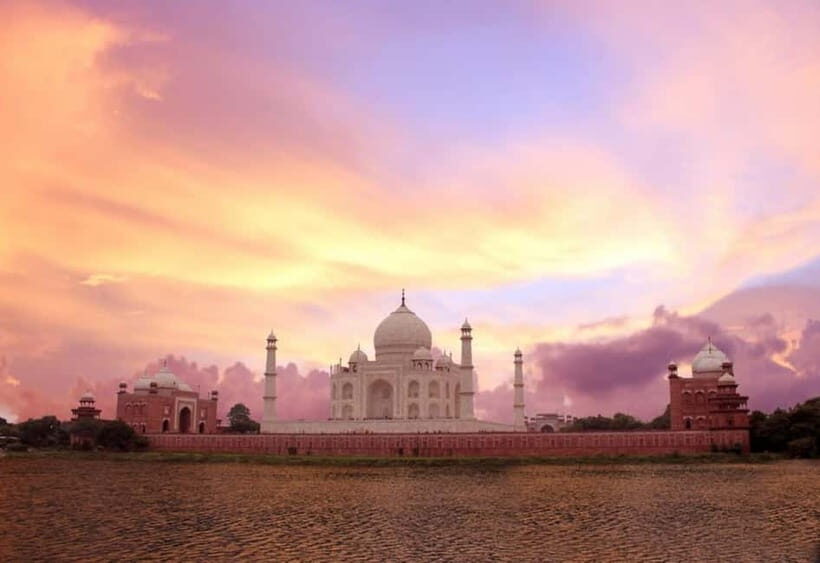
You arrive in Agra and head to the star: the Taj Mahal. You’ll have about 2 hours on site, with a golf cart ride to and from the Taj Mahal area.
That golf cart detail matters more than it sounds. The grounds involve walking, and the day already begins at 4am. The cart helps you conserve energy so your 2 hours can go into watching, photographing, and understanding what you’re seeing instead of saving your knees for later.
Your priorities inside the Taj Mahal complex
Two hours is enough if you’re focused. You’ll want to:
- Start with wide views first, so the building’s proportions settle in.
- Then slow down for the details—arches, symmetry, and the way light changes across the marble.
- Use your guide’s direction for where to stand for the best sightlines. Different angles change the entire feel of the place.
A big part of making this stop work is security and entry flow. People describe guides helping you move through lines quickly. That can turn your Taj time into actual Taj time, not “waiting beside a rope.”
Also, if you’re sensitive to walking distance, mention it when you book. One traveler described how the guide arranged a golf cart-style ride to reduce walking needs at key moments.
Morning light vs. practical reality
A classic Taj tip is to aim for earlier light. With this tour, you’re not necessarily choosing a perfect hour the way a dedicated traveler could. You are, however, getting a schedule that’s built around making sure you still see the complex and get guidance through the busiest checks. In other words: you’re not chasing the perfect sunrise. You’re buying a dependable experience.
Agra Fort: what you get besides the postcard
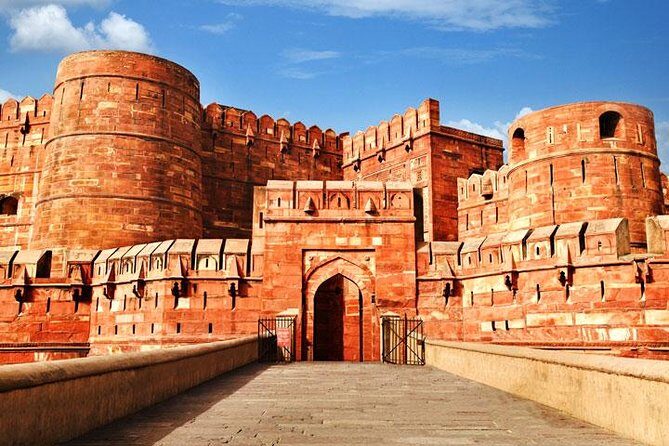
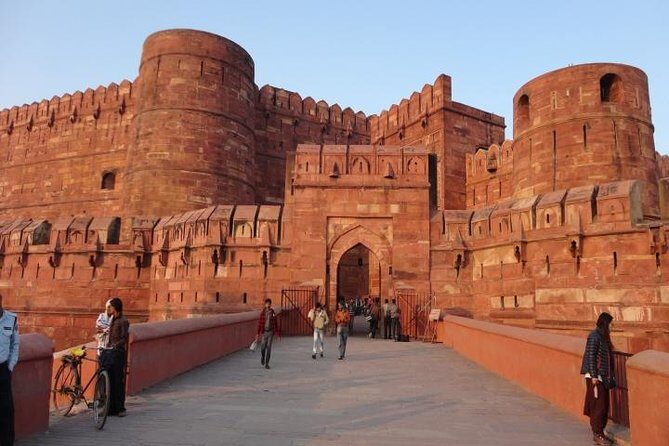
After lunch, you’ll visit Agra Fort, a UNESCO-listed site built by Emperor Akbar in 1565 A.D. It’s about 1 hour of guided time.
This stop is valuable because it adds context. The Taj Mahal is romance and symbolism. Agra Fort is power and administration—one huge red-sandstone statement that helps you see Agra as a real capital, not just a single monument.
Even within 1 hour, you can pick up key ideas:
- The fort’s scale and layout.
- How the architecture reflects a blend of influences.
- Why emperors invested in such strong, high-visibility structures.
If you’re only doing one day, this fort stop is a smart add-on. You’ll leave with a more complete picture of what Mughal-era Agra looked like as a living city.
Shopping stop: the part to handle with clear boundaries
There’s also time set aside for shopping at Sanskriti’s Imperial Gems if time permits, centered on Agra’s crafts—marble and softstone inlay work. This is included as a scheduled activity slot, typically around 1 hour.
I’m fine with a craft stop as long as you stay in charge of it. Here’s what you should expect to manage:
- You may be shown how pieces are made and how work is done.
- The sales pitch can feel intense, depending on the guide and the day’s pace.
One traveler felt rushed and pressured to buy, even mentioning perceived kickbacks tied to purchases. Another traveler’s advice was straightforward: if you do not want marble or stone jewelry, skip the shopping-style visit so you can spend that time walking more at the Taj and fort.
So decide your strategy before you go:
- If you want to browse, browse with a spending ceiling in mind.
- If you don’t, politely treat it as a short stop and ask to move along.
What’s included in the $550 price, and what isn’t
At $550 per person, you’re paying for a package that bundles the expensive parts: flights, transfers, guide, and entry fees. The included items are substantial:
- Both-side commercial flights (Mumbai–Delhi–Mumbai)
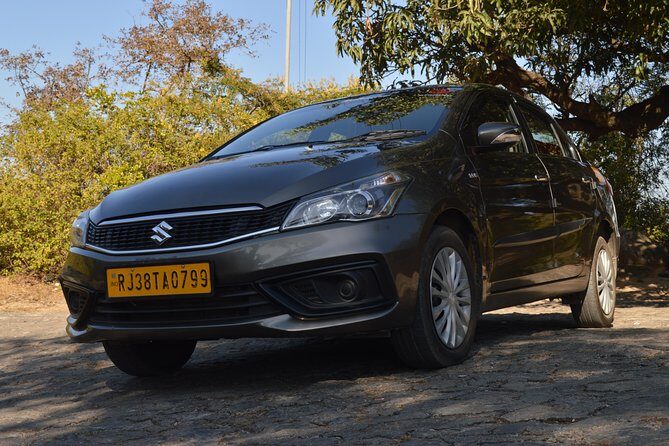
- Air-conditioned private vehicles for transfers
- Professional private tour guide
- Monument entrance fees
- Golf cart ride to and from the Taj Mahal area
- Water bottles
- Breakfast can be included depending on how you book, specifically a buffet breakfast at a restaurant if you select the lunch option
Not included:
- Drinks
- Gratuities (they’re recommended)
Here’s the value logic: the Taj Mahal is one attraction, but the real cost in a day trip is everything around it—timing, airport navigation, driving hours, and a guide who can keep you moving. This tour pays for that coordination. If you tried to DIY the same flow, you’d likely spend more time and effort just lining up transport and tickets.
That said, the price only feels “fair” if the schedule runs smoothly. If your day stretches due to flight timing, you’ll still get the sights, but you’ll pay in fatigue instead of money. This is a trip to buy convenience, not comfort.
Who this trip is perfect for (and who should be careful)

This experience is well-suited for:
- You have one day and want the big two: Taj Mahal + Agra Fort
- You don’t want to manage travel logistics between Mumbai, Delhi, and Agra
- You prefer a private guide and included entry fees
- You’re traveling with someone who benefits from organized check-ins, especially solo travelers
It also seems to work for people with lower energy needs. One traveler described the guide and driver accommodating a recovering visitor by arranging easier transport after the Taj Mahal exit.
Who should be careful:
- You’re sensitive to very early starts and long days.
- You hate airport transitions and want someone to stay by your side for check-in every step. The airport support may vary.
- You don’t like shopping stops that feel sales-driven. Decide your boundary in advance.
A quick tip on guide assignment
You might be paired with different guides across dates. Names showing up in the provided information include people like Raj, KK, Liman, Rajni Kant, Ranji, Rocky, and Sunil. If you want a particular style—fast mover, strong storyteller, photo help—ask the operator when you book. Even a small request like that can change how your Taj hour feels.
The small practical checklist that saves your day
You’ll thank yourself for these:
- Bring a copy of your passport photo requirements since they ask for passport photo copy at booking
- Wear smart casual clothing that still works at 4am
- Plan for sun and walking even if you get help like the golf cart
- Keep a little cash for drinks, snacks, or any optional expenses
- If shopping isn’t your thing, decide you’ll only browse, or skip
Also, the tour is described as private in the sense that only your group participates. That matters because you’re not stuck with random pacing that slows down your best moments.
Should you book this Taj Mahal day trip?
Book it if you want the Taj Mahal and Agra Fort in a single day and you value coordination over spontaneity. The included flights and guide do the heavy lifting. The Taj Mahal stop is given enough time to actually enjoy the place, and the golf cart helps you use your energy where it counts.
Skip it or think twice if your top priority is an ultra-stress-free airport experience or you strongly dislike shopping add-ons. Also, if you’re the kind of person who needs a relaxed pace to enjoy a trip, this is still a sprint day. You’ll see the sites, but your bedtime plans may get ruined.
If you’re short on time in India, this is one of the most practical ways to do the Taj without turning your vacation into logistics homework.