REVIEW · NEW DELHI
4-Day Golden Triangle Tour: Delhi, Agra, Jaipur (Viator Awarded)
Book on Viator →Operated by StayBook · Bookable on Viator
Golden Triangle done in four days. This private tour strings together the big hitters: Mughal Delhi, sunrise at the Taj Mahal, and Jaipur’s pink-stone forts and palaces—while you’re carried around in an air-conditioned car with a guide who helps keep lines from eating your time. I really like that the pacing is built around key sights (like Taj Mahal sunrise), and I also like the practical touch of having your guide help with monument tickets online to reduce queue time.
The main trade-off is that the schedule is full. You’ll move fast, and traffic can shuffle timing, so expect long driving stretches between stops rather than slow, laid-back wandering.
You also get to choose your sleep level: three nights in 3, 4, or 5-star hotels. Meals aren’t included, but the trade is you’ll spend your time seeing things instead of planning every transfer and ticket.
In This Review
- Key Things I Think You’ll Notice
- Four Days Across the Golden Triangle: What the Pace Really Feels Like
- Delhi Day 1: Shah Jahan, Street Food, and Stone That Tells the Story
- Jama Masjid: Big, classical, and built for scale
- Chandni Chowk: Market lanes and quick street-food moments
- Red Fort: Mughal grandeur that still feels alive
- Raj Ghat and India Gate: Two very different monuments with one shared point
- Humayun’s Tomb and Qutub Minar: UNESCO stops you’ll remember
- Lotus Temple and Birla Mandir: Peaceful shapes in between louder streets
- Taj Mahal Sunrise in Agra: Worth Getting Up Early
- Agra Fort and Itmad-ud-Daula: The Mughal Story Gets More Intimate
- Jaipur Day 3: Amber Fort, Views from Jaigarh, and Hawa Mahal’s Window Grid
- Amber Fort: Big palace energy and an elephant ride option
- Jal Mahal: A lakeside break for photos and snacks
- Jaigarh Fort: Panoramic views and the cannon-on-wheels fact
- Jantar Mantar: The planet-measuring observatory
- Hawa Mahal: The Palace of Wind and its iconic window pattern
- Day 4 Back in Delhi: A Soft Landing After Three Hard Days
- Transport, Guides, and Tickets: How the Tour Cuts Friction
- Where You’ll Sleep: Hotel Choices and Room Setup
- Price and Value for Around $599: What You’re Paying For
- Who This Tour Suits Best (and Who Might Not)
- Should You Book This Golden Triangle Tour?
- FAQ
- Is pickup included, and where does it start?
- What transportation do I use during the tour?
- Are monument tickets included?
- Is the Taj Mahal visit on sunrise time?
- What if my travel day includes Friday?
- How is lodging handled?
- Are meals included?
- Can I cancel and get a full refund?
Key Things I Think You’ll Notice
- Skip-queue help: Your guide assists with online monument tickets so you can spend more time looking, less time waiting.
- Sunrise Taj Mahal timing: You leave early to catch the morning light near the Yamuna.
- Private car, air-conditioned: Comfort matters when you’re crossing Delhi traffic and highway time.
- Packed but efficient itinerary: Every day hits multiple major monuments, with set time blocks per stop.
- Hotel choice affects the whole feel: 3 to 5-star lodging changes comfort more than you’d think on a short trip.
- Friday route adjustment: If Taj Mahal is closed on Friday, the tour order changes so you still keep the flow.
Four Days Across the Golden Triangle: What the Pace Really Feels Like
This is a sprint, not a slow stroll. The “Golden Triangle” idea is simple—Delhi, Agra, Jaipur—but fitting all three into four days means you’ll spend more time moving between places than you would on a longer itinerary. The upside is obvious: you see the essentials without having to piece together separate day trips.
The realistic rhythm looks like this: an early start on the high-impact day (sunrise Taj Mahal), then a series of high-signal stops where you’re going in, seeing what matters, and moving on. You’ll still have time at each location—Jama Masjid gets about an hour, Chandni Chowk about two, and the Taj Mahal is allocated a longer block—but the overall day structure stays tight.
Traffic is part of the deal. The tour notes that distances and timings can vary due to congestion. So if you’re the type who needs perfectly timed museum visits, plan for a little flexibility. If you’re okay with that, this format is a good way to get results fast.
A few more New Delhi tours and experiences worth a look


Delhi Day 1: Shah Jahan, Street Food, and Stone That Tells the Story
Delhi on day one is your orientation to Mughal-era power, then it shifts into modern-but-historic landmarks. The beauty of this day is that it groups the “old city” feel (markets and monuments) with the “major photo stops” so you get variety without wasting time.
Jama Masjid: Big, classical, and built for scale
You start at Jama Masjid, described as the largest mosque in India, commissioned by Emperor Shahjahan in the 17th century. The focus here is architecture—Persian and Indian influences mixed into one strong visual statement. You’ll get about an hour, which is enough time to take photos, absorb the geometry, and still move on.
Chandni Chowk: Market lanes and quick street-food moments
Next is Chandni Chowk, one of Delhi’s oldest and most famous markets, also linked to Shahjahan’s 17th-century planning. The tour builds in a longer block here (about two hours) and highlights street food time. This is where you should slow down slightly inside the crowds, because the real value is not just the buildings—it’s the atmosphere, the motion, and the sensory overload that makes Delhi feel like Delhi.
Practical note: markets can be loud and crowded. If you hate tight spaces, keep expectations realistic and go in with a “photo and snack” mindset rather than trying to browse everything.
Red Fort: Mughal grandeur that still feels alive
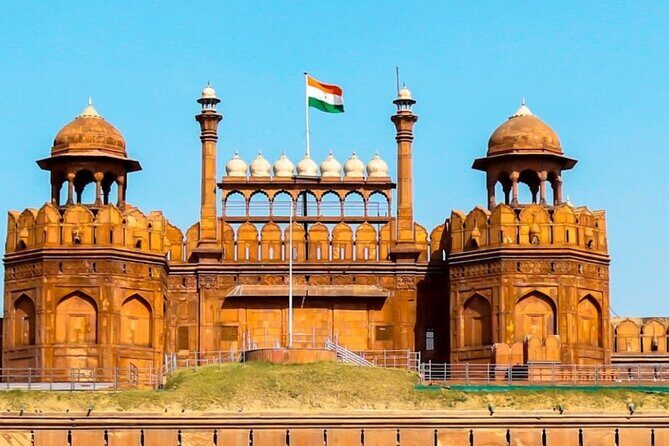
Then comes the Red Fort, a red sandstone complex built by Shahjahan and home of the Mughals for nearly 300 years. The stop is about one hour. You’re not just seeing a fort—you’re reading architecture. Mughal and Persian elements sit in the details, and the walls make the whole place feel monumental even when you’re only there briefly.





Raj Ghat and India Gate: Two very different monuments with one shared point
After the fort, the day shifts to remembrance with Raj Ghat, the memorial for Mahatma Gandhi on the Yamuna’s banks, allocated about an hour. From there it moves to India Gate, a British-era war memorial for Indian soldiers who died in World War I fighting under the British army. Expect this more as a pause for photos and context than a deep linger.
Humayun’s Tomb and Qutub Minar: UNESCO stops you’ll remember
Next you hit two major UNESCO-scale monuments.
- Humayun’s Tomb (about one hour): Built by Bega Begum for her husband Humayun in the 16th century. This is the kind of site where the gardens and symmetry make your brain switch into “slow looking” mode.
- Qutub Minar (about one hour): The world-famous brick minaret, described as the world’s tallest brick minaret with Quranic inscriptions. It’s linked to Qutub ud din Aibak and is also UNESCO listed.
If you like photos, you’ll love Qutub Minar. If you don’t, you can still appreciate it for its sheer mass and the way the inscriptions create texture up close.
Lotus Temple and Birla Mandir: Peaceful shapes in between louder streets
To close the day, you visit:
- Lotus Temple: A Bahai temple built in 1983, open to all religions, with a garden setting. The stop is short (about 30 minutes), which is enough to take in the design without turning it into a time sink.
- Birla Mandir (about one hour): The Laxminarayan (Birla) Temple, blending traditional and modern architectural styles and dedicated to Vishnu and Lakshmi.
Day one is doing a lot, but it’s smartly arranged. You go from power (mosque/fort) to everyday life (Chandni Chowk) to reflective monuments, then finish with calmer spiritual architecture.
Taj Mahal Sunrise in Agra: Worth Getting Up Early
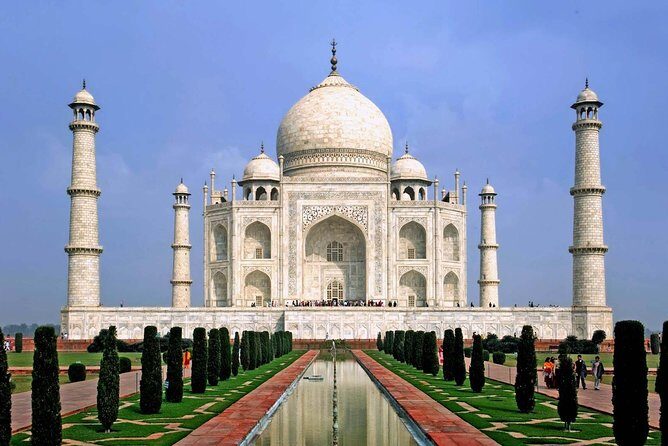
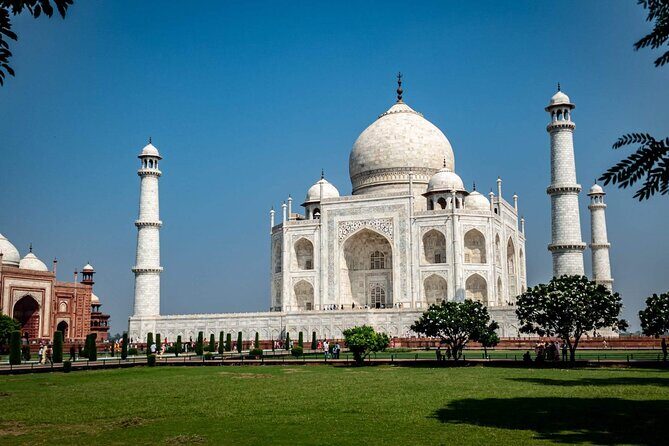
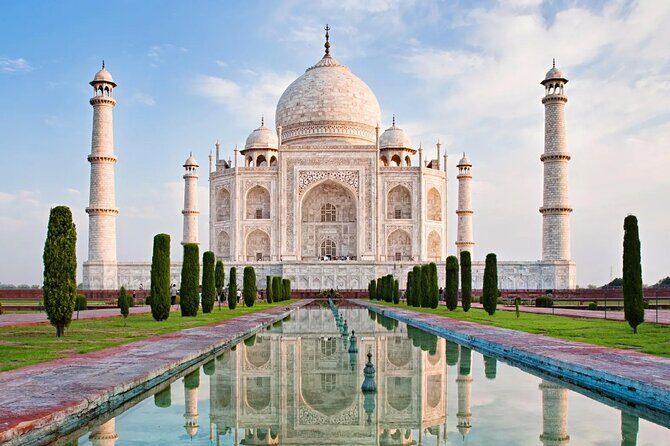
Day two is the one everyone buys the tour for: Taj Mahal sunrise. The plan is to leave early so you can see it in the morning light, with views toward the Yamuna. The Taj Mahal stop is about three hours, which is generous for a “must-see” and means you won’t feel rushed in and out.
Here’s the real value of the sunrise approach: the Taj Mahal changes through the morning. Even if you’re not a photo maniac, the light makes the whole experience feel more special than a mid-day visit. Also, early starts tend to mean fewer crowds and calmer viewing.
One thing to know: the tour explicitly mentions that Taj Mahal is always closed on Friday, so the route changes if your day falls on Friday. In that case, you should expect the order to shift so you still keep the tour’s structure.
Agra Fort and Itmad-ud-Daula: The Mughal Story Gets More Intimate
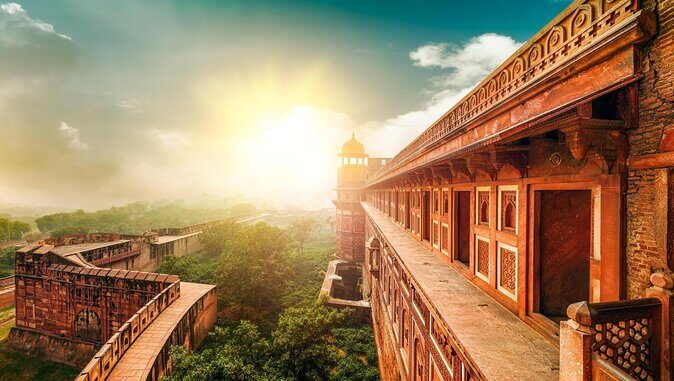
After the Taj Mahal, you move to Agra Fort. It’s UNESCO listed, built by Akbar in 1565, and it served as a Mughal residence until 1638. The stop is around two hours. This is where the trip slows slightly in a good way: you get a stronger sense of how rulers lived and defended power from within a fortified complex.
Then you visit Itmad-ud-Daula, often called the baby Taj. It’s built by Emperor Nur Jahan in memory of her father, Mirza Ghiyas Beg. You get about two hours here as well. This stop is valuable because it complements the Taj Mahal without repeating it. The Taj is grand and dramatic; Itmad-ud-Daula feels more detailed, more personal, and more “crafted.”
If you like inscriptions, inlays, and architectural detail, this portion is a great way to see the Mughal aesthetic beyond the one main icon.
Jaipur Day 3: Amber Fort, Views from Jaigarh, and Hawa Mahal’s Window Grid
Day three is your shift from Mughal Agra into Rajput architecture and the iconic Jaipur skyline. The day is strong because it mixes forts with viewpoints and then caps it with a signature palace façade.
Amber Fort: Big palace energy and an elephant ride option
You start at Amber Fort early in the morning. The tour calls it the most prominent palace showcasing Rajput architecture, and the stop is about two hours. It also mentions time for an elephant ride option.
A practical consideration: elephant rides can be emotionally tricky for some visitors. The tour data says you’ll enjoy an elephant ride, but it doesn’t spell out the exact terms. If you’re unsure, ask your guide on the spot what the ride involves (duration, operator, and where it takes you) so you can decide with clear information.
Jal Mahal: A lakeside break for photos and snacks
Next is Jal Mahal, described as a time to enjoy the area and spend quality time, plus street food time. You get about one hour. This stop is more about the setting and views across the water than about museum-style history.
Jaigarh Fort: Panoramic views and the cannon-on-wheels fact
Then it’s Jaigarh Fort, about one hour. The standout detail here is that it’s famous for world’s largest cannons on wheels. You’ll also get panoramic views of Amber Fort and the Maota Lake.
If you like viewpoints, this is a great use of the day. If you’re monument fatigued after a morning fort, you can treat Jaigarh as your chance to breathe and look out over the landscape.
Jantar Mantar: The planet-measuring observatory
Jantar Mantar gets about one hour. The tour describes it as one of the most famous and accurate planet observatories in the world. Even if you don’t geek out on instruments, you’ll likely enjoy the scale and the way the structures turn astronomy into something you can walk through.
Hawa Mahal: The Palace of Wind and its iconic window pattern
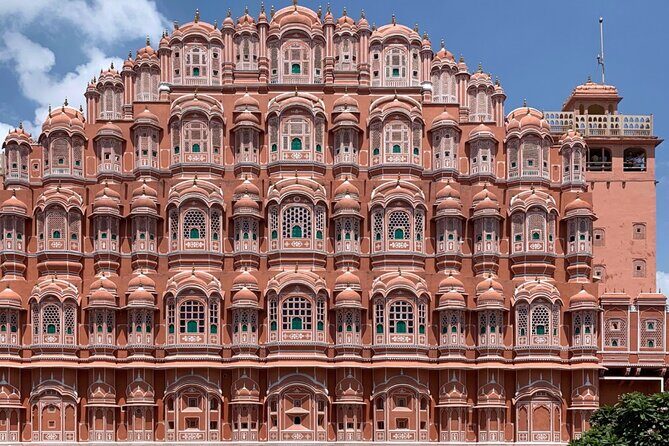
Finally, you visit Hawa Mahal, about one hour. It’s described as a five-story triangular-shaped building made from pink and red sandstone, filled with many windows designed to keep it cool during hot summer days. This is a classic Jaipur stop. The best approach is to look at it from multiple angles and then take close-up shots of the window grid.
Day 4 Back in Delhi: A Soft Landing After Three Hard Days
On day four, you return toward Delhi around 2 pm or at a time recommended by you. The tour aims to drop you at your preferred location. The total time block is about five hours.
This is one of the underrated benefits of the format: after three action-packed days, you don’t have to force another full sightseeing day. You can use this time for a final stroll, a meal, or a little rest—depending on your energy level. The tour also suggests returning back until 4 pm if you want a guideline for planning.
Transport, Guides, and Tickets: How the Tour Cuts Friction
The tour is private, meaning it’s just your group, and you travel in a comfortable private car with air conditioning. That matters more than it sounds. Golden Triangle days can feel like a blur, and air-conditioned transport helps you arrive at each stop with a little more energy.
Your guide is also a real part of the value. The tour states that your personal guide helps you buy monument tickets online to avoid queue time. That doesn’t just save minutes. It saves frustration. And since the schedule is packed, cutting waiting time is a big deal.
The guide is English speaking, and you can request a specific language if you inform the provider earlier.
Where You’ll Sleep: Hotel Choices and Room Setup
This trip includes three nights’ accommodation, and you can choose your hotel category: 3, 4, or 5-star. Meals are extra, so don’t assume breakfast and lunch are all covered. (That said, the tour mentions hotel stays and includes ticket help, so you’re not on your own to handle every detail.)
Room allocation is based on twin-sharing by default. If you book for three or four individuals, rooms are typically assigned as triple-sharing, or family rooms. If you specifically want separate rooms for three or four people, an additional charge may apply.
This matters because comfort can be the difference between enjoying the pace and feeling wiped out. If you’re traveling as a small group, confirm how rooms will be assigned before you land.
Price and Value for Around $599: What You’re Paying For
At $599 for roughly four days, you’re not just paying for sightseeing. You’re paying for the structure that prevents you from turning this into a planning nightmare.
Here’s what your money buys, based on the tour details:
- Private car with air conditioning for the multi-city leg
- A guide who assists with monument ticket purchasing online
- Three nights’ hotel in a category you choose (3 to 5-star)
- A set itinerary across Delhi, Agra, and Jaipur so you’re not building day trips from scratch
- Mobile ticket and pickup offered
Meals being extra does reduce what you’ll spend, and you’ll need to budget for your food. But the trade is you get a tight, workable plan that hits major monuments without turning your trip into a logistics project.
If you’re traveling solo or as a couple who wants maximum value per day, this kind of package usually makes sense. If you hate schedules and prefer slow, independent travel, you might find it too structured.
Who This Tour Suits Best (and Who Might Not)
I’d recommend this tour if you:
- Want to hit Delhi + Agra + Jaipur quickly without hopping between buses and trains
- Like big-name monuments, but also want enough time per stop to actually look
- Prefer having a guide to handle the ticket friction
- Are comfortable with early starts (sunrise Taj Mahal)
I’d be cautious if you:
- Want a slow pace with lots of free time
- Get easily tired by long driving days
- Have strong preferences about avoiding any kind of animal activity, since Amber Fort includes an elephant ride option
Also, if your travel dates fall on Friday, remember the Taj Mahal closure note. The itinerary adjusts to keep the experience coherent.
Should You Book This Golden Triangle Tour?
If you want a clean, efficient first Golden Triangle trip, I think this one is worth considering. The big wins are the sunrise Taj Mahal timing, the private air-conditioned car, and the guide support for online ticketing so you don’t lose your day to queues.
My call: book it if you want certainty and a packed-but-reasonable plan. If you crave freedom to linger, swap stops, and roam at your own speed, you may want something more flexible.
If you do book, I’d suggest two smart moves:
1) Plan your energy around the early morning Taj Mahal start.
2) Double-check your hotel category choice and how rooms will be arranged for your group size.
FAQ
Is pickup included, and where does it start?
Pickup is offered. The meeting point listed is Staybook Hotel Aira New Delhi (Desh Bandhu Gupta Rd, opposite police station, Motia Khan, Paharganj, New Delhi, Delhi 110055, India). The tour also mentions it ends back at the meeting point.
What transportation do I use during the tour?
You travel in a comfortable private car with air conditioning.
Are monument tickets included?
Some sights list admission tickets included, while others list admission ticket free. Your guide helps you buy monument tickets online to avoid queues.
Is the Taj Mahal visit on sunrise time?
Yes. The tour leaves early in the morning to see the Taj Mahal at sunrise, with views toward the Yamuna.
What if my travel day includes Friday?
The tour notes that the Taj Mahal is always closed on Friday, so the tour order can change (Delhi–Jaipur–Agra–Delhi).
How is lodging handled?
The tour includes three nights of accommodation. You can choose 3, 4, or 5-star hotels. Rooms are typically allocated on a double-room twin-sharing basis, with triple-sharing or family rooms if you book for three or four people.
Are meals included?
No. The itinerary states that accommodation is included for three nights, but meals are extra.
Can I cancel and get a full refund?
Yes. You can cancel up to 24 hours in advance for a full refund. If you cancel less than 24 hours before the experience start time, the amount paid is not refunded.