REVIEW · MUMBAI
Mumbai By Shantaram With Private Tour Guide
Book on Viator →Operated by Private India Guided Tours · Bookable on Viator
Mumbai tells two stories in one day. This private, Shantaram-inspired city day mixes film-era Mumbai vibes with a reality-check look at Dhobi Ghat and Dharavi—guided by someone who can translate what you’re seeing. You’ll ride in a private car and stop at major landmarks like Gateway of India without the usual scramble.
I love the setup: hotel pickup and a private, air-conditioned car that keeps the day moving. I also love the contrast stops—especially Dhobi Ghat and Dharavi—because the tour aims to show how people actually live and work, not just what’s on postcards. One consideration: Dhobi Ghat and Dharavi can feel intense, so if you want only polished sights, this route might be too direct.
Guides have been praised for clarity and professionalism, including Sanjay, Anisa, and Ali—each highlighted for making the city feel understandable instead of overwhelming. With about 7–8 hours in total, you get a full slice of Mumbai’s big landmarks and its harder-to-ignore neighborhoods.
In This Review
- Key highlights worth planning for
- A Shantaram-style Mumbai route with a private driver and guide
- Price and what a $87 private day covers
- Hotel pickup, car comfort, and how the day is paced
- Dhobi Ghat: the open-air laundry block you can’t unsee
- Dharavi slums: real neighborhoods where you look longer than you photograph
- Mumbai Central and the High Court: colonial-era architecture, fast stops
- Chhatrapati Shivaji station (Mumbai Central)
- Bombay High Court principal bench
- Colaba: Shantaram story locations by the Arabian Sea
- Gateway of India and the Taj Mahal Palace area: the classic finale
- Gateway of India
- Taj Mahal Palace, Mumbai
- Who this private Shantaram tour is best for (and who should skip it)
- Should you book this private Mumbai Shantaram tour?
- FAQ
- FAQ
- How long is the Mumbai By Shantaram with Private Tour Guide?
- What does the price include?
- Do I need to pay for tickets at every stop?
- Does the tour include a private guide and private car?
- What about airport pickup and drop?
- Is food included in the tour price?
- What are the main places visited during the day?
- Is there free cancellation?
Key highlights worth planning for

- Shantaram link without staying in tourist fiction: the route connects key story settings with real streets and places.
- Dhobi Ghat on an actual laundry block: an open-air scene tied to hereditary work, not a museum display.
- Dharavi time built in: plan on roughly 2 hours there, long enough to understand the neighborhood beyond a quick photo stop.
- Iconic architecture stops in the same day: Chhatrapati Shivaji station and the Bombay High Court principal bench give you old-school grandeur.
- Sea-and-monument finish at Gateway of India: a classic arch moment, capped by the Taj Mahal Palace area nearby.
A Shantaram-style Mumbai route with a private driver and guide

If you’re coming to Mumbai for the first time, it’s easy to end up with only one version of the city. This tour goes for a split-screen approach: the cinematic, landmark Mumbai that pulls you in fast—and the lived-in Mumbai that stays with you longer.
The big advantage is the format. You’re not shared onto a big group bus with a pace that’s too slow or too fast for everyone. You get a private car and a private guide, which matters in a city where time evaporates quickly if you’re relying on transit and haggling. Even the stop lengths are structured: quick hits at major landmarks (around 30 minutes at several sites) balanced with a deeper block of time in Dharavi.
The route is also built around the Shantaram connection, but the value comes from how it’s handled. You’re not just collecting names and photos. You’re visiting places that fit the themes of the book—fame, survival, work, and the city’s contradictions—while the guide helps you read what you’re looking at.
You can also read our reviews of more guided tours in Mumbai



Price and what a $87 private day covers
At $87 per person for a 7–8 hour private experience, you’re paying for three main things: transportation, a dedicated guide, and admission structure that’s mostly simple.
Here’s what’s included:
- Hotel pickup and drop
- Air-conditioned private car
- Bottled water in the car
- Taxes, parking fees, and fuel charges
- Private tour guide fee
What’s not included:
- Airport pickup/drop is an extra $40 per booking
- Food and drinks are $20 per person
- Dhobi Ghat admission isn’t included (admission ticket is listed as not included there)
Is it good value? For Mumbai, yes—especially if you want to pack in both landmark architecture and the social-history side without spending your day coordinating. If you’re traveling as a duo or small group, this “private with a car” setup can feel like a bargain compared with piecing together taxis plus a guide plus multiple separate tickets.
If you’re doing a tighter budget, plan to spend the $20 on meals in a way that matches your comfort level. Keep it basic: you’ll likely want energy for walking and time on the ground.
Hotel pickup, car comfort, and how the day is paced

The day starts with pickup from your hotel in Mumbai and a hop into a private vehicle. That matters because the tour includes a mix of short landmark stops and two longer blocks. You’re looking at about:
- Several stops around 30 minutes each (train station, High Court, Gateway of India, and more)
- One longer visit to Dhobi Ghat (about 30 minutes)
- One long, key visit to Dharavi (about 2 hours)
- An extended Colaba block (about 1 hour)
Because the car is air-conditioned and you have bottled water in the vehicle, you can keep the day moving without building your own “what’s next” plan. I like this style for Mumbai because it reduces wasted time and keeps you focused on the places you actually came for.
Also, the tour is designed for a private group—only your party participates—so the guide can adjust the rhythm if you need extra time at a stop or prefer fewer photos.
Dhobi Ghat: the open-air laundry block you can’t unsee
Dhobi Ghat is one of those Mumbai experiences that changes your sense of scale. It’s described as an open-air laundry taking up an entire block and known as the largest of its kind. The detail that lands is the human side: hereditary laundresses working there, passing down the work through generations.
On this tour, Dhobi Ghat is allotted about 30 minutes. That’s enough time to understand what’s happening without turning it into a rushed photo sprint. You’re there to see the setting and learn what makes this laundry district function as part of the city’s everyday life.
A practical note: admission isn’t included for Dhobi Ghat, so bring cash or have a payment method ready. If you’re sensitive about intense, working-life scenes, this is the moment to pause and decide your comfort level. The tour doesn’t treat the place like a theme park. It’s more like a living workplace.
Dharavi slums: real neighborhoods where you look longer than you photograph
Dharavi is the other half of the emotional equation. This tour frames it in plain terms: a dense neighborhood with about 1 million people living across 215 hectares, described as among the largest slums in the world. The tour also notes that rent can be very low—listed as under $4—which hints at the economic reality shaping daily life.
You get about 2 hours here, which is the right call. A rushed 20-minute stop turns Dharavi into a spectacle. Two hours gives you breathing room to process the streets, the scale, and the everyday movement that makes a neighborhood feel like a community instead of a headline.
The guide’s role is especially important in a place like this. If you want to understand more than surface labels, you’ll rely on a good explanation of what you’re seeing and why it matters. The tour’s overall “real city of Mumbai” goal comes to life most clearly in this stop.
If you’re coming hoping for a dramatic cinematic view of poverty, you might be disappointed. What you’ll likely find instead is life happening—tight spaces, work, and people building routines that keep things going. That’s what makes it powerful.
You can also read our reviews of more private tours in Mumbai





Mumbai Central and the High Court: colonial-era architecture, fast stops
After the neighborhood contrasts, the tour pivots back to big-city landmarks with time-efficient stops.
Chhatrapati Shivaji station (Mumbai Central)
You’ll spend about 30 minutes at Mumbai Central, focusing on the historic Chhatrapati Shivaji station. It’s highlighted as one of the most beautiful buildings in Mumbai and as the largest train station in India, built over 10 years. It’s also listed as a UNESCO World Heritage Site.
This is a great stop if you like architecture. Even with short time, you can feel the ambition of the building. The guide can help you notice details you might miss if you’re just scanning for photo angles.
Bombay High Court principal bench
Next up is the Bombay High Court principal bench, also about 30 minutes. Expect a colonial-style palace look with towers and stone carvings. The tour description even points out a specific relief: a one-eyed monkey holding the scales of justice.
This stop works well because it adds contrast. After Dhobi Ghat and Dharavi, the stonework can feel like another kind of history—another layer of what Mumbai became under different eras. If you keep your attention on the details, this becomes more than “another courthouse you pass by.”
Colaba: Shantaram story locations by the Arabian Sea
Colaba is where the route leans into the book’s atmosphere again. The area is described as the place where the main actions of Shantaram took place, and it sits along the shore of the Arabian Sea.
You get about 1 hour here, which is a comfortable amount of time for exploring at human speed. Colaba is also described as having long European presence since ancient times, and now it has hotels and modern city life layered over older streets.
This stop is valuable because it gives you a softer landing after heavier content. You’re not switching from “serious” to “silly.” You’re switching to the part of Mumbai that draws outsiders in—sea views, characterful streets, and the city’s role as a hub where cultures meet.
If you’re a fan of travel literature, this is also where the story geography starts to make sense. The places stop being abstract and start behaving like real locations you could walk to.
Gateway of India and the Taj Mahal Palace area: the classic finale
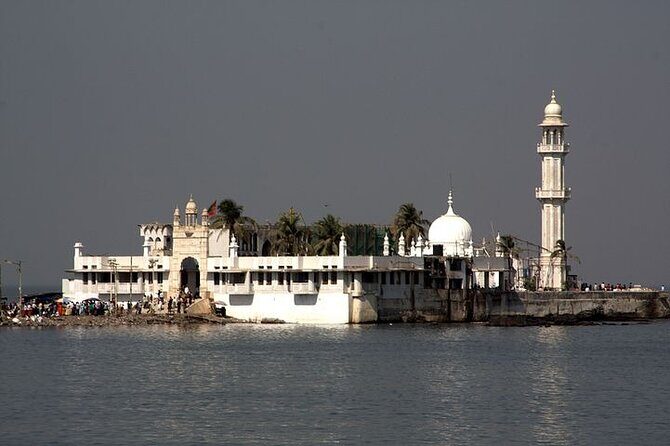
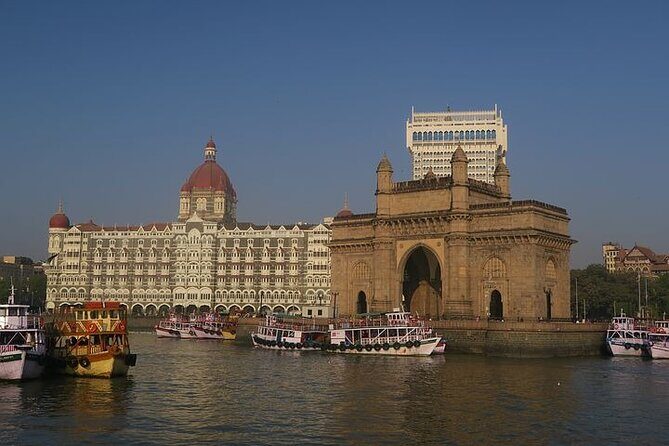
The tour closes with the kind of Mumbai images everyone recognizes, and it’s timed well: 30 minutes at Gateway of India and then another 30 minutes near the Taj Mahal Palace, Mumbai.
Gateway of India
Gateway of India is described as a triumphal arch and the main decoration of the city. It’s also connected to independence—through this arch, the description notes that the British left the country after independence. In other words, it’s not just a pretty landmark. It has a specific political meaning tied to a turning point.
You’ll have enough time here to take photos, pause, and get your bearings. If your day felt like a lot of ideas in motion, this is where you slow down.
Taj Mahal Palace, Mumbai
The Taj Mahal Palace stop is positioned very close to the Gateway of India monument. It’s labeled as the most expensive and popular hotel in Mumbai. This isn’t about going in. It’s about noticing how the city presents its glamour right next to its working life and its monumental history.
This pairing—arch monument, then luxury hotel area—is exactly the kind of contrast Mumbai is famous for. It’s also a clean way to end a day that has already stretched your sense of what “Mumbai” means.
Who this private Shantaram tour is best for (and who should skip it)
This tour fits best if you:
- Want a one-day overview that balances major landmarks with real neighborhood context
- Appreciate the Shantaram angle but prefer it grounded in actual places
- Like having a private guide who can explain what you’re seeing
- Travel with limited time and want an organized plan that still feels human-sized
You might want a different option if:
- You only want postcard Mumbai and would rather avoid tougher street-level reality
- You’re uncomfortable with working-life scenes at Dhobi Ghat or dense community life at Dharavi
- You’re looking for long museum time or a relaxed sightseeing-only pace
Should you book this private Mumbai Shantaram tour?
I think you should book it if your goal is a fuller Mumbai in one day: monuments plus the places that show how the city functions. The private car, bottled water, and hotel pickup make the logistics easier, and the pacing gives the heavy stops enough time to matter.
I’d also book it if you like your guides to do more than point and name. The guides singled out for professionalism—Sanjay, Anisa, and Ali—suggest this is the kind of tour where explanations help you make sense of what you see.
Skip it if your day off is meant to be purely easy and scenic. Dhobi Ghat and Dharavi are central to the experience, and they don’t soften the city’s realities.
FAQ
FAQ
How long is the Mumbai By Shantaram with Private Tour Guide?
The tour lasts about 7 to 8 hours.
What does the price include?
The price includes hotel pickup and drop, an air-conditioned private car, bottled water, all taxes/parking/fuel, and the private tour guide fee.
Do I need to pay for tickets at every stop?
Most stops list admission as free, but Dhobi Ghat admission is not included. The tour description lists Dhobi Ghat admission ticket as not included.
Does the tour include a private guide and private car?
Yes. It is a private tour with only your group and a private car with an air-conditioning system.
What about airport pickup and drop?
Airport pickup and drop are not included and cost $40 per booking.
Is food included in the tour price?
No. Food and drinks are not included, and the tour notes $20 per person for this.
What are the main places visited during the day?
The route includes Dhobi Ghat, Dharavi, Chhatrapati Shivaji station (Mumbai Central), Bombay High Court principal bench, Colaba, Gateway of India, and the Taj Mahal Palace, Mumbai area.
Is there free cancellation?
Yes. You can cancel for a full refund up to 24 hours in advance of the experience start time.
If you tell me your travel dates and whether you’re more interested in landmarks or the neighborhood side, I can help you decide if this pacing fits your style.