REVIEW · NEW DELHI
4 days Golden Triangle tour of Delhi, Taj Mahal in Agra & Jaipur with Guide
Book on Viator →Operated by 5 Senses Walks · Bookable on Viator
Some sights in India hit fast, like fireworks. This Golden Triangle route strings together Delhi’s Mughal-era powerhouses, Agra’s jaw-dropping Taj Mahal, and Jaipur’s forts and palaces in just 4 days.
I especially like the way the pacing keeps you moving without feeling rushed: early starts, smart travel time, and time inside the big sites. I also like that you get a guide plus entrance charges and 3 breakfasts in the price, so the day-to-day decisions stay simple. One drawback to plan for: you’ll still need to budget for meals and a couple of add-on sights, since Jal Mahal and Hawa Mahal are listed as not included.
In This Review
- Key highlights at a glance
- Why this Golden Triangle works (and where it can feel heavy)
- Arrival day in Delhi: Qutub Minar, the Iron Pillar, and Mughal power
- The driving rhythm between cities: why timing matters on a 4-day trip
- Amber Fort and the Jaipur you actually want to see
- Jal Mahal: the water-palace pause
- Hawa Mahal: 953 windows and the science of shade
- City Palace and Jantar Mantar: Jaipur’s two very different sides
- Fatehpur Sikri: the quiet, strange city near Agra
- Taj Mahal: the “beautiful monument” part and the “why it matters” part
- Price and what you’re really paying for
- Who this tour suits best
- Should you book this Golden Triangle with guide?
- FAQ
- What’s included in the price for this 4-day tour?
- Are all entrance fees included for every stop?
- What about meals besides breakfast?
- What time does the tour start?
- How long is the tour?
- Does the tour depend on weather?
- What is the cancellation timeline?
Key highlights at a glance
- A guided sweep of Delhi’s top heritage sites (Qutub Minar, Humayun’s Tomb, and more)
- Taj Mahal built details that actually make sense once you’ve seen the monument’s materials and timeline
- Amber Fort + Maota Lake views that feel made for photos, even in bright daylight
- Jaipur’s palace mix of Mughal and Rajput styles in City Palace and beyond
- Jantar Mantar’s giant sundial gives you a practical way to picture old science
Why this Golden Triangle works (and where it can feel heavy)
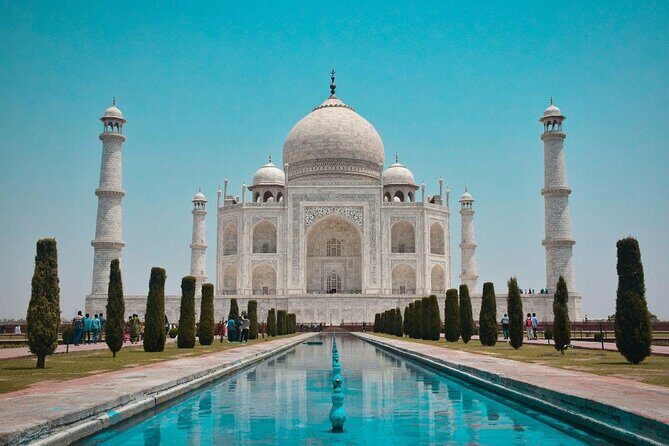
This tour is built for people who want the headline monuments, but also want guidance that turns “pretty places” into “I understand what I’m looking at.” You’re covering three cities—Delhi, Agra, and Jaipur—with a private car and a guide, which matters in India. Traffic, site entry lines, and route decisions can eat an entire day if you’re doing everything on your own.
The value angle is real: entrance charges are included for most stops, plus breakfast is covered for three mornings, so you’re not constantly calculating what costs extra. And the company behind it is described as an India-recognized tour operator that aims to support local guides and local businesses, which is the kind of practical mission that can keep money circulating where it belongs.
Still, this is not a slow cultural stroll. It’s a tight circuit of big-ticket stops. If you’re sensitive to long drive days or early mornings, you’ll feel it—especially when the tour is timed to get you into sites while they’re most comfortable to visit.
You can also read our reviews of more guided tours in New Delhi


Arrival day in Delhi: Qutub Minar, the Iron Pillar, and Mughal power
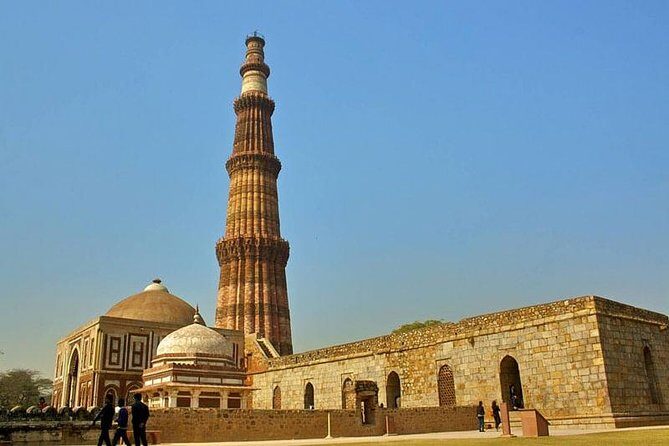
Your Delhi begins with Qutub Minar, one of India’s most famous minarets, tied to early Delhi Sultanate history. The story here is unusually clear: construction starts under Qutub-ud-din Aibak in 1199, with the minaret later completed by Iltutmish in 1236. The monument is also described as inspired by the Minaret of Jam, which helps you see it as part of a wider medieval world, not just a local landmark.
Next comes the Iron Pillar of Delhi, a site that’s short on explanations and long on curiosity. It’s described as about 24 feet tall, roughly 6 tons, made of 98% wrought iron, and famous for resisting rust for centuries. Even if you don’t care about metallurgy, this stop works because it invites you to pause. It’s the kind of object you keep staring at because your brain expects something that old to look corroded.
Then you shift into Mughal grandeur with Humayun’s Tomb, described as built like a palace rather than a burial tomb, and presented as an early model for Mughal architecture in India. This is the point where you start to see a pattern across the route: each city’s “signature” style is not random. It’s political, religious, and artistic choices repeating with local flavor.
After that, the tour moves through major landmarks that help you understand Delhi’s layers:
- India Gate, a memorial tied to soldiers who died during World War I for the British Army, with names also connected to the Afghan war of 1919.
- Rashtrapati Bhavan, the President’s residence, paired with a stop at the Mughal Gardens behind it.
Practical note: these Delhi stops are not all “must-see for everyone” in the same way. If you’re trying to squeeze photos and details into one morning, give Qutub Minar and Humayun’s Tomb priority. India Gate and the Rashtrapati Bhavan gardens are good context, but they’re also easier to skim.
The driving rhythm between cities: why timing matters on a 4-day trip
A big part of the comfort of this tour is the private car. You’re not just saving energy—you’re avoiding the guesswork of transit and route changes between cities. The schedule is designed around starting early and arriving in time for a key site.
For example, on the way to Jaipur you depart in the early morning and are on-site for Amber Fort around late morning (the tour lists 6:30am departure and about 10:30am arrival). That’s smart because Amber Fort rewards you most when you’re not fighting late-day crowds and glare.
On the Agra day, you leave Jaipur around 11am and arrive around 2pm for Fatehpur Sikri. That timing is workable because the stop includes a set visit window and the site itself is spread out, so you don’t feel forced to sprint.
Then on the final day, you’re back to a high-focus site: Taj Mahal, with the day structured so you’re there with time to experience it properly before heading back.
If you like your travel days predictable—hotel to car to site, repeat—this route is built for you.
Amber Fort and the Jaipur you actually want to see
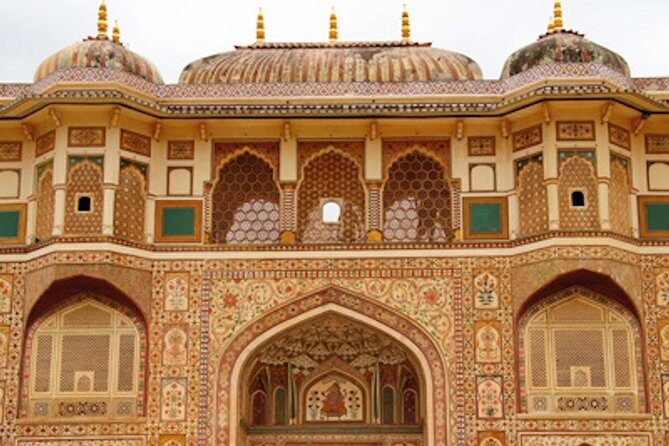
Jaipur is introduced with Amber Fort, and this is where the tour earns serious points. The fort is described as red sandstone and white marble, with construction credited to Raja Man Singh I. The setting matters too: Maota Lake provides a scenic backdrop that makes the fort feel cinematic from the approach.
Amber Fort is also a place where your guide’s explanations change the experience. Details like intricate wall paintings, frescoes, and the use of precious gems in those artworks help you understand why this fort was more than a defensive structure. It was also a showpiece.
After Amber, you get two optional-feeling stops that are still worth planning around:
Jal Mahal: the water-palace pause
Jal Mahal is listed as not included for admission, and the time given is short. That’s fine. The value here is the view: a low, symmetrical palace that appears to float on Sagar Lake. You don’t need long hours. You need the right angle, and ideally a calm moment to look at the water and stone contrast.
A few more New Delhi tours and experiences worth a look



Hawa Mahal: 953 windows and the science of shade
Then comes Hawa Mahal (Palace of Wind), also not included for admission, described as built in 1798 by Maharaja Sawai Pratap Singh. The “wow” is immediate: five storeys shaped like a honeycomb with 953 small windows (jharokas). The tour notes the idea behind those windows: the design supports a constant cool breeze across seasons.
Even if you don’t climb through every level, this stop works because it shows you how architecture solved everyday comfort problems—long before modern climate control.
City Palace and Jantar Mantar: Jaipur’s two very different sides
With City Palace, you slow down just a bit and switch gears from forts-and-views to lived-in royal spaces. The palace is credited to Maharaja Sawai Jai Singh II and described as a fusion of Mughal and Rajput architecture. Inside, you get gardens, buildings, courtyards, a temple, and a museum—so it’s not only about exterior walls.
This stop is valuable if you like knowing how power lived on the ground. City Palace is less “one big photo moment” and more “a place where small details add up.”
Then the tour ends Jaipur at Jantar Mantar, an 18th-century astronomical observatory built by Jai Singh in 1730. What I like about Jantar Mantar is that it’s not just ancient stuff behind fences. It’s built objects meant to measure the sky. The site includes 19 architectural astronomical instruments, and the highlight is the Smarat Yantra, described as the world’s biggest stone sundial.
If you’ve ever looked at a sundial and wondered how anyone made those measurements useful, this stop gives you the answer in physical form. It’s science that you can stand next to.
Fatehpur Sikri: the quiet, strange city near Agra
On the way to Agra, you visit Fatehpur Sikri, described as a magnificent ancient city built by Akbar. The tour notes that Akbar’s inspiration included Persian court influence, and that the architecture reflects Persian design principles plus elements from Hindu and Jain styles.
This is a great mid-route pause because it’s different from the Delhi sites and different from what you’ll see at the Taj Mahal. It has its own mood. You also get a shorter, focused visit window (about an hour listed), which makes it easier to stay sharp during travel days.
One extra detail worth noting: Fatehpur Sikri is listed as admission free in the tour info. That’s a nice value bonus inside an already ticket-heavy trip.
Taj Mahal: the “beautiful monument” part and the “why it matters” part
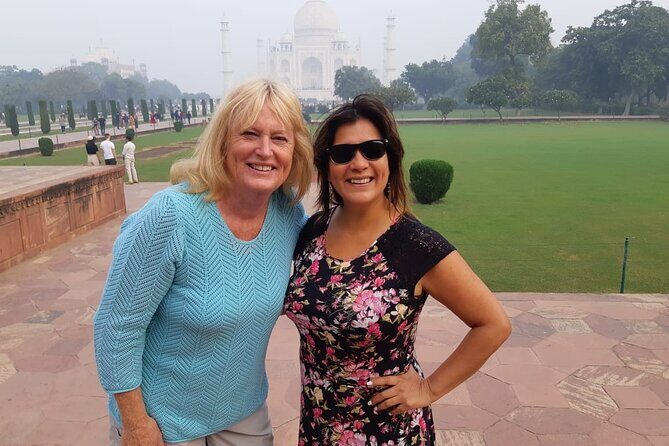
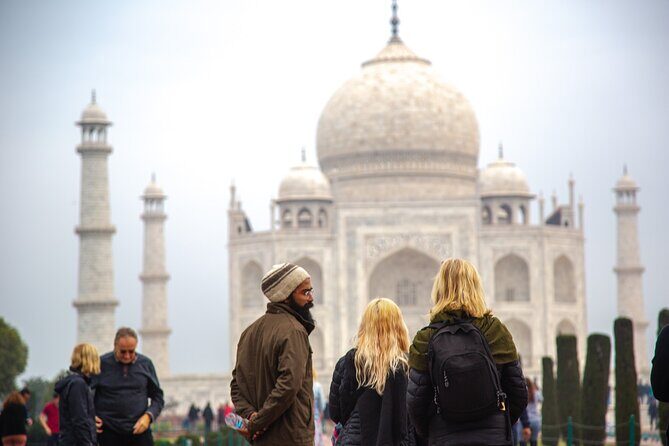
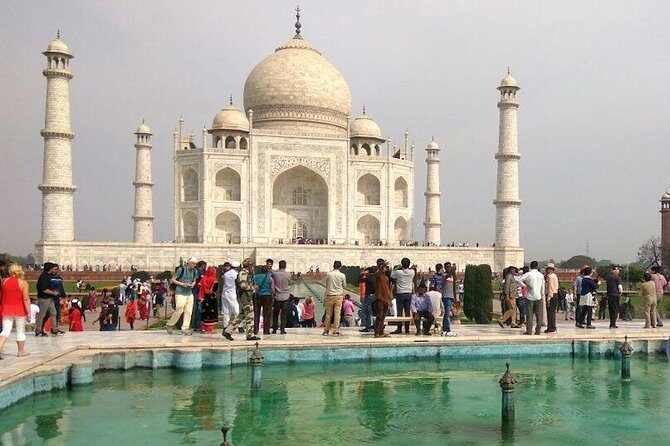
Taj Mahal is introduced with the standard basics—built between 1631 and 1653 over 22 years by Shah Jahan for Mumtaz Mahal, who passed away while giving birth to their 14th child. But what makes this tour’s Taj Mahal stop more useful is the way it explains scale through sourcing and labor.
The tour describes the project as mind-boggling: materials came from across regions and workers arrived from many places. It lists red sandstone from Fatehpur Sikri, jasper from Punjab, jade and crystal from China, turquoise from Tibet, and lapis lazuli and sapphire from Sri Lanka. It also includes names of craft specializations—sculptors from Bukhara, calligraphers from Syria and Persia, and stone cutters from Baluchistan—plus a workforce of 20,000 workers.
So when you stand there, you’re not only looking at a white marble icon. You’re looking at a giant coordination effort. It helps your brain stop treating it like a postcard and start treating it like a functioning monument-building system.
Practical tip: Taj Mahal is one of those places where the light changes fast. If you’re spending the day here, keep your time for viewing flexible. Don’t plan to rush. Even if you don’t stay for every possible angle, you’ll want at least one slow pass where you let the details land.
Price and what you’re really paying for
At $1,045.34 per person for about 4 days and 3 nights, the big question is what you get for that money.
From what’s included, you get:
- A private car for the route between cities
- A guide throughout
- Entrance charges for the listed stops (with a couple of exceptions)
- Breakfast for 3 days
- Pickup is offered, and you get a mobile ticket
What you do not get is food and beverages, and two specific sights (Jal Mahal and Hawa Mahal) are listed as not included.
So the value isn’t just “you don’t have to organize stuff.” It’s also that most of the major costs are bundled: getting between Delhi–Agra–Jaipur, paying for entrances, and having an expert explain what you’re seeing. If you tried to DIY this route, you’d likely save money only by taking on transit stress, ticket planning, and guide research yourself.
This price tends to make the most sense if you:
- want an organized plan with minimal friction,
- care about understanding monuments (not only photographing them),
- and prefer a private vehicle rather than public transport between cities.
Who this tour suits best
This tour fits best if you want a first-time Golden Triangle experience that still feels guided and thoughtful. It’s also a good match if you’re traveling with family and want flexibility inside a set route.
It may feel like a lot if you:
- dislike early starts,
- need lots of downtime between stops,
- or hate paying extra at sites where tickets aren’t included.
Should you book this Golden Triangle with guide?
I’d book it if you want maximum “big monuments per day,” plus a guide who can connect the dots between Delhi’s early sultanate sites, Mughal tomb architecture, Jaipur’s palace-fort mix, and the Taj Mahal’s building story. The structure—private car, included entrances, and breakfast—reduces daily decision fatigue, which is a real quality-of-life factor on a trip like this.
I’d think twice if your top priority is slow travel, long museum time, or deep off-the-beaten-path exploration. This itinerary is designed to hit the classics hard, not to quietly wander for hours.
If you want the Golden Triangle done efficiently, with the meaning filled in, this is a strong choice.
FAQ
What’s included in the price for this 4-day tour?
The tour includes a private car, a guide, entrance charges, and breakfast for 3 days. Pickup is offered, and you also receive a mobile ticket.
Are all entrance fees included for every stop?
Most entrance charges are listed as included, but Jal Mahal and Hawa Mahal are marked as not included. Fatehpur Sikri is listed as free for admission.
What about meals besides breakfast?
Food and beverages are not included. You’ll need to plan for lunch, snacks, and dinner on your own.
What time does the tour start?
The start time is listed as 6:30 am.
How long is the tour?
It runs for 4 days (3 nights).
Does the tour depend on weather?
Yes. The experience requires good weather. If it’s canceled due to poor weather, you’ll be offered a different date or a full refund.
What is the cancellation timeline?
You can cancel up to 6 days in advance for a full refund. Canceling 2–6 days before gets a 50% refund, and canceling less than 2 days before has no refund.