REVIEW · NEW DELHI
4 Days Delhi Agra Jaipur Private Tour From Delhi
Book on Viator →Operated by Atul Holidays · Bookable on Viator
Four days, three cities, and the Taj at last. This private Delhi–Agra–Jaipur tour is built around big, unforgettable sights with human help: hotel and airport pickup, a driver in an air-conditioned vehicle, and guided commentary at each stop. I particularly like the balance of famous landmarks plus everyday Delhi moments like Chandni Chowk, and I also love that the route is packed with UNESCO-listed highlights (Taj Mahal and more). The main thing to watch is that monument entrance fees aren’t included, and the days are full enough that you’ll want to stay flexible with timing.
On the practical side, it’s a smooth setup for travelers who don’t want to fight transport between cities. You’ll start with New Delhi icons (Qutub Minar, Lotus Temple, India Gate), roll into Old Delhi (Jama Masjid and a rickshaw ride), then pivot to Agra and finish with Jaipur’s major sights. One possible drawback: it’s not a slow, leisurely tour. Even with a private car, you’ll spend meaningful chunks of each day moving and sightseeing.
In This Review
- Key things that make this tour worth your time
- Why this 4-day Golden Triangle plan works from Delhi
- Day 1 in Delhi: Qutub Minar, Lotus Temple, and India Gate
- Qutub Minar
- Lotus Temple
- India Gate
- Day 2: Old Delhi by rickshaw, Mughal landmarks, then the drive to Agra
- Jama Masjid
- Rickshaw ride in Chandni Chowk
- Red Fort
- Humayun’s Tomb and Raj Ghat
- Drive to Agra and check-in
- Day 3: Taj Mahal, Agra Fort, and Fatehpur Sikri in one motion
- Taj Mahal
- Agra Fort
- Fatehpur Sikri
- Drive to Jaipur and overnight stay
- Day 4 Jaipur: Amber Fort, Hawa Mahal, Jal Mahal photo views, City Palace, Jantar Mantar
- Hawa Mahal (Palace of Wind)
- Jal Mahal (photo stop)
- City Palace of Jaipur
- Jantar Mantar
- Back to Delhi
- Price and logistics: is $190 per person a good deal?
- The human factor: guides and drivers who keep the day on track
- What to budget for during the trip
- Who should book this Delhi–Agra–Jaipur private tour
- Should you book this Golden Triangle private tour?
- FAQ
- What is the duration of this Delhi–Agra–Jaipur tour?
- How much does the tour cost, and is it per person?
- What’s included in the price?
- Are entrance fees included for the monuments?
- Do you get pickup and drop-off in New Delhi?
- Will I have a guide at the stops?
- Is the tour private or shared?
- How much notice do I need to cancel?
- Is accommodation included automatically?
Key things that make this tour worth your time
- Private car + pickup/drop-off: You’re collected from your New Delhi location or the airport and returned at the end.
- UNESCO-heavy itinerary: Taj Mahal, Agra Fort area sites, and multiple UNESCO-listed stops across Delhi, Agra, and Jaipur.
- A real mix of Delhi: New Delhi’s grand structures plus Old Delhi’s Mughal-era vibe and Chandni Chowk by rickshaw.
- Guides who keep it moving: The experience is designed around ongoing historical commentary, and the most praised guides (like Mr Suraj Mani Sharma) are known for managing the day tightly.
- Photo-friendly Jaipur moments: Including Jal Mahal as a photo stop (entry is prohibited, but the distant view is the point).
- Comfort and basic extras included: Daily breakfast, bottled water, and a clean private vehicle.
Why this 4-day Golden Triangle plan works from Delhi
The Golden Triangle—Delhi, Agra, Jaipur—gets jammed into three boxes. The trick is doing it without wasting half your vacation on logistics. This tour leans into the practical side: a private, air-conditioned car between cities, plus guided time at the major sites.
That matters because Delhi traffic and ticket lines can eat the day fast. With hotel pickup and drop-off built in, you’re not spending your precious hours figuring out where to start. And since monument admission tickets aren’t included, having a guide to tell you what to prioritize saves time and prevents that awkward scramble at each gate.
It’s also a good length for a first Golden Triangle trip. Four days isn’t “slow travel,” but it’s long enough to hit the headline monuments—especially the Taj Mahal—and still see a meaningful chunk of Jaipur beyond one palace.
You can also read our reviews of more private tours in New Delhi


Day 1 in Delhi: Qutub Minar, Lotus Temple, and India Gate
Day 1 is a classic “get oriented” Delhi introduction. You’ll be picked up from the airport, transferred to your hotel, and check-in is set for 14:00. After you refresh, you get a half-day tour covering New Delhi’s major sights.
Qutub Minar
Qutub Minar is a UNESCO World Heritage Site and one of Delhi’s most important medieval monuments. It’s a victory tower/minaret built beginning in 1192, with the height reaching 72.5 meters. Even if you’ve seen photos, the scale lands in person—especially because you’re close enough to notice the construction layers over different reigns.
Practical note: the stop is about an hour, and the admission ticket is not included. If you’re budgeting, plan on additional costs for monuments on top of the tour price.
Lotus Temple
Next is the Lotus Temple, known for its white lotus-petal shape and its role as a Bahá’í House of Worship. It’s designed by Canadian architect Fariborz Sahba and completed in 1986. What I like here is the open-to-all message: it’s not a fortress museum vibe. The architecture does a lot of the talking.
Again, admission isn’t included, but the time window is about an hour—enough to enjoy the setting and get good photos without rushing.
India Gate
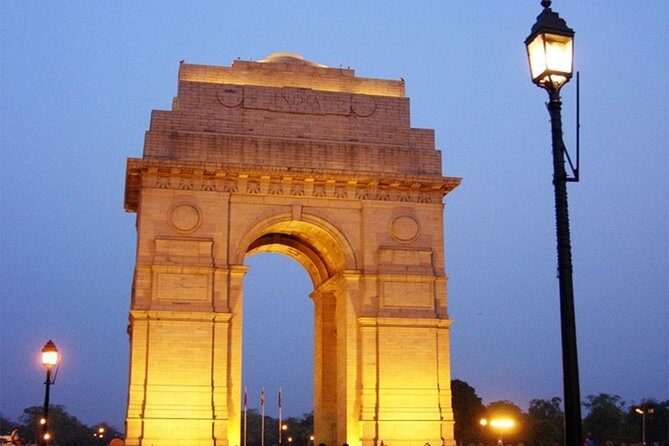
You finish with India Gate, the All India War Memorial designed by Sir Edwin Lutyens. It’s 42 meters tall and often compared to famous European arches. If you’re there around major holidays, the area can have extra atmosphere, but even on a normal day it feels ceremonial.
This stop is short (around 30 minutes). It’s more about getting your first visual anchor for Delhi’s big-city layout.
A few more New Delhi tours and experiences worth a look



Day 2: Old Delhi by rickshaw, Mughal landmarks, then the drive to Agra
Day 2 is where Delhi gets more street-level and historic. After breakfast and checkout, you pack in Jama Masjid, a Chandni Chowk rickshaw ride, the Red Fort area, and more landmarks, then you drive to Agra.
It’s an intense day in the best way—just know that you’re juggling multiple sites before you transition to a new city.
Jama Masjid
Jama Masjid sits in the older part of Delhi near Chandni Chowk. It took enormous effort to build—construction cost was huge for the time, and it was completed over 1650–1656. Even in a quick visit, it helps you understand how dominant Mughal architecture was in shaping Old Delhi.
Rickshaw ride in Chandni Chowk
This is one of the highlights because it’s not just watching monuments—it’s moving through the neighborhood that surrounds them. The rickshaw ride adds a local pace. It also turns the day from “touristic” to “I get a feel for the area.”
A practical consideration: the ride is short in tours like this, so keep your camera ready, but expect tight turns and slower stretches.
Red Fort
The Red Fort (Quila-e-Mubarak) anchors the Mughal-era skyline along the Yamuna. You’ll see it as part of Shahjahanabad, the medieval city core. The tour gives you around an hour here, which is enough to walk the main areas and appreciate the red sandstone design language.
Admission isn’t included, so factor that into your day’s total budget.
Humayun’s Tomb and Raj Ghat
You also visit Humayun’s Tomb, noted as the first garden-tomb in the Indian subcontinent, later recognized as UNESCO-listed. The construction uses red sandstone on a massive scale and mixes Mughal and Persian influences.
Then you stop at Raj Ghat, Gandhi’s memorial cenotaph, with a simple black marble structure in a garden setting. It’s brief, but it adds a completely different emotional tone to the day—less “empire architecture,” more modern memory.
Drive to Agra and check-in
After sightseeing, you head to Agra and check into your hotel. You get an overnight stay, which is exactly what you want after Taj-heavy day timing later.
Day 3: Taj Mahal, Agra Fort, and Fatehpur Sikri in one motion
Day 3 is the heavy-hitter day. You’ll see the Taj Mahal and Agra Fort, then continue onward to Fatehpur Sikri before driving to Jaipur.
Taj Mahal
The Taj Mahal is UNESCO-listed, built as a grand Persian-style monument, and laid out with a gateway approach and water channels and fountains near the entrance area. The tour gives you about two hours, which is a realistic amount to see the main layout, spend time looking at details, and still not feel like you’re watching it from a rope line only.
Admission isn’t included, so plan for it. The best use of your time here is not just snapping the exterior—give yourself moments to look at symmetry and the way the monument changes in different light.
Agra Fort
Next is Agra Fort, also a UNESCO-listed site. It was built by Emperor Akbar starting in 1573 and made of red sandstone. The fort once served as a Mughal residence, and it’s about 2.5 kilometers from the Taj.
You get around an hour, which works well because the Taj already filled your “awe” quota. Agra Fort shifts the vibe to power, walls, and the daily life of rulers.
Fatehpur Sikri
Then comes the longer detour: Fatehpur Sikri, around 40 km away from Agra. This is a red sandstone fortified city founded in 1571 and the capital of Akbar’s empire for 15 years. UNESCO recognizes it, and the complex includes places like Jodha Bai’s Palace, Jama Mosque, Buland Darwaza, and the Tomb of Salim Chisti.
The tour allows about two hours here. If you’ve only seen Fatehpur Sikri from afar, this is the time to appreciate it as an entire designed city rather than a single stop.
Drive to Jaipur and overnight stay
After Fatehpur Sikri, you drive to Jaipur and check in for the night. That means you’re moving through at least two big “wow” days—Agra and Fatehpur Sikri—before you even start Jaipur sightseeing on Day 4.
Day 4 Jaipur: Amber Fort, Hawa Mahal, Jal Mahal photo views, City Palace, Jantar Mantar
Day 4 focuses on Jaipur’s signature architecture and a couple of the city’s most famous landmark experiences. The day ends with a drive back to Delhi airport.
The itinerary notes Amber Fort as part of the Jaipur monuments, plus Hawa Mahal, Jal Mahal (photo stop), City Palace, and Jantar Mantar.
Hawa Mahal (Palace of Wind)
Hawa Mahal is built in 1799 by Maharaja Sawai Pratap Singh. It’s famous for its small windows that let cool air pass through—plus the idea behind it: royal women could observe street festivities without being seen from outside.
It’s a short stop (around 30 minutes), but it’s one of those places where the structure itself is the explanation.
Jal Mahal (photo stop)
You’ll visit Jal Mahal as a photo stop. The tour specifically mentions that entry inside the fort is prohibited, but the view from a distance while boating is enough to mesmerize people.
So go with a camera mindset. Don’t plan on “wandering inside.” This stop is about the postcard shot.
City Palace of Jaipur
The City Palace is a major complex in the old city, built by Maharaja Sawai Jai Singh in 1729–1732. It once occupied one-seventh of the walled city and functioned as the seat of Jaipur’s rulers.
You get around two hours. That’s enough to walk through key sections and understand why it’s considered one of Jaipur’s defining landmarks.
Jantar Mantar
Jantar Mantar is UNESCO-listed too. It has nineteen instruments built from stone and brass, designed for observing heavenly bodies with the naked eye. The building period is given as 1727–1733, and the tour emphasizes that the instruments are still functional in the way they were intended.
This stop adds a different angle: Jaipur isn’t only palaces. It’s also science in stone.
Back to Delhi
After Jaipur sightseeing, you drive to Delhi airport. Plan for a travel-weariness factor here—Day 4 is the last day, so you’ll want your energy for the final transfer.
Price and logistics: is $190 per person a good deal?
At $190 per person for roughly four days, the value mainly comes from the combo of comfort, time-savings, and people power. Here’s what you’re getting that would usually cost extra if you booked it separately:
- Private AC car with driver
- Hotel pickup & drop-off (and airport pickup noted)
- Live tour guide
- Water bottle
- Daily breakfast (when hotel option is selected)
- Mobile ticket is mentioned
- Accommodation is included only if you choose the option that adds it
What’s not included matters too: monument entrance fees and tips for driver and guide aren’t covered. Also, anything not explicitly mentioned stays out of the package.
So the real question is whether you’d rather pay for convenience. If you’re the type who hates changing transport plans mid-trip, this private format usually feels worth it fast. If you’re traveling ultra-budget and you’re comfortable organizing tickets and guides on your own, you might compare costs—but you’ll spend time, not just money.
The human factor: guides and drivers who keep the day on track
The most praised aspect that shows up again and again is the guide quality and the way the schedule gets managed. One name that repeatedly stands out is Mr Suraj Mani Sharma. When he’s involved, the vibe is organized and practical—he helps make sure each day runs smoothly, and he’s known for handling details like photo moments and overall flow.
Drivers are also part of the praise picture. The private car is described as new and clean, and the driver is credited with polite service and safe driving. One of the most useful real-world skills mentioned is flexibility with luggage, which is a big deal on a four-day, multi-city route. You don’t want to spend your downtime wrestling bags at hotels or between stops.
A balanced note: since it’s private and guided, tips matter. If you skip them, that’s between you and your budget philosophy—but the tour structure explicitly doesn’t include them.
What to budget for during the trip
Your tour price covers the transportation and guiding parts, but monuments require additional spending.
Expect to budget for:
- Monument entrance tickets (not included)
- Tips for driver and guide (not included)
- Any extra food and drinks beyond what’s included (the package only clearly mentions bottled water and daily breakfast)
Also, because some stops are religious sites (like the Lotus Temple and Jama Masjid), you might find restrictions on behavior or access areas. The tour doesn’t list rules, so go in with a flexible attitude and follow local signage and guidance.
Who should book this Delhi–Agra–Jaipur private tour
This is a smart fit if:
- You want a private experience without hopping between trains or public transport
- You appreciate guided historical commentary at each stop
- You want to cover the Golden Triangle without leaving big sights for later trips
- You’re traveling as a couple, family, or small group and want one vehicle and one plan
It may not be ideal if:
- You hate structured itineraries and want long, slow wandering time
- You’re comfortable skipping official guidance and organizing tickets yourself
- You want every day to feel light and unhurried
Should you book this Golden Triangle private tour?
If your priority is classic “first time” coverage—Taj Mahal plus Delhi and Jaipur’s signature landmarks—this tour is a strong value. The private car, pickup/drop-off, and live guide help you spend time seeing instead of coordinating.
I’d book it if you’re okay with a schedule that’s full, and you’re willing to pay monument entrance fees on top. If you want total freedom and low daily costs, you might consider a DIY route. But if you’d rather outsource the logistics to people who know the flow, this one makes it easy to get the most out of four days.
FAQ
What is the duration of this Delhi–Agra–Jaipur tour?
The tour runs for about 4 days. The itinerary is structured across Delhi, Agra, and Jaipur, with overnight stays in Agra and Jaipur.
How much does the tour cost, and is it per person?
The price shown is $190.00 per person.
What’s included in the price?
Included features are private AC car with driver, live tour guide, water bottle, hotel pickup & drop-off, and daily breakfast in the hotel (when the accommodation option is selected). A mobile ticket is also mentioned.
Are entrance fees included for the monuments?
No. Monuments entrance fees are not included, and you should plan on paying for tickets at the sights.
Do you get pickup and drop-off in New Delhi?
Yes. The tour includes airport, railway, or other New Delhi pickup and drop-off, and the hotel pickup/drop-off is part of the package.
Will I have a guide at the stops?
Yes. The tour includes a live tour guide, and the overview states that private guides provide historical commentary at each stop.
Is the tour private or shared?
This is a private tour/activity, and only your group participates.
How much notice do I need to cancel?
You can cancel up to 24 hours in advance for a full refund.
Is accommodation included automatically?
Accommodation is included only if the option is selected. Daily breakfast is provided in the hotel when accommodation is included.