REVIEW · NEW DELHI
One Day Delhi City Tour and One Day Taj Mahal Agra City Tour
Book on Viator →Operated by Bagga India Tour · Bookable on Viator
A morning in Delhi, then the Taj the next. This private 2-day tour is built for people who want major sights without fighting traffic, queues, and timing. I like the combo of Old Delhi landmarks plus Mughal-era icons, and I especially like that you get a private guide with context rather than just a checklist. One thing to watch: at this pace, you’ll spend a lot of time on the road and you’ll need to plan around optional monument entrance fees if you choose the non-inclusive option.
Day 1 starts at 9:00am with hotel pickup and heads into Old Delhi’s big hitters, then crosses to Delhi’s grand monuments and viewpoints. I also like the little practical touches—air-conditioned rides and complimentary bottled water—so the day doesn’t feel like a heat-fogged sprint. The one drawback to keep in mind is that Taj Mahal is closed every Friday, so your dates matter.
If you’ve ever worried that Delhi and Agra are too spread out to do well in a short window, this tour is aimed at solving that exact problem: organized transport, a clear route, and a guide who helps you understand what you’re looking at. Reviews for guides named GG and Gigi highlight that they’re professional, kind, and good at connecting the dots between places.
In This Review
- Key things to know before you go
- How this Delhi and Agra tour actually feels in real life
- Day 1 in Delhi: from Old Delhi landmarks to Mughal monuments
- Jama Masjid: scale first, then details
- Chandni Chowk by market rhythm (and what to watch for)
- Red Fort: a quick look with a lot of outside impact
- Gurudwara Bangla Sahib: a calm pause and lunch break
- Humayun’s Tomb: Mughal symmetry you can feel
- Lotus Temple: modern faith with a simple shape
- Qutub Minar: UNESCO status you can see instantly
- India Gate and Rashtrapati Bhawan: memorial and power center
- Day 2 in Agra: Taj Mahal, then the forts and the quieter tomb
- Taj Mahal: 3 hours that are really about your pacing
- Agra Fort: from love story to empire drama
- Itmad-ud-Daula: the so-called Baby Taj
- Price, ticket options, and what you may pay extra
- Guides GG and Gigi: why the human touch matters here
- Who this tour fits best (and who should consider another option)
- Should you book this Delhi and Agra city tour?
- FAQ
- How long is the Delhi and Agra tour?
- What time does pickup happen on Day 1 and Day 2?
- Is transportation included?
- Are monument entrance fees included?
- Does the tour visit the Taj Mahal?
- Is Taj Mahal open every day?
Key things to know before you go

- Hotel pickup and drop-off take the stress out of getting started and ending the day
- Private air-conditioned car makes the long drives more bearable
- Cycle rickshaw ride in Old Delhi helps you experience the streets in a slower, more local way
- Private guide commentary adds meaning to the UNESCO sites and Mughal architecture
- Entrance fees depend on your option, so confirm which ticket package you chose
- Taj Mahal closure Fridays can change your best-laid plans
How this Delhi and Agra tour actually feels in real life
This is a private, door-to-door format, meaning you’re not stuck joining random groups or waiting for someone who’s late. Your days are structured, but the tour still feels flexible because a personal guide can pace you—especially when you’re standing in places where people naturally want time to look up, not just look at photos.
The biggest practical advantage is the simple one: transport. Delhi traffic is real, and Agra adds another layer of time and logistics. With your own car and a driver, you spend energy on the monuments, not on directions, parking, or bargaining with transport every time you change locations.
At $16 per person, it’s also worth thinking about value carefully. The price is hard to compare without seeing what exact inclusions you selected, but the tour clearly covers major components like the private car, English-speaking driver, mineral water, and guide support. What can shift the total is lunch and any monument entrance fees if you pick the option that doesn’t include them.
You can also read our reviews of more city tours in New Delhi



Day 1 in Delhi: from Old Delhi landmarks to Mughal monuments
Your Day 1 begins with pickup from your hotel at 9:00am, with the tour starting in Old Delhi. This timing matters because Old Delhi’s main sights are easier when you’re not starting mid-day, and it gives you a full day of sightseeing before the evening drop-off.
Jama Masjid: scale first, then details
The morning opener is Jama Masjid, a large 17th-century Friday Mosque and listed as a UNESCO World Heritage Site. You’re there for about one hour, which is a good length of time if you want to notice both the big overall structure and the smaller elements that make it feel lived-in rather than museum-like.
If you’re used to modern churches and temples, this is a different vibe: it’s not just a photo stop. It’s an active place of worship, so it helps to follow signage and stay respectful with dress and behavior.
Chandni Chowk by market rhythm (and what to watch for)
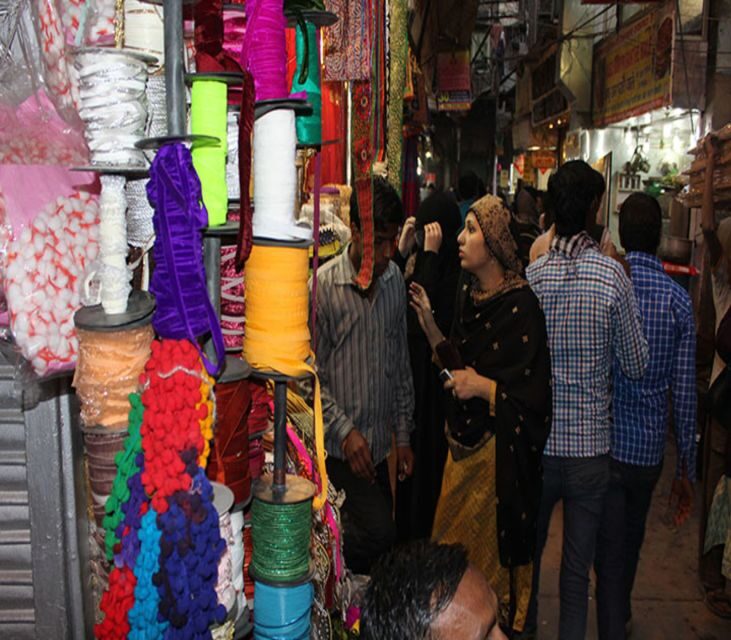
Next comes Chandni Chowk, framed as a major 17th-century market for everyday goods. Your stop is about 30 minutes, and admission is free. Short market stops can be fun because you get variety fast, but 30 minutes also means you’ll have to choose what you actually want—snacks, textiles, spices, or just the street atmosphere.
This is where the included cycle rickshaw ride in Old Delhi becomes more than a gimmick. Even if you only get brief exposure, it helps you experience the street flow without losing your entire day to walking.
Red Fort: a quick look with a lot of outside impact
Then you’ll roll to Red Fort, built between 1639 and 1648, with an impressive 2 km long wall that’s striking from the outside. Your time here is short—about 15 minutes—and admission is free for this stop in the way the tour is described.
A quick stop can feel rushed if you want to explore interior spaces, but it still works if your guide uses the time to explain why the fort mattered and what you’re seeing from the gates and surrounding walls.
A few more New Delhi tours and experiences worth a look






Gurudwara Bangla Sahib: a calm pause and lunch break
After the fort, the tour moves to Gurudwara Bangla Sahib, a prominent Sikh place of worship. You’ll have about one hour here, with admission included. Afterward, you eat lunch.
Keep in mind that lunch is listed as not included, so treat this as a built-in break in your schedule rather than a guaranteed meal cost covered by the tour. It’s still valuable because it prevents the common tourist problem of wandering hungry and then paying more later for a rushed lunch.
Humayun’s Tomb: Mughal symmetry you can feel
Post-lunch, you head to Humayun’s Tomb, the Mughal Emperor Humayun’s tomb, with about one hour on site and admission included. This is where you start noticing how Mughal architecture works at a human scale—how symmetry guides your eye across walkways and domes.
Even if you only know the broad idea of Mughal rule, your guide can make the site click: what it was meant to communicate and why so many later buildings echoed similar design language.
Lotus Temple: modern faith with a simple shape
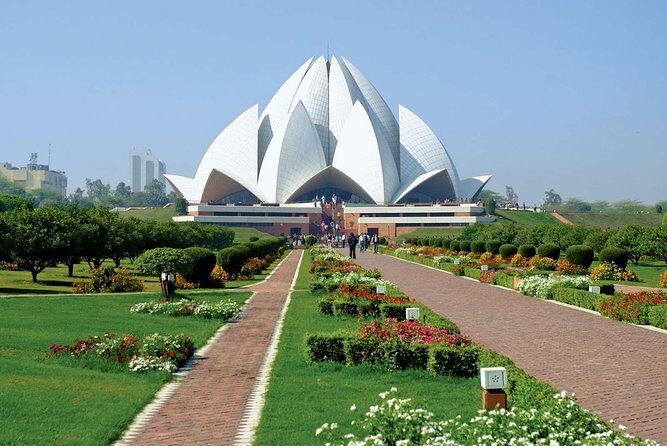
Next is Lotus Temple, dedicated in December 1986, known for its lotus-flower design. You get about one hour, and admission is included.
This stop gives you a contrast from the older Mughal and medieval structures. It’s not there just to add a pretty silhouette to your photos; it’s a chance to see how religious spaces in Delhi aren’t stuck in one era.
Qutub Minar: UNESCO status you can see instantly
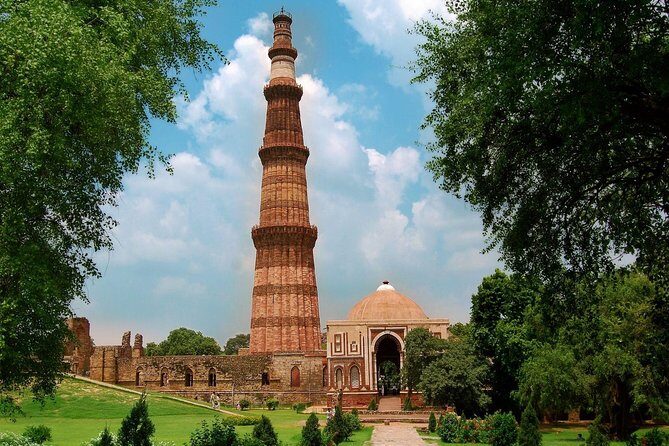
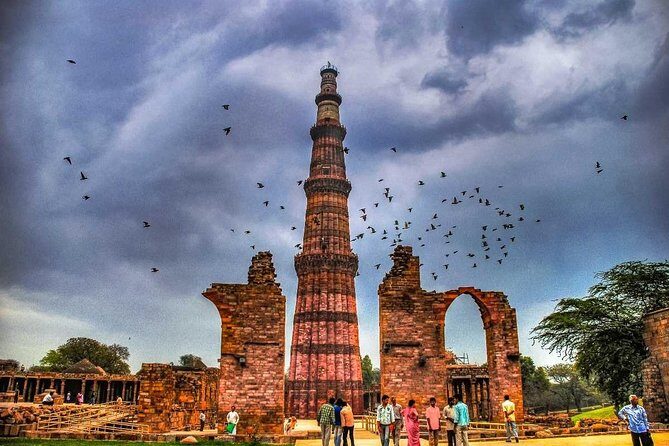
Then comes Qutub Minar, described as Delhi’s tallest minar and a UNESCO World Heritage Site, built in 1192. You’ll spend around one hour here with admission included.
This is one of those places where height does a lot of the storytelling. Even if you don’t spend a long time inside any specific area, the structure itself is hard to forget.
India Gate and Rashtrapati Bhawan: memorial and power center
Later, you stop at India Gate, where the names of 13,300 Indian Army servicemen are carved on the wall who died during World War I. Time here is 10 minutes, with admission free.
Finally, you’ll see Rashtrapati Bhawan, the grand seat described as 330 acres of architecture constructed by Sir Edwin Lutyens and Herbert Baker in 1929. It’s another short 10-minute stop with admission free. This isn’t about deep exploration; it’s about getting oriented to the city’s official center.
At the end, your driver drops you back at your hotel in Delhi for an overnight stay.
Day 2 in Agra: Taj Mahal, then the forts and the quieter tomb

Day 2 starts early. Your driver picks you up at 7:00am, and you drive to Agra, arriving around 10:00am. The schedule is designed so you hit the Taj Mahal before the day fully bakes.
Taj Mahal: 3 hours that are really about your pacing
The headline is Taj Mahal, with about 3 hours on site and admission included. It’s described as the world-famous monument of love, and that reputation is exactly why you’ll want a guide here. The guide’s job is to help you notice the building beyond the obvious postcard view.
Also, check your day. The tour data notes that Taj Mahal will be closed every Friday, so if your trip lands on a Friday, your plan may need adjustment.
Agra Fort: from love story to empire drama
After the Taj, you move to Agra Fort, with about one hour and admission included. This fort is described as Agra’s red fort, and it’s tied to Mughal power—your tour includes the detail that Mughal Emperor Humayun was crowned there.
This is a nice change of pace because it shifts the emotional tone. Taj Mahal gives you romance and perfection; Agra Fort gives you politics and control.
Lunch happens after Agra Fort, but again, lunch is not listed as included—so treat it as a break rather than a meal package.
Itmad-ud-Daula: the so-called Baby Taj
The final stop is Itmad-ud-Daula, often described as the “Jewel Box” and sometimes nicknamed the Baby Taj. You’ll spend about 30 minutes, with admission included.
This short stop is ideal if you want one more taste of Mughal artistry without turning the day into a marathon. It’s also a smart way to end: by the time you reach this tomb, you’ve already trained your eye on Taj Mahal’s major design elements.
Then you drive back to Delhi, where your driver drops you at your hotel, the airport, or another location in Delhi.
Price, ticket options, and what you may pay extra
The tour is priced at $16 per person and runs for about 2 days (with an overnight in Delhi). On paper, that’s a strong value if what you want is simple: pickup, private transport, a guide, and a tight schedule across Delhi and Agra.
But your final cost depends on which ticket option you select. The tour mentions an upgrade to include admission tickets to the Taj Mahal, Humayun’s Tomb, and other sites along the way. It also notes that monument entry fees are not included in the option without monument entrance fees.
So here’s the practical way to think about it:
- If you want one less thing to manage, choose the option where entrance fees are included.
- If you’re trying to keep costs down, be clear about which admissions are covered and which are not.
Also note that lunch and dinner are not included, and tips for the driver and tour guide are not included. That matters because in India, tips are part of how good service gets recognized.
Guides GG and Gigi: why the human touch matters here
The reviews highlight a consistent theme: the guide experience is the difference between seeing monuments and actually understanding them. Guides named GG and Gigi are described as professional, kind, and focused on making people comfortable. One review also emphasized that in a short timeframe, they managed to fit in tons of places while keeping the experience smooth.
In places like Jama Masjid, Humayun’s Tomb, and Qutub Minar, it’s easy to get stuck in “big building, pretty view” mode. A good guide helps you connect architectural details to what those sites were built to do. That’s the value you feel most, especially when you’re moving fast and can’t linger everywhere.
Who this tour fits best (and who should consider another option)
This is a great fit if:
- you want a private experience with hotel pickup and drop-off
- you don’t want to plan your own transport across Delhi and Agra
- you like having a guide explain what you’re seeing as you go
- you want a doable way to cover major UNESCO-listed stops and the Taj Mahal in limited time
It may be less ideal if:
- you prefer slow travel and long stays at each monument
- you hate driving days or early mornings
- you’re on a tight schedule for Friday travel because Taj Mahal closure can affect timing
Should you book this Delhi and Agra city tour?
I’d book this tour if your priority is hitting the big monuments efficiently, with private transport and a guide who helps the sights make sense. The combination of Old Delhi energy with Mughal-era landmarks, then the Taj Mahal the next day, is exactly the kind of short-trip structure that works when you want real results without logistics headaches.
Before you confirm, do two quick checks:
1) Make sure you’ve chosen the entrance-fee package you want, since monument admissions can be included or not depending on the option.
2) Confirm your dates don’t land on a Friday, since Taj Mahal is closed every Friday in this tour’s notes.
If those points line up, this tour looks like a solid value for a first-time or time-limited Delhi + Agra visit, especially because the guide quality comes through clearly in the feedback.
FAQ
How long is the Delhi and Agra tour?
It runs for about 2 days, with a full Day 1 in Delhi and a Day 2 trip to Agra, including the Taj Mahal and other stops.
What time does pickup happen on Day 1 and Day 2?
On Day 1, pickup is at 9:00am from your hotel. On Day 2, pickup is at 7:00am from your hotel.
Is transportation included?
Yes. You get an air-conditioned private car each day, plus airport/hotel pickup and drop-off.
Are monument entrance fees included?
They depend on the option you select. The tour notes an upgrade that includes admission tickets, while it also mentions monument entry fees are not included in the without-monuments-entrance-fees option.
Does the tour visit the Taj Mahal?
Yes, on Day 2 you visit the Taj Mahal for about 3 hours, and admission is included in the described itinerary for that stop.
Is Taj Mahal open every day?
No. The tour states that Taj Mahal will be closed every Friday.