REVIEW · NEW DELHI
4 Days Golden Triangle Tour | 1N Delhi, 1N Agra, 1N Jaipur
Book on Viator →Operated by The Majestic Agra Tours and Sightseeing · Bookable on Viator
This Golden Triangle is fast and focused. You’ll roll through Delhi, Agra, and Jaipur with a private vehicle and local guide, plus hotel/port pickup and drop-off, so you spend less time figuring things out.
I like the way the pacing is built around major Mughal-era landmarks, from Humayun’s Tomb and Qutub Minar to the Taj Mahal and Amber Fort. I also like the built-in mix of paid and free stops, which helps you control costs.
One heads-up: monument entrance charges and food and drinks are not included, and the days are packed with a lot of seeing. The route still works well because you’re traveling as one group and not bouncing between random tickets and schedules.
In This Review
- Quick reasons this Golden Triangle tour works
- Value and pace: why four days feels just right
- Price and logistics: what you’re paying for (and what you still need to budget)
- Day 1 in Delhi: Humayun’s Tomb, Qutub Minar, and the Mughal skyline
- Humayun’s Tomb: the Mughal masterpiece you should not skip
- Qutub Minar: a landmark tower with real scale
- India Gate, Rashtrapati Bhavan, and Sansad Bhavan: sight stops with meaning
- Jama Masjid and the Gandhi memorial pause
- Chandni Chowk’s Pasar: spices and wholesale chaos, controlled
- Lotus Temple: free, calm, and easy to slot in
- Day 2 in Agra: Itimad-ud-Daulah and the sunset Taj angle at Mehtab Bagh
- Itimad-ud-Daulah: the Baby Taj that earns its nickname
- Mehtab Bagh: a different view of the Taj Mahal
- Day 3: Taj Mahal and Agra Fort without losing your day
- Taj Mahal: more than one look, even in the same day
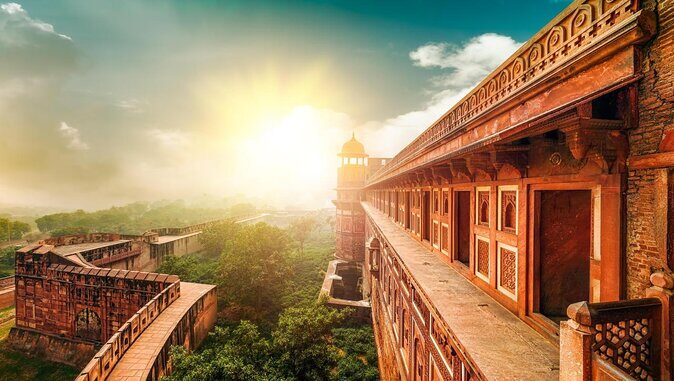
- Agra Fort: the imperial residence piece
- Day 4 in Jaipur: Amber Palace, City Palace, Jantar Mantar, and the Palace of Winds
- Amber Palace: the romantic fort palace with mixed styles
- City Palace: a big complex with multiple layers
- Jantar Mantar: oversized instruments that still work
- Palace of Winds: 953 niches and a dramatic facade
- Jal Mahal: the Water Palace on the lake
- What the guides and driver add to the experience
- Ticket strategy: plan for entrance fees without wrecking your budget
- How this tour fits different travel styles
- Should you book this 4-Day Golden Triangle Tour?
- FAQ
- What is included in the tour price?
- Are monument entrance charges included?
- What’s not included in the tour?
- How long is the tour and which cities are covered?
- Is this tour private or shared?
- What are the pickup times for the experience?
- Can I cancel for a full refund?
Quick reasons this Golden Triangle tour works
- Private vehicle with driver keeps the day moving, especially between cities and between sites.
- Local guides in each area help you read what you’re seeing instead of just taking photos.
- Strategic Taj timing includes Mehtab Bagh in the evening for a viewpoint from the other side of the river.
- Daily breakfast + hotel means you’re not planning lodging and morning meals on top of sightseeing.
- Sagar and the team stay easy to reach, and names like Sagar Arora, drivers Brijesh Ji and Bintu, and guide Akil in Agra come up in how people describe the service.
- Some stops are free like Raj Ghat and Lotus Temple, so not every hour costs extra.
Value and pace: why four days feels just right

The Golden Triangle is popular for a reason: in a short time, you cover three cities that define a big slice of India’s imperial architecture. What makes this 4-day version smart is that it’s arranged as one smooth circuit rather than a grab-bag of unrelated sights.
I also like that the tour is private. You’re not sharing your guide’s attention with a dozen strangers, and you can move at the group’s real pace when crowds or traffic get spicy.
Finally, you get daily breakfast and hotel included. That’s not a small detail. When you’re doing landmark after landmark, breakfast you don’t have to hunt for is real trip value.
A few more New Delhi tours and experiences worth a look

Price and logistics: what you’re paying for (and what you still need to budget)
The price is $192.69 per person for a tour that runs about four days across Delhi, Agra, and Jaipur. For many visitors, the best value here is the combination of private transport, a local guide, and included accommodation with daily breakfast.
What you should plan for separately:
- Monument entrance charges are not included for most of the headline sites.
- Food and drinks are not included.
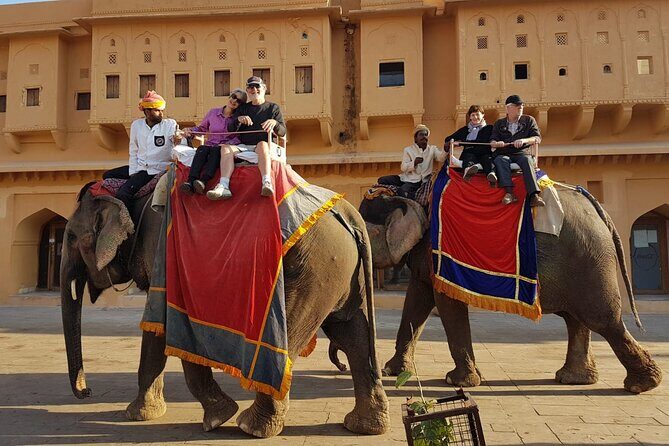
- Elephant ride at Amer Fort, Jaipur is not included.
That last point matters because Amer Fort/Amber Fort is one of those places where extra-cost activities are often offered nearby. You can still enjoy Amber Palace without it, but you won’t be paying for an elephant ride as part of the standard plan.
Day 1 in Delhi: Humayun’s Tomb, Qutub Minar, and the Mughal skyline
Delhi on day one sets the tone: Mughal architecture, big monuments, and lots of iconic landmarks clustered close enough to keep the day efficient.
Humayun’s Tomb: the Mughal masterpiece you should not skip
Humayun’s Tomb is one of the most important Mughal-era memorials in Delhi, commissioned in 1569–70 by Empress Bega Begum. You’ll have a guided look around it for about an hour, and it’s a great “Mughal intro” before you hit even bigger names later.
What I like here is the context. A good guide helps you see how these funerary buildings were designed to project power and to shape how people imagined the afterlife.
Qutub Minar: a landmark tower with real scale
Next comes Qutub Minar, part of the Qutb complex and a UNESCO World Heritage Site. The tower is 73 meters tall with five storeys, and the taper from a wide base to a narrow top makes it feel even more dramatic in person.
This stop is about an hour and works well after Humayun’s Tomb. It’s like switching from a mausoleum mindset to a monument-in-the-landscape mindset, except the “landscape” here is the city itself.





India Gate, Rashtrapati Bhavan, and Sansad Bhavan: sight stops with meaning
You’ll also pass by India Gate, the war memorial at Rajpath, and see the Rashtrapati Bhavan (the President’s official home) and Sansad Bhavan (India’s Parliament building). These aren’t long stays, but they give you quick orientation for how modern Delhi fits over older layers.
Jama Masjid and the Gandhi memorial pause
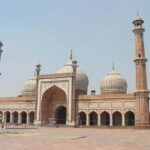
Jama Masjid is one of the largest mosques in India, built by Shah Jahan between 1650 and 1656. You’ll spend about 30 minutes here, and it’s worth treating as a stop for scale and atmosphere, not just architecture snapshots.
Then it’s on to Raj Ghat, the memorial dedicated to Mahatma Gandhi, where the admission is free and you have around an hour. This pause is useful. After a heavy architecture day, it’s grounding to step back into the human story of modern India.
Chandni Chowk’s Pasar: spices and wholesale chaos, controlled
Chandni Chowk’s Pasar Chandni Chowk is famous for wholesale groceries and what’s described as Asia’s largest wholesale spice market. You’ll have about 30 minutes here.
I’ll be honest: this is a place where you’ll want a plan for your energy. If you hate crowded shopping areas, keep it short and focused. If you enjoy food markets, this stop is a fast education in ingredients and trade.
Lotus Temple: free, calm, and easy to slot in
Day one ends with the Lotus Temple, a Bahá’í House of Worship dedicated in December 1986. It’s free and you get about an hour.
What I like is the contrast. You go from intense stone monuments to something that feels more open and quieter, without requiring extra tickets.
Day 2 in Agra: Itimad-ud-Daulah and the sunset Taj angle at Mehtab Bagh
Agra is where the tour turns from “recognizing styles” to “seeing the legend.” Day two sets up the Taj Mahal day with two important stops.
Itimad-ud-Daulah: the Baby Taj that earns its nickname
You’ll visit the Tomb of Itimad-ud-Daulah, often called the Baby Taj and described as a jewel box. It’s only about 30 minutes, but that’s enough time to notice the delicate, intricate design language that foreshadows the Taj’s look.
If you tend to rush big sights, this is a good day-two correction. It’s smaller, but it rewards attention.
Mehtab Bagh: a different view of the Taj Mahal
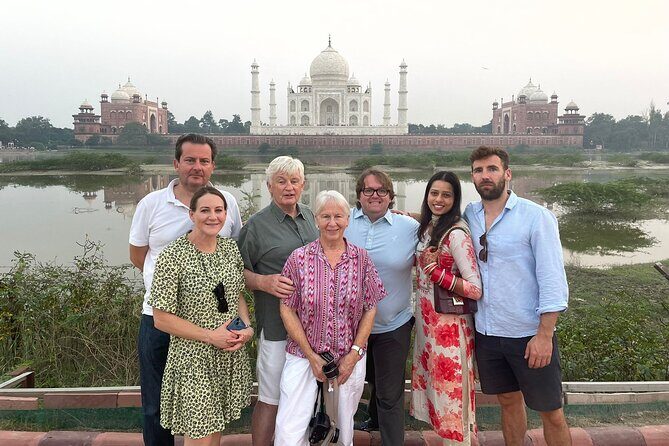
In the evening, you’ll go to Mehtab Bagh for about an hour to view the Taj Mahal from across the river. This is the back-side viewpoint angle, with the sun lowering as the view changes.
This stop can be one of the best “timing wins” in the whole trip. You’re not just seeing the Taj; you’re seeing how light and distance alter the experience.
Day 3: Taj Mahal and Agra Fort without losing your day
Day three is the headline day: Taj Mahal first, then Agra Fort.
Taj Mahal: more than one look, even in the same day
You’ll spend about two hours at the Taj Mahal. It’s described as an ivory-white marble mausoleum on the south bank of the Yamuna river, commissioned in 1632 by Shah Jahan for Mumtaz Mahal.
The key idea to remember is that the Taj looks different across the day. Even without trying to chase perfection, you’ll notice shifts in tone as light changes. Two hours gives you enough time to experience that rather than just walking through once.
Agra Fort: the imperial residence piece
After the Taj, you head to Agra Fort for about 1.5 hours. This fort was the main residence of the Mughal emperors until 1638, when the capital shifted to Delhi.
This is a good follow-up because it connects the mausoleum you just saw to the power center behind it. The Taj is the memory. The fort is the machinery.
Day 4 in Jaipur: Amber Palace, City Palace, Jantar Mantar, and the Palace of Winds
Jaipur day is where Mughal meets Rajasthan. The forts and palaces here feel more theatrical, and the city’s geometry becomes part of the story.
Amber Palace: the romantic fort palace with mixed styles
Amber Palace (Amer Fort area) is a classic fort palace experience. Construction started under Man Singh I in 1592 and was completed by Jai Singh I.
You’ll have about two hours here. This is also where some people expect an elephant ride, but the tour explicitly does not include it, so you can focus on the palace itself.
The exterior can feel forbidding, and the interior spaces feel like a different world. That contrast is one reason this stop is so popular.
City Palace: a big complex with multiple layers
Next is the City Palace of Jaipur, which covers over one-seventh of the walled city. You’ll get about two hours and you’ll see highlights like the Chandra Mahal, Shri Govind Dev Temple, and the City Palace Museum.
This is a stop for people who like more than one room’s worth of details. It’s also a good place to slow down, because “two hours” is enough time to actually look.
Jantar Mantar: oversized instruments that still work
Then comes Jantar Mantar, described as the largest and best preserved of five observatories built by Jai Singh II. The stop is about one hour, and the instruments are outsized astronomical tools that are still in use.
I love this kind of sight because it doesn’t just tell a story. It shows a method. Even if you don’t geek out on astronomy, you’ll understand that this place was built for measurement and observation.
Palace of Winds: 953 niches and a dramatic facade
You’ll also stop for the ornamental facade of the Palace of Winds, a five-storey sandstone-plastered pink structure with fine trelliswork and balconies. It’s described as having 953 niches and windows and being built in 1799 by Pratap Singh, used as a royal grandstand for palace women.
This is a great photo stop, but it’s also worth taking a moment to think about design for privacy, movement, and viewlines. The architecture is doing a job beyond looks.
Jal Mahal: the Water Palace on the lake
Finally, you’ll see Jal Mahal, the Water Palace in the middle of Man Sagar Lake. The palace and the lake area were renovated and enlarged in the 18th century by Maharaja Jai Singh II of Amber.
This is a quieter closer. It doesn’t try to compete with the fort-palace intensity. It gives your eyes a break before you wrap up the circuit.
What the guides and driver add to the experience
A private tour lives or dies by how well it’s managed on the ground. The names that come up in how people describe the experience include Sagar Arora coordinating the trip, drivers like Brijesh Ji, Bintu, and Virendra, and guides like Akil in Agra, plus Prateek and Hersh.
Even if you’re not chasing names, you should care about the practical effects:
- You get pickup and drop-off handled for your hotel/port.
- You get local guide interpretation, which matters at sites like Humayun’s Tomb, where details shape meaning.
- Your driver helps manage the between-sight time so you actually see what you came for.
Ticket strategy: plan for entrance fees without wrecking your budget
Because monument entrance charges are not included, your financial planning should be simple but honest. The Taj Mahal is an obvious example of a paid entry site in most setups, and many other major stops in this route are flagged as not included.
A smarter approach is to:
- Expect to pay at multiple monuments during the trip.
- Prioritize paid sites for the hours you have.
- Let the free stops like Raj Ghat and Lotus Temple act as cost-friendly breaks.
This way, you’re not surprised mid-day, and you can keep your schedule moving.
How this tour fits different travel styles
This is a strong choice if you want:
- A first-time India introduction that focuses tightly on the biggest icons.
- A comfortable pace where you don’t handle inter-city logistics yourself.
- A guided experience that can explain why these buildings look the way they do.
It’s also a good fit for families and small groups, especially if you want someone else handling the transport and timing. If you prefer wandering independently without a set route, you may find the day-by-day schedule a bit structured.
Should you book this 4-Day Golden Triangle Tour?
I’d book it if you want maximum “see the classics” time with private transport, local guides, and hotel with breakfast already handled. It’s a practical way to cover Delhi, Agra, and Jaipur without turning your vacation into a logistics project.
I would hesitate if you dislike paying entrance fees on top of the tour price, or if you want long free time to wander without a plan. Since food and monument tickets are extra, your ideal trip is one where you’re okay budgeting for meals and entries so the schedule can run as intended.
FAQ
What is included in the tour price?
The package includes a private vehicle with driver, a private tour guide (local guide), hotel/port pickup and drop-off, all fees and taxes, accommodation with daily breakfast, and a mobile ticket.
Are monument entrance charges included?
No. Monument entrance charges are not included for the sites marked as admission not included in the schedule.
What’s not included in the tour?
Food and drinks are not included, monument entrance charges are not included, and the elephant ride at Amer Fort, Jaipur is not included.
How long is the tour and which cities are covered?
It’s approximately 4 days and covers 1 night in Delhi, 1 night in Agra, and 1 night in Jaipur, for a Golden Triangle route.
Is this tour private or shared?
This is a private tour/activity, meaning only your group participates.
What are the pickup times for the experience?
The operating window listed is Monday to Sunday, from 7:30 AM to 2:00 PM.
Can I cancel for a full refund?
Yes. You can cancel for free up to 24 hours in advance of the experience start time for a full refund. If you cancel less than 24 hours before, the amount paid is not refunded.