REVIEW · NEW DELHI
Golden Triangle Tour 3 Days
Book on Viator →Operated by Holiday Journey India - Tours & Activities · Bookable on Viator
One tour, three iconic cities. This Golden Triangle route packs UNESCO sights and major Mughal and Rajput landmarks into a tight, practical loop that’s easy to navigate. I especially like that the plan is built around the big wow moments, starting in Delhi and ending with Jaipur’s famous forts and palaces.
Two things I’d point you to right away: the included air-conditioned private vehicle with hotel pickup/drop-off, and the fact that an English-speaking guide handles the explanations for you. That combination turns “I’ll just show up” into “I’ll actually understand what I’m looking at,” without you needing to build an itinerary yourself.
One consideration: most monument admission fees are not included, and that can add up fast once you’re in each city. Also, a few key sites follow strict closure days, so your exact travel dates matter.
In This Review
- Key highlights at a glance
- Golden Triangle in 3 Days: What the Tight Schedule Really Means
- Day 1 in Delhi: Humayun’s Tomb to Parliament House
- Humayun’s Tomb: The Mughal tone-setter
- Qutub Minar: A towering landmark you can measure in your head
- Red Fort: Where empire meets museums
- Lotus Temple: Calm modern architecture in a busy day
- Jama Masjid: A huge mosque stop with real presence
- Raj Ghat: Gandhi memorial, brief but meaningful
- Parliament House: A civic bookend
- Evening transfer: Delhi to Agra on Yamuna Expressway
- Drive to Agra: Using the 3.5 Hours Wisely
- Day 2 in Agra: Taj Mahal Sunrise and Agra Fort Right After
- Taj Mahal interior timing
- Agra Fort: The follow-up that makes Taj Mahal make more sense
- Fatehpur Sikri add-on if you have time
- Day 2 to Day 3: Jaipur Check-In and the Big Visual Day
- Day 3 in Jaipur: Amber Palace, Jal Mahal Photos, City Palace, and Hawa Mahal
- Amber Palace: A fort-palace you can feel
- Jal Mahal: One hour for a lake-and-palace photo moment
- City Palace of Jaipur: Where royal life and today’s museum overlap
- Hawa Mahal: Palace of Wind for a classic Jaipur facade
- Back to Delhi: end-of-tour drop-offs
- Price and Value: What $266.67 Covers and What You Still Pay For
- Hotel, Pickup, and Room Sharing: Smooth Logistics With One Real Caveat
- Best Fit: Who This Golden Triangle Tour Works For
- Should You Book This Golden Triangle 3-Day Tour?
- FAQ
- What time does the tour start?
- Which cities are included in the 3-day tour?
- Is pickup from my hotel included?
- Are monument admission fees included?
- Are there any closure days for major attractions?
- How are hotel rooms handled?
- What is the cancellation policy?
Key highlights at a glance
- Delhi in one day: Humayun’s Tomb, Qutub Minar, Red Fort, Lotus Temple, Jama Masjid, plus Raj Ghat and Parliament House stops
- Taj Mahal morning visit built into the schedule, including about two hours inside with your guide
- Agra Fort pairing after the Taj visit, which helps you connect Mughal power beyond one monument
- Jaipur highlights without wasting time: Amber Palace, Jal Mahal photo stop, City Palace, and Hawa Mahal
- Private tour for your group with hotel pickup/drop-off, water bottle, parking fees, and fuel covered
Golden Triangle in 3 Days: What the Tight Schedule Really Means
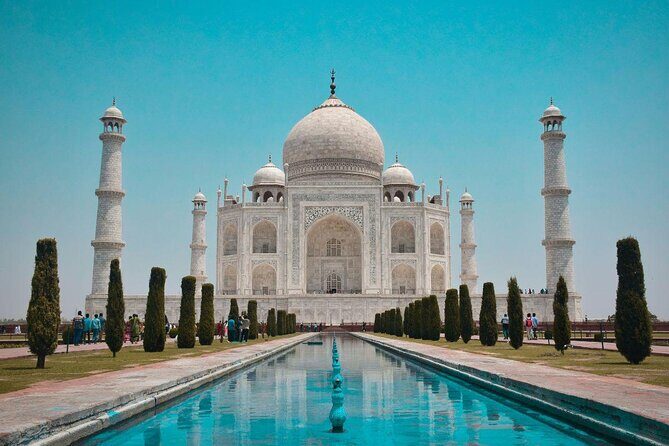
This 3-day loop is the classic Golden Triangle formula: Delhi → Agra → Jaipur. The upside is obvious: you see the big hitters without having to figure out trains, transfers, or how long everything takes. The downside is equally real: you’re moving each day, so you’ll want to keep your expectations matched to a sightseeing sprint.
What helps you enjoy it is the structure. Your day starts with set monuments, you have an experienced English-speaking guide working through the story of each site, and you’re in a private vehicle between cities. Instead of bouncing between ticket lines, buses, and confusing directions, you mostly focus on the places themselves.
For value, the tour’s best feature is what it removes from your mental workload. When transportation and guide are handled, you spend your energy on timing, photos, and absorbing what you’re seeing. Just remember that “included” stops and “free” stops are not the same thing. Many admissions are marked as not included, so plan for that extra spend.
A few more New Delhi tours and experiences worth a look



Day 1 in Delhi: Humayun’s Tomb to Parliament House
Day 1 is a full Delhi sweep that moves from Mughal-era masterpieces to major religious and civic landmarks. It’s ambitious, but it works because the stops are varied. You’ll go from carefully designed tomb architecture to towering minaret geometry, then into Old Delhi’s giant mosque atmosphere, and finally into memorial and government landmarks.
Humayun’s Tomb: The Mughal tone-setter
Humayun’s Tomb is the tomb of Emperor Humayun, commissioned by his first wife and chief consort, Empress Bega Begum, around 1569–70. The design was handled by Persian architects Mirak Mirza Ghiyas and his son Sayyid Muhammad. You’re looking at Mughal ambition and Persian design influence in one place.
This stop is also a good mental warm-up for the rest of the trip. When you later visit the Taj Mahal, you’ll notice how these earlier Mughal forms set up the later grandeur.
Practical note: admission isn’t included here, so budget for the ticket when you get there.
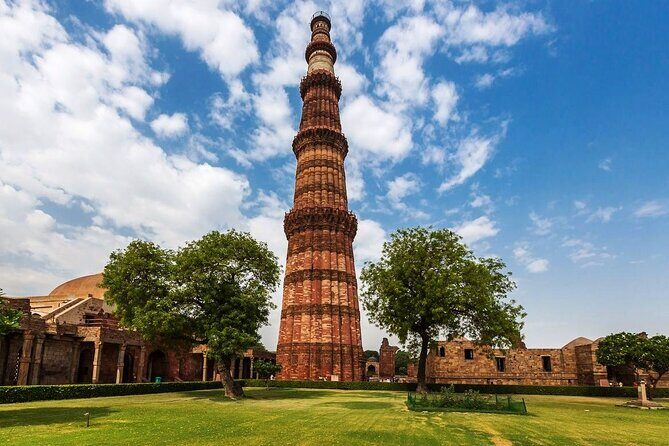
Qutub Minar: A towering landmark you can measure in your head
Qutub Minar is part of the Qutb complex, a UNESCO World Heritage Site. It’s a 73-metre tall tapering minaret with five storeys. That “tapering tower” detail matters because it affects how it looks up close. Your guide will help you understand why it’s such an iconic piece of the Qutb complex.
You get about an hour here, which is usually enough to take in the structure without rushing.
Again: admission ticket is not included.
Red Fort: Where empire meets museums
Red Fort served as the main residence for the Mughal emperors for nearly 200 years, until 1856. Today it houses museums, and it sits centrally in Delhi. This stop is one of the most important political-sounding monuments on your day, because it’s tied to how the empire governed and lived.
Budget time for the fort feel. Even if you don’t go deep into museums, you can still appreciate scale and the sense of a fortified capital.
Date warning: Red Fort remains closed every Monday.





Lotus Temple: Calm modern architecture in a busy day
Lotus Temple is a Bahá’í House of Worship dedicated in December 1986. It’s open to people of all religions, which makes it a refreshing stop after more empire-focused sites. The lotus-flower shape is the headline, but the key value is how it changes the mood of the day.
You get about an hour, and that’s enough to slow down and take a breath.
Practical note: admission ticket isn’t included.
Jama Masjid: A huge mosque stop with real presence
Jama Masjid, also known as Masjid e Jahan Numa, is one of the largest mosques in India. The size and atmosphere are the point here. This isn’t a quick “photo only” stop if you can help it. Even with limited time, being in a place that large gives you a better understanding of the scale of religious life in Delhi.
You get about an hour here. Admission isn’t included.
Date warning: Lotus Temple and Red Fort are closed every Monday, so if you’re traveling Monday, your Delhi rhythm changes.
Raj Ghat: Gandhi memorial, brief but meaningful
Raj Ghat is a memorial dedicated to Mahatma Gandhi. It started as the name of a historic ghat of Old Delhi. Your stop is extremely short—about one minute—so think of it as a moment of pause rather than a long visit.
Even when you don’t plan a long stop, this is a nice reset between major monuments and government landmarks.
Parliament House: A civic bookend
Sansad Bhavan is the house of the Parliament of India, with Lok Sabha and Rajya Sabha. You’ll spend about an hour at this stop. The value here is the contrast: centuries of empire architecture earlier, then the modern seat of national government.
Admission ticket is listed as not included.
Evening transfer: Delhi to Agra on Yamuna Expressway
Once the Delhi stops wrap, you drive to Agra via Yamuna Expressway, about 3.5 hours, then overnight in an Agra hotel. That expressway leg is what keeps the schedule from collapsing.
Drive to Agra: Using the 3.5 Hours Wisely

The Yamuna Expressway transfer is scheduled as roughly 3 hours 30 minutes. That matters because it gives you a real arrival target instead of an “eventually we get there” situation.
On these Golden Triangle tours, the ride itself isn’t the attraction. But a smooth transfer is what protects your next day, especially because the Taj visit is planned for the morning.
Simple tip: pack a small pouch with essentials for the next day (water bottle, sunglasses, any meds). You’re in motion most of these days.
Day 2 in Agra: Taj Mahal Sunrise and Agra Fort Right After
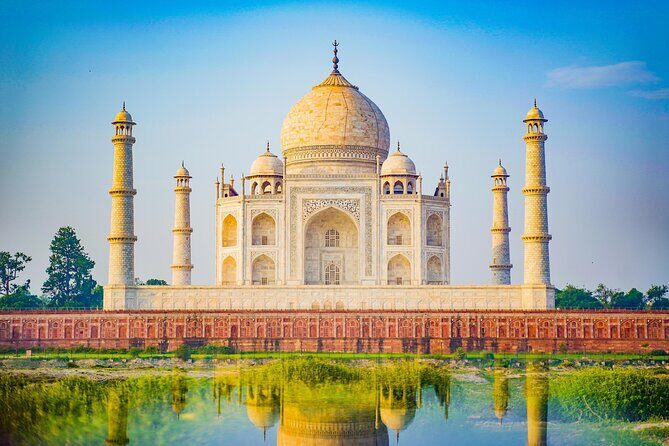
Day 2 is built around the Taj Mahal, and it’s the heart of the whole trip for many people. The plan calls for watching the sun rise over the Taj Mahal, then a guided tour inside for about two hours. Your guide shares its history as a tomb built by Mughal Emperor Shahjahan in 1630 to enshrine his wife.
You also get the famous setting: the Yamuna River background and the gardens framing the monument. Even if you’ve seen photos before, the real value comes from learning what you’re looking at while you’re standing there.
Date warning: Taj Mahal remains closed every Friday.
Taj Mahal interior timing
Two hours inside with a guide is a good pace. It’s enough time to understand the story and still keep your energy. But since monument admission is not included, you’ll want to treat this as a paid highlight and not a freebie.
Agra Fort: The follow-up that makes Taj Mahal make more sense
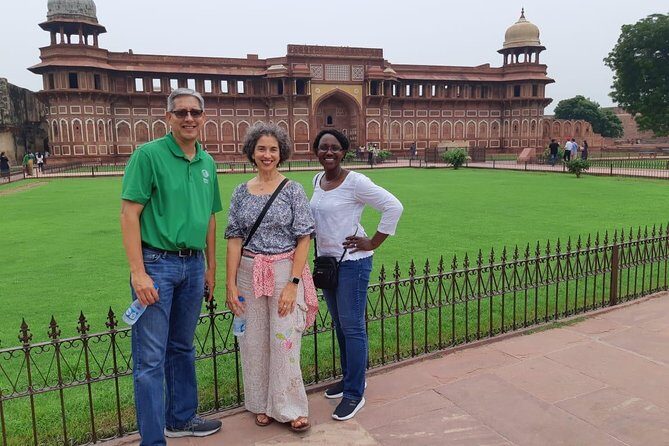
After the Taj, you move to Agra Fort, spending about two hours. Agra Fort was the main residence of Mughal emperors until 1638, when the capital shifted to Delhi. It also mentions that before British capture, the last Indian rulers to occupy it were the Marathas.
That historical timeline is exactly why pairing Taj Mahal with Agra Fort helps. You see both the personal love-story monument and the broader political power base.
Admission is listed as not included.
Fatehpur Sikri add-on if you have time
On the way from Agra to Jaipur, there’s an optional stop: Fatehpur Sikri, with about one hour if you have time. It’s listed as admission ticket free in the schedule provided. You then continue to Jaipur and check in at your hotel upon arrival.
This is a smart way to stretch the day without turning it into a different vacation. If you’re the kind of traveler who likes a short extra detour for big payoff, this stop can be worth your attention.
Day 2 to Day 3: Jaipur Check-In and the Big Visual Day
After Agra, you check in in Jaipur. The itinerary makes Jaipur sightseeing the next day, so you should treat tonight as your buffer. Eat well, rest your legs, and get ready for fort-and-palace walking.
Jaipur is different from Delhi and Agra. Delhi feels layered with empire and modern city life. Agra gives you Mughal monumental scale. Jaipur brings palaces, forts, and the Rajput flavor of Rajasthan architecture.
Day 3 in Jaipur: Amber Palace, Jal Mahal Photos, City Palace, and Hawa Mahal
Day 3 is the Jaipur highlights list, and it’s arranged to keep the big sights close together. You start with Amber Palace, then do a scenic photo stop at Jal Mahal, and finish with City Palace and Hawa Mahal.
Amber Palace: A fort-palace you can feel
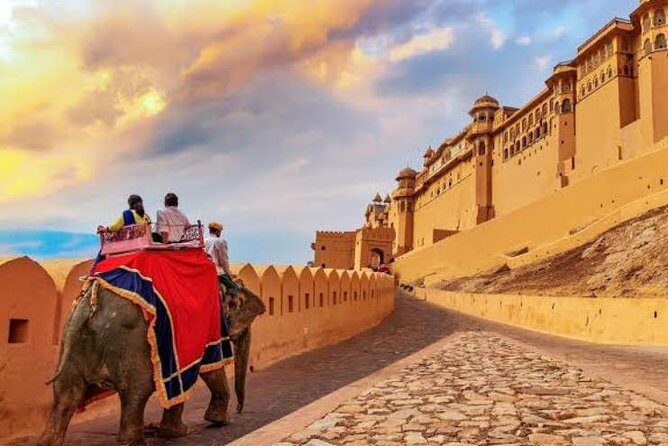
Amber Palace (Amber Fort) was the capital of Rajasthan until 1728. It’s built by Raja Man Singh I and is known for artistic elements. You’ll get a guide-led visit of about two hours, covering palaces, squares, and monuments, plus mention of rampants and a series of gates.
There’s also Maota Lake in front of the monument. It beautifies the view and acts as a water source for the fort.
Admission is not included. Plan to pay for this one because it’s a major centerpiece.
Jal Mahal: One hour for a lake-and-palace photo moment
Jal Mahal is described as a palace floating on Man Sagar Lake. The palace and the lake around it were renovated and enlarged in the 18th century by Maharaja Jai Singh II of Amber. The schedule gives you about one hour and frames it mainly as a photo opportunity.
If you like scenic stops that break up fort walking, this is a nice change of pace. If you’re only after major museum-style interiors, you might find this stop lighter.
Admission isn’t included.
City Palace of Jaipur: Where royal life and today’s museum overlap
City Palace was constructed in 1721 and served as the administrative and ceremonial seat of the Maharajas of Jaipur. The schedule also notes it was a location for religious and cultural events, and it now houses the Maharaja Sawai Man Singh II Museum and continues as home of the Jaipur royal family.
You’ll spend about two hours. This stop is strong because it connects power, culture, and the present day in one site.
Admission is not included.
Hawa Mahal: Palace of Wind for a classic Jaipur facade
Hawa Mahal, or Palace of Wind, is made with red and pink sandstone. It’s a five-storey pyramidal shaped monument built by Sawai Pratap Singh in 1799. You’ll get about an hour, then return to your hotel.
This stop is ideal for photos and architectural appreciation. If you enjoy seeing decorative stonework and design details, you’ll likely enjoy the short time slot.
Admission isn’t included.
Back to Delhi: end-of-tour drop-offs
After Jaipur sightseeing, you drive back to Delhi. Your tour finishes with the driver dropping you at the airport, railway station, or your prebooked hotel.
That gives you flexibility if you have an evening flight or train, but it also means you won’t have another long stop in Delhi before the tour ends.
Price and Value: What $266.67 Covers and What You Still Pay For
At $266.67 per person for a 3-day Golden Triangle route, you’re paying for more than just sightseeing. You’re paying for transportation, an English-speaking guide in all cities, hotel pickup/drop-off, and the logistics that normally eat up time.
Included items in the schedule include:
- Air-conditioned vehicle and private transportation
- Fuel surcharge and parking fees
- Hotel accommodation on a sharing basis (twin-sharing generally)
- Water bottle
- Hotel pickup drop-off and English speaking guide in all cities
- Mobile ticket
What’s not included:
- Monument fees
- Food and drinks
So here’s the honest value math. If you budget for monuments and meals separately, this tour can be good value because you’re not paying extra for guide time or transfers between cities. If you’re hoping to pay only one flat price and show up everywhere without extra spending, you’ll likely feel surprised once tickets come into play.
Also remember: the schedule lists admission as not included for many major stops. Even though some items are marked free in the schedule (like parts related to travel), most of the big monuments are ticketed.
Hotel, Pickup, and Room Sharing: Smooth Logistics With One Real Caveat
The tour includes hotel accommodation with rooms generally provided on a twin-sharing basis. In a booking of 3 people, rooms are provided on triple-sharing by default. If three guests prefer two rooms, an additional charge is required.
That matters because the tour’s comfort level depends on how your group shares space. If you’re traveling solo, you’ll likely be assigned a shared arrangement as per the operator’s process, unless you’ve chosen a different option at booking.
Pickup and drop-off are part of the deal. The schedule starts at 9:00 am and includes hotel pickup/drop-off, which helps you avoid morning scrambling in a city that can be chaotic.
One more small but useful detail: you get water bottles. When you’re walking in warm weather and touring multiple sites in one day, that’s not a luxury. It’s practical.
Best Fit: Who This Golden Triangle Tour Works For
This tour suits you if you want a guided, organized route across Delhi, Agra, and Jaipur without the stress of planning transport between cities. The private vehicle and English guide mean you get context, not just sightseeing checkmarks.
It’s also a good fit if you like UNESCO and major monument clusters. The schedule hits major icons: Humayun’s Tomb, Qutub Minar, Taj Mahal (morning plan), Amber Palace, City Palace, and Hawa Mahal.
If you want a slow travel pace, extra free time in each city, or you hate ticket budgeting, you might find the “packed” format too intense. This itinerary is designed for efficient coverage, not for lingering.
Should You Book This Golden Triangle 3-Day Tour?
I’d book this if you’re the kind of traveler who values structure and explanation. You’ll cover the headline sites across all three cities with an English-speaking guide, included private transportation, and hotel support. The route design also gives Taj Mahal a prime-feeling morning slot, and Jaipur gets its classic fort-and-palace highlights on day three.
Skip or reconsider if your dates fall on a closure day: Taj Mahal is closed every Friday, and Lotus Temple and Red Fort are closed every Monday. Also, be ready to pay monument fees on-site since they’re not included for most stops, and food and drinks are on you too.
If you do book, bring a realistic budget for admissions and plan for walking. This is a fantastic “see the essentials with less hassle” trip, as long as you treat it like a sprint and pack accordingly.
FAQ
What time does the tour start?
The start time is 9:00 am.
Which cities are included in the 3-day tour?
The tour covers Delhi, Agra, and Jaipur.
Is pickup from my hotel included?
Yes. Hotel pickup and drop-off are included, along with pickup options.
Are monument admission fees included?
No. Monument fees are not included, and most stops list admission tickets as not included.
Are there any closure days for major attractions?
Yes. Taj Mahal is closed every Friday. Lotus Temple and Red Fort in Delhi remain closed every Monday.
How are hotel rooms handled?
Rooms are generally provided on a twin-sharing basis. For a booking of 3 people, triple-sharing is default, and if 3 guests prefer 2 rooms, an additional charge may apply.
What is the cancellation policy?
You can cancel up to 6 days in advance for a full refund. For a 50% refund, you must cancel 2–6 days before the start time. If you cancel less than 2 days before, the amount paid will not be refunded.