REVIEW · NEW DELHI
Delhi, Agra, Jaipur 3-Day Private Golden Triangle Tour
Book on Viator →Operated by Hire Taxi India · Bookable on Viator
Some monuments hit fast, then keep echoing for days. This 3-day private Golden Triangle tour strings together Delhi, Agra, and Jaipur with a smooth pace and built-in tickets. I especially love the sunrise Taj Mahal timing and the fact that you do not have to figure out hotel logistics. One thing to consider: the drive times are real, and the schedule is packed, so you’ll want to show up ready to go at each early start.
In Delhi, you get the Qutub Minar (with its 11th-century backstory) and a proper look at India Gate and the big British Raj-era government buildings around it. Then the tour swings south to Agra and keeps building momentum, ending in Jaipur with the biggest visual hits like Amber Fort and Hawa Mahal. A possible drawback is that Taj Mahal sunrise depends on weather, and the visit is closed on Fridays, so timing may shift around those realities.
The good news is that the tour handles the messy parts: private air-conditioned vehicle, a professional live guide, entrance fees, and even a few craft-focused stops with demonstrations. You’ll still have free time moments for wandering, but you won’t be stuck at the wrong entrance or hunting for tickets. Dress smart casual, and plan on a lot of cultural contrast in a short window.
In This Review
- Key things I think you’ll care about
- Day 1 in Delhi: Qutub Minar first, because you start with impact
- The Delhi-to-Agra transfer: plan for a long road, not a short commute
- Sunrise Taj Mahal at 6:00 a.m.: why early matters more than you think
- What “up close and personal” really means
- Agra Fort after breakfast: the fortress that makes the Mughal era feel real
- Carpet House stop: shopping, but also a chance to see how materials are sold
- Craft demonstrations: marble, Zardozi, hand-knotted carpets, and gemstones
- Why these stops can be useful (even if you do not buy)
- The Jaipur textile timing: you get one more chance
- The Jaipur day: Amber Fort, Hawa Mahal, and City Palace in a tight rhythm
- Amber Fort at 8:00 a.m.: where the day’s photos get their backbone
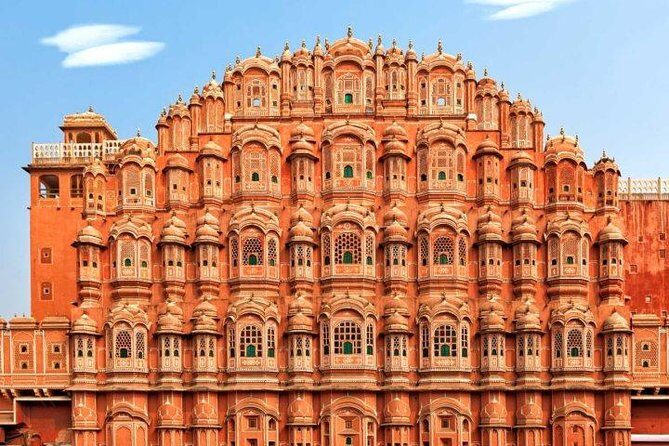
- Hawa Mahal: short stop, big visual payoff
- City Palace and the museum feel: royal residence turned public
- Evening return to Delhi: not a party-night, but a clean finish
- How the private vehicle and guides change the whole experience
- Timing reality check
- Price and value: is $292 per person a good deal?
- Who this Golden Triangle tour suits best
- Should you book this private Delhi–Agra–Jaipur tour?
- FAQ
- What time does the tour start in Delhi?
- Are hotel accommodations included?
- Do I need to buy tickets for the main monuments?
- Is the Taj Mahal visit always available?
- What meals are included?
- Is this a private tour or a group tour?
- What’s the dress code?
Key things I think you’ll care about
- Sunrise Taj Mahal at 6:00 a.m., with a reminder that it is closed every Friday
- Private driver and live guide, with people describing the team as friendly and supportive (names like Sanju, Sing, Rajesh, and Ali come up)
- Two nights of twin-share hotel with breakfast when you choose the hotel-inclusive option
- Entrance fees included for the main monuments, so your day doesn’t turn into a ticket scramble
- Craft demonstrations: marble work, Zardozi embroidery, hand-knotted carpets, and gemstone cutting/polishing
- Short, high-impact blocks in Jaipur: Amber Fort, Hawa Mahal, City Palace, plus time for textiles
Day 1 in Delhi: Qutub Minar first, because you start with impact
Delhi can feel like a lot at once. That is why I like starting with Qutub Minar. At 9:00 a.m., you’re picked up from your hotel or the airport in New Delhi and taken straight to one of the city’s defining monuments. Qutub Minar is tied to early Delhi history, built by Qutub-ud-din Aibek of the Slave Dynasty after taking possession of Delhi in 1206. Even if you’re not a history nut, the scale and the craftsmanship do the talking.
You’re given about an hour at the site, with admission included. That’s usually enough time to see the monument from key angles, read a few details, and still keep energy for the rest of the day. If you’ve ever waited too long at museums and then regretted it, this pacing is the antidote.
Next comes India Gate, a memorial honoring Indian soldiers martyred during the Afghan war. The drive-by also matters here. You pass major government buildings like the President’s House and Parliament House, dating back to the British Raj era. It’s not the kind of stop where you’ll spend forever, but it gives you a feel for how old power shows up in the modern city.
You can also read our reviews of more private tours in New Delhi


The Delhi-to-Agra transfer: plan for a long road, not a short commute
After India Gate, the pace shifts from sightseeing to travel. You head to Agra in the early evening, and the drive is about 3 hours via the expressway. This isn’t a relaxing “let’s see scenery” drive. It’s more like: settle in, keep hydrated, and arrive with enough energy to sleep well. You’re in good shape if you treat the evening as setup for a very early next morning.
Also, note the tour includes meals: lunch is included for multiple days, and breakfast is included for the two mornings. That helps. It means you’re not constantly deciding where to eat while rushing between time-sensitive sights.
Sunrise Taj Mahal at 6:00 a.m.: why early matters more than you think

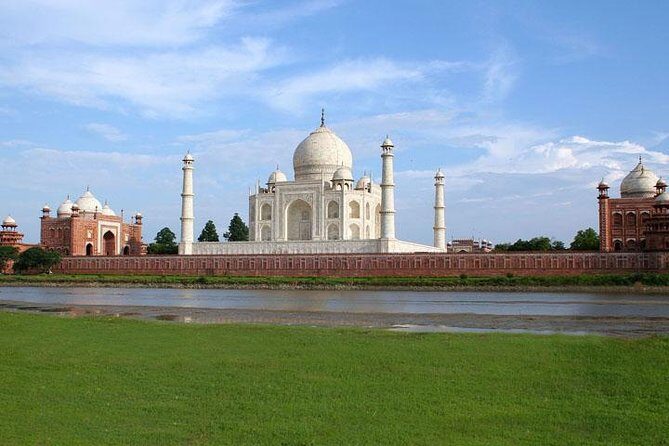
The big reason this tour works is Taj Mahal sunrise. You leave around 6:00 a.m. for the best chance to see the marble in softer light. The Taj Mahal is closed every Friday, so if your dates fall on a Friday you’ll want to confirm how your sunrise plan is adjusted.
At the Taj, admission is included, and you get about 2 hours. That’s enough time to take in the symmetrical front view, walk around to different angles, and still catch details you’d miss if you were doing it at peak midday crowds. You’re also not doing it alone. A private live guide helps connect what you’re seeing to why it was built this way.
The Taj Mahal story is part love story, part engineering feat. The tour frames it as Shah Jahan’s monumental tribute to his beloved wife, with a workforce of about 20,000 men working for over 17 years. The guide context helps you shift from the postcard version to the real material story: white marble paired with semi-precious stone inlays, arranged to glow in changing light.
What “up close and personal” really means
Taj Mahal is one of those sites where the photos can trick you. The real experience is scale plus detail. Up close, you notice how the surface isn’t just marble—it’s patterned work. Two hours sounds short until you realize the Taj Mahal makes you slow down naturally. It’s not a checklist stop. It’s a stare-and-then-notice-more stop.
When you’re done, you head for breakfast and then the next major block at Agra Fort.
Agra Fort after breakfast: the fortress that makes the Mughal era feel real
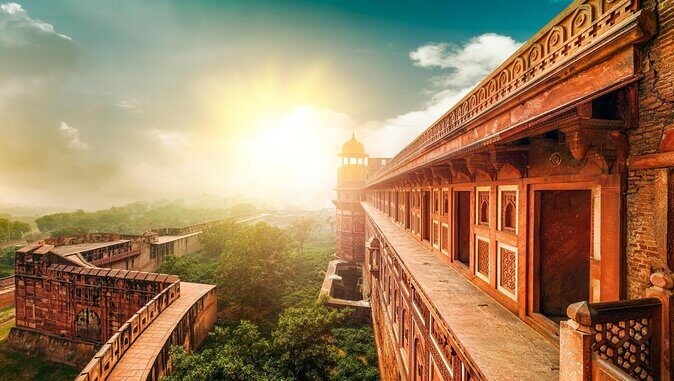
After breakfast, you visit Agra Fort, one of the most impressive remaining Mughal fortifications. You get about 1 hour there, with admission included. The fort is red sandstone and sits inside a roughly 2.5-kilometer-long enclosure wall, which is a big clue that this place was an imperial city, not just a defensive structure.
Agra Fort is packed with named spaces: the Jahangir Palace, the Khas Mahal, and the Diwan-i-Khas audience hall. You also see two very beautiful mosques within the complex. With a guide explaining what these spaces were used for, the fort turns from “walls and courtyards” into a map of how power worked.
The only real caution: you should wear comfortable shoes. Forts are uneven, and the walkways add up.
A few more New Delhi tours and experiences worth a look





Carpet House stop: shopping, but also a chance to see how materials are sold
Next you get time at Carpet House Agra, about 1 hour, with time to explore local handicrafts and shopping centers. This is where you’ll see items tied to traditional crafts: marble inlay work, Zari and embroidery, leather goods, and carpets.
Important framing: these stops can feel like shopping detours if you don’t know what you’re doing. But I like them when they’re used as a learning moment. You get to ask questions, compare quality, and understand what you’re actually looking at—before you spend money.
Craft demonstrations: marble, Zardozi, hand-knotted carpets, and gemstones
This tour includes several hands-on style demonstrations. They’re listed as live demonstrations of marble craftsmanship, handmade embroidery (Zardozi), hand knotted carpet weaving, and cutting and polishing of gemstones. That’s a big value add, because it turns “I saw a shop” into “I understand what makes this different.”
Why these stops can be useful (even if you do not buy)
If you plan to buy souvenirs, these demonstrations give you vocabulary. You can spot better workmanship because you’ve seen the process. If you do not plan to buy, these stops still help you connect the dots between what you saw on monuments and what people make today.
For example:
- Marble craftsmanship connects naturally to the Taj Mahal’s marble surface and inlay style.
- Zardozi embroidery helps you understand that Indian decoration isn’t random. It’s technique and material knowledge.
- Carpet weaving (especially hand-knotted work) is slow, detailed, and expensive in time—so you get a reality check on pricing.
- Gemstone cutting and polishing helps you see why “shiny” isn’t the same as “well-finished.”
The Jaipur textile timing: you get one more chance
In Jaipur, there’s another textile-focused stop, a Carpet and Textile House. It’s time-permitting, but you’re looking at hand-woven carpets and textiles, including time to see silk carpets made by hand. It’s another chance to compare what you learned in Agra with what’s offered in Rajasthan.
The Jaipur day: Amber Fort, Hawa Mahal, and City Palace in a tight rhythm
After Agra, the tour heads to Jaipur. The drive is about 4 hours to the old walled city—the so-called pink city founded by Maharaja Jai Singh II, laid out using principles from Shilpa Shastra, an ancient Hindu architecture treatise. The architecture talk can sound academic, but it matters because Jaipur’s planning affects what you see as you walk.
Then you check in, rest, and the next morning starts with the real Jaipur heavy hitter: Amber Fort.
Amber Fort at 8:00 a.m.: where the day’s photos get their backbone
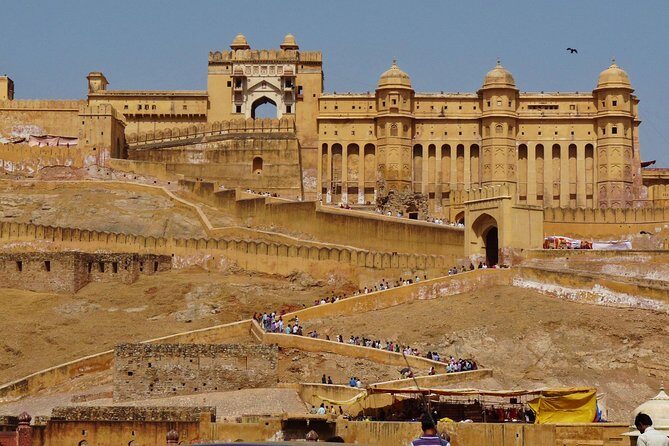
At 8:00 a.m., after breakfast and check-out, you visit Amber Fort. Admission is included and the visit is about 2 hours. Amber Fort used to be the capital of the Kachhwaha clan until Jaipur became the official capital in 1727, so this place is a power anchor in the region’s story.
You’re not just seeing one monument. You’re walking through a complex that shaped royal life. Amber Fort’s look is instantly recognizable—especially once you get enough distance to see it as a whole—and it gives your Golden Triangle trip a different flavor than Delhi and Agra.
Hawa Mahal: short stop, big visual payoff
After that, the tour shifts to a faster hit: Hawa Mahal, the Palace of Wind. It was built in 1799 by Maharaja Sawai Pratap Singh. You get about 30 minutes, with admission free. It’s a perfect example of why this tour works for a short window: you get the signature sight without losing the whole day to one location.
Hawa Mahal can be tricky to appreciate if you only see the outside for a moment. But with the timing, you at least capture the iconic facade and understand why it’s famous.
City Palace and the museum feel: royal residence turned public
Next comes City Palace of Jaipur, about 1 hour after lunch, with entry free. The City Palace is the main residence of the ruling family and includes areas now converted into a museum. The architecture and the scale help you see why Jaipur became such a royal hub.
Also included is Jantar Mantar, a stone observatory from the 18th century. Even if you only get a portion of that area during your hour, the guide framing helps you understand it as practical science, not just decoration.
Evening return to Delhi: not a party-night, but a clean finish
For the final leg, you get an evening transfer back to New Delhi, about 4 hours. You’re dropped at your hotel or the airport on arrival. This is a good close if you want to return with the trip complete rather than adding a fourth day.
How the private vehicle and guides change the whole experience
A private tour sounds like marketing. Here, it actually matters. You’re in an air-conditioned private vehicle for all transfers and sightseeing. That means fewer stress points: no waiting around for slow arrivals, fewer confusion moments at entrances, and less time spent solving logistics.
A lot of the comfort comes from the human piece. The experiences shared include a patient, super nice driver named Sanju, plus guides like Sing (described as funny and friendly), Rajesh (caring and sweet), and Ali (likened to a human encyclopedia). You might not get the exact same team every time, but it tells you what kind of guide style the tour aims for: talk with clarity, keep it human, and answer your questions instead of reciting facts like a robot.
Timing reality check
You’re dealing with early starts and monument opening hours. The tour does a smart thing by clustering the big monuments into manageable blocks: Qutub Minar first day, sunrise Taj Mahal and Agra Fort second day, then Amber Fort and major Jaipur sites the final morning. It still feels like a sprint, but it’s a guided sprint.
If you hate rushing, you might find it intense. If you like seeing a lot and trust your guide’s pacing, you’ll feel right at home.
Price and value: is $292 per person a good deal?
At $292 per person for a 3-day private Golden Triangle, the value depends on one big question: what hotel option did you pick. The tour includes 2 nights of accommodation on twin sharing with breakfast when you book the option that includes hotels.
On top of that, you get:
- Private air-conditioned transfers
- A professional private live guide
- Monument entrance fees for listed sites
- Included meals: breakfast (2) and lunch (3)
- Included craft-focused demonstrations
- Pickup from Delhi / Noida / Gurugram hotel or airport
So you are paying for more than driving. You’re paying for time saved and decisions removed. In India, that difference is huge. The alternative is usually piecing together drivers, tickets, and accommodation yourself—then losing time while negotiating and checking details.
Still, keep expectations realistic. This is not a slow, luxury-style trip. It’s a well-run route with real travel time. If your goal is to stretch each day and linger for hours, you might feel the pressure. If your goal is to hit the highlights with minimal hassle, it’s a strong deal.
Who this Golden Triangle tour suits best
I think this fits you well if:
- You want private transport and a guide without having to plan every ticket.
- You value the sunrise Taj Mahal and want it handled correctly.
- You’re okay with a schedule that moves early and stays efficient.
- You like learning about crafts, not just museums.
It might be less ideal if you:
- Want lots of downtime each day.
- Prefer to travel slower and improvise each stop for long hours.
- Are sensitive to early mornings, since sunrise is built into the plan.
Should you book this private Delhi–Agra–Jaipur tour?
If you want a straightforward Golden Triangle trip with the big sights handled and the logistics taken care of, I’d say yes, this is worth considering. The strongest reasons are the sunrise Taj Mahal, the included entrances, and the way the craft demonstrations add context you won’t get if you only do monuments and shopping.
My final advice is simple: choose it if you want efficiency plus guided context. Skip it if you want slow travel and lots of extra free time. And whatever you pick, treat the early mornings like part of the experience, not a burden.
FAQ
What time does the tour start in Delhi?
The tour starts at 9:00 a.m. in New Delhi, with pickup from your hotel or the airport.
Are hotel accommodations included?
Two nights of twin-share accommodation with breakfast are included when you book the option that includes hotels.
Do I need to buy tickets for the main monuments?
Entrance fees for the listed monuments are included, including places like Qutub Minar, Taj Mahal, Agra Fort, and Amber Fort.
Is the Taj Mahal visit always available?
The Taj Mahal sunrise visit is subject to weather conditions and it is closed every Friday.
What meals are included?
The tour includes breakfast (2) and lunch (3). Drinks are not included.
Is this a private tour or a group tour?
This is a private tour/activity, and only your group participates.
What’s the dress code?
The dress code is smart casual.