REVIEW · NEW DELHI
8 Days Private Luxury Golden Triangle Tour with Udaipur & Pushkar
Book on Viator →Operated by Golden Triangle Tour · Bookable on Viator
Five cities, one smooth itinerary. This private luxury loop strings together Delhi and Agra’s Taj Mahal twice—sunrise and sunset—then carries you on to Jaipur, Udaipur, and Pushkar without you juggling maps or connections.
I especially like the private local guides at most stops. They help you move through big-name sights and smaller details like stepwells and old-city lanes without the usual guesswork.
One catch to plan for: monuments admission tickets aren’t included, so you’ll still budget entry fees for major sites like Taj Mahal and Amber Palace.
In This Review
- Key things that make this tour work
- How the private transport shapes the whole trip
- Day 1 Delhi in layers: Qutub Minar, Lotus Temple, and Old Delhi lanes
- Day 2 Agra move: Agra Fort, Baby Taj, Mehtab Bagh, then Taj at sunset
- Day 3 Taj Mahal sunrise and the Akbar-era detour to Jaipur
- Day 4 Jaipur’s big monuments day: Amber Palace, Jantar Mantar, Hawa Mahal
- Day 5 Udaipur arrival day: a breather after the road
- Day 6 Udaipur by Lake Pichola: boat views, City Palace, and a choice at Bagore Ki Haveli
- Day 7 Pushkar arrival: time to settle into a slower temple town
- Day 8 Pushkar’s Brahma Temple and Pushkar Lake before the drive back to Delhi
- Price and value: what $428.58 per person covers
- Should you book this private 8-day Golden Triangle plus Udaipur and Pushkar tour?
- FAQ
- How long is the tour?
- Where does the tour start?
- Is this a private tour or shared with others?
- Does it include hotel stays and breakfast?
- Are the sightseeing tickets included for major monuments like the Taj Mahal?
- Is the Taj Mahal area walk from parking included?
- What happens if weather is bad?
Key things that make this tour work
- Door-to-door private car with an on-hand driver, using a 4-seater sedan for 1–2 people or a 6-seater MPV for 3–4.
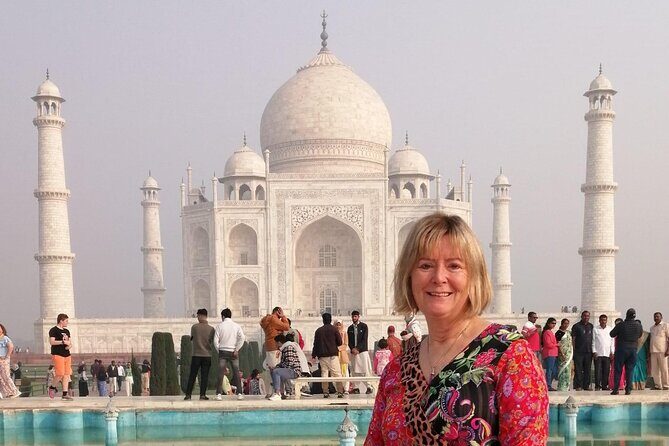
- Taj Mahal twice in one trip, including a sunrise visit plus a sunset view setup across the river.
- Delhi in a smart order: UNESCO sights, a famous lotus-shaped temple, then Old Delhi markets and mosques.
- Amber Fort to Hawa Mahal in one full Jaipur day, plus Jantar Mantar (UNESCO) and City Palace.
- Udaipur by Lake Pichola, with time for views and the option of a boat ride experience.
- Skip-friendly museum time in Udaipur, since Bagore Ki Haveli can be omitted if you want a faster pace.
How the private transport shapes the whole trip
The biggest reason this tour feels calmer than the usual Golden Triangle mix-and-match is that you travel with private, air-conditioned transport from city to city. You start with pickup from Indira Gandhi Intl Airport and you end with the drive back to Delhi.
You also get built-in support for day-to-day sightseeing. Most stops are paired with private local guides, so you’re not trying to translate signs while also herding your group through crowds. Add in bottled mineral water during journeys and hotel breakfast (when you choose the hotel option), and the long road days feel manageable instead of chaotic.
This is a good fit if you want the highlights—Taj Mahal, Amber Fort, City Palaces—but you’d rather spend energy looking at things than planning logistics. It can also suit solo travelers, because it’s explicitly a private tour with only your group.
You can also read our reviews of more private tours in New Delhi


Day 1 Delhi in layers: Qutub Minar, Lotus Temple, and Old Delhi lanes
Delhi here is built like a route with mood changes. You start at Qutub Minar, the tall UNESCO-listed minaret tower (73 meters, five storeys, constructed in 1193). It’s a strong opener because it’s both monumental and distinct.
Next you pivot to the modern-religious side with Lotus Temple, a free entry site designed with a flower-like shape (open to everyone regardless of religion). Then you hit India Gate, the war memorial and a classic picnic spot—short stop length, but a chance to absorb the landmark scale.
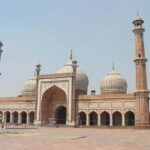
You drive past Parliament House (Sansad Bhavan), then shift into the big Mughal-era centerpiece at Jama Masjid (built 1650–1656 by Shah Jahan). After that, you walk into shopping-energy at Chandni Chowk, where the markets are described as full of spices, dried fruit, silver jewelry, saris, and smaller side streets.
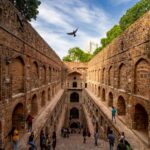
The spiritual stops round out the day with Gurudwara Bangla Sahib, known for a tank inside the complex tied to the story of the eighth Sikh Guru curing people during an outbreak. You finish at Agrasen Ki Baoli, the protected stepwell monument (60 meters long, 15 meters wide).
What I like: the way this day balances UNESCO anchors with very human street scenes.
Your consideration: Old Delhi market time can mean uneven sidewalks and dense crowds, so comfortable shoes matter.
Day 2 Agra move: Agra Fort, Baby Taj, Mehtab Bagh, then Taj at sunset

Day 2 is heavy on transit and then strong on major sights. After breakfast and checkout, you ride through the Yamuna Expressway toward Agra (about 4 hours). That expressway segment matters because it reduces the “how long will this take?” uncertainty.
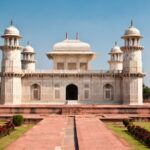
In Agra, you start with Agra Fort, a massive red sandstone complex associated with Mughal rulers (including the imprisonment of Shah Jahan by Aurangzeb). Next you visit Itmad-ud-Daula, often called the Baby Taj, a mausoleum built between 1622 and 1628 with marble decoration and an architectural transition style.
Then comes Mehtab Bagh, a garden restored for viewing the Taj Mahal area across the Yamuna. You wrap the day at Taj Mahal Sunset View Point, positioned across the river for a sunset experience away from the main crush.
One key planning point: multiple Agra stops show admission tickets not included (Agra Fort, Itmad-ud-Daula, Mehtab Bagh, and Taj Mahal time). Also, the tour includes a battery bus ride to and from the Taj Mahal parking area up to the monument—useful for energy and timing, even though tickets are still your responsibility.
What I like: the sunrise/sunset pairing across the two days gives Taj Mahal two different moods without you needing to rearrange anything yourself.
Your consideration: this day stacks monuments after a long drive, so if you prefer shorter sight blocks, tell your guide early about your pace.
Day 3 Taj Mahal sunrise and the Akbar-era detour to Jaipur
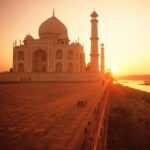
Day 3 starts with the big one: Taj Mahal at sunrise, described as an ivory-white marble mausoleum commissioned in 1632 by Shah Jahan to house Mumtaz Mahal, plus Shah Jahan’s own tomb. The time window (about 2 hours) is long enough to slow down, watch the light, and still feel like you saw it properly.
From there, the day becomes about “Mughal power places” beyond the Taj. You go to Fatehpur Sikri, the City of Victory built by Akbar in the late 16th century, where the Jama Masjid in the complex is noted as one of India’s largest mosques. You then head to Chand Baori in Abhaneri, an enormous stepwell extending about 30 meters into the ground.
Then it’s onward to Jaipur, with arrival followed by hotel check-in and overnight. The drive time is substantial (about 5 hours in the schedule), but it keeps you moving as one continuous loop.
What I like: you get the “main icon” (Taj sunrise) and then a different architectural lesson through stepwell engineering and Akbar-era planning.
Your consideration: sunrise starts mean early wake-up time, so plan for that in your sleep schedule.
Day 4 Jaipur’s big monuments day: Amber Palace, Jantar Mantar, Hawa Mahal
Jaipur is scheduled as a full sightseeing day with a guided flow that hits the city’s signature forms.
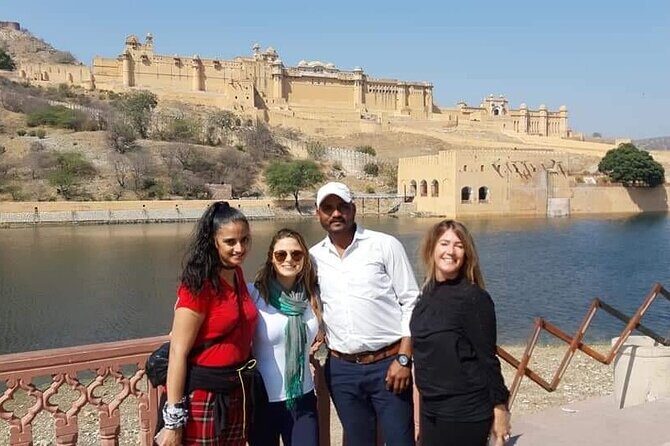
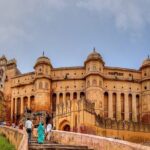
You begin at Panna Meena ka Kund, a short visit to a nearby stepwell. Then you travel to Amber Palace, described as the capital of Rajasthan until 1728. You get around two hours with the guide covering palaces, squares, and monuments—plus the artistic elements and ramparts, with Maota Lake noted as beautifying the monument and acting as a water source for the fort.
Next you do a photo stop at Jal Mahal, the palace “floating” on Man Sagar Lake. After that, you explore City Palace of Jaipur (about 1 hour), which includes the Maharaja Sawai Man Singh II Museum and continues as home of the Jaipur royal family.
From there, it’s Jantar Mantar, a UNESCO site built in 1734 with nineteen architectural astronomical instruments built by Sawai Jai Singh II. Even if astronomy isn’t your thing, it’s a very different type of “what humans built to understand the sky.”
You close with Hawa Mahal, the five-storey Palace of Wind built in 1799 from red and pink sandstone, and then a quick stop at Albert Hall Museum, described as the oldest museum in Rajasthan.
Many of these show admission tickets not included, including Amber Palace, City Palace, Jantar Mantar, Hawa Mahal, and Albert Hall Museum.
What I like: Jaipur feels like a greatest-hits album, but with a guide helping you connect the dots between fort design, palaces, and scientific instruments.
Your consideration: it’s a long day and the schedule includes several paid-entry areas. If you want more time in fewer places, ask your guide to prioritize.
A few more New Delhi tours and experiences worth a look




Day 5 Udaipur arrival day: a breather after the road
Day 5 is a transition day. You arrive in Udaipur, check in, and overnight. The schedule gives about 7 hours listed on the day, but it doesn’t stack specific ticketed sights here.
That’s actually a smart move if you’ve been traveling for a couple of days already. You’re not forced into yet another museum sprint. Instead, you get time to settle, reset your routine, and be ready for the lake-focused day next.
What I like: this breaks the pace right when you need it. Golden Triangle routes often become exhausting by day three or four; here, Udaipur lands like a pause button.
Day 6 Udaipur by Lake Pichola: boat views, City Palace, and a choice at Bagore Ki Haveli
Day 6 is where Udaipur makes its case.
You start with Lake Pichola (about 1 hour). The tour description highlights sightseeing and a boating option with a private boat ride around the lake, including a stop at Jagmandir Palace island. Even without the boat ride, the lake setting is the point of the experience.
Next you visit City Palace of Udaipur, located on the bank of Lake Pichola (about 2 hours). The tour notes the palace’s collection of items like weapons, guns, sedan chairs, tiger cages, and pictures. It also mentions that the royal family still resides in one part of the palace, plus the ferry ride on Lake Pichola operates from within the City Palace area.
After that you step into Jagdish Temple in the City Palace complex. It’s described as Indo-Aryan in style, with a short visit time and free admission.
Finally, you have Bagore Ki Haveli Museum (about 1 hour). The key detail: the description says you can skip it if you don’t want to stop there, and the stop includes private transportation and a guided tour.
Again, multiple items here show admission tickets not included, including the lake boat experience and City Palace.
What I like: Udaipur is paced with views and then culture, not just a checklist of monuments.
Your consideration: boat and palace visits can add up fast on timing. If you want quieter downtime, use the skip option.
Day 7 Pushkar arrival: time to settle into a slower temple town
Pushkar on Day 7 is another arrival and settle-in day. You travel in, check in, and overnight, with about 7 hours on the schedule.
The tour framing suggests Pushkar is set up for temple-and-lake focus rather than big driving loops. So think of Day 7 as your buffer day: you can recover from the Delhi-to-Agra-to-Jaipur-to-Udaipur momentum and be fresh for the religious sites on Day 8.
Day 8 Pushkar’s Brahma Temple and Pushkar Lake before the drive back to Delhi
Day 8 is shorter but very specific.
You start at the Brahma Temple, with the explanation that it’s famous for having a single Brahma temple in the world. It’s a 30-minute stop and is free.
Then you go to Pushkar Lake, heading to Brahma Ghat. The description notes prayers for happiness and tribute to the dead souls at Brahma Ghat, and adds that it’s well known for photography and blessing rituals. That stop is also short (about 30 minutes) and free.
Finally, you drive back toward New Delhi. The schedule mentions roughly a 5-hour journey back to Delhi, with a total time listed as 6 hours in the day plan. Plan on a long sit in the car, and keep that final evening flexible.
Price and value: what $428.58 per person covers
At $428.58 per person for an 8-day private luxury tour, the value depends on whether you choose the hotel-included option. The package states that when booked with hotels, it includes 7-nights accommodation and daily hotel breakfast.
Even without getting lost in math, here’s what you’re buying:
- Private, air-conditioned transport with a driver throughout the circuit
- Hotel or airport pickup and drop-off
- Private local guides for sightseeing at most sites
- Battery bus ride to and from Taj Mahal parking up to the monument area
- Bottled mineral water during journeys
- All applicable hotel taxes
- Private tour (only your group)
What you still pay for:
- Monuments tickets/admission (explicitly not included for multiple sites)
- Personal expenses
- Travel insurance and flight/train tickets
- Pushkar Guide is listed as not included
If you want a “total trip budget,” the best approach is to treat this as a strongly guided transport-and-access package, then add in the admission fees for the big sights you care about most. You’ll also want to keep an eye on timing, since the schedule includes long driving segments between cities.
One more value note: it’s described as booked about 142 days in advance, and it lists group discounts. If you’re traveling with friends, it can make sense to ask about combined pricing and vehicle fit.
Should you book this private 8-day Golden Triangle plus Udaipur and Pushkar tour?
If your dream trip is big-name North India sights with minimal planning stress, this one makes sense. The standout strengths are the private door-to-door car, the private guides for most stops, and the way it treats Taj Mahal as a two-part experience (sunrise plus sunset setup) rather than a single rushed hour.
It’s also a good match if you like clear structure. Delhi gets built in layers, Jaipur is stacked in one decisive day, and then Udaipur and Pushkar shift the pace toward lake and temple settings.
The main reason not to book is simple: you’re still responsible for monument admission tickets. Also, you’ll spend meaningful time in the car. If you hate driving days, this may test your patience.
One final hint: in the service feedback tied to this operator, drivers such as Maan, Man Singh, and Vinod get praised for safe, helpful driving (including English-speaking ability). If you want to maximize quality, ask your operator which driver-guide team you’ll have for your dates.
FAQ
How long is the tour?
The experience runs for 8 days (about 8 days).
Where does the tour start?
The start point is Indira Gandhi Intl Airport, New Delhi.
Is this a private tour or shared with others?
It’s described as a private tour, so only your group participates.
Does it include hotel stays and breakfast?
It includes 7-nights accommodation and daily hotel breakfast if you book with the option including hotels. Breakfast is listed for 7 days.
Are the sightseeing tickets included for major monuments like the Taj Mahal?
No. Monuments tickets are not included. The tour description also lists admission ticket status as not included for many key stops.
Is the Taj Mahal area walk from parking included?
The package includes a battery bus ride to and from the Taj Mahal parking lot up to the monument area.
What happens if weather is bad?
The experience requires good weather. If it’s canceled due to poor weather, you’re offered a different date or a full refund.