REVIEW · NEW DELHI
5-Day Golden Triangle Private Tour in Delhi, Agra and Jaipur
Book on Viator →Operated by Exclusive India Tours · Bookable on Viator
Five days, three icons, no guesswork. This private Golden Triangle tour strings together Old Delhi, Mughal-era UNESCO sights, and the Pink City with one main thing that matters: your guide keeps it clear, calm, and actually interesting.
I love the mix of sunrise access to the Taj Mahal and the way you also get the real street-level India in Old Delhi, including a spice-market detour by bicycle rickshaw. You’ll also benefit from the air-conditioned private vehicle, which makes the long drives feel manageable instead of miserable.
One consideration: monument admission tickets are not included, so your total cost will rise (the tour estimates $45 per person for tickets). If you’re on a tight budget, plan ahead so the add-ons don’t surprise you.
In This Review
- Quick hits you’ll feel on the ground
- Golden Triangle in 5 days: what this pace really gives you
- Old Delhi at Jama Masjid: markets, mosque scale, and that spice-market rickshaw
- Humayun’s Tomb, India Gate drives, and Gandhi Smriti in one city day
- The road to Agra: why the drive time actually matters
- Agra Fort and Mehtab Bagh: history with payoff at golden hour
- Sunrise Taj Mahal: seeing it before the day gets loud
- Jaipur’s big landmarks: Amber Palace, City Palace, and Jantar Mantar
- Hawa Mahal and Jal Mahal photo stops that don’t waste your time
- Guide power: why Mona Singh (and Ashish) show up again and again
- Price and tickets: is $600 per person good value?
- Who this Golden Triangle private tour suits best
- Should you book this 5-day Golden Triangle private tour?
- FAQ
- FAQ
- What does the $600 per person price include?
- Are monument admission tickets included?
- Is this tour private or shared with other people?
- Do you offer pickup in Delhi?
- What are the Taj Mahal timings like on this tour?
- How long is the tour?
- What is the cancellation window for a full refund?
Quick hits you’ll feel on the ground
- Private guidance that gets praised by name (Mona Singh, with Ashish as part of the team)
- Taj Mahal at sunrise plus a second golden-hour Taj view from across the river
- Old Delhi street time: Jama Masjid area bazaars and a bicycle rickshaw ride to the spice market
- UNESCO stops that connect the dots (Humayun’s Tomb influencing the Taj story)
- Jaipur’s major trio: Amber Palace, City Palace area, and Jantar Mantar
Golden Triangle in 5 days: what this pace really gives you
The Golden Triangle is famous for a reason. In less than a week, you can see India’s capital energy, the Mughal masterpieces of Agra, and Jaipur’s fort-and-palace world. The catch is that most tours feel rushed or vague, so you end up standing in lines thinking, I know I should care—why don’t I?
This one tries to fix that with a private setup and a guide who can explain what you’re looking at while you’re standing in front of it. That matters at places like the Taj Mahal and Jantar Mantar, where a quick “this is important” lecture won’t do the job. You want context that helps you notice details (and not just survive the crowds).
The other big advantage is transport. You’re in an air-conditioned private vehicle for the long hops, including the ~3.5-hour drive toward Agra. That doesn’t make India less intense—nothing does—but it keeps your day from collapsing from exhaustion.
You can also read our reviews of more private tours in New Delhi


Old Delhi at Jama Masjid: markets, mosque scale, and that spice-market rickshaw
Old Delhi is where the Golden Triangle starts feeling like real life, not just sightseeing. You begin at Jama Masjid, India’s largest mosque, described as having the capacity for about 25,000 people at once. Whether you’re religious or not, it hits you fast: big scale, big symmetry, and big human energy.
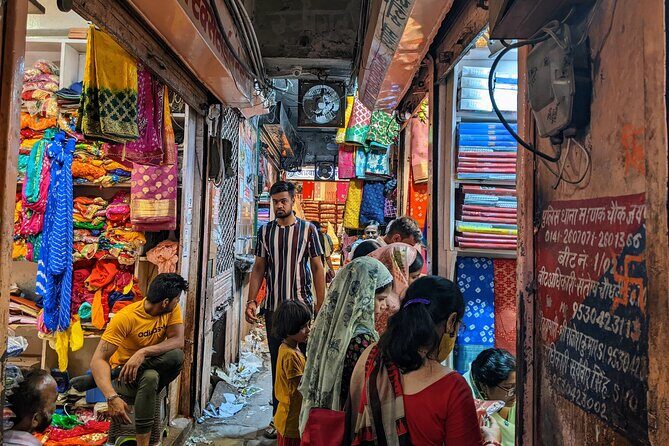
Then you move into the maze of nearby bazaar streets. One of the more memorable details here is the mix of goods—especially the narrow lanes where you’ll see wedding paraphernalia for sale. It’s the kind of stuff you miss when you stay inside the “tourist highlights only” bubble.
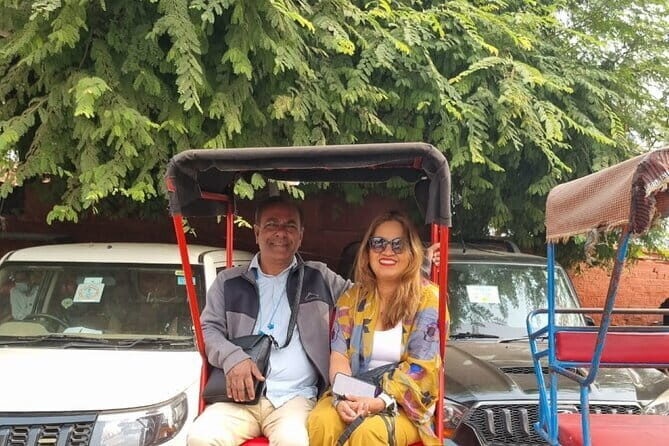
And yes, there’s the bicycle rickshaw ride, used here to reach the biggest spice market of Asia. It’s short, but it’s a smart switch from walking. Your feet get a break and you still feel the street action.
A practical note: you can get photo opportunities easily in this area. You may also find that shopping can feel more “pushy” than bargain-happy, so if you want good prices, keep your expectations realistic and don’t buy on impulse. Bring patience; bring water.
Humayun’s Tomb, India Gate drives, and Gandhi Smriti in one city day
Day one doesn’t stop at mosques and markets. You also get a colonial heritage drive in New Delhi that runs past India Gate, Parliament House, and President’s Palace. This is the contrast piece that helps the city make sense. Delhi isn’t one style of India—it’s multiple layers in the same geography.
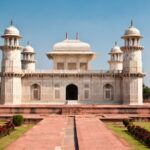
Next up is Humayun’s Tomb, a UNESCO World Heritage Site. The key story connection you’ll hear is that it inspired the construction of the Taj Mahal. That “why it matters” link is useful. Otherwise, tombs can blur together. With the connection in your head, you’ll notice patterns and design choices more easily.
Finally, you visit Gandhi Smriti, where Mahatma Gandhi spent the last days of his life before his assassination. You’ll stroll through the building’s grounds with your guide and talk through Gandhi’s life as you go. It’s a quieter stop, and it gives your trip emotional weight—not just visuals.
If you’re sensitive to heat and walking, pace yourself here. This day can cover a lot of ground, and Delhi sun can turn “2 hours” into “why am I sweating.”
The road to Agra: why the drive time actually matters
The Agra day starts with a private vehicle transfer of about 3.5 hours. You’ll pass farms and villages along the way, which is more than scenery. It gives you a sense of how daily life looks outside the big monument zones.
This is also the part of the tour where the private transport pays off. A group tour can force you into awkward schedules and waiting around. Here, you’re more in control of momentum—especially important before big sights, when you want to arrive with energy.
When you reach Agra, you check into your hotel and then head out. The tour keeps the action going rather than burying you in “rest time,” which I like for short trips. You’ll be tired, sure, but you’ll also feel like you didn’t just spend a day moving from one place to another.
Agra Fort and Mehtab Bagh: history with payoff at golden hour
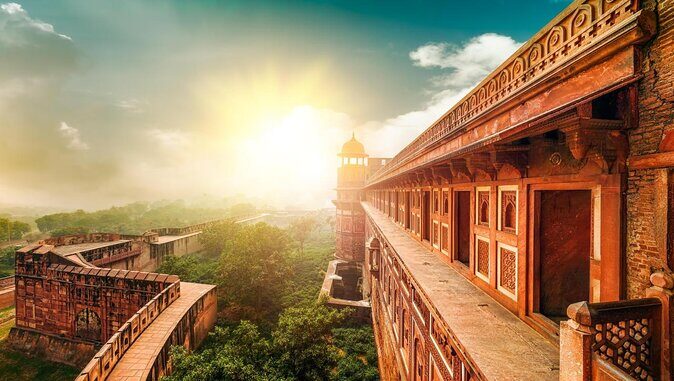
Agra’s first major hit is Agra Fort, another UNESCO World Heritage Site. It’s described as white marble palaces used as the royal residence—and also as a prison for the king who built the Taj Mahal. That contrast gives the fort tension. This isn’t just pretty architecture; it’s where power played out in harsh terms.
You’ll spend about two hours there. That’s enough time to absorb the main structures without feeling like you’re sprinting through details you can’t process. If you’re the kind of person who likes to understand what you’re seeing instead of just collecting photos, this is a good slot.
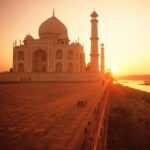
Then you shift to Mehtab Bagh, where you see the Taj Mahal from across the river at sunset. This stop works because it’s a different viewing angle and a different emotional tone. The Taj doesn’t just “look famous” here—it looks like it belongs to the landscape and light cycle.
Also, it’s a helpful warm-up for the next morning. Sunrise Taj Mahal is its own beast. Sunset across the Yamuna river lets you learn where to stand and what angles feel best.
A few more New Delhi tours and experiences worth a look



Sunrise Taj Mahal: seeing it before the day gets loud
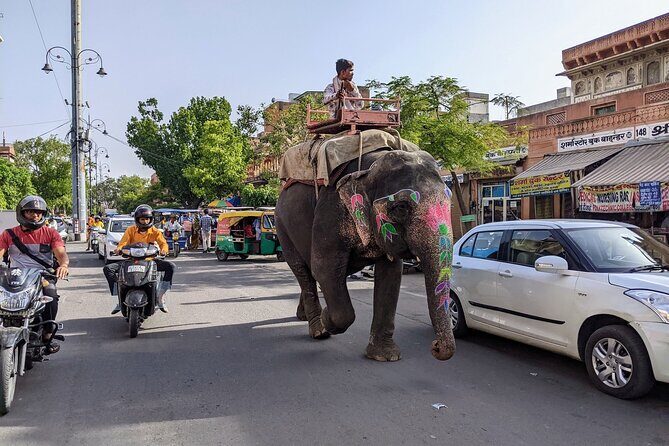
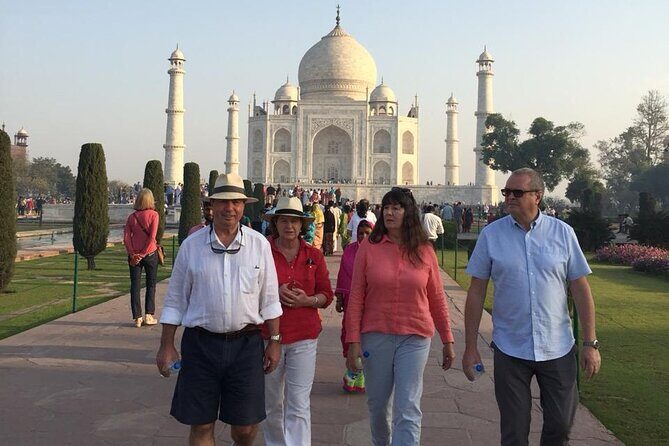
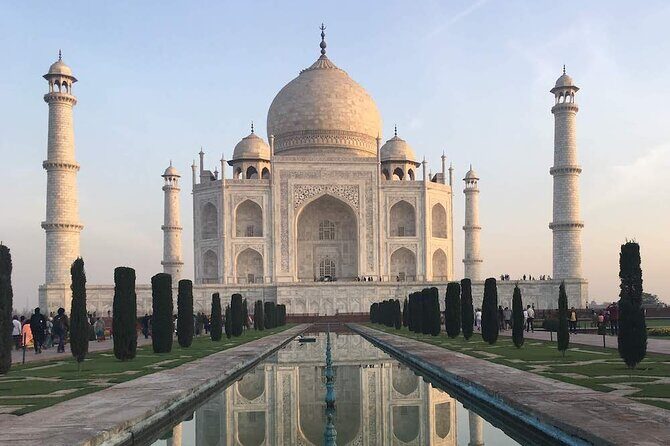
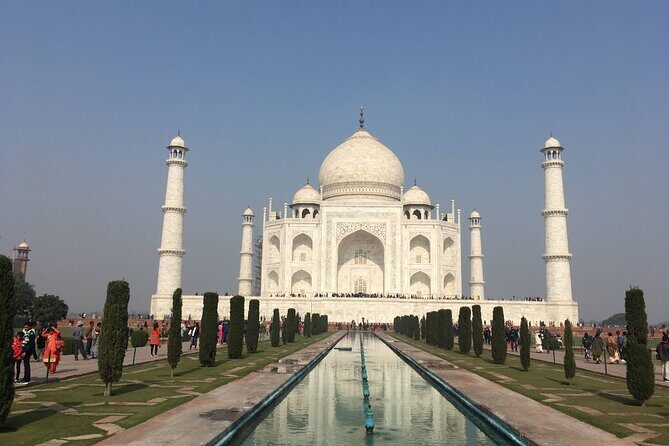
The Taj Mahal is the main reason most people come to Agra. Here, you get a sunrise visit, which is often the best way to appreciate it—soft rays, a calmer atmosphere, and that feeling that the monument is waking up with the sky.
The tour schedule sets you up to return to your hotel for breakfast and relaxation afterward. That rhythm is smart. You’re not trapped in “sightseeing mode” all day. You get a reset, which helps if you’re sensitive to long mornings or want time to recover.
A practical tip: sunrise days are easier if you treat them as a mission—drink water the night before, wear comfortable shoes, and don’t plan to over-schedule later in the afternoon. You’ll want your eyes focused, not glazed from fatigue.
And if you care about understanding, sunrise is a great time to ask your guide to explain the design logic. The Taj is all about symmetry and detail, and the lighting makes those elements easier to pick out.
Jaipur’s big landmarks: Amber Palace, City Palace, and Jantar Mantar
After Agra, you drive to Jaipur, commonly called the Pink City. The drive is about 6 hours with a couple of stops, and it’s one of the better stretches for conversation. You’ll hear topics like arranged marriages, holy cow references, and Mughal kings—basically, big social and historical themes your guide can explain in a way that connects to what you’ll see later.
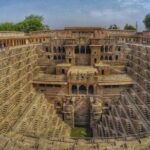
En route, you also visit Chand Baori (or Chand Baoli, as spelled in some materials), an 11th-century stepwell. Stepwells can look like a hole in the ground until someone explains their function. It’s usually about water storage, temperature control, and community use. Once you know that, the architecture starts making sense fast.
In Jaipur, the first “wow” is Amber Palace (Amer Fort). It sits on a hill, so you arrive with views before you even enter the main spaces. It’s a classic fort-palace layout—defensive architecture mixed with royal living.
Later you move into the City Palace area. You’ll get the City Palace Museum, including a collection of royal textiles. That’s a nice shift from stone monuments. Textiles show status in a way that’s easier to visualize than politics alone.
Then you visit Jantar Mantar, a UNESCO-listed observatory housing the biggest sundial in the world (as the tour description states). This stop can either feel like “cool science” or “wait, what am I looking at?” It’s exactly the kind of place where a good guide changes everything.
Hawa Mahal and Jal Mahal photo stops that don’t waste your time
Jaipur isn’t only fort and palace. You also get iconic photo moments, including Hawa Mahal, the famous honeycomb-like façade. It’s a structure that looks dramatic even when you’re just seeing it from the outside.
The tour also includes Jal Mahal, described as a landmark inside a lake. It’s another visual contrast stop: Amber’s hilltop fort energy versus a palace-like silhouette floating in water.
These aren’t long stops, which is good. Over-investing time in quick photo landmarks can steal hours from places that actually need explanation. Here, these are treated like useful breaks that keep the day moving without losing the “Jaipur look.”
If you’re planning your own photos, remember that you’ll get best results when you step back and let your camera include the surrounding context. Don’t zoom only; let the architecture sit in its environment.
Guide power: why Mona Singh (and Ashish) show up again and again
What people love most in the feedback is the guide team—especially Mona Singh. Multiple comments praise his friendliness, caring approach, and a strong pride in India that comes through in how he explains things.
You’ll also see practical praise: fluent English in the guides’ communication and even Spanish mentioned in one account. That matters when you’re tired or when you want cultural explanations without guessing. Another detail that stands out is off-the-clock help—like airport pickup at very early hours in one described case—so the experience starts smoothly instead of with stress.
Then there’s how the guides handle the rhythm. In a place like Old Delhi, you can get hit with crowds, noise, and sudden turns. A guide who can steer you, explain what you’re seeing, and keep timing under control can make the difference between a “good day” and a “this felt easy.”
If you’re hoping for a tour that feels personal rather than mechanical, this is where it delivers. The tour is private, but the real win is that your guide turns each stop into something you can understand in real time.
Price and tickets: is $600 per person good value?
Let’s talk money. The tour is listed at $600 per person for about 5 days, with private transportation and an air-conditioned vehicle included. Admission tickets for monuments are not included, and the tour estimates $45 per person for tickets.
At face value, $600 can sound high—until you compare it to the cost of doing the same circuit on your own. You’d need to arrange transport between three cities, manage timing for sunrise Taj Mahal, and line up a guide who can explain UNESCO and observatory stops without you hunting for answers. The private setup removes most of that friction.
The hidden value is that you’re paying for planning and for the guide’s ability to connect dots—like why Humayun’s Tomb leads to Taj Mahal design ideas, or what Jantar Mantar instruments are measuring. If your goal is “understand what I’m seeing,” a good guide is usually the best investment in the whole trip.
The main cost risk is tickets. Because admissions aren’t included, you’ll want to budget for them from day one. Also, if you like shopping, set a spending boundary early. In India’s markets, your guide may guide you past many shopping areas, and you’ll need to decide what’s worth buying.
Who this Golden Triangle private tour suits best
This tour fits best if you want the Golden Triangle fast—but not shallow. You’ll like it if you appreciate clear explanations, enjoy architectural and cultural stops, and want a sunrise Taj Mahal moment without having to figure it out yourself.
It’s also a solid match if you prefer comfort during travel days. The private vehicle helps a lot, especially on the Agra and Jaipur drive segments. If you dislike long public-transport connections between cities, this arrangement is a relief.
One more fit point: it’s described as a private tour/activity where only your group will participate. That’s great if you travel with family or friends who want shared pace and questions answered without feeling like you’re competing for guide attention.
Should you book this 5-day Golden Triangle private tour?
If your priority is a smooth Golden Triangle with sunrise Taj Mahal, smart Old Delhi street time, and a guide team praised by name (including Mona Singh), I think this is a strong booking choice. The $600 price makes more sense when you value private pacing, transport, and explanation—not just “standing near famous things.”
Book it if you’re ready to budget for separate monument admissions and you’re comfortable with early starts and busy city walking. Skip it if you want lots of free time with no structure, or if you’re mainly after a low-cost checklist and would rather manage transport and tickets yourself.
FAQ
FAQ
What does the $600 per person price include?
It includes an air-conditioned vehicle, private transportation, and fuel surcharge. Monument admission tickets are not included.
Are monument admission tickets included?
No. The tour states monument admission tickets are not included, with an estimated total of $45 per person.
Is this tour private or shared with other people?
It’s a private tour/activity, meaning only your group participates.
Do you offer pickup in Delhi?
Pickup is offered as part of the experience.
What are the Taj Mahal timings like on this tour?
You get a sunrise Taj Mahal visit, and you also visit the Taj Mahal area for sunset views from across the river.
How long is the tour?
It’s approximately 5 days.
What is the cancellation window for a full refund?
You can cancel up to 3 days in advance of the experience for a full refund (must cancel at least 3 full days before the start time).