REVIEW · NEW DELHI
Private 3-Day Golden Triangle Tour : New Delhi Agra And Jaipur
Book on Viator →Operated by ARYABHATT TOUR AND TRAVELS · Bookable on Viator
Golden Triangle, handled like a VIP relay. This private 3-day run connects Delhi, Agra, and Jaipur with a driver-and-guide setup, so you hit the big UNESCO sites without getting tangled in transit plans. I love the professional local city guides plus bottled water and an AC private vehicle, and I also like that you get two nights in a 4- to 5-star hotel with buffet breakfasts each morning. The trade-off: monument admission and camera fees aren’t included, and Taj Mahal timing depends on weather—plus it’s closed every Friday.
You’ll also get a pickup option and stay in a small, private group where it’s easier to ask questions and move at a real sightseeing pace. The itinerary is packed with classic highlights, so comfortable shoes matter. If you’re hoping for a long, slow wander at every stop, you might wish for more free time.
I noticed a repeat theme in the feedback: the trip runs smoothly because the guides and drivers take care of details. Names pop up in notes like Sunil Poddar as a guide, and Mr. Gaurav as a driver, which is a good sign that your day-to-day guidance isn’t left to chance.
In This Review
- Key things that make this tour a smart Golden Triangle choice
- Why the Golden Triangle feels doable in just 3 days
- Day 1 in Delhi: Humayun’s Tomb, Qutub Minar, and India Gate
- Humayun’s Tomb: the garden-tomb idea that changed the game
- Qutub Minar: the victory tower you can measure with your eyes
- India Gate: a war memorial with a straightforward, free stop
- Overnight in Agra
- Day 2 in Agra: Taj Mahal’s timeline and Agra Fort’s Mughal power
- Taj Mahal: crown of the palace, built in a defined timeline
- Agra Fort: where the Mughal dynasty lived and ruled
- Drive to Jaipur and check-in
- Day 3 in Jaipur: Amber Fort artistry, City Palace architecture, and Jantar Mantar math
- Amber Palace (Amer Fort): ramparts, gates, and artistic style
- City Palace of Jaipur: Maharaja Sawai Jai Singh II’s mix of styles
- Jantar Mantar: an astronomical observatory with geometry built in
- Return drive to Delhi
- What you’re really buying: hotel nights, guides, and transport value
- Tickets, the Taj Friday closure, and how to avoid last-minute stress
- Monument entry and camera fees
- Taj Mahal sunrise is weather-dependent
- Friday closure rule
- Staying comfortable on a fast-moving 3-day route
- Who this tour fits best
- Should you book this Private 3-Day Golden Triangle Tour?
- FAQ
- How long is the Private 3-Day Golden Triangle Tour?
- What hotel category is included?
- What’s included in the price besides the tour sites?
- Are monument entry tickets included?
- Is Taj Mahal sunrise included?
- What happens if my travel dates include a Friday?
- Do I need a passport for this tour?
- Can I cancel for a full refund?
Key things that make this tour a smart Golden Triangle choice
- Private AC transportation between Delhi, Agra, and Jaipur keeps the days efficient and less stressful
- Local city guides help you understand what you’re seeing, not just take photos
- Two nights at 4–5-star hotels with buffet breakfasts means you refuel like a grown-up
- UNESCO heavy itinerary covers the Golden Triangle classics: Humayun’s Tomb, Qutub Minar, Taj Mahal, Amber Fort, and more
- Taj Mahal sunrise is weather-dependent and every Friday it’s closed, so your timing needs a plan
- Monument entry and camera fees are extra, so budget for that upfront
Why the Golden Triangle feels doable in just 3 days
The Golden Triangle is famous for a reason: you’re basically compressing centuries of Indian architecture into a tight loop—Delhi’s Mughal-era monuments, Agra’s Taj Mahal moment, and Jaipur’s royal palaces. The danger with a short trip is wasted time. A lot of people burn the day trying to solve logistics: where to go, how to get there, and what to see first.
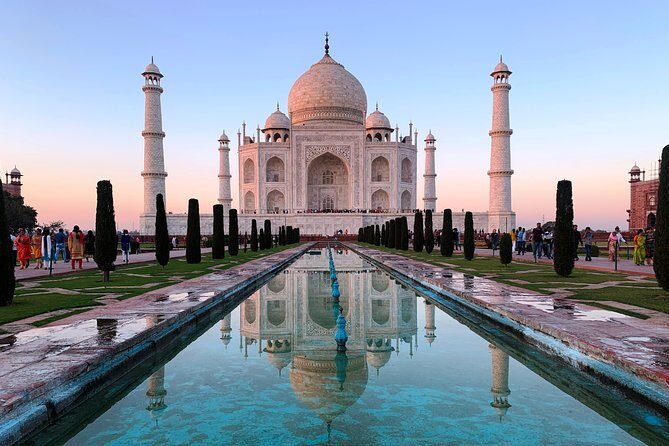
This tour’s value is that it turns that confusion into motion. You’re not just traveling; you’re being carried between the right stops with local guidance at each city’s key landmark cluster. That matters because the monuments aren’t interchangeable. A place like Humayun’s Tomb isn’t just old stone—it’s design thinking. And Taj Mahal isn’t just a postcard; it’s a full composition, built over decades with a lot of symbolism you’ll actually notice when someone walks you through it.
The pace is still busy, though. You’ll spend time inside major sites, but you won’t have an unlimited amount of wandering time. If you like to linger, arrive early, and ask questions, you’ll make the most of the schedule.
You can also read our reviews of more private tours in New Delhi


Day 1 in Delhi: Humayun’s Tomb, Qutub Minar, and India Gate

Delhi can be overwhelming fast: traffic, noise, crowds, and a thousand “quick photo” stops that turn into an all-day detour. This first day keeps you focused on monuments that reward attention.
Humayun’s Tomb: the garden-tomb idea that changed the game
Humayun’s Tomb is where the day earns its UNESCO status (it became one in 1993). It’s designed as a char bagh—a four-garden system—which means the layout is meant to be read like a plan, not just a courtyard. You’ll also hear the backstory: it was built by Humayun’s first wife, Bega Begum, and designed by Mirak Miraz Giyas. One of the standout details is the red sandstone used in the entrance area, which visually ties the complex together.
What I like about starting here is that it sets a baseline for understanding later Mughal architecture. You’ll see how the design language—symmetry, gardens, and formal layout—carries forward through the region’s most famous monuments.
Timing: plan about 45 minutes here, and remember that entry tickets are not included.
Qutub Minar: the victory tower you can measure with your eyes
Then you shift to Qutub Minar, often called the Victory Tower. It’s listed as the tallest brick minaret in the world at 73 meters, and it’s also UNESCO. Even if you don’t care about heights, it’s hard not to feel the scale once you’re looking up. This is the kind of place where the stonework and proportions do the storytelling.
This is another site where you’ll want to be ready for walking and standing around for views. Entry is not included, so you’ll want to budget separately.
Timing note: about 45 minutes on the ground is enough to grasp the monument’s main features if you have a guide explaining what you’re looking at.
India Gate: a war memorial with a straightforward, free stop
India Gate is shorter and calmer compared to the two big monument stops. It’s a war memorial gate and the entry ticket is free. It’s a good breather in the schedule and a nice place to reset before the drive to Agra.
Timing: about 30 minutes.
A few more New Delhi tours and experiences worth a look





Overnight in Agra
After Delhi, you drive to Agra and check into your hotel for the night. Two nights of accommodation are included overall (4- to 5-star category), which is helpful because it prevents you from constantly changing sleeping arrangements mid-journey.
Day 2 in Agra: Taj Mahal’s timeline and Agra Fort’s Mughal power
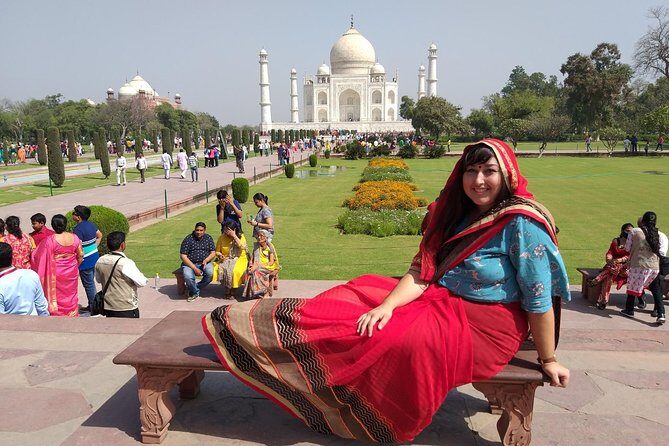
Agra is the headline day, and the itinerary gives you the correct balance: first Taj Mahal, then Agra Fort. Taj Mahal is the emotional peak; Agra Fort is the historical context.
Taj Mahal: crown of the palace, built in a defined timeline
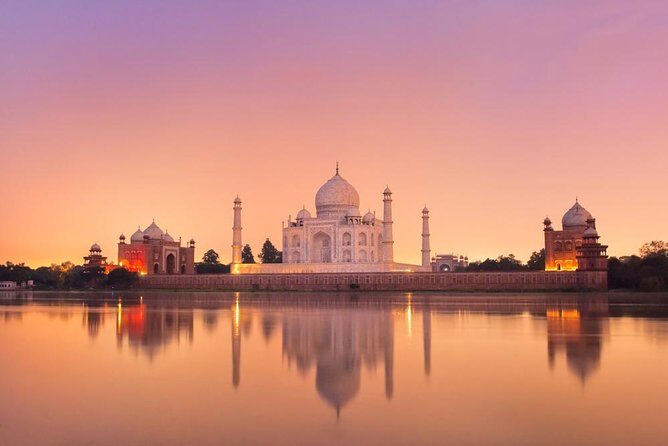
Taj Mahal is described as the Crown of the Palace, and you’ll hear the key construction facts: work started in 1628 and finished in 1658 under Mughal Emperor Shah Jahan. It’s UNESCO (listed in 1983), but the real value here is understanding how it was built to be experienced.
Also, here’s your practical reality check: entry tickets aren’t included, and a sunrise visit (if that’s part of your plan) is weather-dependent. One more timing rule matters a lot: on every Friday, Taj Mahal remains closed. If your dates fall on a Friday, you should expect your day to be adjusted around that reality.
Timing: about 2 hours.
Agra Fort: where the Mughal dynasty lived and ruled
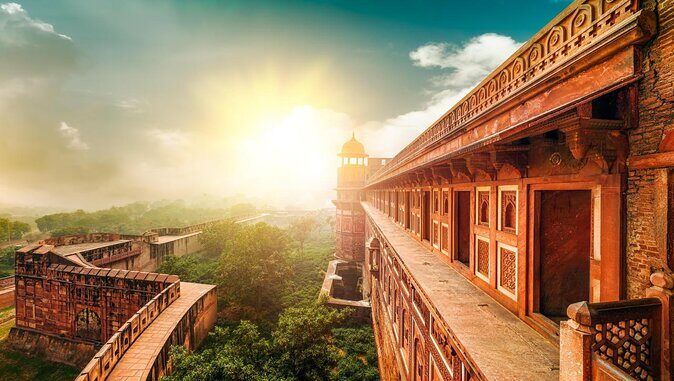
After Taj Mahal, you head to Agra Fort. This fort was the main residence of the Mughal Dynasty, and it’s another UNESCO World Heritage site. Forts can turn into “more walls” if you don’t have context, but with the right guide, Agra Fort becomes a look at power—how rulers built living spaces, security, and ceremony into one complex.
Entry tickets aren’t included here either, so treat it as part of the extra-budget category.
Timing: about 1 hour.
Drive to Jaipur and check-in
Once Agra wraps up, you drive to Jaipur, check into your hotel, and sleep there for the night. This is the smart sequencing: Jaipur’s forts and palaces need energy, and Agra’s driving day already spends most of your day’s daylight.
Day 3 in Jaipur: Amber Fort artistry, City Palace architecture, and Jantar Mantar math
Jaipur feels different from Delhi and Agra. The city’s palaces and observatories make it feel like a planned environment, not just a place that grew over time. This final day stays in that royal core.
Amber Palace (Amer Fort): ramparts, gates, and artistic style
Amber Fort—also called Amber Palace or Amer Fort—is known for its artistic style elements, large ramparts, and a series of gates. You’re not looking at one building; you’re walking through a fort system where each entry point changes the view and the mood.
It’s easy to see why people remember this one. The ramparts give you layers, and the gate sequence makes the fort feel like a story with chapters.
Timing: about 1 hour 30 minutes. Entry tickets not included.
City Palace of Jaipur: Maharaja Sawai Jai Singh II’s mix of styles
Then comes the City Palace, constructed by Maharaja Sawai Jai Singh II. It reflects both Mughal and Rajput architecture—so you’ll see how different royal traditions shaped the same city. What’s practical and interesting is that it isn’t just one palace hall. The complex includes gardens, buildings, open courtyards, and even a temple and museum.
This stop is the most “walk-and-read” style of the day. It’s also where you can slow down if you’re the kind of traveler who likes to look closely at details.
Timing: about 1 hour. Entry tickets not included.
Jantar Mantar: an astronomical observatory with geometry built in
Jantar Mantar is the final major stop. It’s an astronomical observatory used to measure distance and positions of celestial objects. The key idea is that it relies on clever geometrical patterns, and that makes it feel different from purely ceremonial monuments.
It’s also a good way to end the trip because it shifts you from architecture into science and method. Even if you don’t understand all the instruments, you’ll understand the intent: this was observation made physical.
Timing: about 30 minutes. Entry tickets not included.
Return drive to Delhi
After Jaipur, the tour drives back to Delhi and drops you at your hotel or airport. That transfer matters because it saves you time and keeps the day from turning into a separate travel project.
What you’re really buying: hotel nights, guides, and transport value
At $436 per person, you’re paying for more than check-the-box sightseeing. The included parts are where the value tends to live:
- Private driver with AC vehicle across the Golden Triangle routes
- Professional local city guides for the major monuments
- Two nights in a 4- to 5-star hotel
- Everyday buffet breakfast included for 2 mornings
- Bottled water
If you try to assemble this yourself, the price can spread out in annoying ways. You’d pay for transport between cities, pay for multiple guided experiences, and still have to manage where you sleep and when you eat. Here, those pieces are bundled. That’s why the feedback you’ll see tends to focus on ease—because the days are handled as a unit.
One important note: monument entry tickets and camera fees are not included. So think of this as paying for the “experience system” (vehicle + guides + hotel + breakfast), then budgeting separately for the site admissions.
And the tour is private in the true sense: only your group participates. That reduces waiting time and makes it easier for your guide to keep the flow moving around your questions.
Tickets, the Taj Friday closure, and how to avoid last-minute stress
This is the part of the tour you should plan for early, because it impacts timing.
Monument entry and camera fees
Admission tickets are listed as not included at the main stops, and camera fees at monuments aren’t included either. The one exception called out in the schedule is India Gate, which has free entry. Still, for Taj Mahal, Agra Fort, Humayun’s Tomb, Qutub Minar, Amber Fort, City Palace, and Jantar Mantar, you should expect extra costs at the sites.
If you don’t like surprise expenses, set aside a clear budget before you go.
Taj Mahal sunrise is weather-dependent
If your plan includes a sunrise visit, it’s subject to weather conditions. That means you should be flexible with your day’s start time and not assume perfect conditions.
Friday closure rule
On every Friday, Taj Mahal remains closed. This is not a minor detail. If your dates land on a Friday, you’ll need to understand that your “big Taj moment” won’t happen on that day.
Practical advice: if your travel dates include a Friday, look at the rest of the itinerary with fresh eyes. Agra Fort can still be a strong highlight, and Jaipur’s forts and palace complex will still deliver the architecture fix.
Staying comfortable on a fast-moving 3-day route
This kind of tour is about managing your body as much as your schedule.
- Wear comfortable walking shoes. Most of the time you’ll spend on your feet, even if the stops have set durations.
- Expect a mix of standing and sun exposure. You’ll be near open courtyards and large outdoor monument spaces.
- Bring water discipline. Bottled water is included, which helps, but you’ll still want to sip regularly.
- Use the time wisely inside major sites. With guides explaining what you’re seeing, you’ll get more from shorter visits.
Also, a small but helpful detail: your tour uses a mobile ticket. That can reduce friction when you check in and start the day, especially with changes in city traffic and meeting points.
Who this tour fits best
This is a great fit if you want:
- A guided, low-stress Golden Triangle experience
- Big monument coverage without managing city-by-city logistics yourself
- The comfort of 4–5 star hotels for two nights plus breakfast
- A format that stays private and organized, with time to ask questions
It may be less ideal if you want lots of free time for shopping, side streets, or slow museum-style pacing. Here, the day is for landmark hits—done well, but not leisurely.
Should you book this Private 3-Day Golden Triangle Tour?
If you want to see Delhi, Agra, and Jaipur in a tight window without turning your vacation into a planning spreadsheet, I think this is a solid choice. The combination of private AC transport, local city guides, and two nights in a 4–5 star hotel with buffet breakfast is the kind of value that saves real energy.
Book it if:
- You’re aiming for UNESCO classics like Humayun’s Tomb, Qutub Minar, Taj Mahal, Amber Fort, and City Palace
- You’re fine paying monument admissions separately
- You can work with the Friday Taj closure rule and any sunrise weather changes
Skip or reconsider if:
- Taj Mahal timing is non-negotiable for your dates and you’re traveling on a Friday
- You dislike tours where the schedule leaves little room for extra detours
If your goal is to leave with the feeling that the Golden Triangle was handled right—without the hassle—this one deserves a spot on your shortlist.
FAQ
How long is the Private 3-Day Golden Triangle Tour?
The tour lasts about 3 days, with two nights of hotel accommodation.
What hotel category is included?
You get two nights in a 4 to 5 star hotel.
What’s included in the price besides the tour sites?
The price includes a private driver with an air-conditioned vehicle, professional local city guides, bottled water, the hotel stay (two nights), and buffet breakfast (2 breakfasts).
Are monument entry tickets included?
No. Monument admission tickets are not included, and camera fees at monuments are also not included.
Is Taj Mahal sunrise included?
A sunrise visit to Taj Mahal is listed as possible, but it is subject to weather conditions.
What happens if my travel dates include a Friday?
Taj Mahal remains closed every Friday, so you won’t be able to visit it that day.
Do I need a passport for this tour?
Yes. A current valid passport is required on the day of travel.
Can I cancel for a full refund?
Yes, you can cancel for free up to 24 hours in advance of the experience’s start time for a full refund. If you cancel less than 24 hours before, the amount isn’t refunded.