Delhi to Jaipur to Agra, all in one smooth run. What makes this Golden Triangle tour feel worth it is the private guide style and the classic big-ticket sights packed into a tight schedule. You’ll hit the Taj Mahal and the forts, plus Delhi’s major monuments and Jaipur’s wind-and-water icons.
I particularly like how the day structure keeps you moving without feeling frantic: you start with pickups, see the big highlights with guidance, and still get time for shopping and breaks. I also like that your tour includes 4-star hotel stays and breakfast, so you’re not constantly hunting for plans after a long sightseeing day.
One consideration: many stops list admission tickets as not included, so you’ll want to budget extra for entry fees even though the tour covers guide time, transport, and most logistics.
In This Review
- Key things I’d plan around
- Why This Golden Triangle Route Works in 3 Days
- Day 1 in Delhi: Qutub Minar, Humayun’s Tomb, Old Delhi Markets, then Agra Drive
- Day 2 in Agra: Taj Mahal, Agra Fort, and the “Bachcha Taj” feel
- Day 3 in Jaipur: Amer Fort, Jal Mahal, Hawa Mahal, and Jantar Mantar
- What’s Included, and What You’ll Pay Extra for
- Value at $330.67: Is it worth it for your time and comfort?
- Practical tips to make the most of each stop
- Should You Book This Golden Triangle Tour?
- FAQ
- What time does the tour start?
- Where do pickups happen?
- Is this tour private?
- How many nights and days is the trip?
- What’s included in the tour package?
- Are entrance tickets included for all the sights?
- Is the Lotus Temple open every day?
- What is the cancellation policy?
Key things I’d plan around
- Private guide and private vehicle means less waiting and a calmer pace
- Guaranteed line-skip helps a lot at major sites like the Taj area
- Pickup and drop-off from airport, rail station, hotel, or other Delhi location
- 4-star hotel + breakfast for 3 mornings lowers your daily stress
- Some entrance tickets are extra, and the Lotus Temple is closed Mondays
Why This Golden Triangle Route Works in 3 Days
This is the kind of Golden Triangle trip that makes sense if you want the highlights fast and you don’t want to stitch together transport and guides on your own. The route follows the classic loop: New Delhi → Agra → Jaipur → back to Delhi, with hotel check-in built in so you can reset between sightseeing days.
The value is in the mix of guided landmarks plus real-world convenience. You get a professional guide, driver, bottled water, and hotel pickup and drop-off, plus transport by private vehicle. That matters because India’s distances can be real, and “saves time” is not just marketing when you’re moving between three cities.
The best part is that you’re not just watching buildings from the outside. Your stops are built around places that reward a guide’s pacing—what to look for, where to stand, and how the different monuments connect historically and architecturally. You’ll still enjoy the big wow moments, but you’ll also understand what you’re seeing as you go.
A few more New Delhi tours and experiences worth a look



Day 1 in Delhi: Qutub Minar, Humayun’s Tomb, Old Delhi Markets, then Agra Drive
Your day starts early—7:00 am pickup from the airport, railway station, hotel, or another requested Delhi spot. Then you’ll do a half-day city tour focused on Delhi’s landmark cluster: Qutub Minar, Humayun’s Tomb, Lotus Temple, and India Gate, plus driving past major government buildings like the Parliament House and President’s Palace.
Here’s why that opening set works. Qutub Minar gives you an instant sense of Delhi’s layered timeline. It’s a 73-metre tall tapering minaret with five storeys, part of the Qutb complex (UNESCO World Heritage). Seeing it with context helps because it’s not just a tall tower—you start to notice the bigger complex around it.
Then you move to Humayun’s Tomb, commissioned in 1569–70 by Humayun’s first wife and designed by Persian architects. This stop is one of the reasons a guide is useful: you’ll catch the Mughal approach to symmetry and gardens, which makes it feel like a blueprint for later monuments.
Next comes Bahai Temple (Lotus Temple), the flowerlike Bahá’í House of Worship dedicated in December 1986. The practical detail you should care about: it’s closed Mondays. If your dates line up with Monday, you’ll want to confirm whether your schedule adjusts. Like all Bahá’í Houses of Worship, it’s open to everyone, no religious restriction—so dress comfortably for walking, and don’t stress about a special entry vibe.
After that, you’ll have time to shop, including a stop around Chandni Chowk, one of Old Delhi’s busiest shopping areas. Expect narrow lanes, small stalls, and lots of browsing—spices, dried fruit, silver jewelry, saris, oils, stationery, and sweets. This part is where your trip starts to feel like more than sightseeing; it’s Delhi as a living city.
Even though the day includes several stops, you’ll still end with a transfer to Agra via the expressway, about a 3-hour drive. When you arrive, you check into your hotel and can decompress. This is smart planning because Agra days are intense, and you’ll want energy for tomorrow.
Finally, your day also includes the Red Fort area. It’s tied to Independence Day flag-raising and a nationally broadcast speech from its ramparts. If you catch it in daylight, you’ll appreciate it as a fortress first, then as a national symbol.
Day 2 in Agra: Taj Mahal, Agra Fort, and the “Bachcha Taj” feel
Day 2 is built around the Agra highlights: Taj Mahal, Agra Fort, and Tomb of Itimad-ud-Daulah. If you’ve only got a short Golden Triangle, this is the day you’re likely most focused on—and it’s also the day where line-skip (included) helps most.
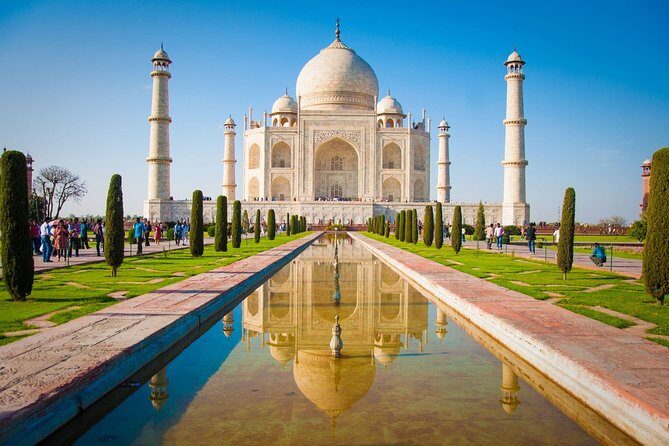
At the Taj Mahal, you’re looking at an ivory-white marble mausoleum commissioned in 1632 by Shah Jahan for Mumtaz Mahal, with Shah Jahan’s tomb also inside. The key to making this stop satisfying is time and positioning. The guide’s job here is to keep you from getting lost in the crowd flow and to point out the details that don’t pop out instantly from the first viewpoint.
Next you’ll visit Agra Fort, which served as the Mughal emperors’ main residence until 1638, when the capital shifted to Delhi. It also includes layers of occupation history beyond the Mughals; the last Indian rulers before British capture were the Marathas. That’s why this fort feels different from other forts: it’s not just walls and gates—it’s a timeline you can walk through.
Finally, you’ll stop at the Tomb of Itimad-ud-Daulah, often described as a “jewel box” and nicknamed the Bachcha Taj. It’s frequently seen as a draft of the Taj Mahal concept, so the takeaway is connection. You’ll notice ideas that lead to the bigger masterpiece you saw earlier, which turns a second mausoleum into something more than repetition.
Admission tickets are marked as not included for these major stops, so plan for that. Still, having a guide and transport sorted saves you from dealing with ticket lines and logistics while your day is already tight.
Day 3 in Jaipur: Amer Fort, Jal Mahal, Hawa Mahal, and Jantar Mantar
Your last day shifts to Jaipur, and it starts with Amer (Amber Fort), a principal tourist attraction high on a hill about 11 km from Jaipur. This stop is marked Admission Ticket Free in the provided details, which is a pleasant surprise in a tour where many other entry fees are extra.
Amer Fort is where you get the fort-on-a-hill wow. You’ll likely spend around 2 hours here, enough for you to see the main areas without racing. The guide’s value shows up again: forts can feel like walls and courtyards until someone helps you understand what each section signals.
Next is Jal Mahal (Water Palace). You’re seeing a palace sitting in the middle of Man Sagar Lake, renovated and enlarged in the 18th century by Maharaja Jai Singh II of Amber. This is one of those stops that’s more about view and setting than heavy indoor time. Plan for photos and a quick look rather than expecting a long museum-style visit.
Then you’ll go to Hawa Mahal (Palace of Wind) for about 30 minutes. It’s the red and pink sandstone façade that extends toward the Zenana (women’s chambers) and was built in 1799. Even with a short stop, it’s worth it if you care about architecture and urban design, because the façade is designed around light, airflow, and the city’s texture. The timing helps you avoid turning this into an hour-and-a-half detour.
After that: Jantar Mantar, the UNESCO-listed collection of astronomical instruments built by Sawai Jai Singh II, completed in 1734. It features the world’s largest stone sundial. This is not a typical “pretty building” stop. It’s a science stop wrapped in stone, and the guide helps you see why these instruments mattered—how measurement, astronomy, and daily life connected.
Your last stretch brings you back to New Delhi. You’ll have lunch in a local restaurant (own expense) and then some free time for shopping in Jaipur before the drive back and drop-off at your chosen Delhi location.
What’s Included, and What You’ll Pay Extra for
This tour’s structure is built to reduce decision-making. Here’s what’s included based on the provided details:
- Private tour with only your group
- Pickup and drop-off in Delhi
- Transport by private vehicle
- Professional guide
- 4-star hotel accommodation
- Breakfast (3)
- Bottled water
- Guaranteed to skip the long lines
- Mobile ticket
Then there’s what’s not included: food and drinks unless specified. Your schedule explicitly calls out lunch on Day 3 as your own expense.
Entrance tickets are mixed. Some locations are marked free (like the Delhi start and Amer), while others are not included. The practical takeaway: treat this as a tour where you’ll likely pay additional site fees for the biggest attractions, especially where the description flags tickets as not included.
If you’re budgeting, I’d plan extra money for entries to Taj Mahal-related areas and major monuments. That way, you won’t hit a surprise moment when you’re tired and just want to keep moving.






Value at $330.67: Is it worth it for your time and comfort?
At $330.67 per person, the price can be a great deal if you value convenience and a guided pace. The biggest “value levers” are the included 4-star hotel, breakfast, private vehicle, and a professional guide for multiple days across three cities. Add in pickup/drop-off and bottled water, and you’re removing a lot of the friction that normally comes with a Golden Triangle trip.
Line-skip is another value lever. When a tour says it helps you skip long lines, that’s usually aimed at the heavy hitters. In a short schedule, losing even one chunk of the day to queue time can wreck your photo timing and energy. Here, the tour builds in guaranteed line-skip, which you’ll feel most on the day you want the Taj Mahal experience to be smooth.
The main trade-off is the tour is packed with major stops, so you should be ready for walking and quick transitions. If you prefer slow travel with long stays at fewer sites, this might feel like a sprint. But if your goal is to check off the classics with a guide and solid logistics, this is a clean way to do it.
Practical tips to make the most of each stop
A Golden Triangle tour goes best when you travel like a planner, not a wanderer.
- Wear shoes you can walk in. You’ll be visiting forts, tomb complexes, and monument areas where surfaces can be uneven.
- Bring a small day bag for water (even though bottled water is included) plus a layer for sun and shade shifts.
- Have a simple entry-fee buffer in your budget, since many stops are marked as not included.
- Lotus Temple timing matters. If your day lines up with Monday, remember it’s listed as closed Mondays.
- Use the guide for transitions. The route includes a lot of moving parts; ask quick questions so you don’t spend energy guessing where to go next.
And one more thing: Jaipur and Agra days can feel hot and intense. If you’re sensitive to heat, pace yourself during breaks, not during the key photo moments.
Should You Book This Golden Triangle Tour?
Book it if you want a private, guided Golden Triangle with 4-star comfort, breakfast included, and line-skip so you spend more time seeing and less time managing. It’s also a strong fit if you appreciate the balance of monuments plus a real shopping stop in Old Delhi.
Skip it (or choose another style) if you want tons of free time, slow wandering, or you don’t want to deal with extra entrance fees at multiple major sites.
If you’re aiming for the classic Golden Triangle in a short window, this one is hard to fault. It’s built to get you from landmark to landmark with less stress, and that’s exactly what makes these three cities feel doable instead of exhausting.
FAQ
What time does the tour start?
The start time is listed as 7:00 am.
Where do pickups happen?
Pickup is offered from the airport, railway station, hotel, or another desired location in New Delhi.
Is this tour private?
Yes. It’s described as a private tour, so only your group participates.
How many nights and days is the trip?
It’s a 3-day (approx.) trip with 2 nights.
What’s included in the tour package?
Included items are bottled water, a driver/guide with a professional guide, hotel pickup and drop-off, guaranteed to skip long lines, private vehicle transport, 4-star hotel accommodation, and breakfast for 3 days.
Are entrance tickets included for all the sights?
No. Some stops are marked as Admission Ticket Not Included, while a couple are marked free (such as the Delhi start and Amer). Food and drinks are also not included unless specified.
Is the Lotus Temple open every day?
No. Lotus Temple is closed Mondays.
What is the cancellation policy?
You can cancel for a full refund if you cancel at least 24 hours before the experience’s start time. Cancellation is listed as free cancellation.