REVIEW · NEW DELHI
5-Day Private Delhi, Agra and Jaipur with Ranthambhore Tiger Tour From Delhi
Book on Viator →Operated by Deejohn Holidays India Tours · Bookable on Viator
Tigers plus the Taj in five days is a great combo. I like that this is built around real logistics (pickup, private air-conditioned car transfers, and admission tickets handled for you) and not just a checklist. I also like the people factor: the driver stays with you most of the time, and you get local English-speaking guides in each city for the right context. One consideration: the itinerary moves early and fast, so you’ll want energy for sunrise Taj Mahal and two Ranthambore safaris.
You’re basically doing India’s most recognizable monuments—Delhi’s Mughal and Lutyens-era landmarks, Agra’s major Mughal sites, and Jaipur’s Rajput gems—then adding Ranthambore National Park with a shared-jeep search for tigers. That mix works well if you want variety without the stress of planning every step. Still, the tiger part is a wildlife safari, not a guaranteed tiger viewing, and the jeeps for safaris are shared rather than fully private.
Practical note: it starts at 8:30am, and you’ll get a mobile ticket. That’s helpful because it reduces the annoying back-and-forth, especially across multiple UNESCO stops and city changes.
In This Review
- Key highlights worth caring about
- Golden Triangle Plus Ranthambore: what you’re really buying
- Day 1 in Delhi: Humayun’s Tomb to Parliament House in one day
- Day 2 sunrise Taj Mahal plus Agra Fort: the day that sets the tone
- Ranthambore Tiger Safari: two shared-jeep attempts that make the trip feel complete
- Day 4 Jaipur’s Old City: City Palace and Jantar Mantar
- Day 5 Amber Palace plus Jal Mahal and Hawa Mahal photos
- Hotels, meals, and that private-car comfort you’ll notice more than you expect
- Price and logistics: when the $697 per person feels like a bargain
- Who should book this tour, and who should pause
- Should you book this 5-Day Private Delhi, Agra and Jaipur with Ranthambhore Tiger Tour?
- FAQ
- What cities are included in this 5-day tour?
- Does the tour include entrance fees and admission tickets?
- Will I have an English-speaking guide?
- Are safaris private?
- What are the main UNESCO sites visited?
- Is hotel comfort included?
- What time does the tour start?
- Can I get a full refund if I cancel?
Key highlights worth caring about
- Admission tickets included across the main sights, so you spend less time waiting and more time seeing.
- Local English-speaking guides in each city, which makes monuments like Humayun’s Tomb and Jantar Mantar click fast.
- Private car transfers throughout, with the driver staying with your group for day-to-day moving.
- Two tiger safari chances (morning and afternoon) in shared jeeps, giving you more than one shot at spotting wildlife.
- A mix of iconic architecture: Mughal tombs, Rajput forts, and Delhi’s early 20th-century government landmarks.
- Service that handles real travel needs, including help with luggage and getting in and out of vehicles, as shown by the driver Kishore in one review.
Golden Triangle Plus Ranthambore: what you’re really buying
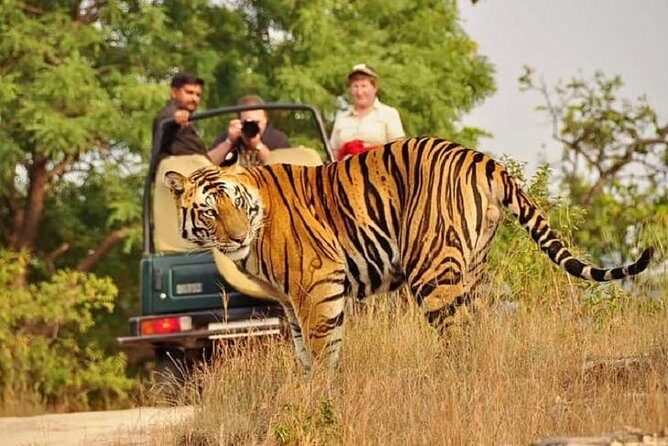
On paper, this looks like a standard Golden Triangle itinerary plus Ranthambore. In practice, what you’re paying for is the smoothing of the travel edges. When you add Delhi, Agra, Jaipur, and a national park safari into one trip, the biggest stress is not the monuments—it’s the timing, ticket lines, and figuring out who does what.
This tour answers those problems with a few concrete choices: admission tickets are included, you have local English-speaking guides, and you ride in a private air-conditioned car with pickup offered. Then you get a wildlife component at the end with two safaris in Ranthambore National Park using shared jeeps.
Value-wise, that matters. If you’ve ever tried to stitch together guides, entry fees, and transport yourself across these cities, you already know how quickly “cheap” becomes “time expensive.” Here, you’re paying to buy back time and sanity—especially on days built around multiple stops. The rate you see ($697.20 per person) only feels fair when you factor in entrances, guides, hotel quality, and the fact that it’s a private tour (your group only).
You can also read our reviews of more private tours in New Delhi


Day 1 in Delhi: Humayun’s Tomb to Parliament House in one day

Delhi on this route is a controlled sprint through the city’s heavy hitters. You start with Humayun’s Tomb, a UNESCO site and one of the Mughal landmarks that teaches you how these rulers blended Persian design with Indian space-making. Then you head to Qutub Minar, another UNESCO stop, where the scale of the tower hits you even before you understand the story.
Next comes a breather that changes the mood: the Lotus Temple. It’s shaped like a lotus with 27 marble-like petals and is designed for calm worship—an intentional pause in a hectic city day. For me, this stop matters because it breaks the pattern of “walk, look, repeat.” It also gives you a chance to reset before the landmarks get more political and monumental.
After that, the day turns outward with Delhi’s big symbolic architecture. You’ll visit India Gate, a stone memorial arch designed by Lutyens, and then the Parliament area where 1947’s handover of power happened and the current parliament still meets. Finally, you stop at Rashtrapati Bhavan, the official President House, formerly home to the British Viceroy. Even without going super deep, these visits help you understand that Delhi isn’t only Mughal-era and temple-era—it’s also a capital built by multiple empires, each leaving their blueprint.
Potential drawback: it’s a lot of ground in one day. You’ll do best if you keep your pace steady, wear comfy shoes, and don’t treat every stop like a museum exhibit that needs a full afternoon.
Day 2 sunrise Taj Mahal plus Agra Fort: the day that sets the tone
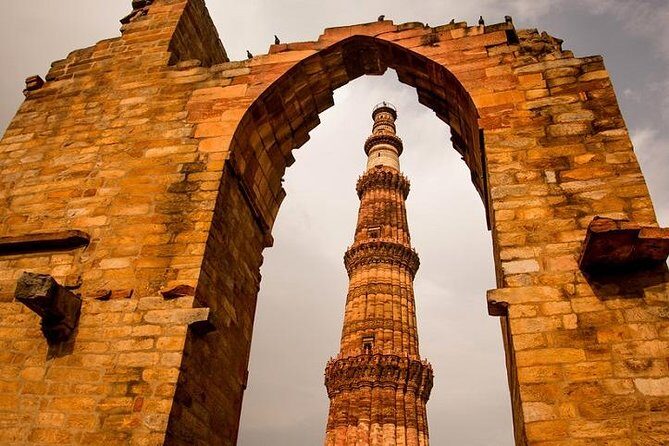
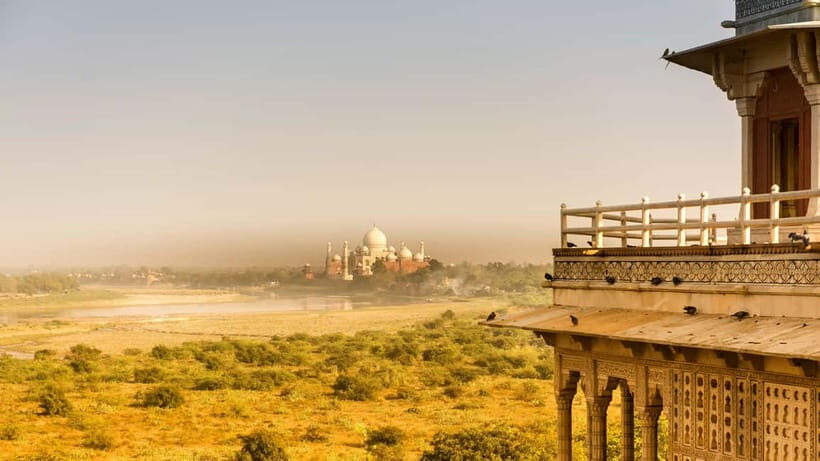
Agra days live and die by timing, and this itinerary tackles that with a sunrise Taj Mahal visit. Going early helps because Taj Mahal is famous for a reason—it’s a masterwork in light, proportion, and craftsmanship—but it also gets crowded and hot as the day moves on. Sunrise gives you a quieter atmosphere and better photographic conditions.
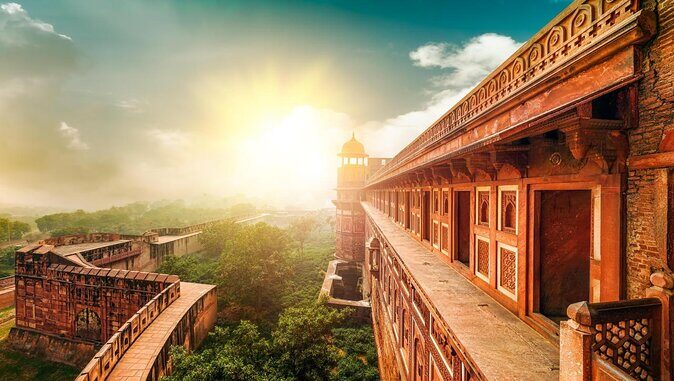
Then you move to Agra Fort, a UNESCO site along the Yamuna River that served as the Mughal emperors’ main residence for a long stretch of time. This is where you shift your brain from beauty (Taj Mahal) to power (fortifications, court life, and the scale of Mughal control). Even if you’re not a “history person,” it’s an easy stop to enjoy because it’s visual and structural. You can look up, look across, and feel the planning behind it.
One real advantage of using guides here is interpretation. The Taj Mahal reads differently when someone explains what you’re seeing beyond the obvious marble-and-domes. And with Agra Fort, a good guide keeps you from getting lost in the maze of walls and gates by giving you a simple route to follow mentally.
Ranthambore Tiger Safari: two shared-jeep attempts that make the trip feel complete
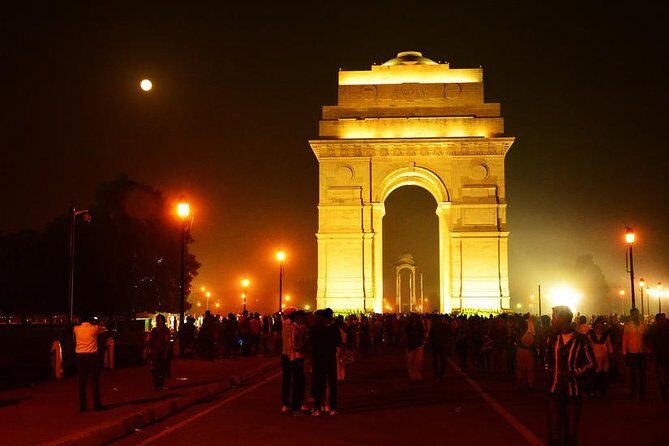
Ranthambore National Park is the reason this tour feels like more than a “monuments-only” India trip. You get two safari outings: one in the morning and one in the afternoon, both in shared jeeps. That matters because it gives you more than one chance during the day. It also keeps the experience realistic in terms of wildlife viewing patterns—wildlife doesn’t wait for your schedule.
The tour specifically frames the safari as searching for tigers, and that’s exactly what you should mentally prepare for. Bring patience. Expect unpredictability. Your job isn’t to “find a tiger on command”—your job is to be in the right place at the right time and stay attentive.
What I like about the two-safari format is that it reduces the odds of one bad outing ruining the whole wildlife component. Even if you don’t see a tiger, you’re still in a protected landscape with the chance to observe the park’s other wildlife and the rhythms of the habitat. Also, the safari is guided by a naturalist, which can help you spot smaller cues you might otherwise miss.
Quick practical tip: safaris are short-window experiences with lots of waiting before movement. Dress in layers, and keep your essentials easy to reach. The car transfers and hotel breaks will be your recovery time—use them well.
Day 4 Jaipur’s Old City: City Palace and Jantar Mantar
After Delhi and Agra’s monumental energy, Jaipur brings a different kind of wonder: palace geometry and scientific design.
You start at the City Palace, the residence of the royal family, right in the middle of Jaipur’s Old City. It’s a complex of courtyards, gardens, and buildings that span different periods, which is helpful because it keeps the place from feeling like one static photo spot. You’ll naturally notice how power and daily life overlap in a palace setting.
Then you visit Jantar Mantar, a UNESCO site and an observatory made of curving geometric structures meant to measure movements of stars and planets. This stop is a great change of pace. Most people come to Jaipur expecting forts and palaces, but Jantar Mantar gives you a reason to pause and think. It’s one of those places where a little explanation makes a huge difference—suddenly the shapes aren’t random. They’re tools.
If you’re tempted to rush these stops because Jaipur days can feel crowded, don’t. Jantar Mantar rewards slow looking, and City Palace is best when you take your time walking through transitions between courtyards.
A few more New Delhi tours and experiences worth a look




Day 5 Amber Palace plus Jal Mahal and Hawa Mahal photos
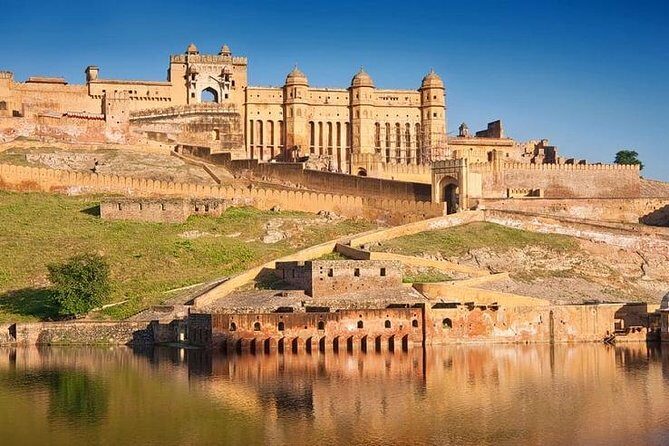
Jaipur’s final day is built for the big views.
You’ll visit Amber Palace (Amber Fort), the honey-colored fort that rises from a rocky mountainside about 11km northeast of Jaipur. This is classic Rajput architecture—strong, theatrical, and designed to impress from far away. It’s also the kind of stop where the guide helps you understand which parts mattered most to the people who lived there and why.
After Amber, you get photo stops at Jal Mahal, the water palace near Man Sagar, and then Hawa Mahal, the Palace of Winds with its signature five-storey honeycomb façade. Since they’re listed as photo stops, don’t treat them like full timed museum sessions. The goal is to see them well and move on with the day.
Jal Mahal is especially interesting visually because it looks different depending on light and water levels. Hawa Mahal hits you with detail when you get close enough: the windows and façade are made for breath and airflow, and they also function as a kind of architectural storytelling.
This day is the “wrap-up brilliance” portion of the trip. You’ll leave with the strongest Jaipur images in your head, but don’t forget that the real payoff is still the fort visit, not only the famous façade photos.
Hotels, meals, and that private-car comfort you’ll notice more than you expect
The tour includes select meals and sleeps you in four- and five-star hotels. That’s not a tiny detail. In India, when you move between cities every day, hotel comfort becomes a daily part of your experience. After sunrise Taj, you’ll feel it. After safari mornings, you’ll feel it again.
You also get private, air-conditioned car transfers. For Delhi-to-Agra-to-Jaipur-style travel, that comfort matters, because you’re in transit a lot. A comfortable car doesn’t just make it pleasant; it helps you keep your energy for the walking portions.
One service detail stands out from the reviews: the driver Kishore took amazing care of a 77-year-old mother who used a cane, helping with getting in and out and handling the luggage. That tells me the team’s attention isn’t only about the route—it’s also about how you physically move during the day. If you have any mobility needs or you’re traveling with someone who does, it’s smart to communicate those needs early.
Price and logistics: when the $697 per person feels like a bargain
Price is always personal, but here’s how I’d judge value for this exact style of tour.
You’re paying around $697.20 per person for:
- A 5-day private itinerary across Delhi, Agra, Jaipur, and Ranthambore
- Local English-speaking guides and admission tickets included
- Private air-conditioned transfers and pickup offered
- Luxury hotel category and select meals
- Two Ranthambore safaris in shared jeeps
For someone who wants convenience and interpretation, it’s a decent deal. For someone who’s happy to self-navigate and hunt down entry tickets and guides, it might feel more expensive than necessary. But the truth is: this itinerary has too many moving parts to DIY comfortably unless you’re already well practiced.
One more consideration: this is private as a group tour, but the safari itself is shared-jeep. So you get privacy with your core group, while still joining others for wildlife logistics.
Who should book this tour, and who should pause
This tour is a strong match if you:
- Want a first-timer-friendly Golden Triangle with the major stops handled
- Appreciate English-speaking guides for context (it noticeably improves monuments like Jantar Mantar and Mughal sites)
- Want wildlife added without turning the trip into a separate planning project
You might want to think twice if you:
- Hate early starts. Sunrise Taj Mahal and safari timing mean your day begins before you’re fully in “vacation mode.”
- Need maximum quiet time. Delhi’s day is packed, and Jaipur’s last day includes fast photo stops.
If you love efficient travel, this works. If you want slow wandering with lots of free hours, you may feel the structure more than you’d like.
Should you book this 5-Day Private Delhi, Agra and Jaipur with Ranthambhore Tiger Tour?
If you want one trip that covers India’s top monument highlights and ends with a real nature experience, I’d book it. The biggest reason is the way it’s organized: English-speaking guides, included admissions, private car comfort, and two chances for safari viewing. That combination takes a lot of pressure off you, which is what you want when you’re juggling several cities in only five days.
Book it if you like having a plan you can trust and you’re okay trading some free time for smooth execution. Skip it (or at least adjust expectations) if early starts and a full schedule make you grumpy. In that case, you’d probably prefer fewer stops or a longer trip.
FAQ
What cities are included in this 5-day tour?
The tour covers New Delhi, Agra, Jaipur, and Ranthambore National Park.
Does the tour include entrance fees and admission tickets?
Yes. Admission tickets are included as part of the tour.
Will I have an English-speaking guide?
Yes. You’ll have local English-speaking guides for the sightseeing days, plus an English-speaking naturalist for the tiger reserve.
Are safaris private?
The Ranthambore safaris are done in shared jeeps, with one in the morning and another in the afternoon.
What are the main UNESCO sites visited?
The itinerary includes Humayun’s Tomb, Qutub Minar, Taj Mahal, and Jantar Mantar as UNESCO World Heritage sites.
Is hotel comfort included?
Yes. The trip includes stays in four- and five-star hotels.
What time does the tour start?
The start time is 8:30am.
Can I get a full refund if I cancel?
The policy allows free cancellation and a full refund if you cancel at least 24 hours before the experience start time.