REVIEW · NEW DELHI
3 Days Express Golden Triangle Tour India
Book on Viator →Operated by India Voyages · Bookable on Viator
Three days is not long for India. That’s why this express Golden Triangle plan works: it hits Agra and Jaipur’s big UNESCO landmarks with a tight, efficient route. I like having pickup built in, plus the trip’s focus on Mughal-era monuments that you can’t easily stitch together on your own in such a short time.
The tradeoff is the pace. Most key sights have admission tickets marked as not included, so you’ll want to budget for entry fees and still respect time at each stop.
In This Review
- Key highlights at a glance
- Three Days, One Big Route: What the Express Golden Triangle Does Well
- Meeting at 8:00am: Timing, Traffic, and Staying Sane
- Agra Fort: Mughal Power in Stone (and What to Look For)
- Itimad-ud-Daulah (Baby Taj): The Mini Masterpiece Moment
- Taj Mahal Planning: Friday Closures and Photo-Friendly Expectations
- Fatehpur Sikri: Akbar’s Short-Lived Capital in One Hour
- Jaipur’s Jal Mahal Stop: A Quick Lake Break That Changes the Mood
- City Palace of Jaipur: Royal Complexes and Courtyard Time
- Jantar Mantar and Hawa Mahal: Science and the Women’s Facade
- Price and Value: What $185 Includes, and What You’ll Add
- Drivers Make or Break It: How Feedback Maps to Your Day
- Who Should Book This Tour (and Who Should Skip It)
- Should You Book This 3 Days Express Golden Triangle Tour?
- FAQ
- What cities does the 3-day Golden Triangle cover?
- Is pickup included, and what time does the day start?
- Are admission tickets included for the main sights?
- Does the tour operate in all weather?
- What happens if I visit on a Friday?
- Is this tour private or shared with other groups?
- Is there free cancellation?
- Is breakfast included?
Key highlights at a glance
- Hotel pickup starting at 8:00am means you lose less time figuring out logistics.
- UNESCO World Heritage concentration: Agra’s Mughal sites plus Jaipur’s historic monuments and science landmark.
- Mughal-to-Rajput story arc: Taj Mahal and Agra Fort on one end, Jaipur palaces and Jantar Mantar on the other.
- Drivers named Sumit, Tabul, Anil, and Shyam show up in feedback for punctuality, patient driving, and calm, practical help.
- Taj Mahal Friday closure workaround: the plan switches to an evening alternative when needed.
- Two breakfasts are included, but you’ll still plan for lunches and dinners on your own.
Three Days, One Big Route: What the Express Golden Triangle Does Well
Golden Triangle tours get called “express” for a reason. You’re not going for slow mornings and long museum breaks. You’re going for the headline sites in a way that feels doable, even if this is your first trip to India.
What makes this one especially practical is the structure. You start in New Delhi with pickup offered, then you move to Agra and Jaipur in a way that keeps you from bouncing around too much. The itinerary also avoids a common mistake: too many stops that sound interesting but don’t fit together historically. Here, the Mughal thread runs through Agra, then Jaipur brings in Rajput royal architecture and Rajput science.
One more thing I appreciate is the “private for your group” setup. That usually means less time herding people and more time for quick questions, photo stops, and small course corrections when traffic or timing gets weird.
A few more New Delhi tours and experiences worth a look



Meeting at 8:00am: Timing, Traffic, and Staying Sane
The plan starts at 8:00am. That matters because driving times across the Golden Triangle can be stretched by traffic and check-in rhythm at major monuments. An early start gives you a better shot at cleaner navigation through busier areas.
Transfers are listed as approximate, and the company also notes that exact duration depends on time of day and traffic. In practical terms, this means you should travel with a flexible mindset. If you’re the type who needs every minute to be perfect, you may find yourself stressed.
From feedback tied to specific drivers—names like Sumit and Tabul come up repeatedly—you also get a sense that the human part is strong: punctual pickup, cautious driving, and willingness to adapt if the day runs later than expected. One driver was even described as planning around disruptions, which is a real skill on long road days.
Agra Fort: Mughal Power in Stone (and What to Look For)
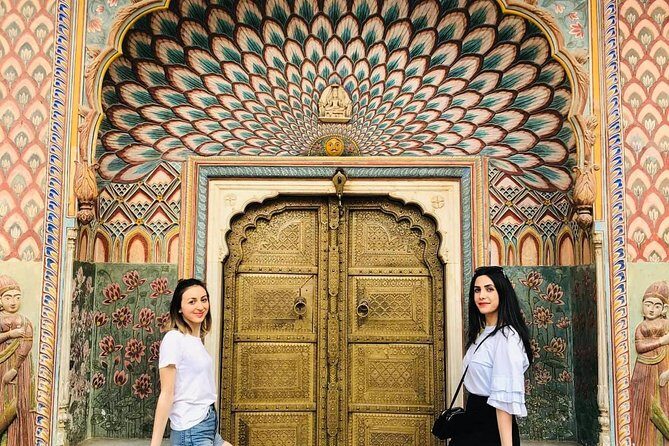
Agra Fort is a UNESCO World Heritage site, and it’s a serious one. This is the fort tied to Mughal royalty and palace life, not just a defensive wall. The context matters: it’s the place connected with Shah Jahan’s late-life story, including the moment when his son took over and kept him restrained.
In a 1-hour slot, you won’t see everything in slow, museum-style detail. But you can still make the visit meaningful if you walk with intent. Look for how the fort’s buildings create a layered impression of power—courts, residences, and the way the Mughal elite lived close to the center of authority.
Admission tickets are marked as not included for this stop, so you’ll want to factor that into your budget. I’d also plan to bring patience for crowd flow, because Agra’s top sights tend to draw people all day.
Itimad-ud-Daulah (Baby Taj): The Mini Masterpiece Moment
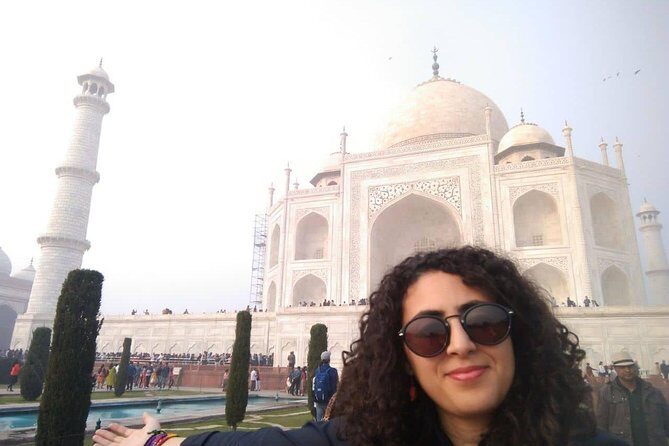
Right after Agra Fort, you’ll see Itimad-ud-Daulah, a Mughal mausoleum built between 1622 and 1628 by Nur Jahan for her father Mirza Ghiyas Beg. You’ll hear it compared to the Taj Mahal, and the nickname Baby Taj isn’t totally random. It’s often described as a draft or early step toward the Taj’s design language.
This stop is only listed as 1 hour, but it’s the kind of monument where shorter time can actually help. You get the chance to focus on detail without rushing your brain through too many big-picture stops back-to-back.
I like this inclusion because it gives you a bridge. You’re not jumping straight from one fort to the Taj’s full-scale showpiece. You get to see the Mughal approach to symmetry and refinement in a smaller, more intimate setting.
As with Agra Fort, admission tickets are marked as not included. Still, if you’re a first-time Golden Triangle visitor, this is one of those hours that makes the rest of your trip click.
Taj Mahal Planning: Friday Closures and Photo-Friendly Expectations
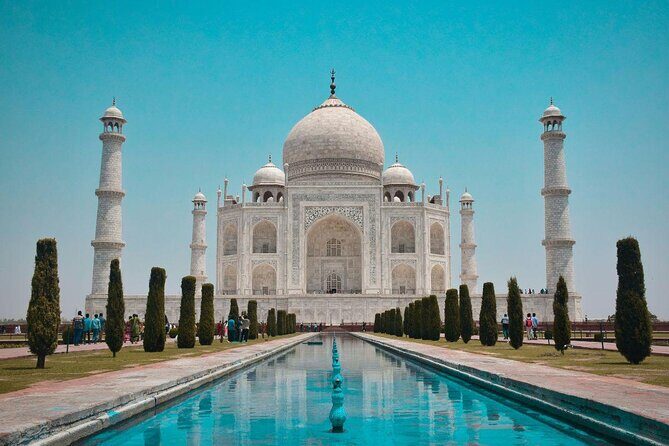
The Taj Mahal is the centerpiece, and the tour allocates 2 hours. That’s enough time to see it properly, even if you don’t want to sprint. It’s described as the 1653 masterpiece of Shah Jahan, built in memory of his wife, in a complex with gardens and fountains.
A key practical detail: Taj Mahal is closed every Friday. If your timing lands on Friday, the plan notes a swap: a sunrise tour becomes an evening tour on Thursday. This matters because it can change your light, your mood, and your ability to move easily through crowds.
You should also know the admission ticket is marked as not included here. So yes, you’ll likely pay extra beyond the tour price to enter. It’s still worth it, but it’s better to expect it than to get surprised.
One practical mindset: 2 hours at the Taj is plenty if you don’t spend all your time trying to “do everything.” Pick a perspective, take a few photos, watch how people move around the complex, and then move on. With an express itinerary, the Taj shouldn’t steal every minute.





Fatehpur Sikri: Akbar’s Short-Lived Capital in One Hour
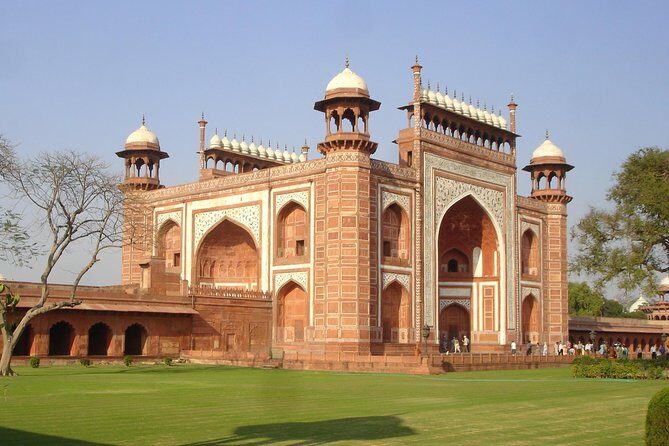
Fatehpur Sikri is a fast stop, but it’s memorable for a very specific reason: it was a capital of the Mughal empire for a relatively brief period (between 1572 and 1585 under Akbar) before it was abandoned. In other words, you’re walking through a royal project that didn’t last—perfect for anyone who likes history with real human timing.
The tour includes a non-guided format for this stop, with 1 hour on the clock. Admission is marked as free for this site, which can be a nice cost relief day after paying for Agra and Taj entries.
The setting is described as red sandstone buildings clustered around the city center. If you go in expecting a fully functioning modern city, you’ll miss the point. Go in expecting an architectural footprint: grand shapes, scale, and the feel of a grand plan left behind.
Since it’s non-guided, you’ll get more out of it if you come with curiosity rather than a checklist. Even a quick glance at major buildings and courtyards can help you understand why Akbar’s reign built this kind of place in the first place.
Jaipur’s Jal Mahal Stop: A Quick Lake Break That Changes the Mood
By Day 3, the trip shifts from Mughal monuments to Jaipur’s royal world. The first stop is Jal Mahal, a palace in the middle of Man Sagar Lake, constructed by Sawai Pratap Singh in 1799. You’ll have only 10 minutes here, and admission is marked as free.
Is 10 minutes enough? For me, it’s enough for what this stop does best: it gives you a visual breather. You go from long stone-and-court days to open water and a palace silhouette. That short pause can reset your energy before the bigger Jaipur monuments.
If you’re traveling with family or anyone who gets tired quickly, this is also a helpful timing choice. It keeps the day from feeling like one long rush of walking.
City Palace of Jaipur: Royal Complexes and Courtyard Time
City Palace is one of Jaipur’s most famous landmarks, and this stop is allocated 1 hour. It’s described as a vast palace complex with courtyards, gardens, and art and craft galleries.
Here’s how I’d handle the time: don’t treat it like a single building. Treat it like a set of connected spaces. Courtyards can feel like separate little worlds, and galleries can be the best place to cool down if the weather is hot.
Admission tickets are marked as not included for this stop, so again, you should plan on entry fees. Even so, the time window is reasonable for an express schedule.
One practical bonus: if you’re interested in Rajasthan’s visual culture beyond the famous exteriors, City Palace tends to deliver more variety than you expect in a limited slot.
Jantar Mantar and Hawa Mahal: Science and the Women’s Facade
Two of Jaipur’s most “only in Jaipur” sights land on this day.
First, Jantar Mantar, an astronomical instrument site built in 1734 by Rajput ruler Sawai Jai Singh II. It’s a UNESCO World Heritage site and is listed for 30 minutes. The headline detail is the world’s largest stone sundial. Even in half an hour, you can understand why the place is famous: it’s a palace of measurement, not just old stones.
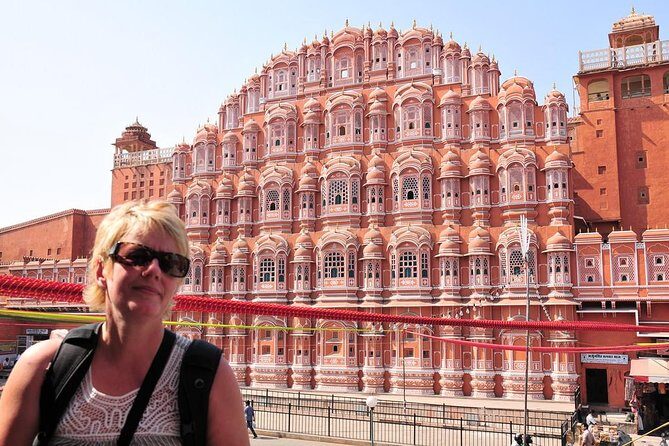
Then comes Hawa Mahal, the Palace of Wind, a five-storey honeycombed building of pink sandstone with 953 small windows (jharokhas). The description ties it to the women’s chamber of the royal family—architecture built for looking outward while staying inside court life. This stop is listed at 20 minutes, with tickets marked as not included.
This pairing is smart for an express tour. Jantar Mantar gives you the brains. Hawa Mahal gives you the look. Together they show that Jaipur wasn’t just about wealth; it was about planning, design, and public-facing identity.
Price and Value: What $185 Includes, and What You’ll Add
At $185 per person, this tour is priced as a classic short-burst Golden Triangle plan. Included items listed here are important: government taxes, parking fees, driver expenses, fuel cost, toll and interstate taxes, plus breakfast (2).
Pickup is also offered, and you get a mobile ticket, which can reduce hassle on the ground. Group discounts are noted, but it’s still a private activity in the sense that only your group participates.
The biggest “extra cost” category is admission. Many stops say admission tickets are not included, with only Fatehpur Sikri and Jal Mahal marked as free. So you should expect to pay entry fees at the Taj Mahal, Agra Fort, Itimad-ud-Daulah, City Palace, Jantar Mantar, and Hawa Mahal.
Even with those extras, the value can still make sense if you want the UNESCO hits without spending extra time arranging transport between cities. You’re buying convenience and a working route, not just a list of attractions.
Drivers Make or Break It: How Feedback Maps to Your Day
In a tour like this, you feel the road before you feel the monuments. That’s why the driver quality shows up again and again in real feedback.
Names like Anil, Sumit, Tabul, Tamul, Shyam, and Surender appear tied to specific strengths: punctual pickup, careful driving, patience with questions, and a calm tone when plans need small adjustments. One driver was described as flexible with timing, including starting later than planned without turning it into a headache.
A very practical example from feedback: a forgotten parcel was handled with follow-up help, which tells you something about reliability. Another example: a surprise detour to a monkey temple hidden in the forest. That kind of detour isn’t guaranteed, but it shows how a good driver can add local flavor when time allows.
Who Should Book This Tour (and Who Should Skip It)
This tour is a strong fit if you:
- want a 3-day Golden Triangle that hits Agra and Jaipur’s must-sees
- like structure and don’t want to coordinate intercity transport yourself
- prefer a driver-led format with pickup and quick practical stops
It may not be your best choice if you:
- hate paying separate admission fees for major sites
- expect slow museum-style pacing
- want long free time at each monument
If you’re traveling as a couple, family group, or small group, the private “only your group” style is especially helpful. In particular, if your group includes older travelers, the day-to-day comfort and careful handling can matter just as much as sightseeing.
Should You Book This 3 Days Express Golden Triangle Tour?
If your goal is to see the headline UNESCO sites in Agra and Jaipur without turning your trip into a logistics project, I’d book it. The combination of pickup, an efficient route, and two included breakfasts makes the basic plan feel manageable.
Just go in with two expectations set: admission tickets for most stops will be extra, and the schedule is tight. If you can handle that, you’ll get a satisfying snapshot of Mughal grandeur and Jaipur’s royal design in a short window—exactly what an express Golden Triangle is supposed to deliver.
FAQ
What cities does the 3-day Golden Triangle cover?
The experience is based in New Delhi and is designed to take you through the Golden Triangle circuit that includes Agra and Jaipur.
Is pickup included, and what time does the day start?
Pickup is offered, and the meeting point start time is 8:00am.
Are admission tickets included for the main sights?
Not for most stops. Taj Mahal, Agra Fort, Itimad-ud-Daulah, City Palace, Jantar Mantar, and Hawa Mahal are marked as admission ticket not included. Fatehpur Sikri and Jal Mahal are marked as free.
Does the tour operate in all weather?
Yes. It operates in all weather conditions, and you’re advised to dress appropriately.
What happens if I visit on a Friday?
Taj Mahal is closed every Friday. If your schedule would normally be a Friday sunrise visit, the plan switches to an evening tour of Taj Mahal on Thursday.
Is this tour private or shared with other groups?
It’s described as a private tour/activity, and only your group will participate.
Is there free cancellation?
Yes. You can cancel for a full refund up to 24 hours in advance of the experience start time.
Is breakfast included?
Yes. Breakfast is included 2 times.