REVIEW · NEW DELHI
3-Day Private Ranthambhore Tiger Tour Including Delhi, Agra, Jaipur
Book on Viator →Operated by Pacific Classic Tours India · Bookable on Viator
Two worlds in three days. This tour strings together sunrise Taj Mahal drama and Ranthambhore tiger safaris while still giving you the classic Golden Triangle hits. I like how the plan is tight and timed for less stress, with a private A/C vehicle doing most of the heavy lifting. One watch-out: the schedule is intense, with an early Delhi pickup and long road days, plus shared jeep/canter safaris.
In This Review
- Key things I’d bookmark before you go
- Quick hits for Delhi–Agra–Jaipur plus Ranthambhore
- Golden Triangle, with tiger-country detour
- Price and what $515.50 is really buying you
- The 2:30am departure: how this trip protects your time
- Agra Fort and the sunrise Taj Mahal: two very different wow moments
- Taj Mahal at sunrise (and what weather can do)
- Breakfast at a 5-star hotel (why this is more than a perk)
- Agra Fort: Mughal power in red sandstone
- The long drive to Ranthambhore: plan for road time, not comfort fantasies
- Ranthambhore National Park: two safaris and one real goal
- Shared jeep/canter: what it means for your experience
- If your day includes a village stop: manage time and dust
- Jaipur after the safari: the Pink City in a quick, practical hit
- Amber Fort, Jal Mahal, Hawa Mahal, and the City Palace in one day
- Amber Palace: the main must-see
- Jal Mahal and Hawa Mahal: photo stops with quick stops
- City Palace: Rajasthani and Mughal mix
- Jantar Mantar: the science side of Jaipur
- Ending in Delhi (or a Jaipur drop-off): keep your next plan flexible
- What to wear, what to pack, and how to avoid tiny frustrations
- Should you book this Delhi–Agra–Jaipur plus Ranthambhore tour?
- FAQ
- What time does the tour pickup start from Delhi?
- Is the Taj Mahal sunrise visit guaranteed?
- Are the Ranthambhore safaris private?
- Does the tour include accommodation?
- What sights and entrances are included?
- What’s not included?
Key things I’d bookmark before you go
Quick hits for Delhi–Agra–Jaipur plus Ranthambhore

- Sunrise Taj Mahal timing: you start with the monument when light is soft and the crowds are thinner (weather permitting).
- Two Ranthambhore safari goes: morning and afternoon chances using shared jeep/canter rides plus an English-speaking naturalist.
- Private guides for sightseeing: local help at Agra and Jaipur, not a random mix of self-guided stops.
- Battery bus/golf cart help at the Taj: less walking right after a very early morning start.
- Hotel option available: 2 nights on twin sharing with breakfast if you book the accommodation-inclusive package.
You can also read our reviews of more private tours in New Delhi


Golden Triangle, with tiger-country detour

If your idea of India travel is more than monuments, this itinerary hits the sweet spot. You get the Golden Triangle route—Delhi to Agra to Jaipur—then trade city pace for wildlife time at Ranthambhore Tiger Reserve. That switch is what makes the trip feel fresh instead of repetitive.
I also like the way the logistics are handled. You’re on a private, air-conditioned vehicle for the main transfers, with professional local private guides for the sightseeing segments. In a short trip, that matters: it saves you from figuring out timing, parking, ticket windows, and who-to-ask when something runs behind schedule.
There’s also a real value angle in the way the ticketing is bundled. Entrance fees for the sights and Ranthambhore national park are included for the stops listed as included, which cuts down on the usual “surprise extras” headache.
Price and what $515.50 is really buying you
At $515.50 per person, you’re not paying for a budget backpacker-style pass. You’re paying for:
- Private A/C transport across Delhi–Agra–Ranthambhore–Jaipur–Delhi (or onward drop-off)
- Dedicated local private tour guides for the major sightseeing days
- Two tiger safaris (morning and afternoon) in shared jeep/canter with a naturalist
- A sunrise Taj Mahal entry plan with support services like the battery bus/golf cart return ride from parking
So the question isn’t just the cost. It’s whether you want someone to coordinate the whole arc of the trip. If you’d otherwise spend days comparing guides, sorting tickets, and timing safaris, this kind of package can be a good deal for your time.
One more thing: accommodation is optional. The package includes 2 nights’ twin-sharing with breakfast only if you choose the hotel-inclusive option. If you already have your own lodging plan, you might want the version without hotels—but if you’re trying to keep the trip friction-free, the hotel option is usually the easier path.
The 2:30am departure: how this trip protects your time
Day 1 starts with a pickup from Delhi at 2:30am, followed by a roughly 3-hour drive to Agra. The idea is simple: you reach Agra in time for the sunrise Taj Mahal experience, not the late-morning rush.
That early start is also the biggest trade-off. You’ll be trading sleep for a lighting window and a smoother experience at a site that’s famous for both crowds and long lines. If you hate waking up before sunrise, plan for it now—pack a travel pillow, bring something warm for early mornings, and keep your first-day energy simple.
The good news is that the tour is set up for you to function during those hours: you get guide coordination on arrival and a planned flow from Taj to breakfast to Agra Fort without you needing to map anything.
Agra Fort and the sunrise Taj Mahal: two very different wow moments
A few more New Delhi tours and experiences worth a look





Taj Mahal at sunrise (and what weather can do)
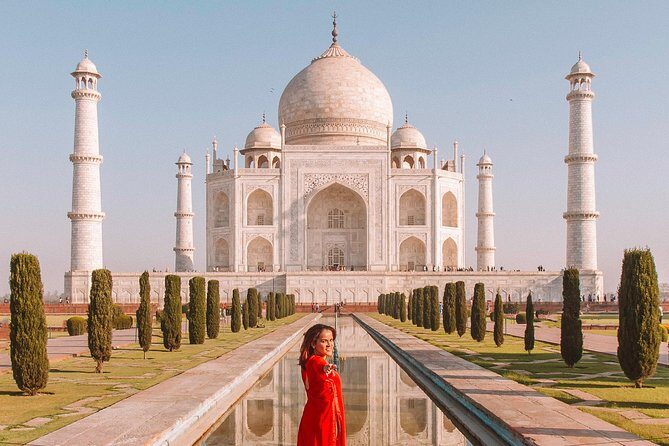
Once in Agra, you meet your guide at a local hotel. After a quick refresh, you head to the Taj Mahal for sunrise. This is built around a specific promise: the Taj visit is subject to weather conditions, so if visibility is poor or conditions change, the timing can be affected.
What I like about structuring the visit this way is that you get the monument’s mood when the light is gentle. The Taj Mahal was built in the 1600s by Mughal emperor Shah Jahan in tribute to Mumtaz Mahal, and sunrise timing helps the details read better—marble surfaces, the symmetry, and the way the complex frames the view.
You’re also supported logistically. The tour includes a battery bus/golf cart return ride from parking to the Taj Mahal, which is a practical bonus after an early-morning start.
Breakfast at a 5-star hotel (why this is more than a perk)
After Taj Mahal, you have breakfast at a 5-star hotel. This isn’t only about comfort; it also stabilizes your day. You’re eating in a predictable place right after a physically demanding morning, which makes the later stops easier to enjoy rather than feeling like a scramble.
Agra Fort: Mughal power in red sandstone
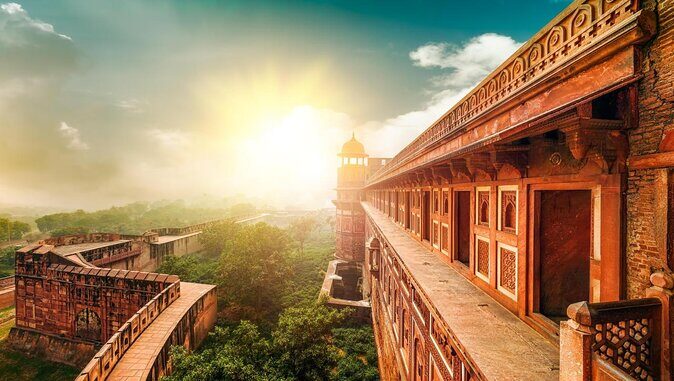
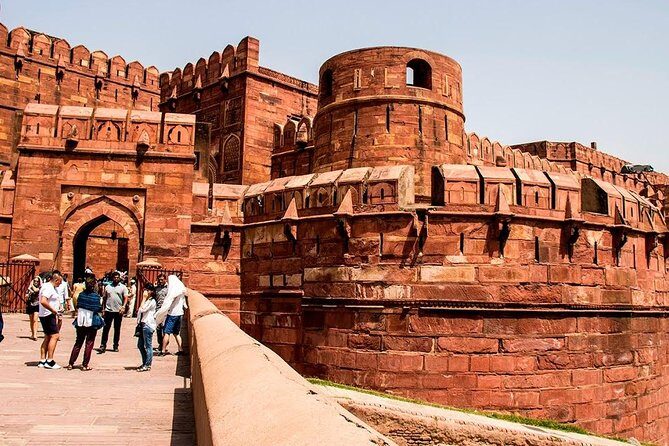
Then comes Agra Fort, the second World Heritage Site of the day. Expect about 1 hour here. The fort sits along the Yamuna River and served as the main residence of Mughal emperors until 1638.
What to look for is the architecture mix: the fort combines Hindu and Central Asian influences. The red sandstone and marble courtyards and palatial scale do the work of explanation for you—standing in the spaces helps you understand how grand the Mughal world was.
A practical note: the tour keeps the fort visit reasonably short. If you love slow museum-style wandering, you may wish you had more time, but the schedule is designed to leave enough energy for the long drive toward Ranthambhore.
The long drive to Ranthambhore: plan for road time, not comfort fantasies
After Agra sightseeing, you drive about 5 hours to Ranthambhore Tiger Reserve. On arrival, the plan is to check into your Jungle Resort.
This is a key reality check point. Road travel is part of the deal here, and it can affect how you feel for your first safari. Build in low expectations for roadside scenery. Your payoff is what happens at the reserve, not the drive itself.
Also, Ranthambhore safari readiness starts before the vehicle turns onto the park road. The tour advises you to wear colors that blend with the forest—khaki, brown, or olive green. The reasoning is simple: bright colors can distract wildlife. If you pack like a fashion show, you’ll regret it the moment you’re getting geared up for tiger-country.
Ranthambhore National Park: two safaris and one real goal
Day 2 is your big wildlife day. You do:
- Morning safari in Ranthambore National Park (about 3 hours)
- Afternoon safari (about 3 hours)
Both are on shared jeep/canter rides, with an English speaking naturalist and expert guidance.
This is where value shows up. Tigers are wild animals, so you don’t control sightings. But running two safari windows significantly improves your odds compared with a single outing. You’re also not stuck only chasing tigers. The park also has lakes and ruins, including a 1,000-year-old fort within the park, plus palaces and chhatris (traditional memorial structures).
Shared jeep/canter: what it means for your experience
Shared vehicles mean you’ll be riding with other groups, and seating is not something you can fine-tune. You’re going to want to be ready to adjust your viewing comfort quickly. Bring a light layer, keep your camera strap secure, and remember that the best wildlife viewing often means waiting quietly rather than zooming around with your lens.
If your day includes a village stop: manage time and dust
One note that comes up around the rural approach to this region: if your program includes a village visit during transfers, expect some rough road conditions—narrow, bumpy sections can kick up dust fast. The upside, when it’s included, is a more human connection: villagers may welcome you, and part of the tourism benefits can be tied to local community needs such as support for girls’ schooling. The downside is time. If you feel a village stop runs long, it can dilute safari focus—so keep your head in the wildlife game once the reserve is near.
Jaipur after the safari: the Pink City in a quick, practical hit
After the evening safari, the tour drives you about 3 hours to Jaipur. This is where the itinerary shifts from nature waiting to city pacing. You arrive and check into your hotel.
Jaipur is called the Pink City because of the way the city was painted pink after a visit from Queen Victoria in 1876. Even if you only get a short taste on arrival day, that historical detail changes how you look at the architecture. You notice the tones, the gates, and the facade colors that make the city look like a planned set rather than an accidental sprawl.
Amber Fort, Jal Mahal, Hawa Mahal, and the City Palace in one day
Day 3 is packed, but it’s built around the essentials that help you understand Jaipur quickly.
Amber Palace: the main must-see
Amber Palace is the highlight. You’ll visit after breakfast, about 2 hours, with included admission. The fort is honey-hued and built from pale yellow and pink sandstone, plus white marble. It’s divided into four main sections with courtyards.
The big practical catch: the tour does not include an elephant/jeep ride at the hilltop part of Amber Fort. If you were counting on that ride for the view or the novelty, you’ll need to arrange it separately (and decide if it’s worth the extra cost and logistics).
Jal Mahal and Hawa Mahal: photo stops with quick stops
Next come two short photo stops:
- Jal Mahal (Water Palace): about 15 minutes, admission not included
- Hawa Mahal (Palace of Wind): about 15 minutes, admission not included
These stops are short on purpose. Jal Mahal is dreamlike because of its position near the cenotaph area and Man Sagar. Hawa Mahal is unmistakable: a pink, honeycombed facade rising five storeys, built in 1799 by Maharaja Sawai Pratap Singh so royal women could watch life and processions.
If you want more than photos—if you want to linger—this day may feel rushed. But if you’re okay with quick framing shots and moving on, the pace works.
City Palace: Rajasthani and Mughal mix
Then you visit the City Palace, the residence of the royal family. Expect about 1 hour with included admission. The complex is a blend of Rajasthani and Mughal architecture, spread through courtyards, gardens, and buildings from different eras, including some from the early 20th century.
This stop rounds out the day. You leave with a sense that Jaipur isn’t only forts and windows—it’s a living palace complex with layers.
Jantar Mantar: the science side of Jaipur
You finish with Jantar Mantar Observatory, a UNESCO World Heritage Site, about 1 hour with included admission. The main idea is geometric structures calibrated to track the movement of stars and planets.
If you like astronomy, or even if you just like weird shapes that make you ask questions, this one lands well. It’s also a good way to slow down the day near the end, because the walking is slower and the learning moment sticks.
Ending in Delhi (or a Jaipur drop-off): keep your next plan flexible
After Jaipur, you’ll drive back toward Delhi / New Delhi / Gurugram / Noida for about 5 hours, or you can request a drop to Jaipur airport/Jaipur railway station or another location in Jaipur.
This matters for planning. Because the itinerary ends with a long drive, your onward plan should leave enough time to check in, eat, and reset—especially if you’re connecting to another flight or train the same day.
Also keep in mind the basic physical demands. The tour mentions a moderate fitness level. You’ll be walking through historical sites and spending early hours on day 1 and long drives across the days.
What to wear, what to pack, and how to avoid tiny frustrations
A few practical pointers based on the way this tour is designed:
- For Ranthambhore: wear khaki, brown, or olive green so you blend into the park.
- Bring a light layer for early mornings and for safari vehicles, which can feel cooler before the day warms up.
- Keep your schedule brain on tight. The trip uses sunrise timing, safari timing, and short photo windows, so delays can cascade.
For documents and admin basics:
- You need a current valid passport and passport details at booking for all participants.
- You may be asked for a COVID vaccination certificate, and the tour notes travelers should be vaccinated and carry the certificate.
And if you’re traveling around major holidays: the tour mentions mandatory gala dinners on Christmas Eve and New Year’s Eve at the hotel of stay are not included and cost extra. If your dates line up, build that into your budget.
Should you book this Delhi–Agra–Jaipur plus Ranthambhore tour?
I’d book this if you want a smart, short trip where someone else solves the timing. It’s especially good for:
- People who want sunrise Taj Mahal rather than a rushed afternoon visit
- Wildlife fans who don’t want to gamble on getting to Ranthambhore alone
- Travelers who prefer private guides for monuments but don’t need private safari vehicles
I’d think twice if:
- You hate very early mornings (2:30am pickup is real)
- You’re sensitive to long driving days (there are major transfer blocks)
- You expect a fully private safari experience (you’ll be in shared jeep/canter)
One final planning tip: choose your package option based on how much you want to think. If you’re fine keeping everything in one place, the hotel-inclusive version can simplify your life on arrival nights. If you already have lodging or a buddy you trust for hotel arrangements, the flexibility can help.
If you go in knowing the trip is structured around tight timing—and you pack for tiger-country and early starts—you’ll get the best of both India moods: Mughal grandeur and real wildlife suspense.
FAQ
What time does the tour pickup start from Delhi?
Pickup from Delhi is scheduled for 2:30am.
Is the Taj Mahal sunrise visit guaranteed?
The sunrise visit is subject to weather conditions.
Are the Ranthambhore safaris private?
No. Safaris in Ranthambhore Tiger Reserve are shared jeep/canter rides (with an option for canter if shared jeep safari isn’t available).
Does the tour include accommodation?
Accommodation is included only if you book the option with hotels: 2 nights in twin sharing with breakfast.
What sights and entrances are included?
Entrance fees are included for the sights and national park that are marked as included in the itinerary, including Taj Mahal, Agra Fort, Amber Palace, City Palace, and Jantar Mantar, plus safaris at Ranthambore.
What’s not included?
Not included items include an elephant/jeep ride at the hilltop Amber Fort in Jaipur, camera fees at monuments, meals and drinks unless specified, and anything not mentioned in inclusions.