REVIEW · NEW DELHI
Old Delhi Spice Market and Temple Tour
Book on Viator →Operated by Travel with Locals in India · Bookable on Viator
Old Delhi hits you fast, and your senses lead. This 3-hour guided loop takes you from Connaught Place into the Mughal-era chaos of Old Delhi, with stops at the spice powerhouse of Khari Baoli and major religious landmarks ending at Gurudwara Sis Ganj Sahib. You’ll also get quick orientation breaks, including a rooftop view, so the crowds don’t fully swallow your bearings.
What I like most is how the tour pairs market life with clear context. The guide explanations tie what you see—spices, streets, walls, and worship spaces—to why they matter, with strong local storytelling credited to guides such as VJ. I also appreciate that it’s kept to a small group (max 10), which makes navigating tight lanes feel less like a contact sport.
The main drawback to plan around is the environment. Old Delhi’s markets can be crowded and intense, and the tour is designed for moderate physical fitness, plus it depends on good weather. If strong smells or shoulder-to-shoulder walking can get to you, you’ll want to pace yourself carefully.
In This Review
- Key Highlights You’ll Feel Right Away
- Old Delhi’s Smart Start: Connaught Place to the Market Maze
- Khari Baoli’s Spice Street: Where the Scent Takes Over
- A Rooftop Reset After the Spices
- Chandni Chowk Market Time: Shopping Energy with a Script
- Fatehpuri Mosque: Red Sandstone and a Calm Pause
- Red Fort Complex Exterior: Shah Jahan’s Walls, Explained
- Gurudwara Sis Ganj Sahib: Sikhism, Sacrifice, and a Kitchen in Motion
- Price and What You Actually Get for About $27.53
- Who This Tour Fits Best (and Who Should Skip It)
- Should You Book This Old Delhi Spice and Temple Tour?
- FAQ
- How long is the Old Delhi Spice Market and Temple Tour?
- Where is the meeting point?
- Is the tour group size limited?
- What is included in the price?
- How much time is spent at each stop?
- Does the tour end at the meeting point?
- Is weather important for this experience?
- What is the cancellation policy for a full refund?
- What kind of ticket do I get?
Key Highlights You’ll Feel Right Away

- Khari Baoli spice market: one of the world’s biggest wholesale spice scenes, heavy on scent and color
- Time-efficient routing: short metro access plus included tuk tuk rides to keep the walk practical
- Rooftop Old Delhi view: a quick pause that helps you make sense of the maze below
- Chandni Chowk variety: spices, dried fruit, silver jewelry, and essential-oil shops in the same corridor
- Multiple major landmarks: Fatehpuri Mosque, the Red Fort complex exterior, and then a Sikh temple stop
- Gurudwara Sis Ganj Sahib stop: Sikhism context plus a community kitchen you can see feeding people
Old Delhi’s Smart Start: Connaught Place to the Market Maze
The tour begins at H&M Inner Cir, B Block, Connaught Place. From there, you take a short metro ride into Old Delhi, which is a big deal if you’re trying to avoid the city getting complicated before you even start.
Once you arrive, the pacing is the real win. You’re not asked to do a full marathon of walking with no breaks. Tuk tuk rides are included, and the schedule is built around a steady rhythm: one market hit, then landmark stops, then more market time, and finally the temple.
Group size also matters here. With a maximum of 10 people, you’re less likely to get separated or feel rushed. It still won’t be calm, because Old Delhi isn’t built for calm. But it feels controlled, like you have a plan instead of just wandering into traffic and noise.
You can also read our reviews of more shopping tours in New Delhi


Khari Baoli’s Spice Street: Where the Scent Takes Over
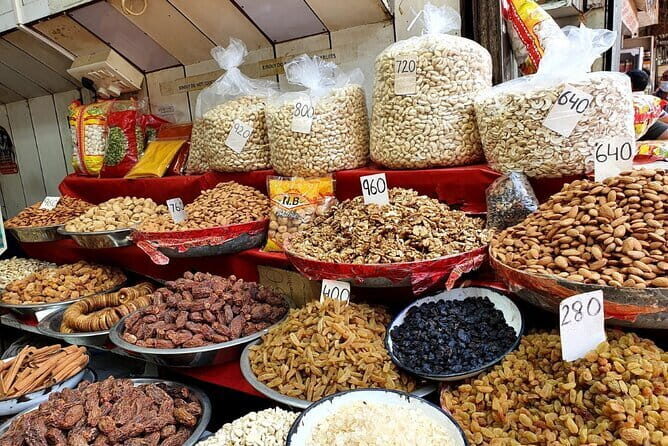
Khari Baoli is the first stop, and it’s the one that sets the tone. This street hosts one of the largest wholesale spice markets in Asia, and during your roughly one-hour visit you’ll see why people talk about it like a sensory event.
Expect thick aromas and bright stacks of spices. You’ll also be surrounded by the market machinery of Old Delhi: people moving goods, shopfront activity, and constant motion down narrow lanes. This is not a museum stop where you stand still and take photos; it’s a working market.
The practical side is that this stop teaches you how to look. Instead of just noticing colors, you start connecting the dots between everyday cooking in India and the raw ingredients being traded here. If you like markets but get overwhelmed easily, this is a good entry point because you get a focused block of time rather than a vague stop-and-scatter.
A small consideration: Khari Baoli is lively and strong on scent. If you’re sensitive to smells, consider holding a light pace early and give yourself a moment before getting fully into the crowd.
A Rooftop Reset After the Spices
Right after the spice market, you get a rooftop view of Old Delhi. This matters more than it sounds. In ground-level chaos, it’s hard to understand where you are or how the streets connect. A viewpoint like this gives you a mental map, so the next lanes feel less random.
Think of it as a breather for your brain. You get a chance to look outward, spot the general layout, and then move back into the tight streets with more confidence. Plus, it’s a relief to pause before you hit another stretch of shopping corridors.
Chandni Chowk Market Time: Shopping Energy with a Script
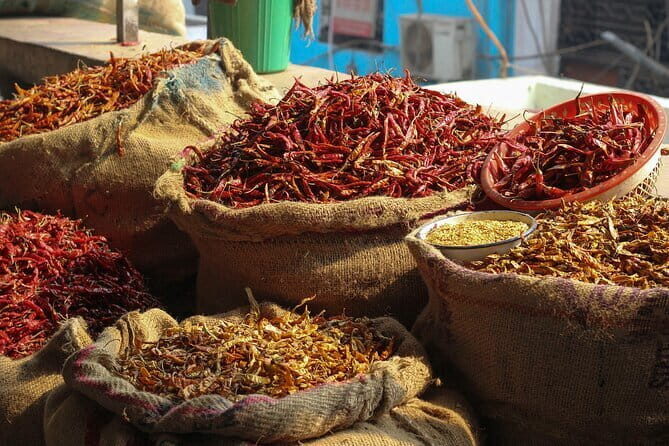
Chandni Chowk is where the tour turns from spices-only into a wider Old Delhi shopping experience. You get about an hour here, and the focus is on what this place is really known for: marketplaces full of spices, dried fruit, silver jewelry, and vivid saris, plus side streets with tiny shops selling essential oils.
What makes this stop more useful than a typical shopping walk is the guided structure. You’re not just left to browse. The guide’s commentary helps you understand what you’re seeing and why the market mix exists—traders and specialty shops living side by side in the same busy zone.
You’ll also notice how Old Delhi commerce works in layers. Big storefront energy in the main lanes, then smaller, specialized shops along side streets. If you like photography, this area gives you plenty to work with—textures, labels, metalwork, fabrics, and the constant flow of people.
Practical note: this is still a crowded market environment. Go slow with your phone out. Keep your belongings secure and stay aware of foot traffic, especially when the lane narrows.
Fatehpuri Mosque: Red Sandstone and a Calm Pause
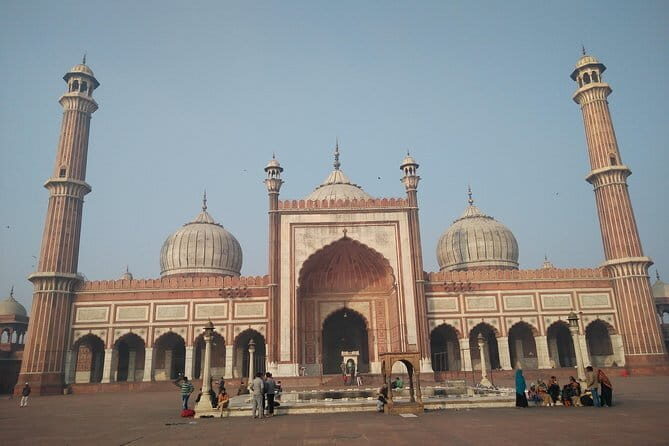
Next up is Fatehpuri Mosque, located at the western end of the oldest street of Chandni Chowk. It’s a 17th-century mosque, and the style cues are easy to spot: built with red sandstone and topped by a single dome.
The stop runs about 30 minutes. That’s enough time to appreciate the architecture and get the historical context the guide provides without feeling like you’re stuck there. It also acts as a change of pace from the surrounding market intensity.
There’s also a nice bonus: it’s free to enter. In a tour that already includes tickets at several stops, this one being free helps keep the overall value steady.
One thing to remember in any place of worship: dress and behavior matter. You’ll want to stay respectful and follow any guidance from the site area.
A few more New Delhi tours and experiences worth a look





Red Fort Complex Exterior: Shah Jahan’s Walls, Explained
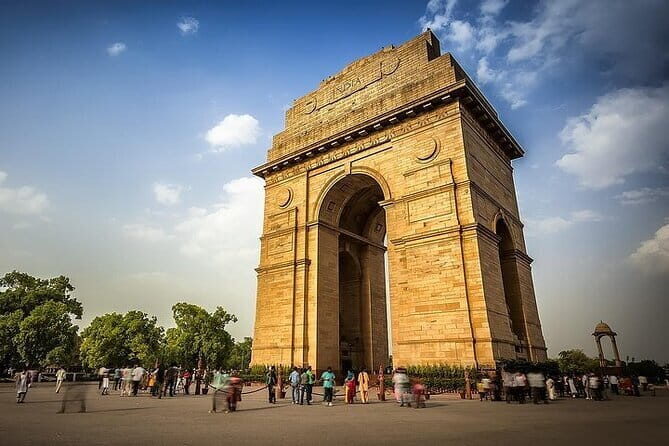
The Red Fort complex is covered as an exterior stop, with the guide talking through its significance. You’ll learn that it was built as the palace fort of Shahjahanabad—the new capital of the fifth Mughal Emperor of India, Shah Jahan.
It’s called the Red Fort partly because of its massive enclosing walls of red sandstone. Even from the outside, the scale hits you. This isn’t a quiet monument; it’s a fortress-shaped statement about power and planning.
This stop is valuable because it bridges your market experience to the bigger story of Old Delhi. The spices and lanes are one layer. The Mughal capital structure is the other. Together, it helps you stop viewing Old Delhi as just a busy bazaar and start seeing it as a designed city with a deep political backbone.
You’ll likely want to look for how the complex relates to the streets around it. The guide’s explanation helps you connect the wall-and-power concept to the everyday movement happening nearby.
Gurudwara Sis Ganj Sahib: Sikhism, Sacrifice, and a Kitchen in Motion
The final stop is Gurudwara Sis Ganj Sahib, your temple stop and the tour’s most reflective moment. You’ll spend about 30 minutes here and learn about Sikhism in a way that feels grounded, not abstract.
The site connects to Guru Tegh Bahadur, the ninth Sikh Guru, who was beheaded here on 11 November 1675 on the order of Aurangzeb. The tour also highlights that before his body could be quartered and exposed to public view, it was stolen under cover of da—your guide will explain this part as part of the story of what happened next.
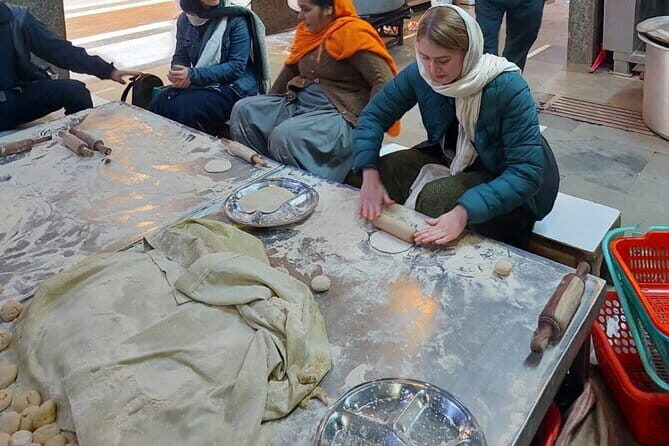
But the tour doesn’t end on tragedy alone. The experience also focuses on the community kitchen aspect. You’ll see how the gurudwara community feeds many hungry people, which is an important counterweight to the heavy historical context.
If you’re looking for one stop that makes the whole tour feel human-scale, this is it. After hours of markets, this offers a different kind of meaning—service as a daily practice.
Admission ticket is included at this stop, which helps justify the overall price for the mix you get.
Price and What You Actually Get for About $27.53
At $27.53 per person for about 3 hours, the value depends on what you count as “included,” and this one is more bundled than it looks.
Here’s what you do get:
- Packaged water
- Tuk tuk rides
- Admission tickets are included at Khari Baoli (1 hour) and Chandni Chowk (1 hour), and they’re included again for Gurudwara Sis Ganj Sahib
- Fatehpuri Mosque is free to enter
- You also get a mobile ticket, which makes the day simpler once you’re in motion
What’s not included is straightforward: tips and snacks. That means you may want to plan for a snack at some point, especially because markets can make you forget to eat.
Also worth noting: the experience offers group discounts. If you’re booking with friends, that can be a real help. With a small group size (max 10), you’re less likely to feel like you’re part of a giant bus-tour herd, and that matters when you’re walking tight streets.
Bottom line: this price feels fair for a guided, multi-stop route that combines market entries and major landmark access, not just a casual walk past a few sights.
Who This Tour Fits Best (and Who Should Skip It)
This is a strong fit if you want Old Delhi in one efficient loop. It’s also ideal if you like markets but want guidance so you don’t get lost in the noise.
You’ll likely enjoy it if you:
- want a first-time friendly route through Old Delhi’s core
- like spice and food-adjacent experiences
- want landmark context that explains what you’re looking at, not just where it is
- appreciate a small group experience
You might want a different plan if:
- strong smells and dense crowds are a problem for you
- you prefer a slower, shopping-heavy schedule rather than a packed 3-hour run
- you’re traveling during weather that’s unlikely to stay clear, because the experience requires good weather
Should You Book This Old Delhi Spice and Temple Tour?
If you’re trying to see Old Delhi without turning it into a full-day scramble, I’d book this. The route is efficient, and the mix makes sense: Khari Baoli to get the spice heartbeat, Chandni Chowk to broaden the market picture, a breather at Fatehpuri Mosque, a landmark moment at the Red Fort complex exterior, and then a thoughtful ending at Gurudwara Sis Ganj Sahib.
The biggest reason to hesitate is also the biggest reality of Old Delhi: it can be intense. If you go in ready for crowded lanes and strong sensory input, this tour gives you a structured way to enjoy it.
FAQ
How long is the Old Delhi Spice Market and Temple Tour?
The tour lasts about 3 hours.
Where is the meeting point?
You meet at H&M Inner Cir, B Block, Connaught Place, New Delhi, Delhi 110001, India.
Is the tour group size limited?
Yes. The maximum group size is 10 travelers.
What is included in the price?
Packaged water and tuk tuk rides are included. Admission tickets are included for Khari Baoli, Chandni Chowk, and Gurudwara Sis Ganj Sahib. Fatehpuri Mosque is free.
How much time is spent at each stop?
Khari Baoli is about 1 hour, Fatehpuri Mosque is about 30 minutes, Chandni Chowk is about 1 hour, and Gurudwara Sis Ganj Sahib is about 30 minutes. The Red Fort complex is included as well, with time not listed as a separate stop duration.
Does the tour end at the meeting point?
Yes. It ends back at the meeting point.
Is weather important for this experience?
Yes. It requires good weather. If it’s canceled due to poor weather, you’ll be offered a different date or a full refund.
What is the cancellation policy for a full refund?
You can cancel up to 24 hours in advance for a full refund. If you cancel less than 24 hours before the start time, the amount paid is not refunded.
What kind of ticket do I get?
You receive a mobile ticket.