REVIEW · CHENNAI
Mahabalipuram and Kanchipuram Day trip from Chennai by Private car with Guide
Book on Viator →Operated by Wonder tours · Bookable on Viator
Temple stonework can feel like a time machine, and this day trip packs two of the best stops near Chennai. You get a private guide to make sense of what you’re seeing, plus a car that takes you door-to-door without the extra planning headache.
What I really like is that entry fees are included and you’re not left negotiating tickets on the fly. I also like the pacing with a private setup: you can ask questions, linger briefly when something grabs you, and move on when you’re ready.
The main catch is the schedule: this is a 12-hour day with multiple sites, so it’s not the best fit if you want a slow, sleepy pace.
In This Review
- Key highlights worth your attention
- A Long Temple Day: What 12 Hours From Chennai Feels Like
- Private Car and Pickup: Why Door-to-Door Matters in Chennai
- Kanchipuram Start: Ekambareswarar Temple and Kailasanathar Temple
- Ekambareswarar Temple: earth, scale, and carvings
- Kailasanathar Temple: Pallava roots in Kanchipuram
- Mahabalipuram Rock Temples: Pancha Rathas and Arjuna’s Penance
- Pancha Rathas: five temples cut from single rocks
- Arjuna’s Penance: a huge bas-relief from the Mahabharata
- Krishna’s Butter Ball and Shore Temple by the Sea
- Krishna’s Butter Ball: the physics-bending boulder
- Shore Temple: Pallava architecture overlooking the water
- Price and What You’re Actually Getting for $129
- How Guides Shape Your Experience at These Temples
- Timing, Heat, and Comfort Tips (So You Don’t Hate Hour 10)
- Who This Private Day Trip Is Best For
- Should You Book This Mahabalipuram and Kanchipuram Day Trip?
- FAQ
- How long is the Mahabalipuram and Kanchipuram day trip?
- Is hotel pickup and drop-off included?
- Do I need to pay entry fees at each site?
- Is this a private tour or a group tour?
- Who provides the guide?
- Are drinks included during the day?
- What are the main stops on the itinerary?
- How far in advance should I book?
- When do I receive confirmation?
- What is the cancellation policy?
Key highlights worth your attention
- Private guide on a temple-focused route so stone carvings and symbolism make more sense
- All entry fees included for both Kanchipuram temples and Mahabalipuram monuments
- Round-trip hotel pickup and drop-off by taxi, which saves real time in Chennai
- A great mix of styles: big living Shiva temples plus coastal Pallava-era monuments
- Several stops with serious wow-factor like Arjuna’s Penance and the Shore Temple
A Long Temple Day: What 12 Hours From Chennai Feels Like
This is a proper full-day excursion. You’re out the door early (pickup is included), and you’ll be back after about 12 hours. That length matters because you’ll spend time walking inside temple precincts, standing to look at rock carvings, and transferring between towns.
The upside is you get a concentrated hit of what makes this corner of Tamil Nadu special: Kanchipuram brings you into the temple-town rhythm, and Mahabalipuram shows off the famous coastal monuments. If you’re on a first visit to Chennai and want more than one day-trip idea, this is the kind of itinerary that helps you stop guessing and start seeing.
The downside is simple: you’ll likely be tired by the end. Comfortable shoes are a must, and you’ll want to treat the day like sightseeing plus some weather exposure, not a relaxed museum stroll.
You can also read our reviews of more guided tours in Chennai


Private Car and Pickup: Why Door-to-Door Matters in Chennai
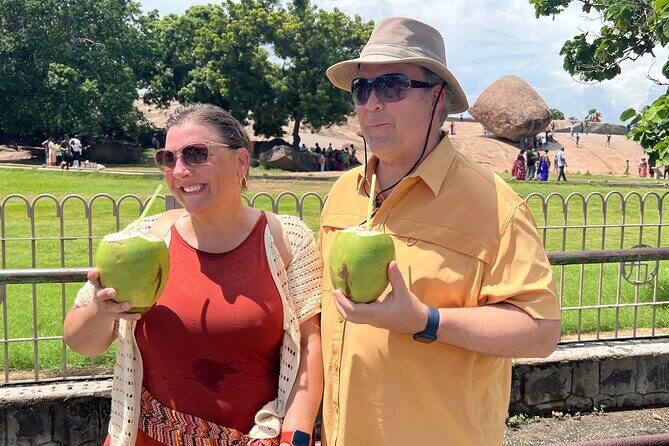
Chennai traffic can be a puzzle. This tour reduces the guesswork by including round-trip taxi transfers from your hotel, so you’re not lining up transport mid-day or trying to figure out where the easiest entry point is.
The private setup also helps with flow. A group bus is built around fixed timing. A private car is built around you and your guide. That matters here because temple visits often come with moments where it’s worth waiting a minute—maybe to get your bearings at a gate, or to see a carving detail from the right angle before you move.
If you’re staying outside the city center, door-to-door pickup can be a real time-saver. It’s one of those “small” benefits that makes the day feel smoother than it would otherwise.
Kanchipuram Start: Ekambareswarar Temple and Kailasanathar Temple
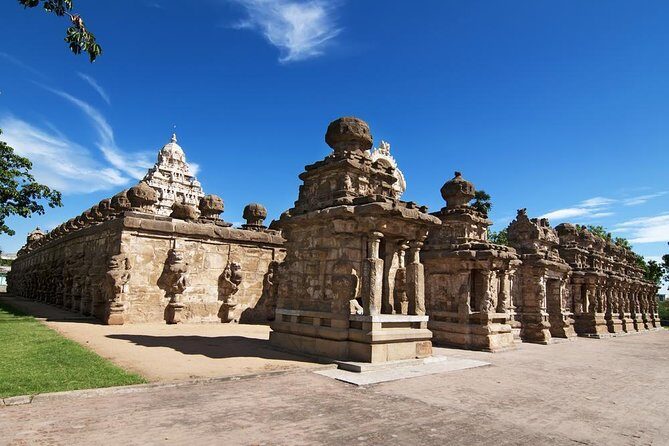
Kanchipuram is one of the most important temple towns in South India, and starting there sets the tone. You’re dealing with Hindu sacred architecture that’s not just old—it’s active, and it has that living sense of place.
Ekambareswarar Temple: earth, scale, and carvings
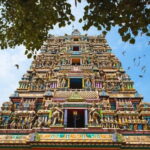
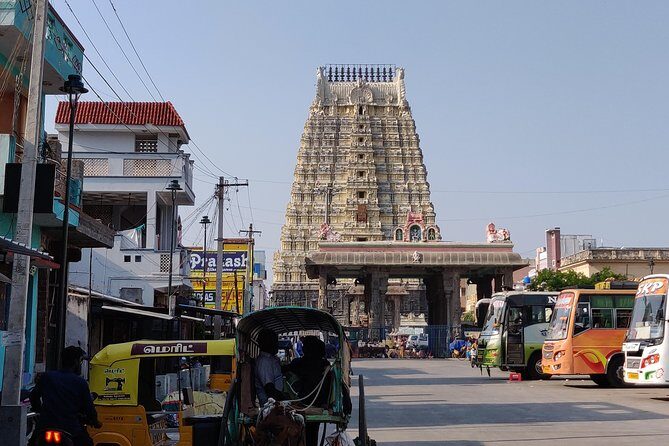
Your first temple stop is Ekambareswarar Temple, connected with South India’s five Shiva temples tied to the five elements, where this precinct is associated with earth. You enter beneath a towering 59-meter-high south gopuram, described as unpainted with lively carvings.
What I love about this kind of stop (and what you’ll likely appreciate too) is how it trains your eye. Once you look up at a tall gopuram and then look closer at the stonework, you start seeing how much planning went into visual storytelling. You also get a strong sense of how big temple complexes are, not just the single building you see in a quick photo.
A practical note: the scale can make it easy to lose time. If you’re the type who likes photos, set a quick personal limit so you don’t fall behind the group rhythm. Your guide helps keep you oriented.
Kailasanathar Temple: Pallava roots in Kanchipuram
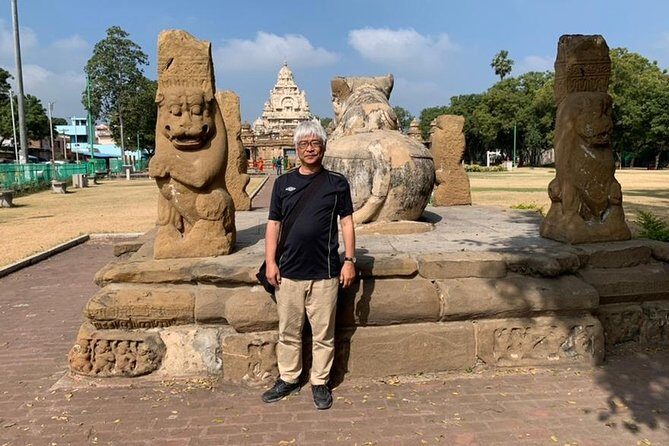
Next comes Kailasanathar Temple, from Pallava times. Kanchipuram was the capital of the medieval Pallavas, and this stop gives you a direct connection to that era.
This is one of those temples where the “why it matters” is tied to power and patronage. The Pallavas weren’t just building religious spaces; they were shaping cultural identity through architecture, and Kanchipuram was their stage.
The time here is set for about 45 minutes, which is usually enough to see key structural features and understand the background if your guide is good at explaining. A strong guide can make a Pallava-era temple feel far less abstract.
You can also read our reviews of more private tours in Chennai




Mahabalipuram Rock Temples: Pancha Rathas and Arjuna’s Penance
After Kanchipuram, the day tilts toward Mahabalipuram, where stone carvings are the main event. These monuments don’t just sit there—you have to look at them with patience. The reward is that they’re so specific, like stone chapters from an epic.
Pancha Rathas: five temples cut from single rocks
At Pancha Rathas (Five Rathas), you’ll see temples carved from single large rocks—five separate structures, all squeezed together at the southern end of Mahabalapuram. The information tied to this stop says they’re 7th-century temples dedicated to Hindu gods.
The wow factor here is the engineering and the idea of compression. Instead of a sprawling complex, you’re seeing multiple shrines in close quarters, each carved with enough individuality to feel like separate temples, not just rock sculptures.
If you’re a detail person, this is where you can slow down. But it’s also easy to rush, especially if the weather is warm. Stick to your guide’s suggested viewpoint first, then go back for any extra angles.
Arjuna’s Penance: a huge bas-relief from the Mahabharata
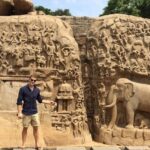
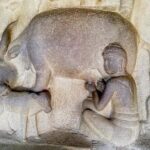
Then you hit Arjuna’s Penance, described as a bas-relief around 100 feet by 45 feet carved with scenes from the Mahabharata epic.
Bas-reliefs can feel crowded at first. The key is to let your guide frame what you’re seeing. With that context, the panel becomes more than a long wall of figures—it becomes a sequence. You start noticing how the carving narrates action and emotion.
This stop is shorter on the clock (about 30 minutes), which is tight for a carving-heavy site. If you’re serious about reading stone scenes, prioritize quality over quantity: spend more time on one section than sprinting across the whole relief.
Krishna’s Butter Ball and Shore Temple by the Sea
Mahabalipuram’s monuments often give you a double experience: art plus atmosphere. One moment you’re staring at a boulder that looks like it shouldn’t exist; the next you’re facing the sea with a temple perched in the coastal wind.
Krishna’s Butter Ball: the physics-bending boulder
Krishna’s Butter Ball is a famous sight: a roughly 5-meter diameter ball-shaped boulder perched precariously on a slope. The description is playful—like it breaks Newton’s laws—which is exactly why people love it.
This stop is quick (about 30 minutes), and that’s appropriate. It’s less about extended walking and more about looking, circling slightly, and taking in the way the rock sits. A good guide will also give you the story angle so it’s not only a quirky photo moment.
Practical tip: keep your footing careful. Coastal and rock sites can be slippery depending on the season and conditions.
Shore Temple: Pallava architecture overlooking the water
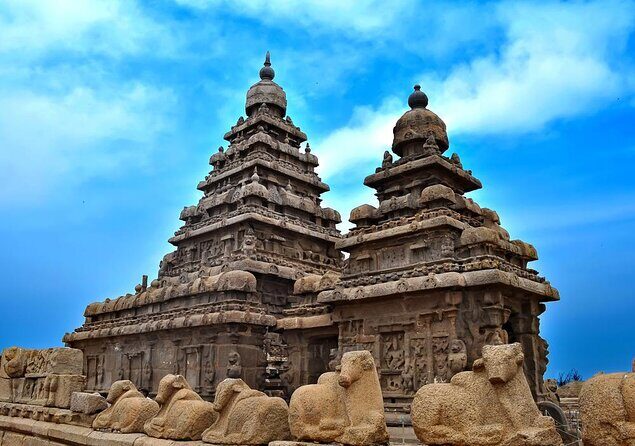
Your final major stop is the Shore Temple, standing near the sea like “rock-cut elegance,” with two towers and a setting of gardens and ruined courts. It’s described as symbolizing the heights of Pallava architecture.
This is the emotional closer of the day. Once you’ve spent hours on carved stone and temple layouts, Shore Temple gives you a wider perspective. You can step back, look at the sea-facing position, and feel how architecture and coastline work together.
You’ll spend about 45 minutes here, which is long enough to take in the structure and then soak up the surroundings. If light matters for you, you might want to ask your guide the best side to stand on for views.
Price and What You’re Actually Getting for $129
At $129 per person, this isn’t the cheapest option—but it’s not outrageous for what’s included. The big reason is that you’re not paying separately for much of the on-site access.
Here’s what the tour includes:
- Hotel pickup and drop-off
- Local guide
- Entry fees for Mahabalipuram monuments
- Entry fees for Kanchipuram temples
- Private tour with only your group
What’s not included: drinks.
So the value equation looks like this: you’re paying for transportation + a guide + paid access. In South India, temple entry fees can add up, and the guide component is often the difference between seeing stone and understanding it. When the guide can explain symbolism tied to themes like earth (Ekambareswarar) or epic storytelling (Arjuna’s Penance), your visit starts to feel more meaningful.
Also, this is booked about 26 days in advance on average. That suggests demand is real, so if your dates are firm, don’t wait too long.
How Guides Shape Your Experience at These Temples
One thing that shows up in the experience feedback: the guide quality can make or break a temple day. On this kind of itinerary, you’re paying for interpretation as much as admission.
I’d especially watch for clear, understandable explanations. In one case, a guide named Rajesh was described as good and easy to follow. Another guide named Nanda was praised for friendliness and attention, and for packing in interesting information without losing people. Even the driver Venkadesh was noted as professional and safe, which matters on a long day when you’re tired.
The practical take: if you book and you get a guide who explains patiently, you’ll enjoy every stop more. Ask questions early, even small ones like what to look for, or what a key feature symbolizes. Your day has too many sites to treat it like a checklist.
Timing, Heat, and Comfort Tips (So You Don’t Hate Hour 10)
You’re looking at many active stops across two towns. That means you’ll want to plan for a day that can feel long.
What to do:
- Wear comfortable, grippy shoes for temple floors and stone areas
- Bring a hat or use sunscreen, especially if you hit midday sun on the way between towns
- Keep an easy pace at rock carvings: you’ll see more by slowing down than by rushing your eyes
- Remember drinks aren’t included, so plan for hydration on your own
A helpful approach is to mentally switch modes. For temples, slow down and let the guide talk. For rock carvings, look first, then ask questions about the scenes or what’s special about the structure. That keeps you from doing the most common mistake—just collecting images without collecting understanding.
Who This Private Day Trip Is Best For
This fits best if you:
- Want a one-day route that covers both Kanchipuram temples and Mahabalipuram’s iconic coastal monuments
- Prefer a private guide over joining a large group
- Like architectural storytelling and epic themes more than just quick photo stops
- Have limited time in Chennai and want maximum value from a full day
It might not be ideal if you:
- Want a short day or minimal walking
- Get cranky with long schedules and multiple transfers
- Prefer totally independent pacing without any structured stops
Should You Book This Mahabalipuram and Kanchipuram Day Trip?
I’d book it if your priority is a guided, entry-fee-covered temple day that feels organized. The private setup and the included admissions save both money and mental energy. Plus, the pairing makes sense: Kanchipuram shows you the living temple context, and Mahabalipuram shows you the carved stone masterpieces tied to the Pallavas and epic traditions.
If you’re sensitive to long days, consider it anyway but plan to keep expectations realistic. You’ll see a lot. You won’t have the freedom to turn this into a laid-back stroll through only one site. For most first-timers from Chennai, though, that packed-and-guided format is exactly what makes it worth it.
FAQ
How long is the Mahabalipuram and Kanchipuram day trip?
The duration is approximately 12 hours.
Is hotel pickup and drop-off included?
Yes. Round-trip hotel pickup and drop-off by taxi is included.
Do I need to pay entry fees at each site?
No. All entry fees are included for the Kanchipuram temples and Mahabalipuram monuments.
Is this a private tour or a group tour?
It is a private tour/activity, and only your group participates.
Who provides the guide?
A local guide is included with the tour.
Are drinks included during the day?
No. Drinks are not included.
What are the main stops on the itinerary?
The tour includes stops at Ekambareswarar Temple, Kailasanathar Temple, Pancha Rathas, Arjuna’s Penance, Krishna’s Butter Ball, and Shore Temple.
How far in advance should I book?
It is booked on average about 26 days in advance, so booking earlier is a good idea.
When do I receive confirmation?
Confirmation will be received at time of booking.
What is the cancellation policy?
You can cancel for a full refund up to 24 hours in advance of the experience’s start time.