REVIEW · JAIPUR
Jaipur City Tour with Traditional Flower Market Visit
Book on Viator →Operated by Rajasthan India Tour Driver · Bookable on Viator
Jaipur gets easier when someone else plans the route. This private car day pairs top sights with a morning flower and vegetable market walk, so you see both the postcards and the real street rhythm.
Two things I especially like: the schedule gives you a photo stop at Hawa Mahal before you head into the market, and the tour builds in a local food pause with masala chai plus a snack like samosa or kachori. And the experience is tied together by a friendly driver—Vinod comes up again and again in the tour feedback for being helpful and professional.
One thing to consider is cost creep at the monuments. The combined monument entrance fees (listed at $30 per person) are not included, and camera fees plus tips can add up if you plan to photograph everything.
In This Review
- Key highlights you’ll feel on the ground
- Private car Jaipur: what you’re really buying
- The 7:00 AM flower and vegetable market walk in Jaipur
- Hawa Mahal at sunrise-ish light, then on to Amer
- Panna Meena Ka Kund, Jal Mahal, and Royal Gaitor: monuments with fewer crowds
- City Palace, Jantar Mantar, and Isarlat Sargasuli Tower: royal design meets science and views
- City Palace Complex: Mughal meets Rajput, and the royals still live here
- Jantar Mantar: astronomy in the open air
- Isarlat (Sargasuli) Tower: climb for the city view angle
- Albert Hall Museum and Galta Ji: two very different ways to end the day
- Albert Hall Museum: classic Indo-Saracenic architecture
- Galta Ji Temple: pilgrimage energy and spring-fed kunds
- Optional market time for shopping without turning the day chaotic
- Price and what the money actually buys (plus the monument fee reality)
- When this tour is the right fit (and when it’s not)
- Should you book this Jaipur City Tour with flower market?
- FAQ
- What is the duration of the Jaipur city tour?
- What does the tour include for pickup and transport?
- Is a local guide included?
- What time is the flower market visit?
- Are monument entrance fees included in the price?
- Are camera fees included?
- What refreshments are included during the market stop?
- Does the price depend on group size?
- What happens if weather is poor?
Key highlights you’ll feel on the ground
- Morning flower and vegetable market walk timed for the 7:00 AM to 8:00 AM slot
- Hawa Mahal photo stop before walking through the market area
- Chai-and-snacks break at local food stores with samosa or kachori
- A tight loop of Jaipur icons (Amer, City Palace, Jantar Mantar) plus quieter stops like a stepwell and cenotaphs
- Long, guided value with a private AC car, pickup/drop-off, and a local tour guide
Private car Jaipur: what you’re really buying

This is a full-day Jaipur city tour built around a simple idea: don’t waste time figuring out routes, parking, or where to start. You’re picked up in an air-conditioned car from your hotel in Jaipur City, then you spend the day hopping between major sights with a friendly driver and a local guide.
The day typically runs 9 to 10 hours, which matters more than it sounds. Jaipur monuments are spread out, and traffic can change your timing fast. A private car helps you keep the flow, especially on a day that includes both early-morning street time and multiple palace-and-fort style stops.
Your group stays small too. The pricing is listed per group (up to 3), and it’s described as a private experience where only your group participates. That’s good if you want less waiting around and more control over how long you linger at each photo spot.
If your priority is “see the highlights but also get real local moments,” this itinerary fits. It isn’t only about big monuments; it starts with a market experience and includes breaks for chai and snacks.
You can also read our reviews of more city tours in Jaipur

The 7:00 AM flower and vegetable market walk in Jaipur
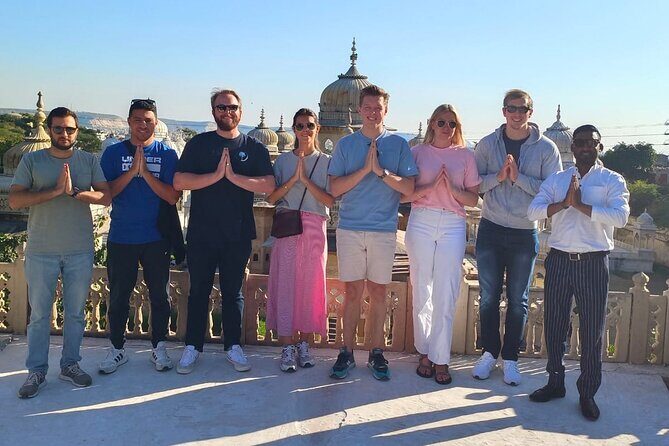
If you choose the 7:00 AM to 8:00 AM time slot, your day begins with a focused local experience: the flower and vegetable market.
Here’s how it works in practice. First, you get driven to Hawa Mahal for a photo opportunity. Then you start walking toward the market, passing an 18th-century heritage building along the way. That walking segment is important because it shifts you from “tour mode” into “how the neighborhood actually looks and moves.”
At the market, the tour is designed to be more than sightseeing. You learn the Indian local way of selling flowers and vegetables—how people display, handle, and trade. You’re not just watching from a distance; you’re meant to understand what you’re seeing.
After the market visit, you head to the oldest local food stores for masala chai and snacks. The included snack option is samosa or kachori, and the tour also lists complementary tea/coffee and lassi, so you’re covered whether you’re a tea person or not.
Practical note: this is an early start, and market walking means you’ll want comfortable shoes. Also, the whole experience is listed as weather-dependent, so if it’s raining hard, the market portion may be affected.
Hawa Mahal at sunrise-ish light, then on to Amer
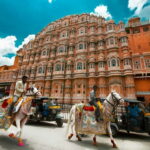
Hawa Mahal is one of those Jaipur sights that looks like it belongs on a postcard. The details are part of why it’s so famous. It’s a five-story building, described as the tallest building built without a foundation, with a curved design that leans at an 87-degree angle and a pyramidal shape. It’s dedicated to Lord Krishna, which gives the site a religious layer beyond the architecture.
In this tour, Hawa Mahal isn’t the whole stop—it’s a setup. You get a photo opportunity early, then move on. That’s a smart way to do it because it keeps your energy for the walking and the more hands-on market portion.
Then the itinerary turns toward Amer Town, located about 11 kilometers from Jaipur. Amer is where Rajasthan feels especially “royal”: the tour highlights a mix of Mughal and Rajput architecture, plus palaces, temples, and intricate carvings.
The key named stops in Amer include:
- Sheesh Mahal (Mirror Palace), known for its reflective interior effect
- Sila Devi Temple, which adds a spiritual anchor to the visit
You’ll feel the contrast here. Hawa Mahal is all about façade, angles, and visual rhythm, while Amer adds depth: carvings, palace details, and a complex layout that rewards slowing down for a bit.
Panna Meena Ka Kund, Jal Mahal, and Royal Gaitor: monuments with fewer crowds
After Amer, the tour shifts into “wait, this is a different side of Jaipur” mode.
First comes Panna Meena Ka Kund, a 16th-century stepwell. It’s described as a little hidden compared to the major postcard sites, and what makes it compelling is location: it sits in the shadow of a famous fortress. Stepwells in Rajasthan aren’t just architecture; they connect to how communities managed water and shade. Even if you don’t go deep into the engineering, you’ll notice the scale and calm setting.
Next is Jal Mahal, the palace located in the middle of Man Sagar Lake. It’s one of those “how is that even here?” sights, because you’re used to palaces being on land. Even from the outside viewing points, it gives you a softer, more reflective mood than the forts and courtyards.
Then the day turns toward Royal Gaitor on the Nahargarh foothills. This stop is built around cenotaphs—stone monuments—associated with Maharaja Pratap Singh, Madho Singh II, and Jai Singh II. The itinerary highlights that Jai Singh II’s marble cenotaph is especially impressive: it has a dome supported by 20 carved pillars.
What makes Royal Gaitor valuable on a long day is pacing. After several major architecture stops, this is a quieter shift where you can take in stonework and details without feeling like you’re constantly charging to the next big checkpoint.
City Palace, Jantar Mantar, and Isarlat Sargasuli Tower: royal design meets science and views
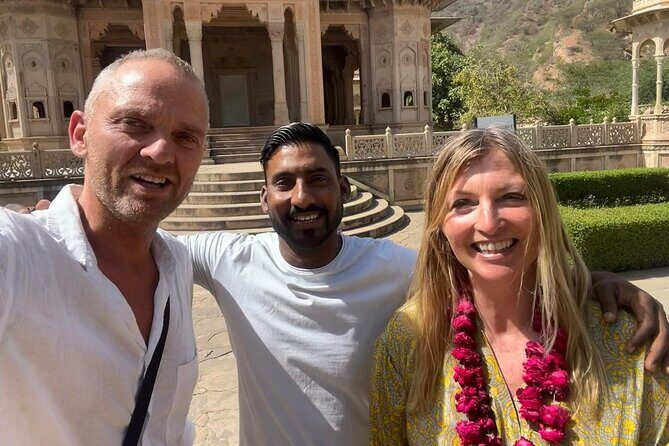
Jaipur is known for architecture that looks designed for humans and gods—courtyards, walls, windows, and symmetry. This part of the tour leans into that.
You can also read our reviews of more shopping tours in Jaipur






City Palace Complex: Mughal meets Rajput, and the royals still live here
The City Palace Complex was conceived and built by Maharaja Sawai Jai Singh II, the founder of Jaipur. It’s described as a fusion of Mughal and Rajput architecture.
One reason this stop matters is that it’s not only museum-like. The tour notes that the palace is still home to the last ruling royal family, though they live in a private section. That means the site feels “active,” not just staged for tourists.
Jantar Mantar: astronomy in the open air
Then you move to Jantar Mantar, an early 18th-century astronomical observation site. It includes a set of about 20 main fixed instruments.
If your brain likes patterns, this stop can be satisfying. It’s not a palace, it’s measurement—angles, shadow, timing—built into the stone. Even a quick visit gives you a sense that these weren’t guesses; they were systems.
Isarlat (Sargasuli) Tower: climb for the city view angle
Finally, you’re told about Isarlat/Sargasuli Tower, a seven-storied monument built by Sawai Ishwari Singh in 1749. The big perk is the payoff view: you can experience panoramic city views from the top of this prominent minaret.
If you get tired from walking through courtyards, a tower stop can reset your attention. It also gives you orientation. Jaipur starts to “make sense” spatially—how the older areas relate to each other.
Albert Hall Museum and Galta Ji: two very different ways to end the day
Not every Jaipur day should end on more palaces. This itinerary gives you two alternatives that change the mood.
Albert Hall Museum: classic Indo-Saracenic architecture
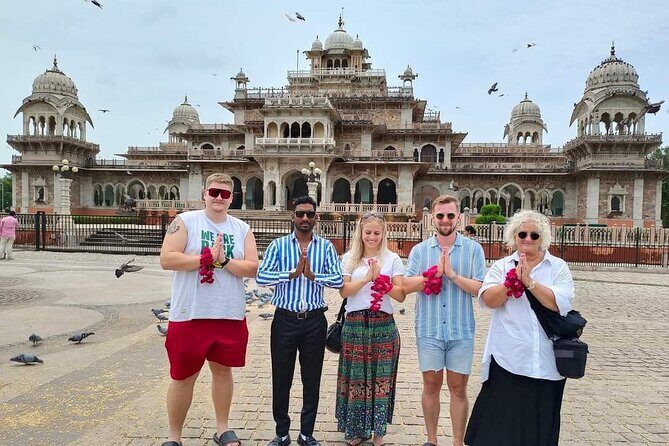
The Albert Hall Museum is described as the oldest museum of Rajasthan and functions as the state museum. The building sits in Ram Niwas’s garden outside the city wall opposite New Gate, and it’s noted as an example of Indo-Saracenic architecture. It also goes by the name Government Central Museum.
If you like having a change of pace, this museum stop does that. You get a chance to slow down indoors (or at least in a calmer garden setting) after a day of forts and open-air monuments.
Galta Ji Temple: pilgrimage energy and spring-fed kunds
Then there’s Galtaji (Galta Ji Temple), about 10 kilometers from Jaipur. This is an ancient Hindu pilgrimage site built into the crevice of hills surrounding the city. A natural spring water system flows down and fills sacred kunds (water tanks) where pilgrims bathe.
The tour also notes you can ascend further to reach a hilltop temple for stunning views over the valley floor, including Jaipur’s fortifications. There’s a legend tied to this place too: Saint Galav is said to have lived, meditated, and done penance here.
This stop can feel more spiritual and grounded than the royal monument sequence. It’s also more “real world,” because you’re observing an active pilgrimage setting rather than only historical displays.
Optional market time for shopping without turning the day chaotic
One of the practical wins in this itinerary is that it doesn’t force shopping. It offers it if you want it.
If you’d like to visit Jaipur markets after sightseeing, the driver can take you to famous markets where you can shop for items like fabrics, sandals, and bags. The information says prices can be low, with fantastic quality.
Two pieces of advice if you do this part:
- Set a rough budget before you enter. Markets can be fun, but they can also run away with you.
- Give yourself time to compare options, especially for textiles and bags, so you don’t buy in a hurry just because you’re tired.
This added market time is also easier with a private car than doing it on your own, since the guide can handle the practical navigation while you focus on choosing items.
Price and what the money actually buys (plus the monument fee reality)
The listed price is $13.59 per group (up to 3), with a duration of about 9 to 10 hours. On paper, that looks like a bargain for a full-day, private, air-conditioned car with a local guide.
Here’s what’s included:
- Hotel/Airport/Railway Station pickup and drop
- Private transportation plus fuel, parking charges, and taxes
- Local tour guide
- Bottled water
- Complementary tea/coffee/lassi and snacks (samosa or kachori)
- Mobile ticket
What’s not included:
- Entrance fee for Jaipur’s popular monuments (listed as $30 per person combined entry fees)
- Camera fees at monuments
- Tips & gratuities (recommended)
So how does this shake out for value? Your base price covers the big logistics and the guided flow. The separate entrance fees are the main variable, and those fees matter because they’re per person, not per group. If you’re traveling as two or three people, the group price can feel very efficient, but you should still plan for that extra per-person spend.
If you’re the type who likes photos, count on camera fees being an add-on. If your main goal is the architecture and viewpoints rather than photographing every square inch, you may spend less on that side.
When this tour is the right fit (and when it’s not)
This tour makes the most sense for you if:
- You want a private AC car and a guided route across Jaipur’s major sights
- You like having one early local experience that goes beyond monuments (the flower/vegetable market walk plus chai)
- You prefer not to juggle multiple tickets, entrances, and route changes across the day
It may not be the best match if:
- You dislike early starts. The flower market visit depends on the 7:00 AM to 8:00 slot.
- You’re trying to keep everything ultra-budget. Entrance fees and camera fees are separate, and tips are typical in this kind of tour setting.
- You’re traveling during bad weather windows. The experience is marked as weather-dependent.
Should you book this Jaipur City Tour with flower market?
Yes, if you want a smooth “best of Jaipur” day with a morning market moment that feels genuinely local. The mix of stops—Hawa Mahal, Amer, a stepwell, a lake palace, royal cenotaphs, City Palace, Jantar Mantar, and optional Galta Ji—means you won’t spend the day doing the same type of sightseeing over and over.
It also feels like the kind of tour where having a good guide matters. The name Vinod shows up repeatedly in the tour feedback, and the consistent theme is friendliness and professionalism, not just reading off a script.
Before you book, do two quick checks:
- Confirm you’re okay paying the listed $30 per person monument entrance fee separately.
- Pick the market timing slot that works for you, since the flower market experience hinges on the 7:00 AM to 8:00 AM window.
If those points are fine, this is a strong way to get your bearings in Jaipur fast—while still getting a taste of the city that happens before the crowds.
FAQ
What is the duration of the Jaipur city tour?
The tour lasts about 9 to 10 hours.
What does the tour include for pickup and transport?
Pickup and drop-off are included, and you travel by private transportation in an air-conditioned car.
Is a local guide included?
Yes. The tour includes a local tour guide.
What time is the flower market visit?
The flower and vegetable market visit is for the 7:00 AM to 8:00 AM time slot.
Are monument entrance fees included in the price?
No. Entrance fees are not included, and the combined entry fees for Jaipur’s popular tourist monuments are listed as $30.00 per person.
Are camera fees included?
No. Camera fees at the monuments are not included.
What refreshments are included during the market stop?
The tour includes complementary tea/coffee/lassi and snacks such as samosa or kachori.
Does the price depend on group size?
The price is listed per group, up to 3 people.
What happens if weather is poor?
The experience requires good weather. If it’s canceled due to poor weather, you’ll be offered a different date or a full refund.