REVIEW · BHUBANESWAR
Immersive Bhubaneswar walking tour with professional guide
Book on Viator →Operated by 5 Senses Walks · Bookable on Viator
Walking temple paths in Bhubaneswar feel personal. This 3-hour Old Town walking route links major Kalinga architecture sites with time for stories, close-up carvings, and a breather by the Bindu Sagar lake.
I especially like how the tour is built around the temples you came for—starting at the 7th-century Parasurameshwara and working through standouts like Lingaraj and Raja Rani. I also like the pacing: short walks between sites, plus a local bazaar segment so you get more than postcard views.
One thing to consider: it’s a walking tour with multiple temple stops in a single session. If you’re sensitive to sun, crowds, or uneven stone steps, plan your shoes and hydration first.
In This Review
- Key highlights you’ll feel right away
- Why this Bhubaneswar walking tour works better than rushing by taxi
- Your starting point: Parasurameshwara Temple and the Kalinga “signature”
- Mukteshwar and Someshwar: 10th-century carvings that explain the evolution
- Bindu Sagar: the lake stop that refreshes your eyes and your feet
- Ananta Vasudev: strong icon details that make the sculpture easier to read
- A walk past the bazaar: smelling the city between temples
- Lingaraj Temple: the most famous stop for a reason
- Vaital Deul: an 8th-century temple with an impressive tower shape
- Raja Rani Temple: dancing women, and a great finish line
- The guide experience: what makes it more than just walking
- Price and value: $55 for 3 hours of temple-focused guidance
- Who should book this Bhubaneswar Old Town walk
- FAQ
- FAQ
- How long is the Bhubaneswar walking tour?
- What does the tour cost?
- Where does the tour start and end?
- Is pickup offered?
- Is admission included for temple stops?
- Do I need a paper ticket?
- What is the group size limit?
- What’s the cancellation window?
- Should you book this tour?
Key highlights you’ll feel right away
- A pro guide with temple storytelling that keeps the carvings readable instead of just decorative
- Tight Old Town loop that moves from Parasurameshwara to Raja Rani within about 3 hours
- Bindu Sagar break at a long, lake-and-shrines picnic spot with a simple legend attached
- Kalinga architecture stops in sequence (7th, 8th, 10th, 11th centuries), not random hopping
- Local bazaar time to smell city life and see everyday commerce between temples
Why this Bhubaneswar walking tour works better than rushing by taxi

Bhubaneswar’s temple complex isn’t one single big attraction. It’s a cluster, spread through Old Town, where the details only make sense when you can pause, look up, and get the “why” from a guide. This tour is the “walk slow” option.
You’ll also feel the value in how it’s structured. You get a clear start at Parasurameshwara Temple, then a logical flow through Mukteshwar and Someshwar, a lake pause at Bindu Sagar, and a continued circuit that reaches Raja Rani. That means less time figuring out logistics, more time focusing on what you’re actually seeing.
The tour maxes out at 15 people. That’s big enough for a lively group, but small enough that a guide can still respond when you stare too long at a carving and ask, okay, what am I looking at?
You can also read our reviews of more walking tours in Bhubaneswar

Your starting point: Parasurameshwara Temple and the Kalinga “signature”
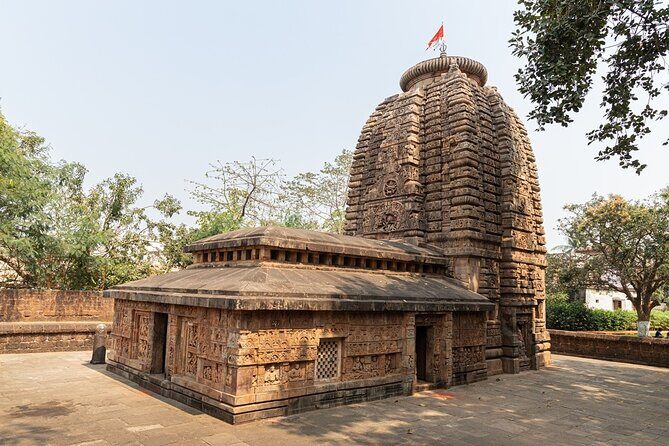
The route begins at Parasurameshwara Temple, a 7th-century shrine known for finely carved sculptures and ornamentation. This is where the guide usually sets the frame: Parasurameshwara is described as the harbinger of the Kalinga style of architecture.
What I love about leading off here: it teaches you the building language before you start collecting temples like trophies. The guide can point out how the style shows up in details, not just the overall shape. Once you’ve seen those patterns at the start, later temples feel like variations on the same theme.
Expect about 20 minutes at this first stop. It’s short on purpose. You’re not meant to “camp” at stop one. You’re meant to get your bearings, then keep moving.
Mukteshwar and Someshwar: 10th-century carvings that explain the evolution
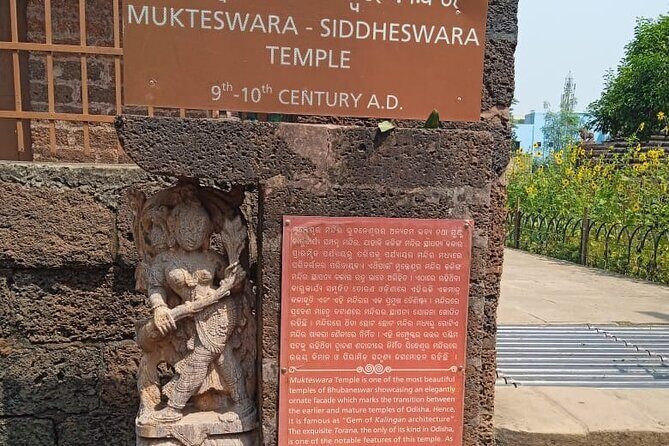
After Parasurameshwara, you walk toward Mukteshwar and Someshwar Temples, both from the 10th century. These are highlighted as two gems of the Kalinga school of architecture, with fine carvings that reflect the way the style was building momentum over time.
This is the kind of stop where a guide matters. From street level, it’s easy to notice “old temple” and move on. A good guide helps you notice what changes between eras: proportions, ornament patterns, and how the carved surfaces communicate with the eye as you move around the structure.
You’ll spend about 45 minutes here, which is generous for two temples. That extra time helps when you want to angle your body to see carvings from different sides. If you’re the type who pauses often (same), this section will suit you.
Bindu Sagar: the lake stop that refreshes your eyes and your feet
Then the pace changes. You get to Bindu Sagara, a picnic spot about 1,300 feet long and 700 feet wide. There’s a tiny island in the center with several shrines, and there’s a legend tied to it—Lord Shiva created the lake to quench Goddess Parvati’s thirst.
This is one of those stops that makes the whole tour feel balanced. If you only do temple after temple, your brain turns carvings into background. A lake break resets attention.
Admission for Bindu Sagara is included on this experience, and the stop runs about 20 minutes. It’s long enough to look across the water and then regroup, not long enough to slow the tour down into a half-day.
Tip for your comfort: treat this as your hydration moment. Water + shade management matters more than you think on a 3-hour walking circuit in India.
Ananta Vasudev: strong icon details that make the sculpture easier to read
Next comes Ananta Vasudeva Temple, described as spectacular, with multiple identifiable figures and symbols. The idol includes Balarama standing under a seven-hooded serpent. You’ll also find Subhadra holding a pot of jewels, and Lord Krishna depicted holding a mace, chakra, lotus, and conch.
Here’s why this stop is useful even if you’ve seen temple icons before: the tour framing makes the details easier to recognize. You won’t just see figures—you’ll know what the figures are doing.
Time at this stop is about 20 minutes, with admission ticket free. That’s enough for a focused look without feeling rushed, especially if your guide points out the icon positions so you can follow the story the sculpture is trying to tell.
You can also read our reviews of more guided tours in Bhubaneswar
A walk past the bazaar: smelling the city between temples
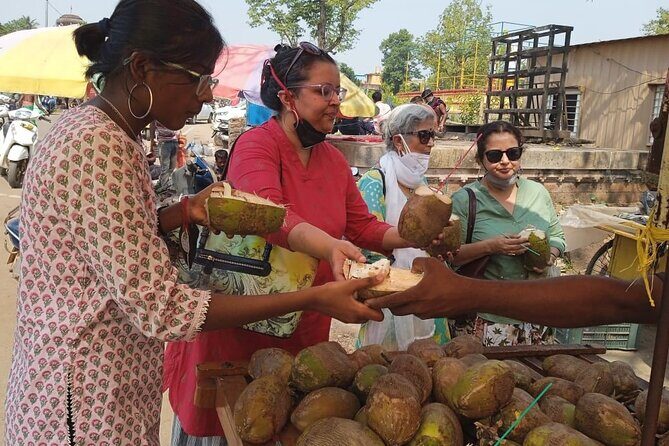
After the temples, the tour includes a short walk past local bazaars in Bhubaneswar. This part is only about 15 minutes, but it changes the whole feel of the experience.
Instead of treating the city like a museum, you get a reminder that these temples still exist inside daily life. You might notice everyday goods, people moving through lanes, and the rhythm of commerce that doesn’t stop for tourists.
This is also a good time to pick up small snacks or cool drinks if your guide gives a quick moment. Just keep it practical: you’ll still have more temple stops ahead.
Lingaraj Temple: the most famous stop for a reason
Lingaraj Temple is described as the most famous temple of Bhubaneshwar. It’s built in Kalinga style and made of sandstone and laterite, dedicated to Harihara—a combined form of Vishnu and Shiva. The tour notes it was built in the 11th century.
This is often where visitors start asking the bigger questions: how do these traditions overlap, and why does the architecture look the way it does. With a guide, you’re more likely to catch the religious symbolism and the building logic rather than just taking photos and moving on.
You’ll have about 20 minutes here, with admission ticket free. That’s enough time to see the temple’s overall form and then focus on carvings and material changes if the light is right.
If you’re photographing: keep an eye on angles. Sandstone and laterite can look different as you move, so a guide’s timing can make the “texture” pop.
Vaital Deul: an 8th-century temple with an impressive tower shape
After Lingaraj, you’ll head to Vaital Deul Temple, an 8th-century temple dedicated to Goddess Chamunda. The tower is described as impressive, and the roof’s semi-cylindrical shape is said to resemble Dravidian-style gopurams.
This is where you may start noticing the broader Indian temple language crossing styles. The Kalinga style is the theme of the tour, but Vaital Deul helps you see how regional architecture shares ideas—especially with the silhouette and tower design.
You’ll spend about 20 minutes here, with admission ticket free. It’s a good stop if you like architecture more than iconography, because the tower form gives you something visual to track even from a distance.
Raja Rani Temple: dancing women, and a great finish line
The walking tour ends at Raja Rani Temple. This is a temple from the 11th century made from reddish and yellow sandstone. Locally, the material was called Rajarani, and that name became part of the temple identity.
Raja Rani is famous for sculptures of dancing women. If you want a “final emotional image,” this is a strong one. The carvings feel like movement even though the stone is still. A guide can help you spot what makes the poses and ornament patterns feel rhythmic.
Time at Raja Rani is about 20 minutes, with admission ticket free. The tour ends at the temple, so you’re not forced into an immediate travel sprint right after your last stop.
The guide experience: what makes it more than just walking
A walking route is only as good as the person holding the thread. The tour is designed around a professional guide, and I’ve seen examples of guides meeting people right on time at the stated spot—Sarat is one such example. The difference is how quickly they can make carvings and icon meaning feel clear.
Another reported name you might encounter is Mr. Sumnat Babu Das, who’s described as turning short walks between temples into a story-led experience. You’ll likely hear temple context that connects one stop to the next, so you don’t treat them as isolated stops.
This matters for value. If you’re paying for a guide, you want the guide to help you see. In this itinerary, the stops are closely tied through Kalinga architecture and time period, so the guidance has a natural structure.
Also, the experience is tied to supporting local communities—training and employing local guides and supporting local businesses so travel dollars stay in the local economy. That’s not just a feel-good note; it usually correlates with guides who know how to explain the places without turning them into corporate scripts.
Price and value: $55 for 3 hours of temple-focused guidance
At $55.00 per person for about 3 hours, this isn’t a budget “free-for-all” walk, but it is positioned as a real guided experience. You’re paying for three things that matter in temple cities:
- Temple access clarity: multiple stops, and the tour notes admission for most temple stops is free, with Bindu Sagara admission included
- Meaning-making: a professional guide keeps the carvings and symbols from becoming random stone textures
- Time efficiency: a tight circuit through key sites in one session, plus a bazaar walk without detours
So for most people, the question isn’t whether it’s cheap. The question is whether you want help reading what you’re seeing. If you do, the price starts to make sense fast.
Who should book this Bhubaneswar Old Town walk
This tour fits best if you:
- Want a temple route focused on Kalinga architecture instead of vague sightseeing
- Enjoy walking short distances with built-in pauses at each site
- Prefer a small group (up to 15) so you can ask questions and not feel lost
- Like a bit of everyday city texture via the bazaar segment
It may be less ideal if you:
- Have mobility limits and struggle with uneven stone steps at temples
- Expect long stays at each temple (this is a circuit, not a slow museum visit)
FAQ
FAQ
How long is the Bhubaneswar walking tour?
It’s about 3 hours (approx.).
What does the tour cost?
The price is $55.00 per person.
Where does the tour start and end?
It starts at Parasurameshwara Temple (6RVQ+6JX, Kedar Gouri Vihar, Old Town, Bhubaneswar) and ends at Raja Rani Temple (near BOI ATM, Tankapani Rd area).
Is pickup offered?
Yes, pickup is offered.
Is admission included for temple stops?
The tour notes admission ticket is free for the temple stops listed, and Bindu Sagara’s admission ticket is included.
Do I need a paper ticket?
You’ll use a mobile ticket.
What is the group size limit?
The experience has a maximum of 15 travelers.
What’s the cancellation window?
You can cancel for a full refund up to 24 hours in advance. If you cancel less than 24 hours before the start time, the amount you paid is not refunded.
Should you book this tour?
If you’re coming to Bhubaneswar for temples, I’d book this. The route is tight, the stops are clearly connected through Kalinga architecture, and you get the extra balance of a lake pause plus a short bazaar walk. For $55, the biggest win is that a professional guide helps you read the carvings and icon details instead of just glancing up and moving on.
If you want a temple experience that stays organized, small-group friendly, and focused on seeing what’s actually in front of you, this is a smart pick.