REVIEW · NEW DELHI
Exclusive Full-Day Guided Tour of Old and New Delhi
Book on Viator →Operated by Tourinza India · Bookable on Viator
Delhi changes pace with every turn. This private day tour strings together Old Delhi landmarks and New Delhi icons with a guide who helps you make sense of it all. I like that it’s built around clear sightseeing blocks instead of random stops, and you start with a fun tuk-tuk ride past the older lanes.
Two things I especially liked: the private air-conditioned car with chauffeur keeps the day comfortable while you jump between neighborhoods, and the guide’s explanations help the monuments feel connected instead of like a pile of photos. The route also mixes major ticket sights (like Jama Masjid and Qutub Minar) with easy, free stops so you still feel value even if you are selective about entrances.
One consideration: the schedule can shift on Mondays, since Akshardham is closed and Lotus Temple is also listed as closed for that day. If your dates include Monday, plan for a small swap and a slightly different flow.
In This Review
- Key highlights at a glance
- First pickup to Sunheri Masjid: the day’s pacing
- Tuk-tuk through Old Delhi: bazaars explained, not just viewed
- Jama Masjid: a big courtyard moment with an easy walking pace
- Chandni Chowk spices: senses first, facts second
- Red Fort drive-by: big Mughal architecture from the road
- Gurudwara Bangla Sahib: short stop, strong story
- India Gate and the WWI names you can’t ignore
- Parliament House and President’s House: photo chances without long stops
- Humayun’s Tomb (UNESCO) and the Akshardham trade-off
- Qutub Minar: a focused UNESCO moment
- Lotus Temple: calm geometry to end the day
- Raj Ghat optional: a low-key final thought
- Transport, timing, and how to plan your day around it
- Value check: is $22.03 worth it for a private day?
- Who this tour suits best (and who should consider alternatives)
- Should you book this Old and New Delhi guided tour?
- FAQ
- How long is the tour?
- Where does pickup happen, and when can I be picked up?
- What sights are included in the route?
- Are entrance fees included?
- What happens if I’m booking on a Monday?
- What should I bring for monument entry?
Key highlights at a glance
- Sunheri Masjid meets your guide and then you ride Old Delhi by tuk-tuk to get oriented fast.
- Jama Masjid + Chandni Chowk are paired in a way that makes the city’s spiritual and street-life sides feel linked.
- Imperial Delhi drive-bys include Parliament House, India Gate, and President’s House for quick photo chances without long detours.
- Humayun’s Tomb and Akshardham are both on the route, with a Monday swap if Akshardham is closed.
- Qutub Minar is included as a focused UNESCO stop, not just a passing glance.
- Lotus Temple and optional Raj Ghat give you a calm finish before the drop-off back to your pickup zone.
First pickup to Sunheri Masjid: the day’s pacing

Your day begins with pickup from anywhere in Delhi, Noida, Gurugram, Ghaziabad, or Faridabad. You can choose a pickup time between 8 AM and 10 AM, which is handy if you’re coming from an early flight, a train arrival, or you just want to sleep in a little. The tour is private, so it’s only your group—no waiting around for strangers.
Once you meet your guide at Sunheri Masjid, the focus shifts immediately to Old Delhi. After that meet-up, you’ll travel by tuk-tuk for the first leg through the older bazaars. That early switch from car to tuk-tuk matters: it sets the tone and helps you understand why these streets and markets still matter to locals today.
Logistically, it’s also built to reduce stress. Round-trip transfers are included from your hotel, airport, or train station (and you’ll also get a drop-off at the end anywhere in the same areas). There’s even parking, tolls, fuel, and taxes handled—small details that add up when you’re spending a whole day on the move.
You can also read our reviews of more guided tours in New Delhi


Tuk-tuk through Old Delhi: bazaars explained, not just viewed
The tuk-tuk ride is short enough to feel fun, but long enough for your guide to paint a picture of how Old Delhi’s markets function day to day. You’ll pass colorful, busy bazaars while your guide explains the important role they play for locals. I like this approach because it turns a drive past shops into a quick lesson.
What you’ll gain here is context. When you later walk around a big site like Jama Masjid or browse the Chandni Chowk spice market, you understand the city isn’t split into tourist-only zones. The same streets that look photogenic also serve real daily needs.
One practical thing: since this portion is done by tuk-tuk, you’ll want to keep your hands free for photos and small items. Bottled water is included, which helps when the day starts outdoors before the car sections.
Jama Masjid: a big courtyard moment with an easy walking pace
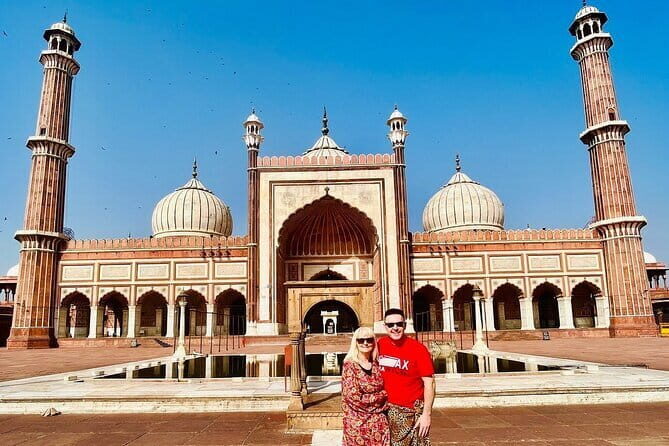
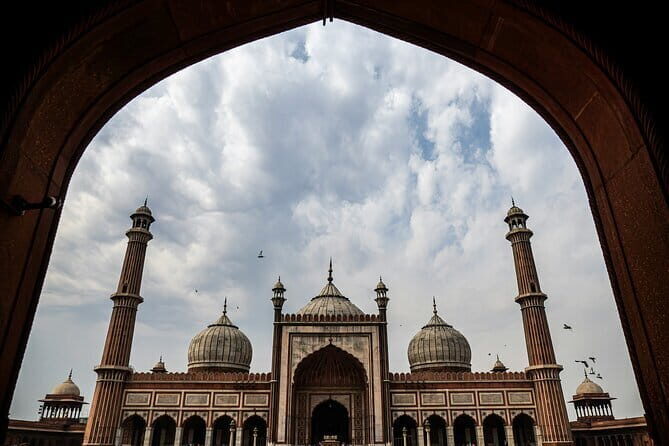
Your first major stop is Jama Masjid, described as India’s largest mosque. You get about an hour here, with admission included. The core experience is walking around the red sandstone courtyard and taking in the scale.
A helpful detail to know before you arrive: Jama Masjid was built in 1656 with the help of 5000 workers. That fact alone gives the stop weight; you can connect the size you see with the labor implied by the construction.
There are two ways this kind of stop can go on a day tour: either you rush through it as a photo stop, or you slow down and actually look. Here you get enough time to do the second. If your goal is classic Delhi sights with breathing room, this one fits well.
Chandni Chowk spices: senses first, facts second
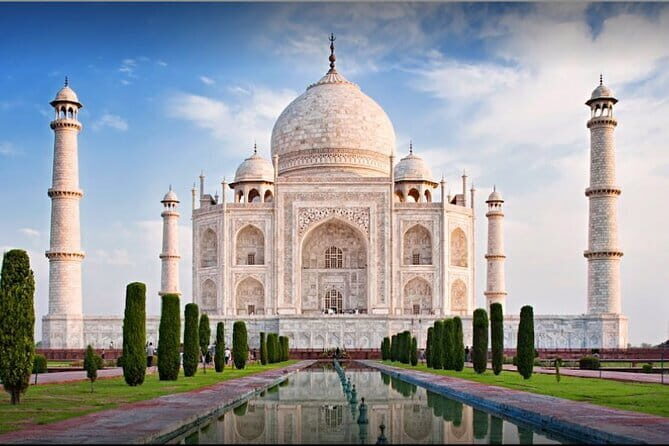
Right after Jama Masjid, you’ll head to the famous Chandni Chowk market for spices. This is one of those stops that’s hard to summarize without tasting and smelling. The tour leans into that—your time here is about letting your senses take over, then learning some interesting facts about spices and how they’re used.
I like this because spices are more than souvenirs. When your guide points out uses, you start seeing the market as a practical food system rather than a tourist corridor. It also helps you buy with confidence if you decide to pick something up later.
Tip for your own comfort: keep your shopping pace calm. This is a street market stop, and you’ll get the most out of it if you’re not sprinting between stalls.
Red Fort drive-by: big Mughal architecture from the road
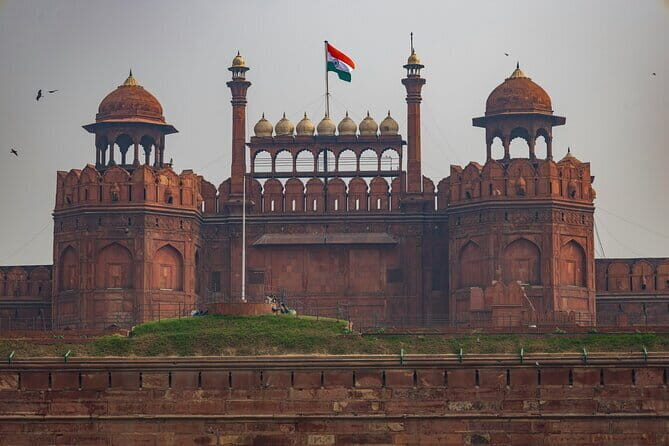
Red Fort is mentioned as part of the route, with a drive-by option during your transition through central Delhi. You’ll see it while moving, and you can take pictures as you continue toward the next cluster of landmarks.
This section is best for two types of travelers. If you want maximum coverage in one day, drive-bys are efficient. If you’re hoping for a long inside-the-fort visit, you might find you’ll want more time elsewhere later—so treat this stop as a visual hit, not the full deep visit.
A few more New Delhi tours and experiences worth a look






Gurudwara Bangla Sahib: short stop, strong story
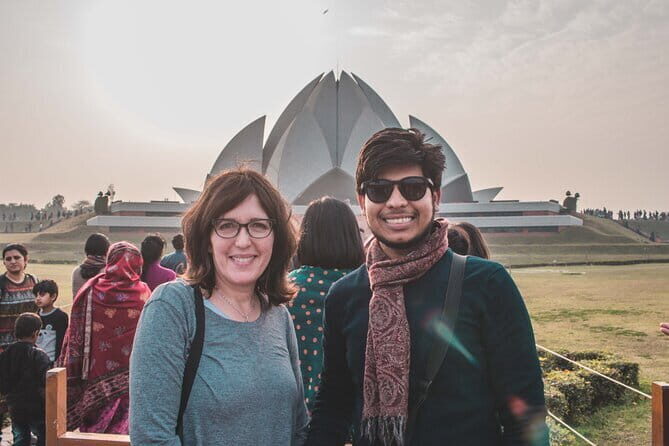
Next up is Gurudwara Bangla Sahib, with about 30 minutes and admission free. Even in a short window, the tour gives you a core story: in 1664, the eighth Sikh Guru visited a king and helped people during a smallpox and cholera epidemic by distributing water from the tank. That tank and the associated tradition are part of why the site draws visitors.
What I like about including this stop is the way it balances the day. After mosque and market, you’re now in a Sikh religious site with a very human-centered origin story around healing. It makes the spiritual theme of the day feel broader than one religion.
India Gate and the WWI names you can’t ignore
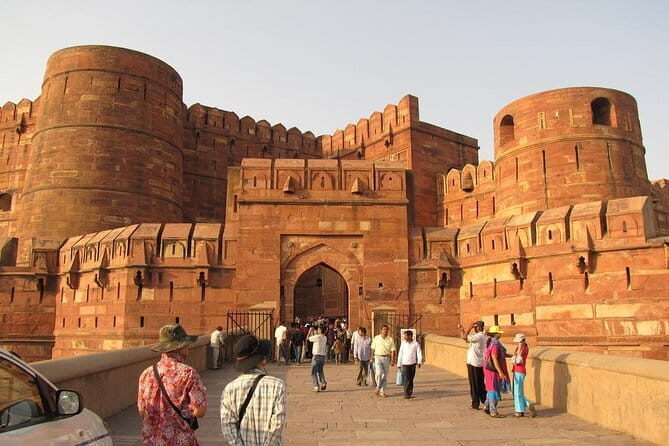
Then you roll into India Gate for a quick 15-minute visit, with admission free. India Gate is a memorial: it’s the 1921 Tomb of the Unknown Soldier, with names of 13,300 Indian army servicemen carved on the wall who died during the First World War.
You don’t need to be a military-history person to feel the weight of that fact. Even a brief stop lands because the names are specific. It also gives you a meaningful pause in the day before the tour moves on to government buildings.
Parliament House and President’s House: photo chances without long stops

After India Gate, you’ll drive past Parliament House for pictures and continue onward to President’s House. This isn’t set up as a long viewing experience. It’s more about getting familiar with the central government zone and snapping a few photos from the road.
If you like “big buildings in the frame” sightseeing, this works. If you’re expecting guided access inside, the tour setup suggests otherwise—so plan for a view from outside.
Humayun’s Tomb (UNESCO) and the Akshardham trade-off
Humayun’s Tomb is one of the big centerpiece stops, especially because it’s UNESCO-listed and described as the first garden tomb of India. You’ll have about 30 minutes, and admission is included for this option.
The story you get here is also central: the tomb was built after Humayun’s death by his wife. That makes the site feel personal, not just architectural. You’re not only seeing a structure; you’re seeing a response to loss in stone and garden design.
Now the swap: you can either visit Humayun’s Tomb or Akshardham Temple. The route also notes that Akshardham is closed on Monday, so you’ll be taken to Humayun’s Tomb instead.
Akshardham is a different kind of wow. It’s one of the biggest Hindu temples, constructed in 2005 but designed to look like it’s been built for over a thousand years because of its architecture. If you catch it on a day when it’s open, it adds a modern-feeling monument that still aims for an old-world scale.
I’d treat this segment as one of the main reasons to book. It’s where Delhi starts feeling cinematic: UNESCO gardens on one side, big temple architecture on the other, depending on the day.
Qutub Minar: a focused UNESCO moment
Next is Qutub Minar, about 45 minutes with admission included. The tour describes it as the tallest minaret, built up in 1192 with bricks, and part of the UNESCO World Heritage Site in Mehrauli.
This stop is long enough to appreciate height and detail without feeling like you’re stuck for hours. You get a proper block of time rather than a quick stop for a single shot. If you care about structure and proportion, Qutub Minar is one of the best uses of your hours on this route.
One practical note: the day includes multiple sites with tickets that are checked with a valid photo ID. Bring your photo ID to avoid delays at monument entrances.
Lotus Temple: calm geometry to end the day
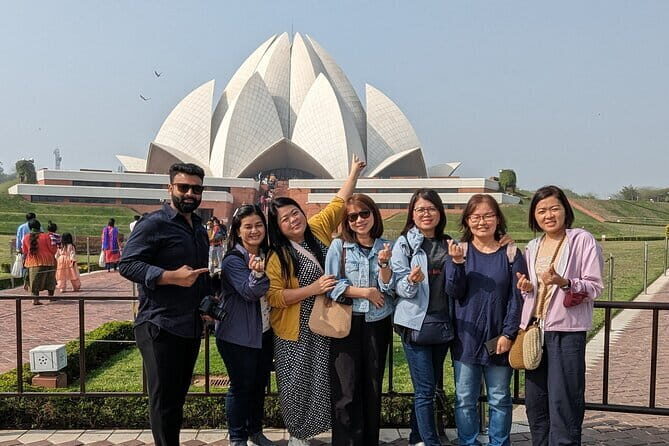
For your last major sight, you’ll visit Lotus Temple, a Bahá’í House of Worship dedicated in December 1986. It’s known for its flower-like shape and has become a prominent attraction in Delhi.
You’ll have about an hour here in the standard flow, and admission is free. The atmosphere here typically works well at the end of a long day, because it’s less about rushing from one photo angle to the next and more about letting the geometry do the talking.
Monday note to keep in mind: Lotus Temple is listed as closed on Monday, and the route includes a note saying you’ll instead show Gurudwara Bangla Sahib. If your dates land on Monday, expect a timing adjustment so the day still moves.
Raj Ghat optional: a low-key final thought
There’s also an optional stop at Raj Ghat, the memorial dedicated to Mahatma Gandhi in Delhi, with about 30 minutes and admission free. The tour notes it originally related to the name of a historic ghat in Old Delhi and mentions nearby city-gate context.
Because it’s optional, you can decide based on your energy. If you’ve been out since morning and want a calmer finish, Raj Ghat is a good fit. If you’re already monumented out, you can skip and use the time for an easier ride back.
Transport, timing, and how to plan your day around it
This is a full-day route, listed at about 8 hours. The tour also mentions you can choose from three tour durations to fit your schedule, including a 6-hour New Delhi tour and a 4-hour Old Delhi tour (with set itineraries for those options). If you’re short on time, the idea is that you can pick which side of Delhi you want most.
During the day, you’ll also spend time traveling. The tour notes that remaining hours are allotted for traveling one place to another, which matters because Delhi distances can add up. Your best strategy is not to treat every stop as a sprint. Let the structure of the day carry you.
In terms of comfort, the private vehicle is air-conditioned. The car size depends on group size: a four-seater sedan for one to two people, a six-seater wagon for three to five, a nine-seater van for six to nine, and a twelve-seater van for ten to twelve. That’s useful if you’re traveling with family or a small group and want everyone to stay together.
Also, you’ll get complimentary water bottles and you won’t be managing parking fees and tolls. Those are the “invisible” parts of value that make a long day feel lighter.
Value check: is $22.03 worth it for a private day?
At $22.03 per person, the value depends on what you want: speed, comfort, and guidance. This tour bundles a lot into one booking—private air-conditioned transport, a private live guide, a tuk-tuk ride in Old Delhi, and entry tickets included depending on your option.
Some monument stops are free (like Gurudwara Bangla Sahib, India Gate, Lotus Temple, and Raj Ghat). Others require admission tickets (like Jama Masjid and Qutub Minar, and either Humayun’s Tomb or Akshardham depending on the day and option).
So you’re not paying extra for every stop on top of the base tour. And because it’s private, the guide can shape the pacing around your interests within the overall schedule.
My take: if you’re new to Delhi and want the biggest hits across Old and New Delhi without piecing it together yourself, this looks like strong value—especially with hotel/airport/train pickup and drop-off handled for you.
Who this tour suits best (and who should consider alternatives)
This tour fits best if you want a guided, organized day that hits major sights across Delhi without you needing local navigation skills. You’ll like it if you appreciate context—your guide explains things like why Old Delhi bazaars matter, what spices are used for, and why certain monuments are significant.
It also suits couples and small groups because it’s private, with vehicle size matched to your party.
Where it might not be the best match: if you want long, slow, deep visits inside every major site. This is a “see a lot with guidance” format. Drive-bys (like Parliament House area and Red Fort from the road) won’t satisfy you if you want extended time.
Should you book this Old and New Delhi guided tour?
I think you should book it if your goal is a high-coverage Delhi day with a guide who helps you understand what you’re seeing, plus comfort during the long stretches between Old Delhi and New Delhi. The tuk-tuk ride gives you that classic city flavor early, and the mix of Jama Masjid, Chandni Chowk, UNESCO sites, and Lotus Temple helps the day feel balanced instead of one-note.
Hold off or be cautious if you’re traveling on a Monday and Akshardham or Lotus Temple is specifically on your must-see list. The tour does adjust, but it’s not guaranteed to deliver every stop exactly the same way every day.
If you want one day that feels like a guided overview of Delhi’s past and present, this tour is built for that job.
FAQ
How long is the tour?
The exclusive full-day guided tour is listed at about 8 hours. The experience also mentions shorter options, including a 6-hour New Delhi tour and a 4-hour Old Delhi tour.
Where does pickup happen, and when can I be picked up?
Pickup is available from anywhere in Delhi, Noida, Gurugram, Ghaziabad, or Faridabad. You can choose any pickup time between 8 AM and 10 AM.
What sights are included in the route?
The tour includes Jama Masjid, a Chandni Chowk spice market visit, Red Fort drive-by, Gurudwara Bangla Sahib, India Gate, President’s House drive-by, Humayun’s Tomb and/or Akshardham Temple, Qutub Minar, Lotus Temple, and optional Raj Ghat.
Are entrance fees included?
Tickets to monuments are included if you choose the option with entrance fees. Some stops in the route are described as free, including places like Gurudwara Bangla Sahib, India Gate, Lotus Temple, and Raj Ghat.
What happens if I’m booking on a Monday?
The tour notes that Akshardham is closed on Monday, so you’ll be taken to Humayun’s Tomb instead. It also notes Lotus Temple is closed on Monday, so the day’s order may shift toward Gurudwara Bangla Sahib.
What should I bring for monument entry?
Carry a valid photo ID for checking at the monuments.