REVIEW · NEW DELHI
Delhi: Qutub Minar UNESCO World Heritage Site Walking Tour
Book on GetYourGuide →Operated by Crystal India Holidays · Bookable on GetYourGuide
Qutub Minar hits you fast. At the base of the Qutub Minar, the 73-meter red-sandstone minaret rises above you, and you can spot the fine Mamluk geometry and Arabic inscriptions up close. It’s the kind of landmark that looks dramatic from far away, but also rewards you for slowing down and looking carefully.
I really like how the tour makes the Quwwat-ul-Islam Mosque feel personal. You’re not just walking past arches and pillars—you’re seeing how older Hindu and Jain temple elements were reused, which gives the whole complex a practical, human story.
One consideration: this is an outdoor walking tour on uneven heritage ground, so comfortable shoes matter, and you’ll want to keep moving at a steady pace for the full 2–3 hours.
In This Review
- Key things I’d bet on in this Qutub Minar tour
- Qutub Minar’s base-level view: the 73-meter scale you feel
- Mamluk carvings and storeys you can compare as you walk around
- Quwwat-ul-Islam Mosque: the first mosque in India you can’t ignore
- Iron Pillar: a rust-resistant mystery with a real presence
- Alai Darwaza and the unfinished Alai Minar: ambition you can see
- How the 2–3 hour walking pace keeps the site understandable
- Price and value at about $9 per person
- Who this tour fits best (and who might want a different plan)
- Should you book this Qutub Minar walking tour?
- FAQ
- How long is the Qutub Minar walking tour?
- What will I see during the tour?
- Is the tour guided?
- Is it a private group?
- Is wheelchair access available?
- What’s included in the price?
- Can I cancel for a refund?
- Is there a reserve and pay later option?
Key things I’d bet on in this Qutub Minar tour
- 73-meter Qutub Minar scale you can understand from the ground, then compare as you walk around it
- Mamluk carvings and storey-by-storey design changes that you can actually spot with a guide’s pointers
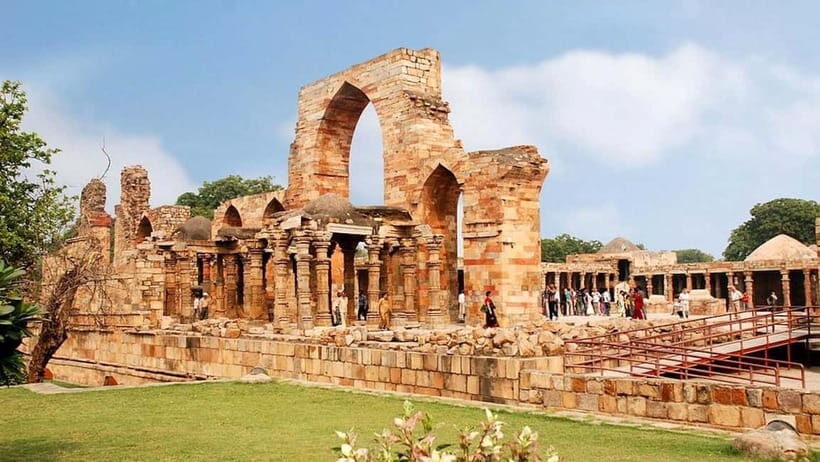
- Quwwat-ul-Islam Mosque: reused pillars and an early fusion style that’s visible in the details
- The Iron Pillar’s rust-resistant surface as a real, physical mystery
- Alai Darwaza plus the unfinished Alai Minar to show ambition—and what happens when plans stop
- A live English or Hindi guide, including the kind of clear, engaging explanations you’d hope for (like Madhuvan in prior bookings)
Qutub Minar’s base-level view: the 73-meter scale you feel
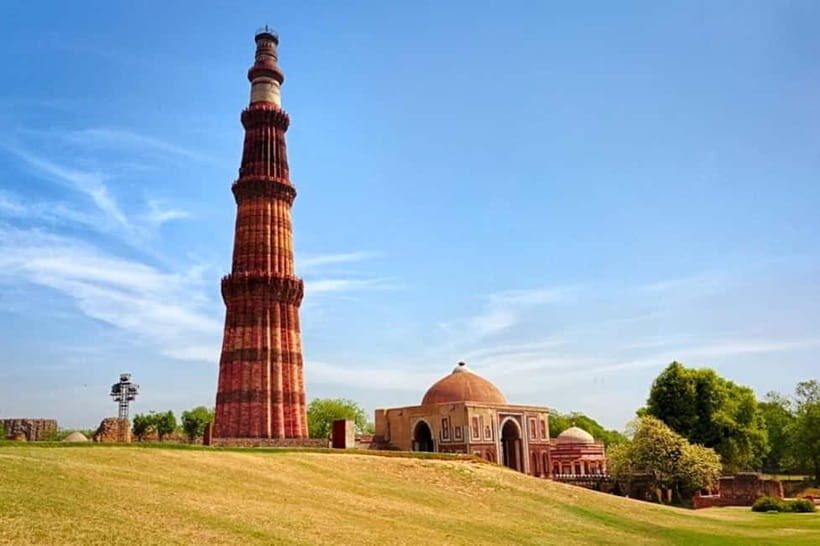
Start at the foot of Qutub Minar, and the first reaction is usually the same: you crane your neck, then you look again because it keeps changing as your eyes adjust. The minaret rises to 73 meters and was built in the early 13th century, but the experience isn’t about memorizing dates. It’s about seeing how heavy architecture can still feel precise and crafted.
The material matters too. You’ll notice the red sandstone and marble look like they were chosen for contrast, not just decoration. When you stand close, the minaret stops being a single big shape and turns into a vertical set of surfaces—each one meant to be read.
A good guide helps you see what you’re looking at. Instead of treating the carvings like wallpaper, you’ll learn to identify what’s special about the inscriptions and geometric patterns, and why they belong to the Mamluk artistic influence. That shift—looking with purpose—is what turns a “famous monument” into an actual experience.
You can also read our reviews of more walking tours in New Delhi



Mamluk carvings and storeys you can compare as you walk around
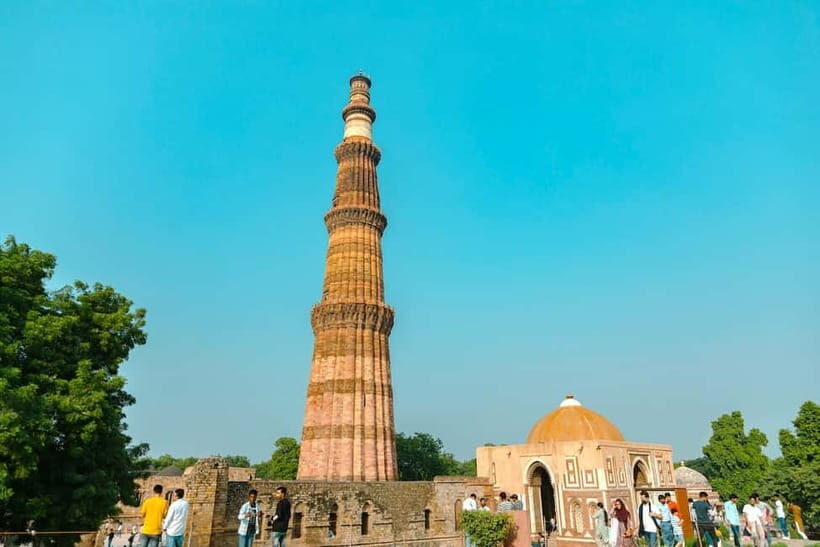
One of the best parts of this walking tour is the chance to circle the minaret and treat each storey like its own clue. The structure is tall, but it’s not uniform. Each storey has a distinct design, and successive rulers built it up over time.
That’s where a guide earns their spot. The carvings and patterns can look complex all at once from a distance. With a professional guide, you learn what to look for: Arabic inscriptions here, geometric rhythm there, and how the design changes as you move around.
This is also where the tour feels extra useful for first-timers. If you’ve only seen photos, the minaret’s details can feel random. On-site, they become a system. You’ll end up remembering the minaret not just for its height, but for the way it evolves—storey to storey—like a history written in stone.
If you’re into architecture, bring patience. The best moments are the quiet ones: leaning in slightly, then stepping back to re-check proportions, then leaning in again.
Quwwat-ul-Islam Mosque: the first mosque in India you can’t ignore
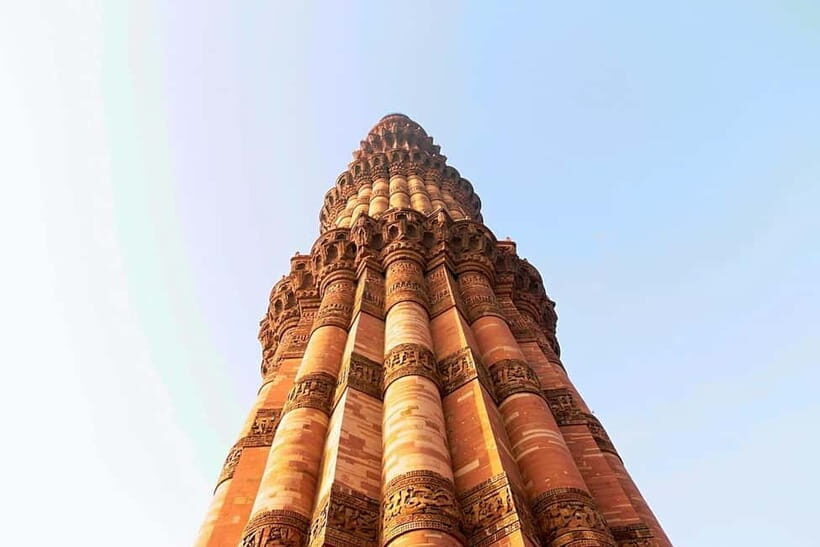
Next comes the Quwwat-ul-Islam Mosque, described as the first mosque built in India. That claim matters because it puts you at the start of a long story. But the real impact is visual and physical.
Look at the arched gateways and pillars, and you’ll see something surprising: many pillars were repurposed from earlier Hindu and Jain temples. That’s not a vague “influence” idea—it’s a concrete, on-the-ground example of how building materials and design traditions can cross cultural lines.
A strong guide ties the look to the meaning. You’ll start noticing the mix: the way older carved elements sit inside a later mosque setting, and how the overall form still reads as Islamic architecture. It’s a site where the craftsmanship is the point, not just the label.
There’s also a practical benefit to visiting the mosque in this tour format. You’re already in the Qutub Minar zone, so you don’t spend time hunting around. The guide leads you through the complex like a clear path rather than leaving you to guess what to prioritize.
Iron Pillar: a rust-resistant mystery with a real presence
Just beyond the mosque area, you’ll see the Iron Pillar. The standout detail is its rust-resistant surface, which is why people keep returning to it. It’s not a tall monument with clever “views” to chase. It’s a single artifact that invites you to ask why it has survived with such stubborn integrity.
On this walking tour, you’re not expected to solve metallurgy in the moment. Instead, you’re encouraged to treat the pillar like evidence. The surface tells a story through what it lacks—no dramatic corrosion that you might expect from something made of iron left outdoors.
This stop adds a nice change of pace. Up to this point, you’re focused on architecture: carvings, arches, storeys, and design shifts. The Iron Pillar turns the focus toward materials—what people made, what they achieved, and how they built things meant to last.
It’s also a useful lesson in why guides matter on heritage sites. Without context, the pillar can feel like a “cool thing to take a photo of.” With a guide, it becomes part of a bigger picture: ancient Indian craftsmanship and the long reach of engineering choices.
Alai Darwaza and the unfinished Alai Minar: ambition you can see
After you’ve taken in Qutub Minar, the mosque, and the pillar, the tour pulls you toward two final highlights: Alai Darwaza and the unfinished Alai Minar.
Alai Darwaza is known for its striking Indo-Islamic architecture. That phrase can sound vague, but you’ll get a clearer read just by standing there and comparing shapes and decoration styles across the complex. It acts like a hinge between different eras of design language.
Then comes the unfinished Alai Minar, and it’s one of those rare heritage moments that feels honest. The project was ambitious, but it stopped, and you can see the interruption in the way it exists today. That makes it more than a “missing piece” sight. It shows you that history isn’t only about finished monuments—it’s also about plans that didn’t reach completion.
With a guide, you’ll connect this to the earlier idea you saw at Qutub Minar: buildings created over successive rulerships. At Qutub Minar, you see change through completion. At Alai Minar, you see change through stopping.
You can also read our reviews of more historical tours in New Delhi




How the 2–3 hour walking pace keeps the site understandable
This tour is built around a practical timeframe: 2 to 3 hours. That duration is actually a good fit for Qutub Minar because the site can sprawl mentally once you start looking closely. With limited time, you need someone to help you keep priorities straight.
You’ll spend your energy in the main clusters:
- the base and perimeter reading of Qutub Minar,
- the Quwwat-ul-Islam Mosque area,
- the Iron Pillar,
- and the Alai Darwaza / unfinished Alai Minar highlights.
The “walking tour” format also helps you avoid the common problem at big monuments: zoning out while waiting for a photo-perfect moment. Here, the guide’s explanations encourage short stops and quick comparisons. You’re constantly reorienting—standing, looking, then moving on.
If you’re the type who likes to go back later on your own, this schedule sets you up well. You’ll learn enough on the first pass to know what to re-check—like specific carvings, the reused pillars, or the layout logic of the complex.
Price and value at about $9 per person
At around $9 per person, this is one of the more budget-friendly ways to experience Qutub Minar with real guidance. What you’re mostly paying for isn’t access—it’s interpretation. On UNESCO sites, interpretation is the difference between seeing a famous structure and understanding what you’re actually looking at.
This tour also includes a professional tour guide, and if you choose the option, a private car transfer. That matters for value because it reduces friction. Even if you’re comfortable navigating Delhi on your own, having a simple plan can make the experience feel calmer and more focused on the site.
The fact that it’s a private group also changes the feel. You’re not fighting crowds for a view of the carvings or the exact spot where a guide wants you to stand. You’ll still want to move carefully—this is a heritage site—but the pace is more controllable.
Bottom line: if you want Qutub Minar details explained in English or Hindi, and you’re okay with a focused 2–3 hour walking format, the price-to-value ratio is strong.
Who this tour fits best (and who might want a different plan)
This tour suits you if you like architecture that has layers. You’ll appreciate the Mamluk influence, the storey-by-storey design changes, and the visible reuse at the Quwwat-ul-Islam Mosque. You’ll also enjoy the variety: minaret, mosque, pillar, then two different statements from the Alai Darwaza and Alai Minar story.
It also fits couples and small groups who want an efficient, guided circuit rather than a long, open-ended museum-style day. If you’re traveling with older kids (or anyone who likes “why is this here?” questions), a guide-led format keeps the site from becoming overwhelming.
If you prefer very long stops where you can wander without direction, you might find 2–3 hours a bit tight. But most people don’t come to Qutub Minar to wander for the whole day—they come to understand the essentials and move on.
And if you care about language support, you’ll have live English or Hindi guidance. In prior bookings, guides like Madhuvan have been praised for being engaging and explaining the complex background clearly, which is exactly what makes the details click.
Should you book this Qutub Minar walking tour?
Yes, I’d book it if you want your visit to make sense fast. The site is big enough to feel confusing, and Qutub Minar in particular rewards close looking. A guided walk helps you turn famous landmarks into legible details—especially the Mamluk carvings, the Quwwat-ul-Islam Mosque reuse story, and the contrast between finished and unfinished projects.
If you’re on a tight budget, the price around $9 is hard to beat for a guided heritage route. If you’re short on time in Delhi, the 2–3 hour length is exactly the sweet spot.
If you still aren’t sure, use this rule: if you’d rather understand what you’re seeing than just take pictures, this tour is for you.
FAQ
How long is the Qutub Minar walking tour?
The tour lasts 2 to 3 hours.
What will I see during the tour?
You’ll see Qutub Minar, the Quwwat-ul-Islam Mosque, the Iron Pillar, Alai Darwaza, and the unfinished Alai Minar.
Is the tour guided?
Yes. It includes a live tour guide (English and Hindi).
Is it a private group?
Yes, this is a private group.
Is wheelchair access available?
Yes, the tour is wheelchair accessible.
What’s included in the price?
It includes a professional tour guide. Transfer in a private car is included if you select that option.
Can I cancel for a refund?
Free cancellation is available up to 24 hours in advance for a full refund.
Is there a reserve and pay later option?
Yes. You can reserve now and pay later, with no payment due today.