REVIEW · CHENNAI
British Architecture Walk in Chennai by Wonder tours
Book on Viator →Operated by Wonder tours · Bookable on Viator
British-era Chennai looks different when you slow down on foot. This 3-hour British Architecture Walk threads together famous civic buildings built during colonial rule and shows how British and Indian design ideas got mixed. You’ll cover big landmarks tied to rail, war, churches, bridges, and education—without spending the day chasing transit.
Two things I really like about this tour: you get admission tickets included at each stop, and the route is built around real city landmarks rather than distant, hard-to-reach sights. Plus, there’s a local snack and coffee/tea included, which helps when you’re walking in Chennai’s heat and light.
One drawback to consider: it’s a walk-focused outing with no hotel pickup, so you’ll want to start at the meeting point and be ready for a steady pace over a few main areas.
In This Review
- Key reasons this walk works well in Chennai
- Price and what you’re really buying at $49
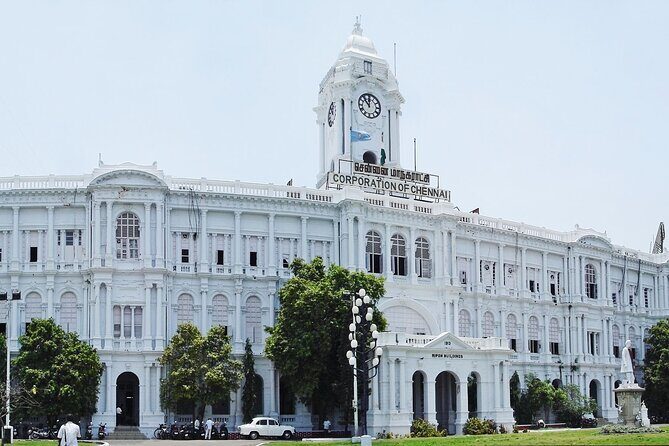
- Starting at the Greater Chennai Corporation Office (and why that’s smart)
- Stop 1: Ripon Building, where local self-government meets architecture
- Stop 2: Chennai Central Railway Station and the Gothic Revival vibe
- Stop 3: Southern Railway Headquarters in Indo–Saracenic style
- Stop 4: Victory War Memorial, from Cupid’s bow to World War I remembrance
- Stop 5: Fort St. George and St Mary’s Church (plus the colonial museum)
- Stop 6: Napier Bridge—an iconic city angle that shows up in media
- Stop 7: University of Madras—built for education, designed to last
- The guide makes or breaks it: Rajesh, Nanda, and the power of clear explanations
- Who should book this walk (and who might want to skip it)
- Practical tips to get the most from your 3 hours
- Should you book British Architecture Walk in Chennai by Wonder tours?
- FAQ
- How long is the British Architecture Walk in Chennai?
- How much does the tour cost?
- Where does the tour start and where does it end?
- Is hotel pickup or drop-off included?
- What’s included in the price?
- Are admission tickets included?
- Is the tour private?
- Is it near public transportation?
Key reasons this walk works well in Chennai

- Tight 3-hour route that still hits major British-era institutions
- Entry tickets included at each scheduled stop, not just a photo parade
- Guide-led storytelling that connects design details to what the buildings were used for
- Snack and coffee/tea included, helpful mid-walk
- A mix of styles: Gothic Revival, Indo–Saracenic, and colonial civic architecture
Price and what you’re really buying at $49
At $49 per person for roughly three hours, this tour is priced like a “guided access” experience rather than a casual stroll. You’re paying for three practical things: a local guide, entry tickets built into multiple stops, and a snack with coffee or tea. That matters because admission and guided interpretation are usually where cheap tours fall apart—you end up standing outside buildings, guessing what you’re seeing.
There are also small cost traps you should watch for. Porterage and tips aren’t included, and camera/video camera fees may apply at some locations (those aren’t covered). If you’re traveling with a camera you care about—bring a phone setup too, just in case.
You can also read our reviews of more walking tours in Chennai


Starting at the Greater Chennai Corporation Office (and why that’s smart)
The tour begins at the Greater Chennai Corporation Office on Raja Muthiah Road in Periamet. It ends back at the meeting point, so you’re not left figuring out how to get home after the last stop.
Starting in this part of Chennai also makes the route feel logical. You begin near civic administration and move outward through the city’s institutional core—rail, war memorial, church and fort, then education. If you like walking tours that teach you how neighborhoods “function,” this one fits that style.
If you’re planning your day around it, do two simple things: travel light (since porterage isn’t included), and arrive a few minutes early so you can meet the group without stress.
Stop 1: Ripon Building, where local self-government meets architecture
Your first major stop is the Ripon Building, associated with Lord Ripon (the namesake behind local self-government). It was designed by G.S.T. Harris and built by Loganatha Mudaliar—the kind of detail your guide can connect to the bigger British-era story of administration and civic planning.
What I like here is the tone of the building. Early stops matter because they set your “lens” for the rest of the walk. You start learning to spot how colonial-era public architecture wanted to look official and enduring, while still working within local building realities.
Practical note: you’ll get about 15 minutes here with an admission ticket included. That’s enough time to take in the exterior character and get an orientation explanation before you move on.
Stop 2: Chennai Central Railway Station and the Gothic Revival vibe
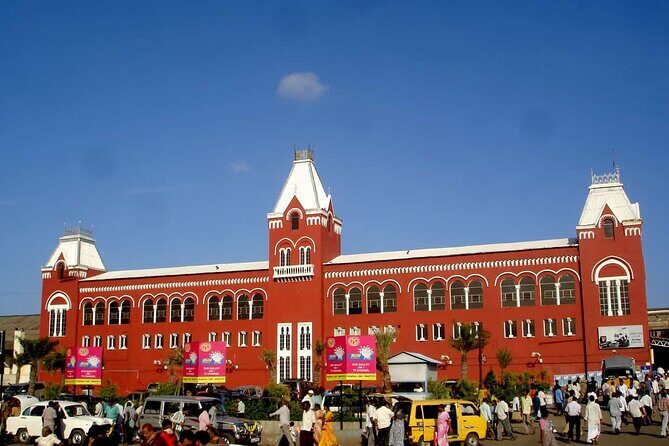
From Ripon Building, you head to the Chennai Central Railway Station, a working station that handles over 350,000 passengers every day. The station was built in 1873 in the Gothic Revival style by British architect George Harding, later modified by Robert Chisholm.
This stop is fun even if you’re not a rail enthusiast. The station shows you colonial-era priorities in a nutshell: connect trade, manage movement, and make the system feel permanent. Gothic Revival details also give you a “reading” tool—once you spot the style cues here, you’ll notice similar intentions elsewhere on the route.
Expect roughly 30 minutes at this stop, with admission ticket included. If you’re sensitive to crowds (a station is always lively), you’ll still have time to focus on architecture rather than getting swept into movement.
Stop 3: Southern Railway Headquarters in Indo–Saracenic style
Next up is the Southern Railway Headquarters, designed in the Indo–Saracenic style. The building was designed by N. Grayson, built by Samynada Pillai, and completed in 1921.
I like this stop because it’s a clear example of architectural “translation.” Instead of one straight colonial style, you see a blend meant to look right for both empire-era administration and local visual language. A good guide can help you notice how forms and details carry meaning—this building wasn’t just an office. It was a statement.
You’ll spend about 15 minutes here, again with admission ticket included. That shorter time works because it keeps the pace of the walk moving while still giving you a style “anchor” for the rest of the route.



Stop 4: Victory War Memorial, from Cupid’s bow to World War I remembrance
Then comes the Victory War Memorial, which was formerly called the Cupid’s bow. It commemorates the victory of the Allied Armies during World War I (1914–1918).
This stop turns the tour from architecture into meaning. It helps you see how colonial spaces were also used for memory and messaging. Even if you don’t consider yourself a history person, this kind of landmark is one of the easiest ways to understand how public design carries politics and emotion at the same time.
You get about 30 minutes here with an admission ticket included. Take your time to read the context your guide gives you. War memorials are better when you know what they’re pointing at, not when they’re just photo stops.
Stop 5: Fort St. George and St Mary’s Church (plus the colonial museum)

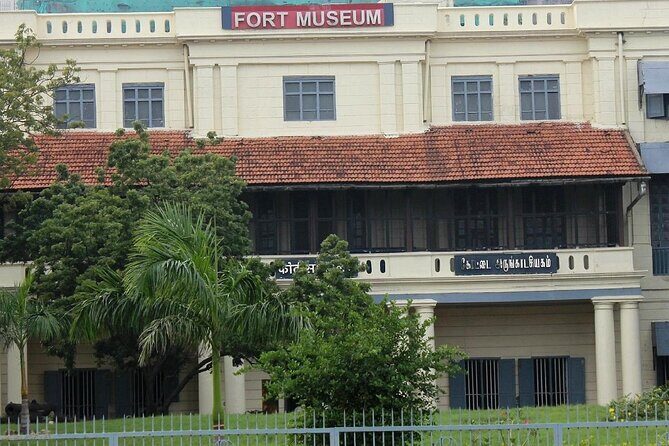
Your next stop is Fort St. George, where you’ll visit St Mary’s Church, described as the oldest Anglican Church of India, and also a museum with colonial relics.
This is a strong “big picture” stop because forts and churches explain how colonial rule used religion, law, and physical control together. The church adds a human scale—something you can feel as a place of worship rather than just a monument. The museum helps you connect the building to artifacts and everyday colonial material culture.
Plan for about 30 minutes here, with admission ticket included.
If you’re someone who likes to balance exterior architecture with interior context, this is one of the best places on the walk to slow down. If you prefer only outward “facades,” you might want to focus on what you can see quickly and ask your guide what’s most worth your time inside the museum.
Stop 6: Napier Bridge—an iconic city angle that shows up in media
Next is Napier Bridge, one of those places that turns into a shorthand for Chennai. The bridge was broadened and converted into a concrete structure, and it opened to the public in July 1943. It’s often used by media to represent the city.
This stop is shorter—around 15 minutes—but it serves a purpose. It reminds you that British-era design didn’t only happen on administrative buildings and stations. Infrastructure also shaped how Chennai moved and how outsiders pictured the city.
Since the tour is walking-based, use this moment to reset. Grab water, check your photos, and ask your guide how the bridge changed daily life back then. Even small answers can make the next stop land better.
Stop 7: University of Madras—built for education, designed to last
The walk finishes at the University of Madras area. The main complex was constructed between April 1874 and 1879. You’ll see elements like a convocation hall, porticos, a parapet, meeting halls, and a library. The Senate House is the administrative center of the university.
This is a satisfying end point because it closes the loop: from movement (rail) to governance (administration and forts) to remembrance (war memorial) and finally to education. When you connect those themes, the architecture stops feeling random. It starts feeling intentional.
You’ll spend about 30 minutes at the final stop with admission ticket included.
The guide makes or breaks it: Rajesh, Nanda, and the power of clear explanations
The strongest praise around this walk centers on the guides’ delivery—especially Rajesh and Nanda, who are repeatedly described as friendly and strong on explanations. What you want from a British architecture walk isn’t just facts. It’s interpretation: what a style choice might signal, why a building was built in that shape, and what it meant for the city at the time.
In practice, that means you should listen when your guide ties each building to how Chennai functioned—rail networks, war remembrance, religious presence, and education. The tour becomes more than a list of stops. It becomes a guided way to read the city.
So if you get Rajesh or Nanda, pay attention early. Their explanations set the tone for the entire route, and it’s much easier to spot details once you know what to look for.
Who should book this walk (and who might want to skip it)
You’ll likely enjoy this tour if you:
- like architecture with context (not just exterior photos)
- want a structured route through Chennai’s key colonial-era landmarks
- prefer a guided walk over piecing together rail stations and forts on your own
- appreciate small perks like snack and coffee/tea
You might choose something else if you:
- hate walking in city heat and prefer vehicle-based sightseeing
- want lots of free time at each stop (this is timed and moves along)
- don’t plan to visit interiors; the value is tied to admission tickets included
Also, this is described as a private tour/activity, meaning it’s limited to your group. That can be a big quality-of-experience advantage: fewer interruptions, more chance to ask questions, and better pace control.
Practical tips to get the most from your 3 hours
- Wear comfortable walking shoes. The duration is short, so you’ll want to keep moving without foot pain.
- Bring a bottle of water. Snack and tea help, but your body still needs water on a walk.
- If you care about photos, plan for possible camera/video fees since they aren’t included.
- Start with a clear goal: pick 2–3 styles you want to recognize (Gothic Revival, Indo–Saracenic, and colonial civic design) and ask your guide to point them out.
Should you book British Architecture Walk in Chennai by Wonder tours?
Yes, I’d book it if you want a compact, well-structured way to understand British-era Chennai without making it a whole-day logistics project. The combination of entry included at multiple stops, a guided narrative, and a small comfort perk like coffee/tea and snack makes the $49 price feel more like access than just narration.
I’d hesitate only if you strongly dislike walking city streets or you want unlimited time at each landmark. This is built for momentum and context, not for wandering.
One more thing: the experience is described as non-refundable and cannot be changed. If your schedule is tight, make sure you’re confident you can make the start time and meeting point.
If you do book, come in with curiosity about style and purpose. This tour is at its best when you treat Chennai like a living classroom—stone, arches, and rail lines included.
FAQ
How long is the British Architecture Walk in Chennai?
It’s about 3 hours (approx.).
How much does the tour cost?
The price is $49.00 per person.
Where does the tour start and where does it end?
It starts at Greater Chennai Corporation Office, 53, Raja Muthiah Rd, Periamet, Kannappar Thidal, Poongavanapuram, Chennai, Tamil Nadu 600003, India and ends back at the meeting point.
Is hotel pickup or drop-off included?
No. Hotel pickup and drop-off are not included.
What’s included in the price?
Included are a local guide, a local snack and coffee/tea, and all taxes, fees and handling charges.
Are admission tickets included?
Yes. Admission tickets are included for the stops listed (Ripon Building, Chennai Central Railway Station, Southern Railway Headquarters, Victory War Memorial, Fort St. George, Napier Bridge, and University of Madras).
Is the tour private?
Yes. It’s listed as private, meaning only your group will participate.
Is it near public transportation?
Yes, it’s described as near public transportation.