REVIEW · CHENNAI
Mahabalipuram walking tour by tourism ministry approved company
Book on Viator →Operated by 5 Senses Walks · Bookable on Viator
Mahabalipuram rewards slow looking. In just about 3 hours, this guided walk focuses on the Pallavas’ most striking rock-cut temples and monuments inside a UNESCO World Heritage Site. It’s priced at $50 per person, capped at 15 so you’re not lost in a crowd.
I especially like the tight, guided storytelling—the kind that helps you read the carvings instead of just taking photos. I also like the practical setup: admission tickets are included at each stop and you get a mobile ticket. One thing to consider is that the route ends at Five Rathas, not back at the same starting point, so you’ll want a plan for your next ride.
If your goal is to understand why these 7th-century stone sites still matter, this is a very efficient way to do it—without turning the day into a rushed checklist.
In This Review
- Key points worth knowing before you go
- Entering Mahabalipuram with a guide (instead of just wandering)
- Price and value: what $50 buys you in real time
- The route matters: Shore Temple start, Five Rathas finish
- Pancha Rathas: the 5 rock-cut “chariots” that set the tone
- Pancha Pandava Cave: six pillars, yali creatures, and a bigger-than-it-looks cave temple
- Arjuna’s Penance: the bas-relief that gives you scale fast
- Krishna’s Butter Ball: the myth you notice, then the geology you respect
- Varaha Cave Temple and Trimurti Cave: Pallava temple design in stone
- Ganesh Ratha: single-stone power and a dedication shift
- Old Light House (built 640): why a lighthouse belongs in a temple walk
- Mahishasura Mardini Cave and the Shore Temple finish: drama, then views
- The guide really makes the difference (including Ramesh’s style)
- Logistics that affect comfort: weather, pacing, and tickets
- Who should book this Mahabalipuram walk?
- Should you book this tour?
- FAQ
- How long is the Mahabalipuram walking tour?
- What is the meeting point and where does the tour end?
- Is this tour mainly walking?
- How many people are in the group?
- Is admission included?
- Do I need to print anything?
- What monuments are included?
- Is the tour dependent on weather?
- Is free cancellation available?
- Is the tour operated by a tourism ministry approved company?
Key points worth knowing before you go
- Max 15 people means more personal pacing and better chances to ask questions.
- Admission tickets included keeps the time and hassle down at each major monument.
- Mobile ticket cuts paperwork and makes check-in simpler.
- Walking or autorickshaw options help you match the route to your comfort level.
- A guide who can adapt: on one occasion, the tour was extended an extra hour when there was interest and time.
Entering Mahabalipuram with a guide (instead of just wandering)
Mahabalipuram can feel like one long stone museum—until you know what you’re looking at. A good guide turns the carvings into stories: who built them, what scenes show up repeatedly, and how the Pallavas used architecture to communicate power, belief, and artistry.
This tour is built for that moment when the site clicks. With small group size (15 max), you’re not waiting behind five lines of strangers for someone to explain what a yali is or why a bas-relief is shaped the way it is. Instead, you get context right where your eyes land.
I also like that the experience encourages your own pace. You can do it on foot, but there’s the option to use an autorickshaw if you’d rather keep the walking lighter. That matters because the “best” tour is the one you can actually enjoy in your own body.
You can also read our reviews of more walking tours in Chennai


Price and value: what $50 buys you in real time
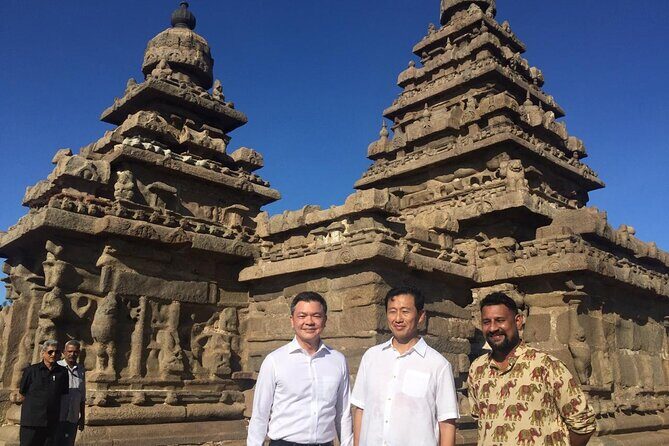
At $50 per person, this isn’t trying to be a budget afterthought. The value comes from three parts working together: a guided route, short stop times that keep momentum, and admission tickets included for each major site along the way.
When admission is included, you avoid the small time penalties that add up fast in India’s top heritage areas—ticket lines, searching for the right counter, or losing the group while you’re trying to sort it out. You also get a guide explaining the artwork while you’re already standing in front of it, not after you’ve left the monument.
The group-discount angle is a nice bonus if you’re booking with others. And because the tour is capped at 15, the guide can keep the explanations at a human volume instead of turning into a lecture you can’t hear.
The route matters: Shore Temple start, Five Rathas finish
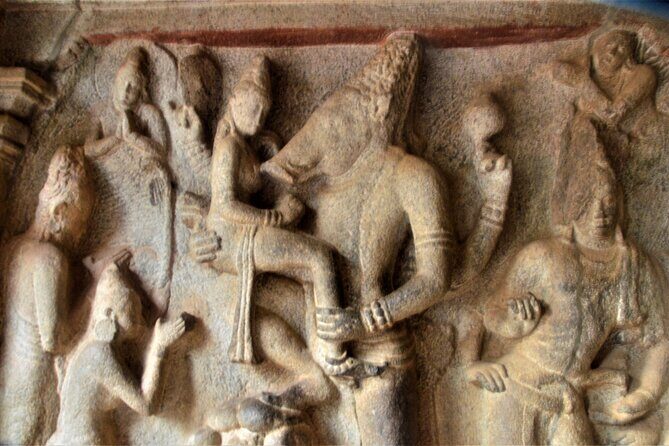
The meeting point is the Mahabalipuram Shore Temple area, on Beach Rd. The walk ends at Five Rathas (Pancha Rathas) on W Raja St—so you’re not returning to the exact starting spot.
That ending point is a hidden detail worth planning around. If you’re catching a ride afterward, set your drop-off and pickup expectations in advance because the temple zone can get busy. In fact, one practical tip that came up is to arrange pickup or drop-off a bit away from the heaviest areas, so you’re not stuck at the most congested gates.
Also, keep in mind this is an “approx 3 hours” plan. It’s not meant to stretch into half a day, so you’ll be moving from sight to sight, with brief guided stops that hit the essentials.
Pancha Rathas: the 5 rock-cut “chariots” that set the tone
You begin at Mahabalipuram’s UNESCO zone and first head to Pancha Rathas, often called the five chariots. These are rock-cut monolith structures, carved to look like monumental vehicles of worship, with different forms that help you see how Pallava design varied instead of repeating the same pattern.
Why this stop works on a walking tour: it’s a quick visual orientation. From the start, you understand the main idea of Mahabalipuram—stone carved into architecture that still feels like it belongs to living ritual.
Practical note: you’ll likely want a moment here for photos, but don’t skip the guide’s explanation. When you hear what each chariot-like form represents, the carvings stop looking random.
Pancha Pandava Cave: six pillars, yali creatures, and a bigger-than-it-looks cave temple
Next comes Pancha Pandava Cave, described as the largest cave-temple at Mahabalipuram. It’s supported by six pillars and two pilasters, and the pillars carry sculptures of mythical creatures called yali.
This is where the carvings become more than decorative texture. When you’re told what the yali are doing visually and symbolically, you start noticing how the pillars frame the space and guide your attention toward the center.
This stop is also a good “mental reset.” After the chariot shapes, the cave temple shifts you into a darker, enclosed world where the stone feels more intentional—almost like a performance stage carved into granite.



Arjuna’s Penance: the bas-relief that gives you scale fast
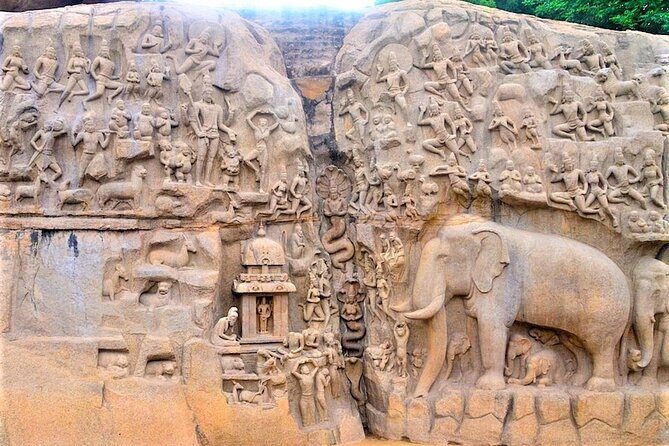
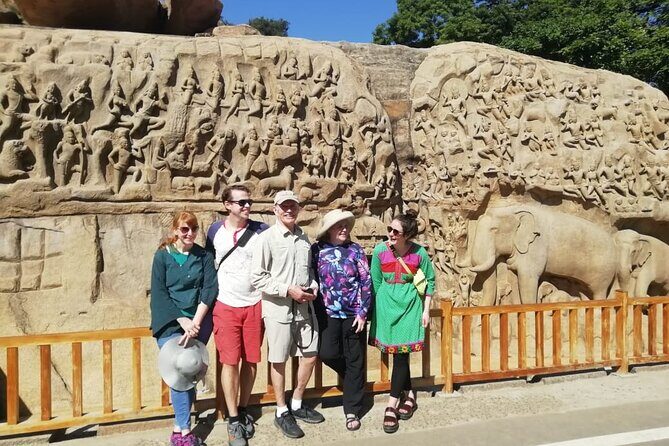
Then you reach Arjuna’s Penance, a huge bas-relief monument tied to scenes from the Mahabharata. The relief is about 100 feet long and 45 feet tall, which is one of those facts that means almost nothing until you’re standing in front of it.
On a guided walk, this stop is especially valuable because the guide’s job is to help you read a long narrative. You don’t just see bodies and horses; you understand how the story unfolds across the stone and how the composition stays coherent at that size.
Time here is short—about 20 minutes—but you can still get a satisfying overview if you’re paying attention to the guide’s pointing and sequencing.
Krishna’s Butter Ball: the myth you notice, then the geology you respect
After the scale of Arjuna’s Penance, Krishna’s Butter Ball feels like a curious pause. It’s a granite boulder perched on a slope, famous for seeming to defy gravity, and it has not moved.
What you’ll like here is the conversation between perception and explanation. The guide’s context helps you treat it as more than a quirky photo stop, while still letting you enjoy the simple amazement.
Tip for this one: try to view it from a couple of angles if the pathway allows. Your brain will start testing how the stone sits and why it might look like it should roll.
Varaha Cave Temple and Trimurti Cave: Pallava temple design in stone
Two cave stops follow that bring you back to the Pallava architectural style.
At Varaha Cave Temple, you’re looking at a temple carved from a huge piece of granite, dating to the 7th century. It reportedly took several decades to complete, and squatting lions decorate the pillars—so even if you’re not a sculpture specialist, you can spot the animal forms and see how they frame the structure.
Then Trimurti Cave focuses on the sacred trinity of Hindu gods—Brahma, Vishnu, and Shiva. There are also fine carvings of elephants, which add another layer of detail to the Pallava carving style.
These cave temples are worth your attention because they show technique. On this tour, the guide doesn’t just name the places; you get background on how the stonework is constructed and how the Pallavas achieved consistent carving patterns.
Ganesh Ratha: single-stone power and a dedication shift
Ganesh Ratha Temple is an imposing chariot carved out of a single stone. Originally, it was dedicated to Lord Shiva, but it now has the deity of his son Lord Ganesh. It was built in the 7th century by King Mahendravarman I.
This stop is great for two reasons. First, the single-stone design makes the ratha feel like a serious feat of engineering, not a decorative model. Second, the dedication shift is a reminder that these sites weren’t frozen in time; they adapted to changing worship.
If you like architecture that shows both imagination and discipline, this is one of the strongest monuments on the route.
Old Light House (built 640): why a lighthouse belongs in a temple walk
Next is Old Light House, built in 640. It’s described as India’s oldest lighthouse and one of the oldest in the world. Mahabalipuram was a busy port from the 7th century, and the lighthouse helped keep mariners safe.
This is the stop that gives the tour balance. The earlier monuments focus on religion and storytelling in stone; the lighthouse reminds you the same coastline also supported travel, trade, and daily life.
Even if you don’t spend long here, it changes how you see the whole Mahabalipuram shoreline. The Bay of Bengal isn’t just scenery—it’s part of the historical engine that made Mahabalipuram important.
Mahishasura Mardini Cave and the Shore Temple finish: drama, then views
You end the monument sequence with Mahishasura Mardini Cave, which has two big bas-reliefs. One shows Lord Vishnu sleeping on the coils of a serpent, and the other depicts Goddess Durga fighting the demon Mahishasura on a lion.
This double-scene format works well in a short tour because it gives you strong contrast. You get mythology that feels almost theatrical—sleep versus battle, serpent coils versus motion—so your eyes don’t get bored halfway through the narrative.
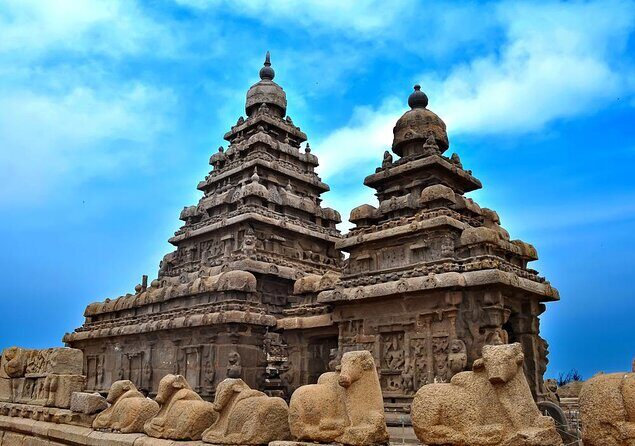
Finally, you reach the Shore Temple, which overlooks the Bay of Bengal. It was an important centre during the Pallavas’ reign when Mahabalipuram functioned as their main port. Finishing here gives you a satisfying wrap-up: you’ve spent the day with carved stories, then you close with the setting those stories lived beside.
If you time it right, the Shore Temple area also helps you connect the monuments to the coastline in a way that feels immediate, not academic.
The guide really makes the difference (including Ramesh’s style)
A recurring theme is the guide’s energy and clarity—especially with Ramesh. The way he talks about Pallava sculptures and the construction techniques helps you understand the monuments as made objects, not random stone patterns.
What stood out is how flexible the guide can be. On one occasion, the tour was extended by another hour, which tells me the guide isn’t stuck in a rigid script if the group wants more time with the art.
You’ll also appreciate how the explanations can be simple without being shallow. That matters when you’re walking from one stop to another and your attention span is naturally limited by the heat and movement.
And yes, transportation choices matter here too. One helpful detail from real-life use: a tuk tuk is a super option for people who want a quicker route between certain points, and buggy rides can be a thoughtful workaround for seniors.
Logistics that affect comfort: weather, pacing, and tickets
This experience depends on good weather. That’s not a minor footnote—it’s a real factor because most of the route is outdoors and you’ll want clear conditions for walking between sites.
Since the duration is about 3 hours and stop times are short, you should dress for movement. Wear comfortable walking shoes, keep water handy, and expect you’ll cover a lot of stone in a short window.
The mobile ticket is a plus. It reduces back-and-forth and helps you keep your attention on the monuments instead of your phone searching for the right screen at the gate.
Also, it’s near public transportation, which is useful if you’re combining this with other Chennai or nearby sightseeing. Still, the start-to-finish difference means you’ll want to line up your onward ride before you walk away.
Who should book this Mahabalipuram walk?
This tour is a great fit if you like architecture, carving details, and historical context that’s explained on the spot. It’s also ideal if you want a structured route that hits the UNESCO highlights without spending energy building your own plan.
It’s especially suitable for people who:
- want small group attention (max 15)
- prefer short, focused stops over long museum-style browsing
- like mythology and want it tied directly to what you see in stone
- are okay with a finish point at Five Rathas rather than returning immediately to the Shore Temple
If you’re the type who wants to linger for a long time at one monument, you might feel the pace. But the guide’s willingness to adjust—when time allows—can help smooth that out.
Should you book this tour?
I think this is an easy yes for first-timers to Mahabalipuram who want the most meaningful stone sights in a short, guided format. At $50 with admission included, you’re paying for a guide’s explanation plus a friction-free entry setup—both of which make the time feel worth it.
If you’re sensitive to walking or you want flexible movement, choose the walking/autorickshaw approach that matches your comfort, and plan your pickup near (but not inside) the busiest temple areas. And because weather is part of the deal, pick your day with the forecast in mind.
Book it if your goal is understanding the Pallavas through what they built—fast, focused, and with a guide like Ramesh keeping the story readable in front of you.
FAQ
How long is the Mahabalipuram walking tour?
It’s listed as approximately 3 hours.
What is the meeting point and where does the tour end?
The start is Mahabalipuram Shore Temple, Beach Rd, Mahabalipuram, and the walk ends at Five Rathas (Pancha Rathas), 58 W Raja St, Mahabalipuram.
Is this tour mainly walking?
You can visit the sites on foot, but there’s also the option to go by autorickshaw.
How many people are in the group?
The tour has a maximum of 15 travelers.
Is admission included?
Yes. Admission tickets are included for the stops listed on the route.
Do I need to print anything?
No. You use a mobile ticket.
What monuments are included?
The tour covers Pancha Rathas, Pancha Pandava Cave, Arjuna’s Penance, Krishna’s Butter Ball, Varaha Cave Temple, Trimurti Cave, Ganesh Ratha Temple, Old Light House, Mahishasura Mardini Cave, and Shore Temple.
Is the tour dependent on weather?
Yes. The experience requires good weather.
Is free cancellation available?
Yes. You can cancel up to 24 hours in advance for a full refund.
Is the tour operated by a tourism ministry approved company?
The experience description says it is offered by a tourism ministry approved company under 5 Senses Walks.