REVIEW · NEW DELHI
Adventurous & Classical India Curated Journey: South & Golden Triangle
Book on Viator →Operated by Incredible Real India Tours · Bookable on Viator
India feels like two trips at once. This tour links South India’s ancient ruins with the Golden Triangle’s big Mughal sights in a single, organized sweep. You’ll move by domestic flights plus private car, so you spend your energy on temples and monuments instead of logistics.
I especially like how many heavyweight sites are built into the schedule—UNESCO caves and UNESCO forts—without feeling like a frantic shopping trip. I also like the human touch that shows up in the guide/driver picks: names like Mr. Sandeep (around 20 years’ experience) and drivers such as Bhanwar Singh, Mudaram, and Ashok come up for being steady, informed, and good at handling India’s road rhythm. The main drawback to consider is pacing: it’s a packed route with long sight days, so you’ll want good stamina and flexible expectations.
In This Review
- Key things to know before you go
- A 15-day South India and Golden Triangle plan that actually feels organized
- Mumbai: Elephanta’s caves, Gateway time, then real-life texture in Dharavi
- Hampi’s Vijayanagara storytelling: from Lotus Mahal calm to Virupaksha devotion
- Ajanta and Ellora: two UNESCO cave worlds, one cultural shift after another
- Jaipur’s royal geometry: City Palace, Amber, Hawa Mahal, then the forts ring
- Agra: making the Taj Mahal hit twice
- Delhi’s UNESCO to Mughal to modern devotion
- Price and value: what $1,920 buys in real-world terms
- Guides and drivers: the difference between seeing India and feeling safe in it
- How to make a packed route feel comfortable (not exhausting)
- Should you book this South and Golden Triangle tour?
- FAQ
- How long is the tour?
- What does the price include?
- Is this tour private?
- Where does the tour take place?
- Are tickets and admissions included?
- What is the cancellation policy?
Key things to know before you go
- Domestic flights + private car keeps the long distances workable
- Elephanta, Hampi, Ajanta, and Ellora give you four UNESCO highlights close together
- Two Taj Mahal moments (sunset view and daytime visit) help you experience it in different light
- Jaipur forts plus observatory means you see more than the postcard spots
- Included breakfasts and handled tickets reduce daily “what now?” stress
A 15-day South India and Golden Triangle plan that actually feels organized
The headline promise here is balance: classic India, but in two accents. You get the South’s Vijayanagara stone world at Hampi, then you shift into Maharashtra’s cave artistry at Ajanta and Ellora. After that, you land in Rajasthan’s royal theater in Jaipur, and then finish with Agra and Delhi’s Mughal-and-beyond landmark stack.
What makes the itinerary feel practical is how it’s built around logistics. You’re not bouncing between cities by guessing trains or chasing connections. The tour includes domestic flights and private car travel between major cities, and it also includes accommodation plus daily breakfasts, which removes a lot of the friction from moving through India.
The other thing I like: the sites are varied enough that the days don’t all blur together. Temples and cave art, fort walls and palaces, and then mausoleums and mosques. You’re always switching gears—sometimes in the same region, sometimes across states.
You can also read our reviews of more tours and experiences in New Delhi.



Mumbai: Elephanta’s caves, Gateway time, then real-life texture in Dharavi
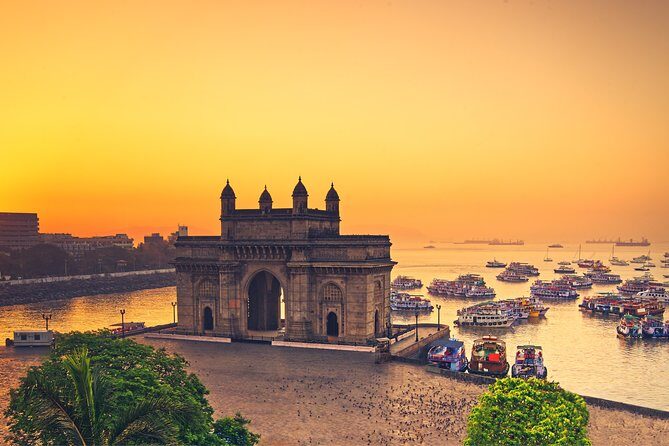
Mumbai opens the trip with two classic hits. First up are the Elephanta Caves, a UNESCO World Heritage site with cave temples mainly dedicated to Shiva. This is the kind of place where you slow down without being told to. The other stop is the Gateway of India, an early-20th-century arch monument tied to the 1911 landing of King-Emperor George V and Queen-Empress Mary at Apollo Bunder.
Then you get a shift in tone on purpose. Dharavi is Mumbai’s largest slum (and noted as the third-largest in the world), made widely known after Slumdog Millionaire. It can feel heavy, but it’s also one of the fastest ways to understand Mumbai as a living system, not just a skyline. Right after that, you visit Dhobi Ghat, the open-air laundry area where dhobis clean linens from hotels and hospitals.
My practical advice: treat those parts with extra respect, keep your questions thoughtful, and remember photography etiquette varies by area. The tour won’t turn this into a theme-park stop—it’s more about seeing how the city works.
Hampi’s Vijayanagara storytelling: from Lotus Mahal calm to Virupaksha devotion
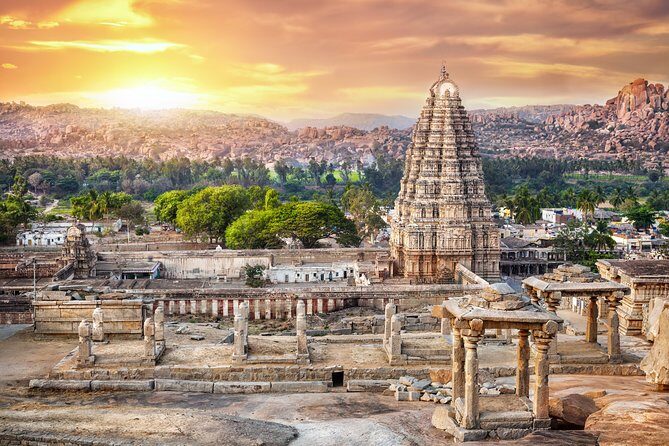
Hampi is where the “adventurous” part becomes real. The ruins come from the medieval Hindu kingdom of Vijayanagar, and the craftsmanship still reads like engineering, not just art. The schedule gives you multiple perspectives on the same ancient world, starting with the Mahanavami Dibba (also called Dasara Dibba), a stone platform built by King Krishnadevaraya to commemorate victory over Udaygiri. It’s the kind of structure that helps you imagine royal ritual happening where the stones now sit silent.
Then you visit the Lotus Mahal, an ancient stone palace structure with quieter gardens, arches, and carved detail. If you’ve been expecting only giant temple towers, this is a nice reminder that palace design mattered too.
The day that really balances the whole Hampi story is Virupaksha Temple. It’s dedicated to Lord Virupaksha (a form of Shiva) and forms part of the Group of Monuments at Hampi, another UNESCO highlight. The tour schedules a longer block here, and that’s smart: Hampi isn’t a “photo and move on” site. You’ll get a far better experience if you let your eyes adjust to the layout and notice how temples anchor the landscape.
A consideration: Hampi days can mean a lot of walking and sun. Bring water, plan for some dust, and don’t underestimate how much time your feet ask for.
Ajanta and Ellora: two UNESCO cave worlds, one cultural shift after another
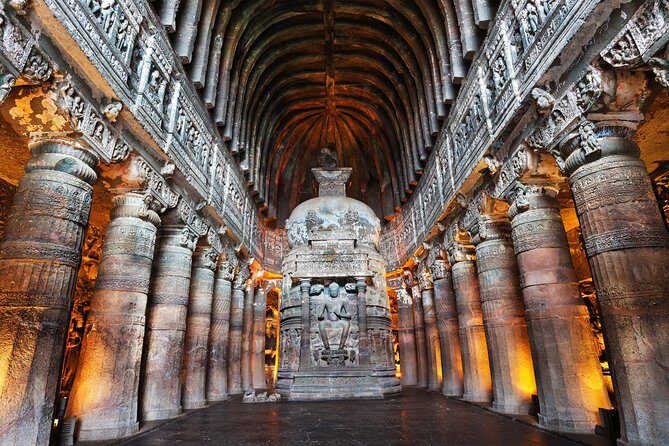
After Hampi, the tour moves you into Maharashtra’s cave country. Ajanta Caves are Buddhist rock-cut cave monuments dating roughly from the 2nd century BCE to around 480 CE. This is slower, more contemplative. You’re stepping into a long timeline of religious art—painted narratives and sculpted forms carved into rock.
Then you go to Ellora, another UNESCO World Heritage site, and one that changes the rules. Ellora is a massive rock-cut complex featuring Hindu, Buddhist, and Jain monuments across about 600–1000 CE. That “multiple faiths in one cliff” setup is why Ellora often lands with people who felt Ajanta was beautiful but specific. Here, you can see how different traditions shaped styles and themes.
One extra detail in this stretch: the plan includes Bibi-Ka-Maqbara (The Lady’s Tomb), described as the burial mausoleum of Aurangzeb’s wife Rabia, often called the Taj of the Deccan. It’s not as globally famous as the Taj Mahal in Agra, but it fits the theme of Mughal-era memory and monument-building.
Practical tip: cave sites reward time spent inside, not just time spent at the entrance. If you get even slightly rushed, the art can feel like it’s passing by too quickly.
Jaipur’s royal geometry: City Palace, Amber, Hawa Mahal, then the forts ring
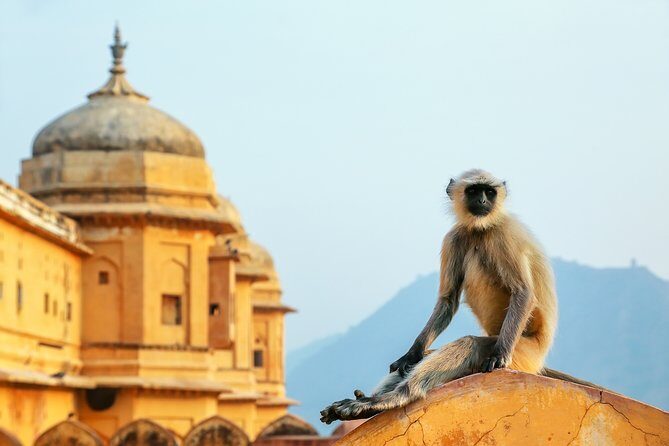
Jaipur days hit you with variety. The schedule starts with City Palace, established when Maharaja Sawai Jai Singh II moved his court to Jaipur in 1727. It’s a good anchor because it gives you context for why the city looks the way it does.
Then you head to Amber Palace, also known as Amber Fort. After that comes Hawa Mahal (Palace of Wind), a five-storey façade built in 1799 by Maharaja Sawai Pratap Singh of the Kachhwaha Rajput dynasty. Hawa Mahal is the kind of stop where it’s helpful to understand it was designed for visibility and daily life from behind ornate screens—not just for scenic selfies.
The plan also includes a morning worship visit at Vaishnava Temple Govind Dev Ji. This is a smaller but meaningful beat. If you’ve only read about India’s religion from museums, these moments add real-world texture.
The itinerary doesn’t stop at palaces. It layers in Jantar Mantar, the observatory built by Jai Singh in 1724 for astronomical tables. It’s followed by Jaigarh Fort, built in 1726 to protect the Amer Fort and named after Jai Singh II, and then Albert Hall Museum, described as Rajasthan’s oldest museum.
And then there’s the defensive ring idea. Nahargarh Fort is framed as part of the city’s protection system, with a story connected to a spirit named Nahar Singh Bhomia and a temple built to pacify the spirit. You also get Royal Gaitor Tumbas, with a white marble exterior set in a valley at the foot of a mountain.
My take: Jaipur on this schedule works best if you’re the type who likes to walk between viewpoints. The forts aren’t just buildings; they’re how you understand how the city was defended and how elites viewed it.




Agra: making the Taj Mahal hit twice
Agra is classic Golden Triangle energy, but the smart part is that the tour doesn’t treat the Taj Mahal like one checkbox. It gives you a sunset Taj Mahal view along the river, then a daytime visit later.
The evening moment matters because the Taj is famous for a reason: the white marble shifts as light changes. Even if you think you know what it looks like, seeing it in sunset conditions tends to make the monument feel more human and less like a postcard.
Daytime gets you the full story: the Taj Mahal was built between 1632 and 1647 by Mughal Emperor Shah Jahan, dedicated to Mumtaz Mahal, who died during childbirth. After that, you visit Agra Fort, the Mughal main residence until 1638, and the Tomb of Itimad-ud-Daulah, often nicknamed the Bachcha Taj and described as a jewel box draft of the Taj Mahal.
If you want this part to feel like a real experience rather than a sprint, don’t overbook nearby food stops. Keep some energy for quiet moments in the gardens and long looks at the marble details.
Delhi’s UNESCO to Mughal to modern devotion
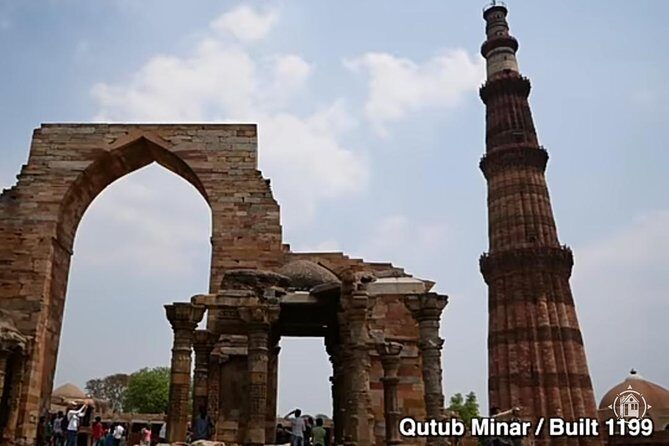
Delhi ends the circuit with a strong mix of eras. The tour starts with Qutub Minar, a minaret and victory tower forming part of the Qutb complex, a UNESCO World Heritage site. It’s a good “scale reset” after the broad Agra monumental language.
Next is Humayun’s Tomb, commissioned by Humayun’s first wife and chief consort Empress Bega Begum in 1569–70, designed by Persian architects Mirak Mirza Ghiyas and his son Sayyid Muhammad. Humayun’s Tomb is often easier to absorb than the Taj because it’s more about proportion and garden framing.
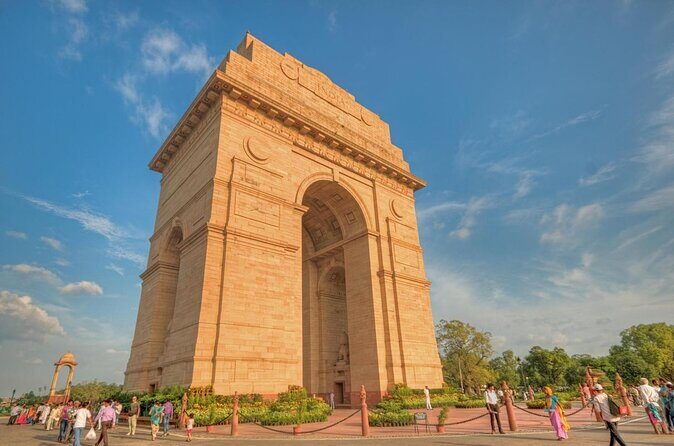
Then the itinerary gives you two more Delhi anchors: India Gate (an all-India war memorial) and the Red Fort, Mughal emperors’ residence. India Gate is free, and it has that long, grounded sense of remembrance—good for a breather after temple and mausoleum intensity.
Day 14 leans spiritual and cultural with Swaminarayan Akshardham, a Hindu house of worship and spiritual campus. It’s followed by Gurudwara Bangla Sahib, a major Sikh gurdwara known for its sarovar (holy water) inside the complex. You also visit Gandhi Memorial Hall and end with Jama Masjid, described as one of the largest mosques in Delhi.
Practical note: big religious sites can mean changing routines (security lines, quiet hours). Having a guide and a plan helps you keep moving without feeling stressed.
Price and value: what $1,920 buys in real-world terms
At $1,920 per person for a 15-day private-style journey, the value comes from how much is bundled. You’re not only buying sightseeing. You’re buying internal travel by domestic flights and private car, plus accommodation and daily breakfasts. Add in that many major admissions are shown as included in the schedule, and you’re also paying for the time saved by not chasing tickets and entry windows across multiple states.
This matters especially in India, where getting from one site to another can turn into a half-day if you’re doing it alone. Here, your time is directed toward monuments like Elephanta Caves, Ajanta, Ellora, Amber, the Taj Mahal, Qutub Minar, and Red Fort—then the smaller supporting stops fill in the connective tissue.
Where the value can feel different is if you’re the type who wants long free afternoons with no plans. This itinerary is packed. If you love structure and hate logistics, it’s a strong match. If you want lots of spontaneity, you may find yourself wishing for slower days.
Guides and drivers: the difference between seeing India and feeling safe in it
This is a big point, and it comes through in the provided feedback: the company leans on drivers and guides who handle stress well.
In particular, drivers like Mudaram are described as calm, safe, and capable in the middle of chaos. Bhanwar Singh is highlighted as professional, flexible, funny, friendly, and well informed. Ashok is mentioned for skilled handling of difficult roads and city movement.
On the guiding side, Mr. Sandeep is repeatedly connected with deep familiarity—about 20 years’ experience, with strong historical and geographical knowledge. One mention even points out a Spanish-speaking guide, which can make the complex art and dates easier to follow.
My advice for you: when you book, use that relationship. Ask short questions as you move between stops. If you understand what you’re looking at—Vijayanagara-era purpose, Mughal timing, the idea behind Jantar Mantar—you’ll get more satisfaction out of every hour.
How to make a packed route feel comfortable (not exhausting)
This kind of India itinerary works best if you travel with a few habits.
First, protect your mornings. You’ll have long sight blocks: Hampi, Virupaksha Temple time, caves at Ajanta and Ellora, and multiple Jaipur and Delhi sites. Eat breakfast, drink water, and don’t start the day already behind.
Second, pace your shopping and side stops. The itinerary has major market energy in Mumbai with Colaba Market, but you’ll enjoy that more if it’s planned as a highlight rather than an all-day wandering plan.
Third, pack for dust and sun. Hampi and open-air spots like Dhobi Ghat can mean heat and airflow that changes your comfort fast. Bring a hat, sunscreen, and something light for evenings.
Finally, keep your photo expectations realistic. Some sites are best experienced slowly, not sprinted through. Save your energy for the moments that make you stop.
Should you book this South and Golden Triangle tour?
I’d recommend this tour if you want a structured, high-impact route that connects Mumbai, Hampi, Ajanta, Ellora, Jaipur, Agra, and Delhi without you doing the hard work of planning transport between states. The included flights, private car travel, accommodation, breakfasts, and lots of included admissions are what make it feel like good value rather than just a long list of places.
I wouldn’t book it if you’re looking for lots of free time, because the schedule is built for momentum. Also, if you’re sensitive to difficult social realities, go into the Dharavi stop with respect and a calm mindset.
If you want history, temples, and major monuments—and you’d rather trust the logistics—this is the kind of trip that can turn India from overwhelming into manageable.
FAQ
How long is the tour?
The tour is approximately 15 days.
What does the price include?
The tour price is listed as $1,920 per person, and it includes accommodation and daily breakfasts. It also includes domestic flights and private car travel between major cities, plus many admissions are marked as included in the schedule.
Is this tour private?
Yes, it’s a private tour/activity, so only your group will participate.
Where does the tour take place?
The route covers sites in Mumbai, Hampi, Ajanta and Ellora (Maharashtra), Jaipur (Rajasthan), Agra, and Delhi.
Are tickets and admissions included?
Many major attractions have admission tickets marked as included (and some stops are listed as free). The schedule includes examples like Elephanta Caves, Ajanta, Ellora, Amber Palace, Hawa Mahal, Jantar Mantar, and the Taj Mahal.
What is the cancellation policy?
This experience is non-refundable and cannot be changed for any reason. If the minimum number of travelers isn’t met, you’ll be offered a different date/experience or a full refund.