REVIEW · NEW DELHI
7-Day Private Tour: Delhi, Agra, Jaipur, Jodhpur and Udaipur from Delhi
Book on Viator →Operated by Pacific Classic Tours India · Bookable on Viator
Seven days, five cities, big wins. This private route strings together major UNESCO sights, standout palaces, and a relaxed end on Lake Pichola, all with a private driver and local guides. I especially love the Taj Mahal at sunrise and the sunset boat cruise on Lake Pichola.
You get your plan handled: pickup in Delhi, air-conditioned private transport, hotel stays with breakfast, and entrance fees for the scheduled sights—so you spend less time figuring things out and more time seeing.
One thing to know: the itinerary is packed, with early starts and long road days. It’s the kind of week that gives you a strong overview, not slow, in-depth wandering.
If you like your travel structured but still flexible, this one fits well—just keep an eye on the sunrise weather note and the odd closure like Lotus Temple (Monday closed).
In This Review
- Key highlights worth bookmarking
- A Delhi-to-Udaipur route that matches the Golden Triangle pace, with a lake finale
- What you’re really paying for: hotels, guides, tickets, and a car that stays with you
- Day 1 in Delhi: Humayun’s Tomb, Qutub Minar, Lotus Temple, and India Gate in one controlled day
- Day 2: Taj Mahal sunrise plus Agra Fort, then a long transfer to Jaipur
- Day 3 in Jaipur: Amber Palace, Jal Mahal photos, Hawa Mahal views, plus City Palace and Jantar Mantar
- Amber Palace jeep add-on (what to expect)
- Day 4: Jodhpur’s Blue City streets and the Clock Tower evening at Ghanta Ghar
- Day 5: Mehrangarh Fort, Jaswant Thada, Umaid Bhawan, then Ranakpur Jain Temple and onward to Udaipur
- The Ranakpur detour that makes the day feel special
- Day 6 in Udaipur: Jagdish Temple, City Palace, Lake Pichola cruise, Bagore Ki Haveli, and Monsoon Palace
- Day 7: end at Udaipur with drop-off after breakfast
- Timing tips, dress code, and the two main reasons plans can shift
- Sunrise depends on weather
- Lotus Temple closure on Mondays
- Dress code
- Food reality check
- Who this tour is best for
- Should you book this Delhi to Udaipur private tour?
- FAQ
- What is the duration of this tour?
- Where do I get picked up, and what time does the tour start?
- Does the price include hotel stays and breakfast?
- Are entrance fees included?
- Is the Taj Mahal visit included, and do I go at sunrise?
- Is there transport to help with walking at the Taj Mahal?
- Is the Lake Pichola boat cruise included?
- Does the tour include food?
- Are there any extra costs for Amber Palace?
- What is the cancellation policy?
- Is the tour private?
Key highlights worth bookmarking
- Taj Mahal sunrise with practical support plus a battery bus/golf cart return ride from parking to the monument
- UNESCO-heavy schedule across Delhi, Agra, and more stops in Rajasthan
- 4-star hotels with breakfast for six nights and unlimited bottled water during the tour
- Lake Pichola timing built around the day’s light, including a shared boat cruise
- Amber-to-Jaipur essentials like City Palace and Jantar Mantar, with a note on optional jeep ride at Amber
- Ranakpur Jain Temple en route to Udaipur, with its forest of 1444 pillars
A Delhi-to-Udaipur route that matches the Golden Triangle pace, with a lake finale
This is a true “private tour” style itinerary: one driver, one car, local guides at the major stops, and you’re not trying to stitch together tickets, routes, and schedules on your own. It follows the classic India arc—Delhi to Agra to Jaipur—and then pushes on into the Rajasthan power centers of Jodhpur and Udaipur.
The big idea here is coverage with context. You’re not just seeing monuments. You’re getting enough explanation to connect them: Mughal Delhi transitions into Taj Mahal-era Agra, then the Rajput look and feel in Jaipur and beyond. By the time you reach Udaipur, the pace shifts from forts and tombs toward water, palaces, and sunset light.
And yes, the end of the trip is made for photos, but it’s also made for calm. Lake Pichola gives you that needed exhale after days of stone, steps, and city traffic.
You can also read our reviews of more private tours in New Delhi


What you’re really paying for: hotels, guides, tickets, and a car that stays with you
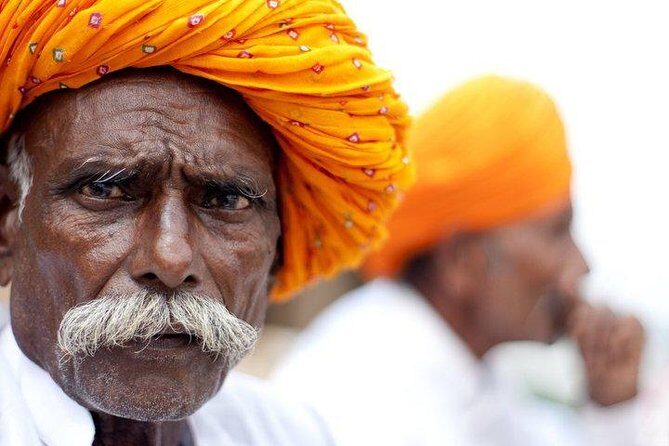
At $608 per person, the value comes from bundling the stuff that usually makes self-planning stressful in North India: accommodation for six nights, breakfast, private air-conditioned transport, local private tour guides at sightseeing locations, and entrance fees for the sights listed.
A lot of “cheap” tours in this region fail the same test: you save money up front, then get hit with paid attractions, extra transfers, and guide time that doesn’t actually cover everything. Here, the structure is clearer. You can budget with fewer surprises because so many key items are included, including a shared boat ride on Lake Pichola and water throughout the trip.
There are still add-ons and limitations, though. Meals are not included, and if you’re traveling during Christmas Eve or New Year Eve, a mandatory gala dinner at the hotel is not included and is charged extra. Also, the Taj Mahal sunrise visit depends on weather, so understand that early morning can be real early—and sometimes the plan shifts if conditions are off.
Day 1 in Delhi: Humayun’s Tomb, Qutub Minar, Lotus Temple, and India Gate in one controlled day
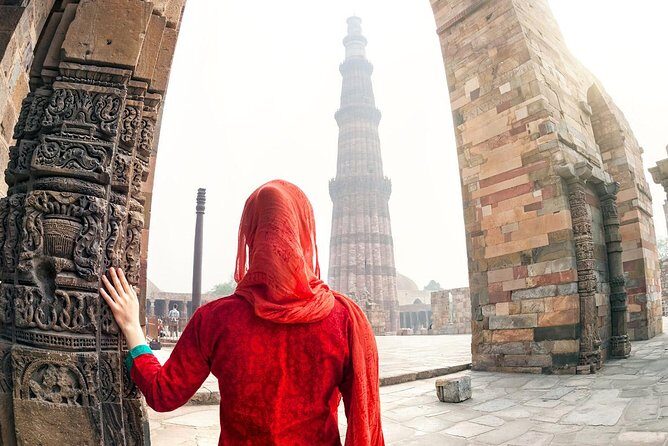
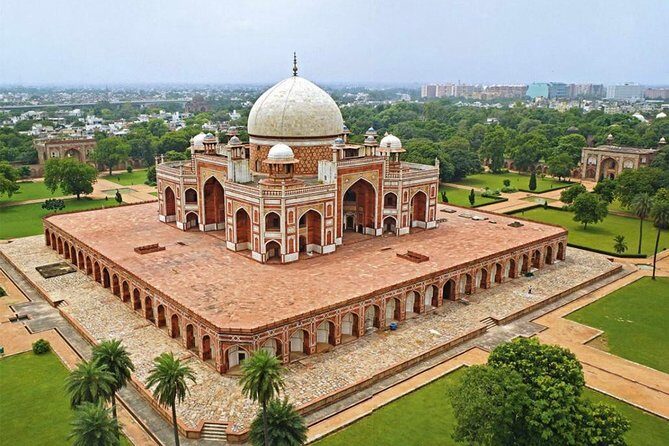
Your day starts with pickup at 9:00am in Delhi (and also Gurugram/Noida). The first stop is Humayun’s Tomb, a UNESCO World Heritage site and one of the best introductions to Mughal-era architecture in the city. If you’ve never studied Mughal design, this place helps you recognize patterns early: symmetry, grandeur, and the way gardens are used as part of the monument.
Next comes Qutub Minar, another UNESCO site. The highlight is the tall, iconic minaret (about 73 meters) inside the broader complex. You’ll get the full setting—ruins and surrounding monuments—so the tower doesn’t feel isolated.
Then there’s the Lotus Temple, shaped like a lotus and designed in the 1980s. It’s listed as free and it’s a quiet counterpoint to Delhi’s traffic noise. The only catch: Lotus Temple is Monday closed, so the day’s flow matters if your pickup lands on a Monday.
After that, you head through central Delhi for India Gate, a major WWI-era memorial designed by Lutyens. From there, you also get drive-bys of Parliament House and Rashtrapati Bhavan, which helps you get your bearings for how the capital is laid out.
Late afternoon, the plan turns into movement: a roughly 3-hour drive to Agra, with hotel check-in on arrival.
Practical note: This is one of those opening days where you’ll likely spend more time inside vehicles than you expect. That’s not a problem if you’re okay with road travel. It is a problem if you need long, slow walking days from the start.
Day 2: Taj Mahal sunrise plus Agra Fort, then a long transfer to Jaipur
Day 2 is built around the most famous experience on the route: Taj Mahal at sunrise. Sunrise here is not just a time stamp; it’s a different kind of viewing. The light is gentler, crowds can feel more manageable, and the monument’s marble tones shift beautifully through the early hours. Just remember the tour notes that sunrise is subject to weather conditions.
You also get a practical inclusion that matters: battery bus/golf cart return ride from parking to the Taj Mahal. That can save energy when you’re already moving on a tight morning schedule.
After Taj Mahal, you visit Agra Fort, another UNESCO World Heritage site and a former Mughal power center along the Yamuna River. This stop is valuable because it puts Taj Mahal in a bigger political picture. Taj Mahal is the showpiece; Agra Fort is the power.
Then it’s off to the next city: a transfer to Jaipur, check-in at your pre-booked hotel, and time to rest.
How to think about this day: It’s a lot of landmark impact in a short span. If you love photography, you’ll appreciate it. If you’re the type who likes lingering, you’ll still enjoy it—but you may wish there were an extra day in Agra to slow things down.
Day 3 in Jaipur: Amber Palace, Jal Mahal photos, Hawa Mahal views, plus City Palace and Jantar Mantar
Jaipur is where the itinerary really shows its intent to combine drama with interpretation.
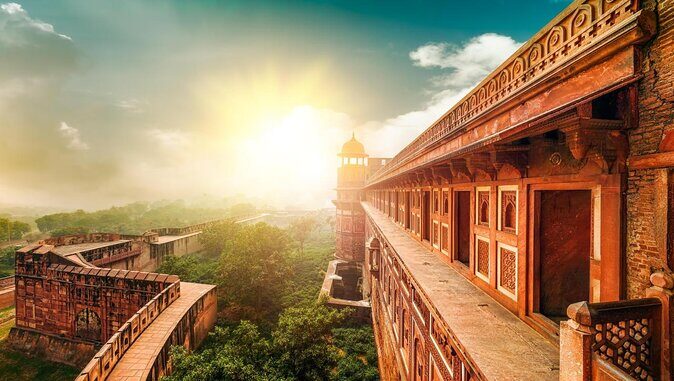
You begin with Amber Palace, a standout example of Rajput architecture set on a rocky hillside. This is one of the Jaipur stops that many people remember most, partly because of the location and partly because the place feels like a whole story in stone. Admission is included.
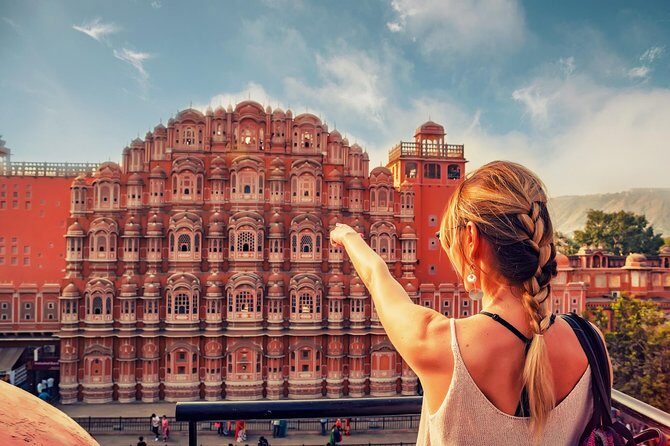
You’ll also see a photo stop at Jal Mahal (Water Palace). You don’t spend long there, but the idea is simple: you get the instantly recognizable palace image against the lake backdrop without spending hours. Next is a quick photo stop at Hawa Mahal, the honeycombed facade made famous by its pink color and the design that allows people to look outward.
Then you move into the heart of the old city area with City Palace of Jaipur, the royal residence now functioning as a museum complex. This stop adds texture beyond just forts: courtyards, museum displays, and the feeling of how royal families lived in layers.
Finally, Jantar Mantar (UNESCO) gives you a different angle on Jaipur. It’s not a palace and it’s not a tomb—it’s an observatory, built as a set of geometric instruments for tracking celestial movement.
A few more New Delhi tours and experiences worth a look




Amber Palace jeep add-on (what to expect)
The tour notes a potential add-on: a jeep ride at Amber Palace is $3.00 per person for travelers in groups of 5 and above, and it’s not included. If you think you might want it, plan for the small extra cost and confirm timing with your guide.
Day 4: Jodhpur’s Blue City streets and the Clock Tower evening at Ghanta Ghar
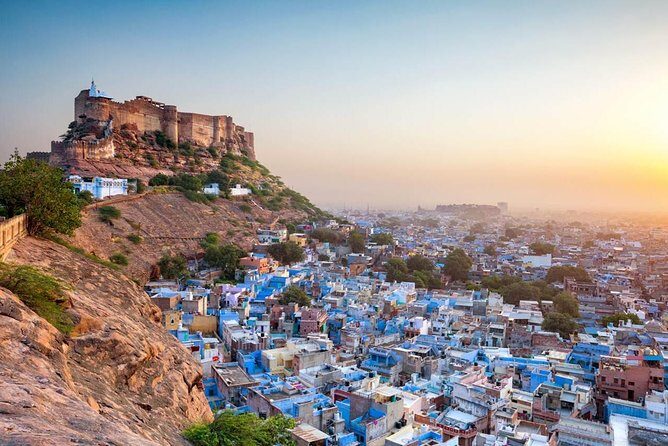
After breakfast, the transfer moves you into Rajasthan’s rugged mood: Jodhpur, the famed Blue City. The schedule gives you time to explore the inner maze of old lanes and markets at your own pace, with the guide helping you make sense of what you’re seeing.
The evening stop is Ghanta Ghar, also called the Clock Tower, surrounded by Sardar Market. This is a great time of day to feel city life without the mid-day heat—plus it’s the part of the day where you’ll notice how markets and landmarks feed into each other.
If you like street scenes, you’ll enjoy this. If you hate crowds and prefer museum-heavy travel, you might find this day less structured than the others. That said, it’s exactly the kind of break that keeps the trip from becoming a checklist.
Day 5: Mehrangarh Fort, Jaswant Thada, Umaid Bhawan, then Ranakpur Jain Temple and onward to Udaipur
This is a major history day, and it ends with a long push to Udaipur.
You start at Mehrangarh Fort, one of India’s largest forts. The guide helps you read the fort like a narrative—hard sandstone, palaces inside, and the way fort walls communicate power. Admission is included, and the stop lasts long enough to actually see more than a quick photo stop.
Next is Jaswant Thada, a white marble cenotaph built in the 19th century. It’s short but memorable because it feels lighter than the fort—more reflective space than defensive structure.
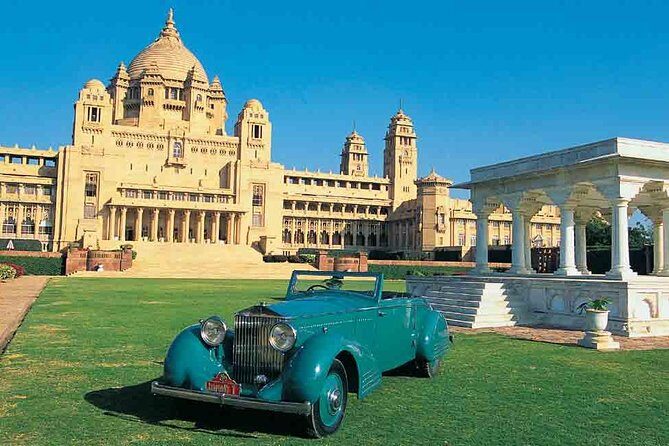
Then comes Umaid Bhawan Palace Museum. The itinerary notes that part of the royal family still lives in the palace, while another section is museum space showing items belonging to the family. That split matters: you’re not just looking at antiques; you’re seeing how the royal legacy continues.
The Ranakpur detour that makes the day feel special
On the way to Udaipur, you stop at Ranakpur Jain Temple, described as superbly preserved for over 500 years. The big reason to include it: 29 halls and 1444 pillars with none of them identical. Admission is included, and the timing works well because you’re already traveling between cities.
Then the day finishes with a drive to Udaipur. The itinerary lists about 6 hours of driving, so it’s a late-day arrival style.
If you’re sensitive to road time: this is the day to pack your patience. The payoff comes the next day, when Udaipur’s lake atmosphere takes over.
Day 6 in Udaipur: Jagdish Temple, City Palace, Lake Pichola cruise, Bagore Ki Haveli, and Monsoon Palace
Udaipur is the soft landing of the trip. The day moves from temple detail into palace scale and then back to water and sunset views.
You begin with Jagdish Temple, a busy Indo-Aryan temple built in 1651. It’s listed as free and only about 30 minutes, but it’s a good reminder that this isn’t only a sightseeing circuit. It’s also a working religious center.
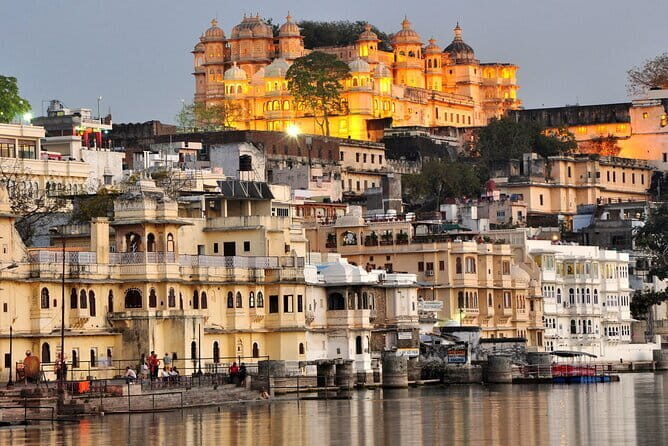
Next, City Palace of Udaipur dominates the skyline over the lake. It’s described as Rajasthan’s largest palace, and the main section is now a museum with collections including mosaics and glass work. Admission is included.
Then comes one of the day’s most enjoyable inclusions: Lake Pichola shared boat cruise. This is where the tour’s tone shifts. The water and the surrounding hills change your sense of scale. It also offers a classic lake-city angle that you can’t replicate from shore.
After the cruise, you visit Bagore Ki Haveli Museum, an 18th-century haveli with many decorated rooms. It’s great for understanding how people lived in Udaipur’s older neighborhoods, not just how palaces look from outside.
The day finishes with Sajjangarh Monsoon Palace, perched on a hill like a fairy-tale silhouette in the late day light. Admission is included, and it gives you a view-over-the-city feel.
Day 7: end at Udaipur with drop-off after breakfast
The tour ends after breakfast with drop-off at Udaipur airport, railway station, or your desired location in Udaipur. That keeps the final day simple and avoids a scramble to catch a flight right after sightseeing.
This last day also matters because it’s your first chance to avoid “one more stop.” You can plan your onward travel without thinking about timing for another attraction.
Timing tips, dress code, and the two main reasons plans can shift
A smooth week like this usually comes down to handling two variables.
Sunrise depends on weather
The tour explicitly notes that Taj Mahal sunrise is subject to weather conditions. If the sky isn’t cooperating, the timing could change. The best mindset: treat sunrise as a goal, not a guarantee.
Lotus Temple closure on Mondays
Lotus Temple is Monday closed. If you’re traveling on a Monday, expect the itinerary to follow its logic around that. It’s not a deal-breaker, but it’s the kind of small detail you should keep in mind when your trip dates matter.
Dress code
The stated dress code is smart casual. For Indian temples and indoor museum spaces, it’s usually a good rule of thumb: comfortable clothes you can move in, and something that doesn’t feel too casual for formal spaces.
Food reality check
Meals are not included, so your day-to-day costs for lunch and dinner will vary depending on where you choose to eat. If you’re vegetarian, the tour notes a vegetarian option is available—just advise at booking.
Who this tour is best for
This is a strong match for you if:
- you want a private experience with a single car and guides handling navigation and explanations
- you care about UNESCO sites and major Rajasthan landmarks, without spending your vacation time booking tickets
- you like structure, especially when travel includes long road days between cities
It’s less ideal if you want:
- a slow travel pace with long stays in fewer cities
- deep, unhurried time in one city at a time
One thing I appreciated in the program’s design is that it doesn’t pretend this is a leisurely trip. It’s a week built to cover a lot, and that’s honest.
Should you book this Delhi to Udaipur private tour?
If you want the highlights of Delhi, Agra, Jaipur, Jodhpur, and Udaipur in a single week—while keeping stress low—this is a solid buy. The included hotel nights, breakfast, entrance tickets for the listed sights, local guides, and private driver do the heavy lifting for you. Add the Taj Mahal sunrise and the Lake Pichola boat cruise, and you’ve got two moments that make the trip feel like it has a soul, not just a schedule.
Before you say yes, check two things: your travel dates (because Lotus Temple is Monday closed) and whether you’re okay with an itinerary that moves briskly. If that pace sounds like your style, book it. If you prefer two or three cities only, you might do better splitting the route into separate trips.
FAQ
What is the duration of this tour?
It runs for about 7 days and includes six nights of hotel accommodation.
Where do I get picked up, and what time does the tour start?
Pickup is offered in Delhi, Gurugram (Gurgaon), or Noida, with a start time of 9:00am.
Does the price include hotel stays and breakfast?
Yes. The tour includes six nights of accommodation with breakfast (twin sharing is mentioned when booked with the option including hotels).
Are entrance fees included?
Entrance fees for the sights mentioned in the itinerary are included.
Is the Taj Mahal visit included, and do I go at sunrise?
Yes, the tour includes a sunrise visit to the Taj Mahal, and it’s noted as subject to weather conditions.
Is there transport to help with walking at the Taj Mahal?
Yes. A battery bus/golf cart return ride from parking to the Taj Mahal is included.
Is the Lake Pichola boat cruise included?
Yes. The itinerary includes a shared boat ride at Lake Pichola.
Does the tour include food?
No. Meals and drinks are not included unless specified.
Are there any extra costs for Amber Palace?
A jeep ride at Amber Palace is noted as an extra $3.00 per person for travelers in groups of 5 and above, and it is not included.
What is the cancellation policy?
You can cancel for free up to 24 hours in advance for a full refund. If you cancel less than 24 hours before the start time, the amount paid is not refunded.
Is the tour private?
Yes. It’s a private tour/activity, meaning only your group participates.