REVIEW · NEW DELHI
7 Day Golden Triangle Tour – Delhi Agra Jaipur Tour
Book on Viator →Bookable on Viator
Seeing the Golden Triangle in seven days feels fast, but it works because the trip is built around a licensed driver and English-speaking city guides at each stop. I like that you’re not left to figure out logistics—airport pickup, air-conditioned car transport between cities, and a guided run through the big monuments. It’s also a smart way to tick off major UNESCO sites, including the Taj Mahal at sunrise.
Two standout wins for me are the mix of sights across the three cities and the timing. You get the old-meets-new feel of Delhi, the royal swagger of Jaipur, and then Agra’s jaw-dropping Mughal monuments without wasting days on constant re-planning. A possible drawback to keep in mind: many monument entry fees are not included, and one day starts extremely early for sunrise.
If you want history with clear explanations and a smooth travel rhythm, this itinerary is a good fit. If you’re the type who wants to wander totally on your own schedule—or you hate early mornings—then you may find the pace a little intense.
In This Review
- Key things I’d circle before you book
- The Golden Triangle loop: why this 7-day format makes sense
- Day 1 in Delhi: arrive, get settled, and start rested
- Day 2 Delhi highlights: Old Delhi + Lutyens landmarks in one long day
- Jama Masjid: first stop, powerful Mughal scale
- Chandni Chowk: the rickshaw ride through market streets
- Red Fort (outside): military control means you mostly view it from the road
- Raj Ghat + India Gate: modern memorials and national symbolism
- Parliament House + Rashtrapati Bhavan: photo stops only
- Humayun’s Tomb + Qutub Minar: the two UNESCO anchors
- Day 3 transfer to Jaipur + Chokhi Dhani cultural night
- Jaipur check-in and downtime
- Chokhi Dhani: hands-on Rajasthani heritage in a village-style setting
- Day 4 Jaipur sights: Fort, City Palace, Hawa Mahal, and Jantar Mantar
- Jaipur Fort: Rajput architecture with major wow factor
- Jal Mahal photo stop: Water Palace framed against the reservoir
- City Palace: royal residence in the heart of the old city
- Hawa Mahal: the Palace of Winds as a honeycombed facade
- Jantar Mantar: the UNESCO observatory you can actually understand
- Day 5 toward Agra: Chand Baori and Fatehpur Sikri before you reach the Taj region
- En route: a countryside drive with a couple of high-impact pauses
- Chand Baori stepwell: ancient water engineering
- Fatehpur Sikri: Akbar’s capital that couldn’t stay
- Arrive in Agra: check-in and recharge
- Day 6 Agra at sunrise: Taj Mahal, Agra Fort, Baby Taj, and Mehtab Bagh
- Taj Mahal at sunrise: pinkish hues and serious craftsmanship
- Reset, breakfast, then Agra Fort
- Itmad-ud-Daula: the Baby Taj idea
- Mehtab Bagh: a garden opposite the Taj view
- Day 7 back to Delhi: finish strong without rushing
- Price and value: what $579 really buys you
- The people make the difference: drivers and guides that keep it calm
- Who should book the Golden Triangle, and who should pass
- Should you book this 7-Day Golden Triangle tour?
- FAQ
- What cities are included in this 7-day Golden Triangle tour?
- Is pickup included?
- Are monument entry tickets included in the price?
- Do you visit the Taj Mahal?
- How do you travel between cities?
- What’s the cancellation window?
Key things I’d circle before you book
- Sunrise Taj Mahal experience with a 5:45 AM hotel meet time
- City guides in each city who handle the talking, context, and questions
- Old Delhi walking moments like the Jama Masjid area and a rickshaw ride through Chandni Chowk
- Rajasthan culture night at Chokhi Dhani, with dances and live shows
- UNESCO-heavy route across Delhi, Jaipur, Agra, plus extra stops like Fatehpur Sikri and Chand Baori
- Driver continuity: names like Parveen, Pooran Singh, Ram Pal, and Dev come up often for a reason
The Golden Triangle loop: why this 7-day format makes sense
This tour is a classic Delhi–Agra–Jaipur circuit with start and end in New Delhi. The real value is that you’re traveling with an air-conditioned vehicle and a driver between cities, so you can spend your energy on seeing, not negotiating transport. Add in hotel stays in a 3/4/5-star category (based on your chosen option) and six included breakfasts, and you’re set up for a comfortable week even if it’s your first time in India.
The route also balances “big-ticket” icons with supporting monuments that make the Mughal and Rajput stories feel connected. One day you’re standing near grand imperial architecture; the next you’re watching stars-meet-geometry at Jantar Mantar. That rhythm helps the trip feel like more than just photo stops.
Group size is another point: it’s listed as private (only your group), which usually means less waiting and more control over your day. Still, it’s not a slow, no-rush vacation. This is a sightseeing-focused week.
A few more New Delhi tours and experiences worth a look


Day 1 in Delhi: arrive, get settled, and start rested
Day 1 is straightforward: you land, meet the company chauffeur, and get transferred to your pre-booked hotel by air-conditioned vehicle. There’s no heavy sightseeing day here, which I appreciate. It lets you recover from travel and get your bearings before the full Delhi day begins.
Since the schedule is tight on the next day, this arrival buffer matters. You’re going to see a lot of ground on Day 2.
Day 2 Delhi highlights: Old Delhi + Lutyens landmarks in one long day
Delhi is where the tour’s pace shows up. You’ll start with Old Delhi’s Mughal-era landmarks, then shift to New Delhi’s grand British-era government architecture.
Jama Masjid: first stop, powerful Mughal scale
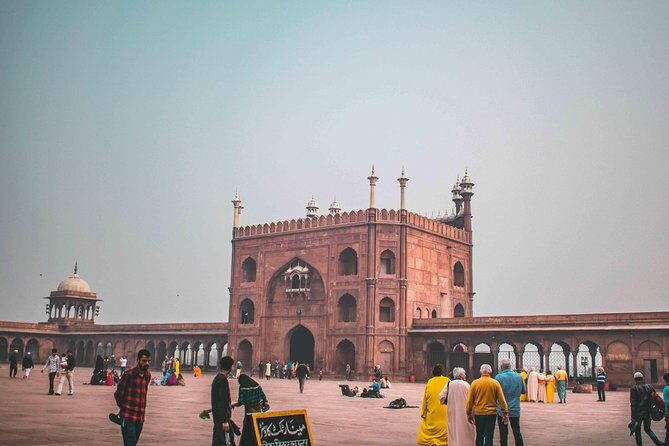
You begin at Jama Masjid, the Friday Mosque. It’s described as commissioned by Shah Jahan, who is also known for major Islamic architecture including the Taj Mahal. Expect this to feel formal and monumental, and keep an eye on dress norms—covering appropriately is a good idea for comfort and respect. Entry is not included, so budget separately.
Chandni Chowk: the rickshaw ride through market streets
Afterward, you’ll enjoy a rickshaw ride through Chandni Chowk. This is where Delhi’s street life shows up. You’ll pass through intense activity, narrow lanes, and lots of visual motion. It’s one of the best “feel” moments of the day because you’re not just looking from a bus—you’re moving through the neighborhood.






Red Fort (outside): military control means you mostly view it from the road
Next is the Red Fort, but the tour notes that much of the building is acquired by the Indian Army, so you see it from the outside. That sounds like a compromise, and it is, but it still works for photos and orientation. If you love architecture, seeing it as part of the city’s living landscape is still interesting.
Raj Ghat + India Gate: modern memorials and national symbolism
You then visit Raj Ghat, the memorial area marking where Mahatma Gandhi was cremated, followed by India Gate, a war memorial gateway tied to British Indian Army casualties from the First World War. These stops are short, but they give context for how Delhi holds national memory in public space.
Parliament House + Rashtrapati Bhavan: photo stops only
You’ll stop for photos at Parliament House and Rashtrapati Bhavan (the President’s official home). Expect quick moments rather than guided exploration. That’s fine—these stops help connect the visual dots of New Delhi’s planned layout.
Humayun’s Tomb + Qutub Minar: the two UNESCO anchors
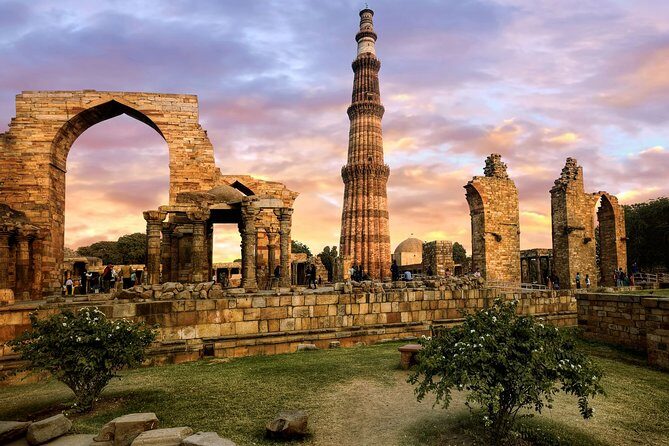
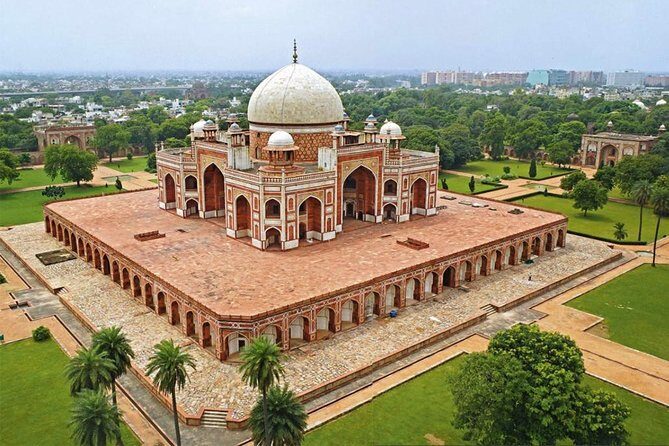
To end, you visit Humayun’s Tomb and Qutub Minar. Humayun’s Tomb is noted as India’s first garden-tomb, commissioned in 1558, and Qutub Minar is explained as an Indo-Islamic architectural masterpiece. Both are meaningful stops for anyone trying to understand the development of Mughal-era monumental design.
Entry fees for both are not included. Still, having a guide matters here because the monuments are easier to appreciate when someone ties the design choices to the broader historical story.
One practical tip: Delhi Day 2 is long. Wear comfortable shoes and plan to keep water with you, even though bottled water is provided in the car.
Day 3 transfer to Jaipur + Chokhi Dhani cultural night
Day 3 starts with a drive to Jaipur. It’s about a four-hour trip, with time to enjoy the countryside of Rajasthan along the way. This travel segment is useful because it shifts your mental mode from Delhi’s fast intensity to Rajasthan’s slower, more open-feeling scenery.
Jaipur check-in and downtime
Once you arrive, you check into your hotel. The schedule includes rest time before the cultural activity, which I think is the right call.
Chokhi Dhani: hands-on Rajasthani heritage in a village-style setting
In the evening, you head to Chokhi Dhani for a village-life experience. This part isn’t just entertainment; it’s a chance to see how Rajasthani traditions are performed for guests—food, music, dance, and live shows.
The tour specifically calls out Kalbelia and Ghoomar dances, plus live puppet shows and magic shows. Entry here is noted as not included, so plan for that cost separately. If you’re interested in culture beyond monuments, this evening is one of the easiest “yes” moments on the itinerary.
Day 4 Jaipur sights: Fort, City Palace, Hawa Mahal, and Jantar Mantar
Jaipur is called the Pink City for a reason, and this day leans into that identity. You’ll see the royal core, the iconic skyline landmarks, and the science-meets-royal design of an observatory.
Jaipur Fort: Rajput architecture with major wow factor
The big anchor is Jaipur Fort (described as a magnificent fort rising from a rocky mountainside). The tour frames it as a palace complex made from sandstone and white marble. Expect a guided walkthrough that helps the fort feel less like one big wall and more like a designed world.
Entry is not clearly marked as included here (the itinerary lists the entry ticket as not included for some stops), so treat it as a separate payment item.
Jal Mahal photo stop: Water Palace framed against the reservoir
Next is a photo stop at Jal Mahal, the Water Palace in Man Sagar. This is quick, and the value is mostly the viewpoint. Even if you can’t linger, it’s a great contrast to the fort’s massive stone presence.
City Palace: royal residence in the heart of the old city
Then comes the City Palace of Jaipur, described as a complex of courtyards, gardens, and buildings blending Rajasthani and Mughal architecture. This stop gives you a better sense of how power was displayed through layout, not just through individual buildings.
Hawa Mahal: the Palace of Winds as a honeycombed facade
You’ll make a photo stop at Hawa Mahal, the pink honeycombed five-story landmark built in 1799. The point here is the look—an instantly recognizable slice of Jaipur. The tour also explains the purpose: enabling royal women of the household to watch city life and processions.
Jantar Mantar: the UNESCO observatory you can actually understand
Finally, you visit Jantar Mantar Observatory, called out as a Unesco World Heritage Site. It’s described as curving geometric buildings calibrated to monitor stars and planets. This is one of my favorite types of sights because it shifts you from “look at pretty stone” to “understand how they measured the sky.”
Entry fees are not included for this stop, so plan accordingly.
Day 5 toward Agra: Chand Baori and Fatehpur Sikri before you reach the Taj region
Day 5 is the bridge day between Jaipur and Agra. It keeps the momentum going with two notable stops before you check in for the night.
En route: a countryside drive with a couple of high-impact pauses
The schedule suggests enjoying Rajasthan countryside along the way, then visiting sights like Chand Baori and Fatehpur Sikri.
Chand Baori stepwell: ancient water engineering
You stop at Chand Baori (Step well), described as one of the deepest and largest stepwells in India. The point of a stepwell is practical: water storage and relief from Rajasthan heat. When you see it in person, it stops being abstract history—it becomes a functioning idea turned into architecture.
Entry fees are not included here.
Fatehpur Sikri: Akbar’s capital that couldn’t stay
Next is Fatehpur Sikri, built by Emperor Akbar in 1571 and serving as Mughal capital for about 15 years before being abandoned due to water shortages. This stop helps the Mughal story feel real. You’re not just seeing a monument—you’re seeing how environment shaped power.
Entry fees are not included.
Arrive in Agra: check-in and recharge
Then you reach Agra, check into your hotel, and overnight. After a day of walking and driving, that hotel downtime is a real asset.
Day 6 Agra at sunrise: Taj Mahal, Agra Fort, Baby Taj, and Mehtab Bagh
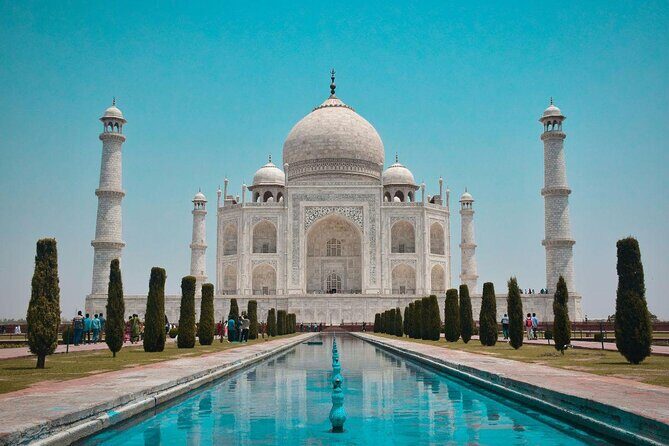
This is the day you came for. The itinerary schedules a 5.45 AM hotel lobby meet for sunrise. That early start changes everything: softer light, quieter atmosphere, and that “first look” feeling at the Taj Mahal that doesn’t happen when you show up later.
Taj Mahal at sunrise: pinkish hues and serious craftsmanship
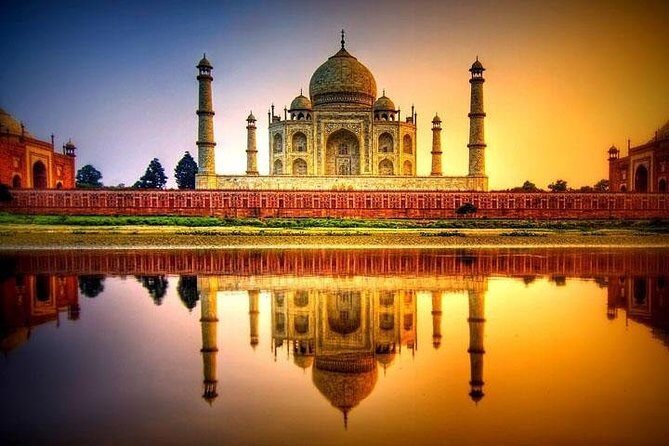
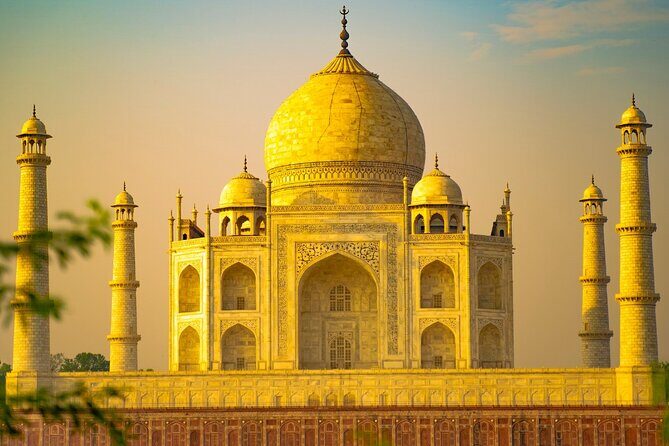
You visit Taj Mahal at Sunrise with up to two hours allotted. The tour notes that at sunrise it can show a pink shade, and it emphasizes the craftsmanship and structural design. Even if you’ve seen pictures, sunrise turns it into a living, changing scene.
Entry fees are not included for the Taj.
Reset, breakfast, then Agra Fort
After sunrise, you return to the hotel to freshen up and have breakfast, then you rest. Later you visit Agra Fort, described as an architectural masterpiece and Unesco World Heritage Site, built by Akbar in 1565 (also called Lal Qila or Qila-i-Akbari). It’s a huge red-sandstone walled-city style complex and once the Mughal residence.
Entry fees are not included.
Itmad-ud-Daula: the Baby Taj idea
You also visit Itmad-ud-Daulah’s Tomb, often called the Baby Taj. It’s described as a stunning Mughal mausoleum and the first Mughal tomb made entirely of marble, marking a transition from red sandstone to white marble architecture.
Entry fees are not included.
Mehtab Bagh: a garden opposite the Taj view
Finally, you visit Mehtab Bagh, the Moonlight Garden on the Yamuna’s banks opposite the Taj Mahal. The tour notes that Shah Jahan identified it as an ideal view location for seeing the Taj Mahal during sunset. Even if you’re not going at sunset time, the placement helps you understand why this garden belongs in the Taj story.
Entry fees are not included.
Day 7 back to Delhi: finish strong without rushing
Day 7 is mainly travel. After breakfast, you drive back to New Delhi, about three to four hours. Then you’re dropped off at your hotel, Delhi airport, railway station, or another preferred location in Delhi/Noida/Gurgaon.
It’s a tidy ending that avoids a last-minute scramble. If you plan a flight, you’ll want to allow buffer time, but the schedule itself is clear and standard.
Price and value: what $579 really buys you
At $579 per person for roughly seven days, you’re paying for a package that bundles the things that usually eat up time and money: a/c transport between cities, a professional driver, and daily guided sightseeing in multiple cities. On top of that, you get hotel accommodation (in a 3/4/5-star category you choose), airport pickup and drop-off, packaged bottled water in the car, and six breakfasts.
What you should expect to pay separately is monument entry fees. The itinerary repeatedly lists admission tickets as not included for key sights like Jama Masjid, Humayun’s Tomb, Qutub Minar, Chokhi Dhani, Chand Baori, Fatehpur Sikri, the Taj Mahal, Agra Fort, Itmad-ud-Daulah, and Mehtab Bagh.
One practical consideration based on real-world experience: hotel quality can vary within a star category. One detail I’d plan for is that your chosen category doesn’t always mean every property feels identical to the top-end expectation. The tour still aims for good hotels, and many people highlight positive hotel experiences, but it’s smart to double-check what is promised for your specific option.
Overall, this price makes sense if you want someone else to handle the route and you’d rather spend your time learning on-site than managing transportation.
The people make the difference: drivers and guides that keep it calm
I’d book this kind of tour partly for the logistics, but mostly for the human layer. In the feedback patterns here, drivers like Parveen, Pooran Singh, Ram Pal, and Dev are repeatedly praised for being professional, accommodating, and helpful over long drive hours. That matters because Delhi traffic and intercity driving can be tiring, even when roads are fine.
Also, the guides are a big part of why this itinerary works. You’ll have government-approved guides in each city, and you’ll be spending time with them at places where the details make a huge difference. One Delhi guide name that comes up is Alvina, noted for loving her city and being good at handling jet lag. That kind of practical guidance is exactly what you want when you’re adjusting to a new time zone and a new pace.
Who should book the Golden Triangle, and who should pass
This tour is ideal if you:
- want a first-time India introduction that focuses on the big monuments without planning each day from scratch
- care about having a guide with clear explanations rather than just a list of sights
- like structured days with a driver handling intercity travel
- are okay with a very early morning for the Taj Mahal sunrise
You might want to think twice if you:
- dislike early starts (the sunrise schedule is the big one)
- want fully independent flexibility between stops
- want all monument fees included in the price (this tour separates those costs)
Should you book this 7-Day Golden Triangle tour?
If you want an efficient, guide-led Golden Triangle week that starts and ends in Delhi, I’d say this is a strong option. The combination of sunrise Taj Mahal, major Delhi and Jaipur monuments, and extra historical stops like Chand Baori and Fatehpur Sikri gives you more than just three famous icons.
I’d base your decision on two things: first, whether you’re ready for the early morning Taj timing; second, whether you’re comfortable budgeting for monument entry fees that are not included. If those are both yes, you’ll likely enjoy this as a smooth, high-value sampler of North India’s most iconic places—without getting lost in the planning.
FAQ
What cities are included in this 7-day Golden Triangle tour?
It covers New Delhi, Agra, and Jaipur, with the trip starting and ending in New Delhi.
Is pickup included?
Yes. The tour includes hotel/airport pickup and drop-off in New Delhi.
Are monument entry tickets included in the price?
No. Monument fees are not included, and many stops note admission tickets as not included.
Do you visit the Taj Mahal?
Yes. You visit the Taj Mahal at sunrise with a morning meet time at 5.45 AM.
How do you travel between cities?
All transfers and sightseeing are done by air-conditioned car with an experienced/licensed driver.
What’s the cancellation window?
You can cancel up to 24 hours in advance for a full refund; within 24 hours, no refund is offered.