REVIEW · NEW DELHI
6 Days Golden Triangle Tour with Varanasi from Delhi
Book on Viator →Operated by Agra Trip · Bookable on Viator
A few places in India feel like a movie set, then reality hits hard. This 6-day circuit from Delhi strings together UNESCO monuments, palaces, forts, and the Ganges rituals of Varanasi. I especially like the way the tour builds in early moments like sunrise sights plus a dawn river ride.
The second thing I like is the guide-led pacing: you do top stops in each city without getting stuck trying to figure out timings or logistics. One consideration: monument entrance fees and meals aren’t included, and early starts (Taj Mahal and the boat ride) mean you’ll want to be ready for mornings.
In This Review
- Why This Tour Works for First-Time India (and Return Trips)
- Delhi’s Qutub Minar to India Gate: A Half-Day Start That Gets You Oriented
- Jaipur’s Amber Palace, City Palace, Hawa Mahal, and Jantar Mantar in One Tight Day
- Fatehpur Sikri en Route to Agra: One Stop That Changes the Mood
- Sunrise Taj Mahal Plus Agra Fort, Itmad-ud-Daulah, and Mehtab Bagh
- Delhi Again, Then Off to Varanasi: Two Different Worlds on One Schedule
- Varanasi at Dawn: Ganges Boat Ride, Monkey Temple, Vishwanath Temple, and Market Time
- Guides and Drivers: Why the Human Touch Makes This Feel Private
- Price and Value: What $599 Covers, and What You’ll Pay Extra
- Small Logistics You Should Not Ignore
- Should You Book This Delhi–Jaipur–Agra–Varanasi Tour?
- FAQ
- How long is the 6 Days Golden Triangle Tour with Varanasi?
- What’s included in the price?
- Are monument entrance fees included?
- Is the Taj Mahal visit guaranteed on your date?
- What about the Lotus Temple?
- Can I get a refund if I cancel?
Why This Tour Works for First-Time India (and Return Trips)
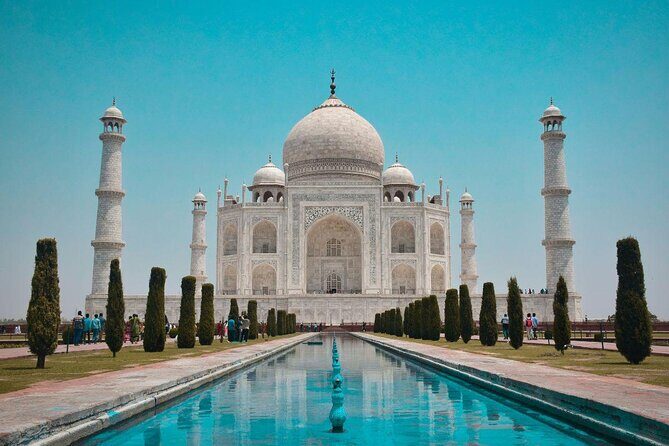
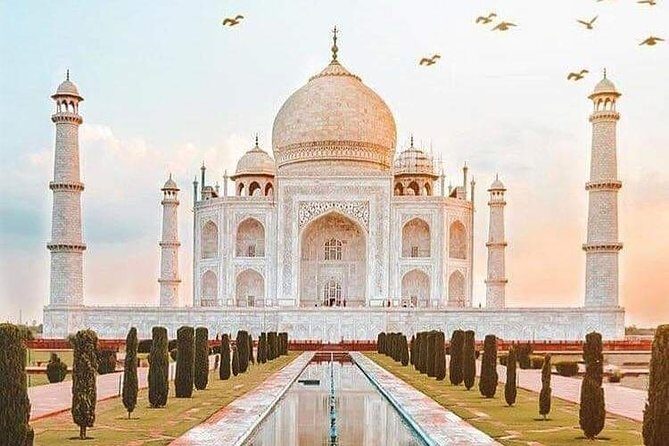
- Sunrise Taj Mahal timing is built in (Taj Mahal is closed Fridays), plus you add Agra Fort and more Mughal-era sights the same day.
- Ganges dawn boat ride in Varanasi is included, so you’re seeing the river with soft light and morning momentum.
- Local private guides meet you city by city, with the kind of explanations that help the monuments make sense fast.
- You get breakfast included at 3/4/5-star hotels for 5 nights on twin sharing, with private AC transport between stops.
- Delhi–Varanasi transfer is included as train tickets, but flights are listed as not included—so it’s worth confirming which option you’ll actually use.
Delhi’s Qutub Minar to India Gate: A Half-Day Start That Gets You Oriented
Your trip begins with a pickup from your location in Delhi or Gurgaon, then you head into the capital with a focused, half-day hit of major landmarks. This matters because Delhi can overwhelm you on day one. You’re not wandering; you’re getting a map in your head.
You’ll visit Qutub Minar (UNESCO), the soaring 11th-century minaret complex that frames medieval Delhi with stonework that still looks crisp. Next is Humayun’s Tomb (UNESCO), another landmark that helps explain how Mughal architecture developed its signature style. Then you’ll see India Gate, the war memorial that ties the city’s modern story to its past.
You may also stop at the Lotus Temple, also known as the Bahai Temple, but note it’s closed Mondays. If your timing lands on a Monday, plan to treat that as a schedule placeholder rather than a guaranteed photo stop.
A small practical plus: the drive past major civic buildings like the Parliament House, President’s Palace, and Secretariat buildings helps you understand where “power” sits in Delhi, even if you’re not going inside.
My take: This first day is structured so you leave Delhi knowing what you’re looking at later. That’s the difference between seeing sights and actually understanding them.
A few more New Delhi tours and experiences worth a look


Jaipur’s Amber Palace, City Palace, Hawa Mahal, and Jantar Mantar in One Tight Day
Jaipur is where the tour shifts from monuments to drama—color, craft, and royal design. After breakfast, you meet your private guide and head straight into the royal core.
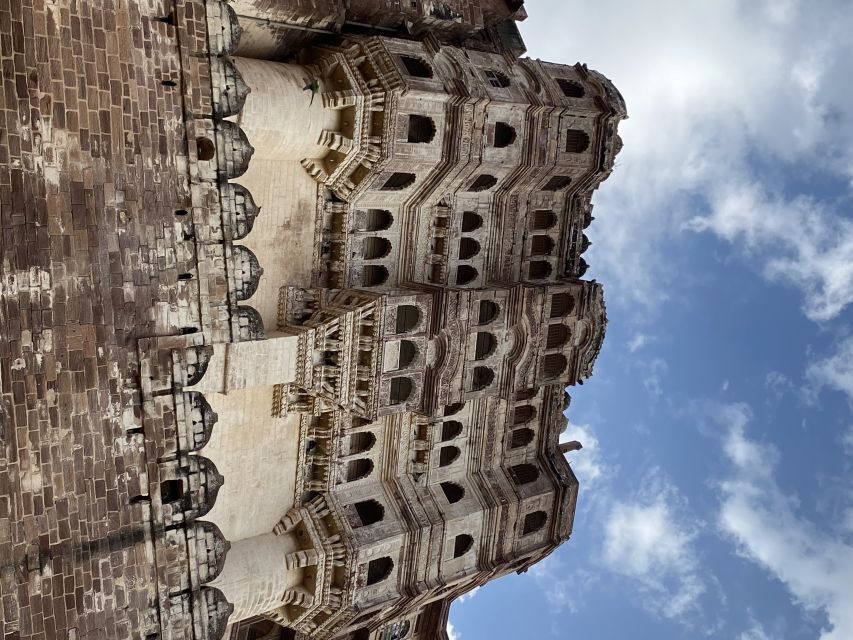
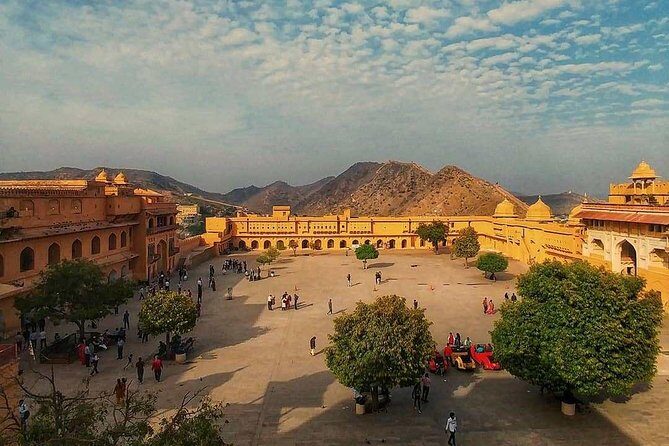
Amber Palace is the first big one. It’s not just about the walls and views; your guide’s explanations help you see why this place worked as a power center. You’re also set up for great photo angles without feeling like you’re sprinting through chaos.
Next comes City Palace. This one is especially valuable because it blends Rajasthani and Mughal architecture and gives context for how Jaipur positioned itself historically. Inside, there’s mention of a fine collection of textiles, costumes, and armor. Even if you skim, it gives you a sense of what “royal life” looked like beyond the big exterior shots.
Then you visit Hawa Mahal (Palace of Winds). The famous facade is more than a pretty postcard. The building was designed so royal women could watch street processions while staying out of direct sight—so it’s architecture with rules built into it.
You finish with Jantar Mantar, the stargazing observatory built by Maharaja Jai Singh. This is a nice contrast after forts and palaces. It reminds you that Indian science and astronomy were serious business, not just a side hobby.
A good expectation check: Jaipur day is packed with major icons. If you like slow afternoons, you might want to treat this tour as a “big sights first” plan and save slower wandering for a future trip.
Fatehpur Sikri en Route to Agra: One Stop That Changes the Mood
On the way from Jaipur to Agra, you stop at Fatehpur Sikri, the Mughal capital between 1571 and 1585. That detail matters. You’re not just seeing ruins; you’re seeing a whole city built for a specific moment in history—then abandoned.
The tour keeps this as a purposeful en-route stop, so you get the value without sacrificing the main Agra highlights. It also helps break up the drive day, which keeps energy up for what comes next.
After Fatehpur Sikri, you continue to Agra and check into your hotel. There’s evening time at your leisure, which is helpful because Agra can feel intense once you start moving through palaces and tombs.
Sunrise Taj Mahal Plus Agra Fort, Itmad-ud-Daulah, and Mehtab Bagh
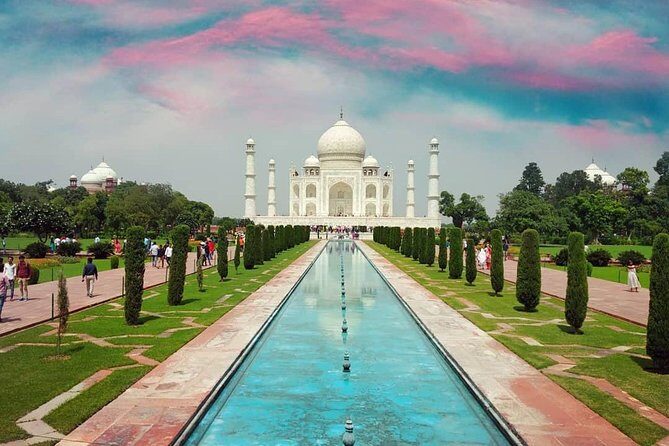
Agra is where the itinerary makes its big claim: sunrise at the Taj Mahal. It’s closed Fridays, so your exact day matters. If you’re traveling on a Friday, you’d want the operator to swap timing or adjust the plan—but the tour description is clearly built around the sunrise experience.
From there, your day turns into a deeper Mughal checklist:
- Agra Fort, built by Emperor Akbar in 1565, sits on the Yamuna River. It’s massive and visually bold, but the real value is your guide’s explanation of how it functioned as a fortress of power.
- Itmad-ud-Daulah, described as a mausoleum and noted for being the first Indian tomb made entirely out of marble. Even if you don’t know its history, the design details can feel like a turning point between styles.
- Mehtab Bagh, the series of 11 parks across the Yamuna’s east bank. This is a smart add because it gives you a different angle and a calmer feel than the main Taj area.
The practical advantage: You’re not just doing one headline sight. You’re getting the broader Mughal setting that makes the Taj Mahal feel like it belongs to a whole world, not a standalone masterpiece.
Delhi Again, Then Off to Varanasi: Two Different Worlds on One Schedule
After the Agra day, you drive back to Delhi and check into your hotel. This is a reset day in practical terms: you get your overnight back in the capital before moving to Varanasi the next morning.
The Varanasi transfer day includes a move from Delhi to Varanasi, and here the tour data points to a potential mismatch worth flagging. Your inclusions list train tickets (1st or 2nd class) between Delhi and Varanasi and back, while the itinerary text references flying. Also, flights are listed as not included. So before you go, confirm whether your route uses the included train or if you’ll book flights separately.
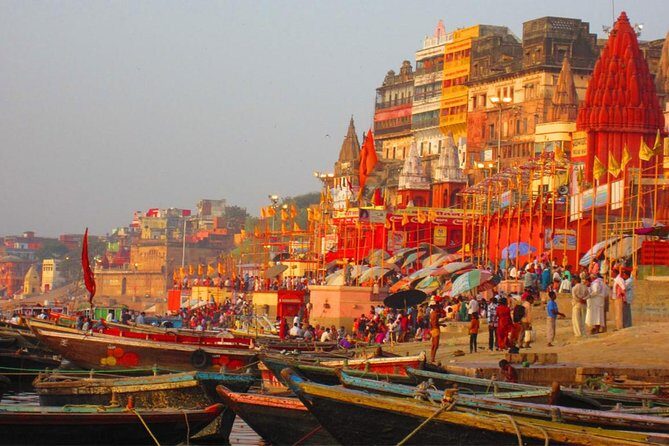
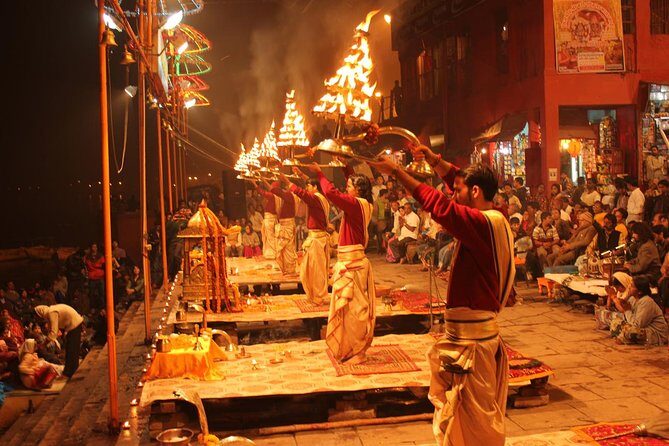
Once in Varanasi, you check into your hotel. In the evening, you’ll experience Ganga Aarti, which is described as happening facing the Ganga River with lamps lit and circled by Hindu priests, with songs in praise of Mother Ganga. The ritual ends with devotees raising hands to the forehead after cupping the flame.
What you should expect: Ganga Aarti isn’t a museum show. It’s a living religious moment. If you’re sensitive to strong atmosphere and close crowds, choose your viewing spot thoughtfully and stay respectful.




Varanasi at Dawn: Ganges Boat Ride, Monkey Temple, Vishwanath Temple, and Market Time
Day 6 starts early with a morning boat ride along the Ganges. The tour describes it as a quintessential Varanasi experience with pilgrims bathing and performing puja. This is one of those moments where timing really matters: the dawn light changes the entire mood.
After the boat ride, you visit temples such as the Monkey Temple and Vishwanath Temple. Then you explore local markets, which is where you catch the everyday side of Varanasi—the part that’s hard to understand if you only stick to the big rituals.
Your day ends with a transfer to the airport for your onward journey.
My take: This final day balances the sacred and the street. The boat ride and temples give you the spiritual “why.” The markets give you the “how people actually live around it.”
Guides and Drivers: Why the Human Touch Makes This Feel Private
This tour is private, meaning your group is the only group running with the guides and driver. That’s a big deal in India, where getting the route and timing right can save hours.
The guide names in the feedback you provided are also a good clue about the type of service you’ll receive. You may be accompanied by guides such as Ankush in Delhi, Boby in Agra, Ranvijay in Jaipur, and Varun in Varanasi. Other guidance names mentioned include Sartaj and Ganesh, recognized for attentive care and explanations. In practical terms, that translates to fewer awkward pauses and more “this is what you’re seeing and why it matters.”
Drivers are also highlighted as handling traffic skillfully. That matters because your route includes city transfers plus long day drives, and you’ll want someone who keeps things moving without turning every road into a stress test.
Price and Value: What $599 Covers, and What You’ll Pay Extra
At $599 per person, the value comes from bundling multiple categories that usually cost extra if you book separately:
- 5 nights in 3/4/5-star hotels with breakfast (twin sharing)
- Private AC transport
- Professional local guides in each city
- Bottled mineral water during journeys
- Morning Ganges boat ride in Varanasi
- Train tickets between Delhi and Varanasi and back (per inclusions)
What’s not included is equally important:
- Monument entrance fees
- Lunch and dinner
- Flights (Delhi to Varanasi and Varanasi to Delhi are listed as not included)
So you can think of the price as “transport + guides + main lodging + a couple of key included experiences.” If you’re the kind of traveler who likes to pay for comfort and pay for guidance rather than planning every detail, it tends to feel fair. If you’re trying to minimize daily spending and you’re comfortable building an itinerary on your own, the excluded items can add up.
My recommendation for budgeting: plan for entrance fees plus at least two main meals daily on days with lots of walking. Also assume you’ll spend a bit on water/tea/snacks even with bottled water provided during transfers.
Small Logistics You Should Not Ignore
A few details from the tour info can affect your comfort:
- Dress code: it lists both smart casual and formal. For temples and evening rituals, err on the neat side.
- Comfort with early mornings: sunrise Taj Mahal and dawn boat ride mean you’ll likely start the day earlier than you would on a slower itinerary.
- Opening/closure days: Taj Mahal is closed Fridays and Lotus Temple is closed Mondays. If your travel dates hit either, you’ll want the operator to confirm alternatives.
Also, the tour includes pickup from Delhi or Gurgaon and uses a mobile ticket. That’s mostly convenience, but convenience matters on trips where you’ll be hopping between airports, hotels, and sight entrances.
Should You Book This Delhi–Jaipur–Agra–Varanasi Tour?
Book it if you want an efficient route that hits the biggest names—Taj Mahal at sunrise, Jaipur’s signature palaces, and Varanasi’s dawn and Ganga Aarti—without you managing the day-to-day complexity.
Skip it (or adjust expectations) if you hate early starts or you prefer lots of free time. This schedule is designed to cover major sights in a short span. Also, be ready for extra spending on entrance fees and meals.
If you’re a first-timer to India, I think this is a strong “foundation trip.” You’ll learn how these places connect—Mughal architecture in Delhi and Agra, Jaipur’s royal planning, then Varanasi’s living river culture.
FAQ
How long is the 6 Days Golden Triangle Tour with Varanasi?
The tour is described as 6 days (approx.) with 5 nights of hotel accommodation.
What’s included in the price?
Inclusions include 3/4/5-star hotel accommodation for 5 nights on twin sharing with breakfast, private AC transport, professional local tour guides, a morning boat ride in Varanasi, mineral water during journeys, and train tickets between Delhi and Varanasi (1st or 2nd class).
Are monument entrance fees included?
No. Monument entrance fees are not included.
Is the Taj Mahal visit guaranteed on your date?
The plan specifies Taj Mahal is closed Fridays, so your sunrise visit depends on your travel day.
What about the Lotus Temple?
The tour notes that the Lotus Temple is closed Mondays.
Can I get a refund if I cancel?
You can cancel up to 3 days in advance for a full refund. If you cancel less than 3 days before the start time, the amount paid won’t be refunded.