Delhi feels different in every street. This private full-day route strings together Old Delhi mosques and forts with New Delhi monuments, plus hotel pickup and a guide to keep it all making sense. I like the private pace and the fact that you hit multiple UNESCO highlights without juggling tickets or transit.
I also like that the tour mixes big icons with specific cultural context, like the Laxminarayan Temple’s red-and-gold carvings and the Mughal stories tied to Humayun’s Tomb, Jama Masjid, and the Red Fort. And you get a plan for your day, with a morning start and a return around 5pm.
One thing to consider: you will walk and deal with a strict dress code at worship sites (no shorts or sleeveless tops; knees and shoulders covered). If your clothes are borderline, you may be refused entry.
In This Review
- Key takeaways
- Why this Old-and-New Delhi mix works so well
- Price and what you truly get for $189 per person
- The morning start: pickup, timing, and a comfortable pace
- Laxminarayan Temple: red-and-gold carvings and Gandhi’s 1938 moment
- Old Delhi’s Jama Masjid and Red Fort: scale you can feel
- Jama Masjid (largest mosque)
- Red Fort (Lal Qila)
- New Delhi’s India Gate and Parliament-area drive-bys
- Humayun’s Tomb: UNESCO stop with included entry
- Qutub Minar: India’s tallest minaret, plus shopping time
- Dress code and smart packing: avoid the entry headache
- Lunch on your terms, plus camera-fee awareness
- Who this private day tour suits best
- Should you book this Old and New Delhi private tour?
- FAQ
- What time does the tour start?
- How long is the private sightseeing tour?
- Is hotel pickup and drop-off included?
- Do I get a private guide and air-conditioned transportation?
- Which UNESCO or main sites have admission fees included?
- Is lunch included?
- Is a dress code required?
- What should I bring for the day?
- What’s the cancellation policy?
Key takeaways
- Private guide + air-conditioned car keeps the day efficient, especially for crossing between Old and New Delhi.
- UNESCO-focused route hits Humayun’s Tomb, Qutub Minar, Jama Masjid, and the Red Fort.
- Entrance fees are partly included, with some sites covered and one major stop (Jama Masjid) not included.
- Lunch is on you, so you can choose what fits your budget and spice tolerance.
- Gandhi, Lakshmi, and Mughal rulers show up in the details, not just on the postcard signs.
- Hotel pickup/drop-off makes it easier to start at 9:00am and stay on schedule.
Why this Old-and-New Delhi mix works so well
Delhi can feel like two cities stacked on top of each other. Old Delhi is about Mughal-era power, crowded lanes, and monumental faith. New Delhi is wider streets, government buildings, and memorials that read like history carved in stone.
This tour works because it respects that contrast. You start with standout religious architecture, then shift to Old Delhi’s biggest Mughal sights, and end with New Delhi’s famous memorials and a couple of UNESCO masterworks. With a private setup, you’re not forced to rush with a crowd just to keep up.
You also get a guide to translate what you’re seeing. That matters in Delhi, where the same stone, arch, and inscription can carry very different meanings depending on who built it and when.
You can also read our reviews of more private tours in New Delhi


Price and what you truly get for $189 per person
At $189 per person for a 7 to 8 hour private day, the value comes from what’s bundled. You’re paying for hotel pickup/drop-off, a private guide, and transportation in an air-conditioned vehicle—a big deal in a city where travel time can balloon fast.
Entrance fees are included for several of the key stops:
- Humayun’s Tomb (included)
- Qutub Minar (included)
- Red Fort (included)
Jama Masjid is the one that isn’t included for admission. Laxminarayan Temple is listed as free.
So even though not every site’s ticket is covered, you’re still getting most of the paid-entry monuments handled. If you’ve ever tried to coordinate multiple UNESCO sites on your own, you’ll appreciate how much stress this removes.
Also, there’s a mobile ticket, plus group discounts if you’re traveling with others. Private means it’s just your group, not shared headcounts and stop-and-go choreography.
The morning start: pickup, timing, and a comfortable pace
The tour begins around 9:00am with hotel pickup. You ride in a private air-conditioned vehicle with your guide, which helps you cover the distance between Old and New Delhi without turning the day into a series of weather changes.
Your day is built around a realistic rhythm:
- morning sightseeing
- a lunch break where food is your choice
- more major monuments and UNESCO stops
- time for shopping before the return to your hotel around 5:00pm
That schedule is especially helpful if you want to see the big names (and not just one area) while still having time to breathe. Delhi rewards that. If you push too hard, you end up watching your own feet instead of the buildings.
Laxminarayan Temple: red-and-gold carvings and Gandhi’s 1938 moment
Your day kicks off at the Laxminarayan Temple, also known as the Birla Mandir. This stop is a smart opener because it isn’t ancient Mughal stone. It’s a more modern expression of Hindu devotion, and it sets a tone for the day beyond the usual fortress-and-minaret loop.
Here’s what to look for:
- intricate red-and-gold carvings
- the temple’s dedication to Lakshmi, the goddess of wealth
- a connection to Mahatma Gandhi, who attended the inauguration in 1938
The temple was built by B. R. Birla and Jugal Kishore Birla between 1933 and 1939. One detail I’d plan to notice is how the temple walls are decorated with Hindu symbols plus quotes from the Gita and Upanishads. That turns a quick photo stop into a place where you can actually read the idea behind the artwork.
Admission for this temple is listed as free, so it’s a good value moment early on—one less ticket task before you hit the UNESCO sites.
Old Delhi’s Jama Masjid and Red Fort: scale you can feel
Old Delhi is where Delhi stops being “a city” and becomes a collection of power structures—religious and political. Jama Masjid and the Red Fort sit close enough that you get to compare the Mughal approach to faith and authority in the same block of time.
A few more New Delhi tours and experiences worth a look





Jama Masjid (largest mosque)
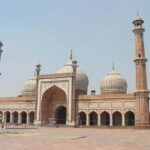
Jama Masjid is India’s largest mosque and was constructed in 1656 for the fifth Mughal emperor. It’s laid on a hillock in Shahjahanabad, which is essentially the Mughal-era core of Old Delhi.
You’ll want to give yourself a little time to absorb the structure before you rush onward. The minarets and domes are dramatic at eye level, and the surrounding scale changes how big it feels.
Important practical note: admission for Jama Masjid is not included in the ticket package for this tour. It’s still part of the guided experience, but you should expect to pay your own entry fee here.
Red Fort (Lal Qila)
Next comes the Red Fort, locally known as Lal Qila. This is where you get the political backbone of the Mughal story. The fort served as the capital of the Mughals until 1857.
This is one of those places where a guided explanation makes the walls feel alive. A fort isn’t just stone; it’s administration, ceremony, and control. In Old Delhi, that context helps you look beyond the obvious archways and gates.
Admission for the Red Fort is included, and you’ll have time here to take it in without feeling like you’re sprinting through.
New Delhi’s India Gate and Parliament-area drive-bys
After Old Delhi, the tour shifts to New Delhi, and that shift is part of the experience. The roads widen, the architecture becomes more institutional, and the mood turns from street-level intensity to national symbolism.
You stop to view India Gate, a national monument in the heart of New Delhi. It’s 42 meters (138 feet) high and is often compared to the Arc de Triomphe in Paris. After independence from the British Empire, the monument also housed the Indian army’s Tomb of the Unknown Soldier.
Then you drive past major government buildings, including:
- Parliament House
- the Delhi Secretariat
- Rashtrapati Bhavan, the President’s House, with an enormous mansion and extensive gardens
You’re not getting a long museum-style visit here. You’re getting a sense of the spine of modern Delhi—useful because later, when you revisit these areas on your own, you’ll understand where everything sits and why.
If you like seeing both the human scale of religious sites and the bigger-than-life scale of national monuments, this drive segment lands well.
Humayun’s Tomb: UNESCO stop with included entry
Humayun’s Tomb is one of the major UNESCO World Heritage sites on this route, and you visit it after lunch. The complex was built between 1562 and 1571 for the Mughal emperor Humayun.
Admission for Humayun’s Tomb is included, and the stop is timed at about an hour. That duration is usually enough to appreciate the main layout and get a feel for the symmetry without exhausting yourself.
What makes this stop worth your energy is how it connects back to the Mughal theme running all day. You’re seeing the same dynastic mindset—grand planning, religious significance, and architectural statements—just expressed through a tomb complex instead of forts or mosques.
Qutub Minar: India’s tallest minaret, plus shopping time
In the southern section of the city, you’ll see Qutub Minar, which is listed as the tallest minaret in India. This is another UNESCO anchor for the day.
You’ll have about two hours here, and admission is included. That longer window matters. Qutub Minar isn’t just a single photo spot; it’s a whole area where you can walk, compare angles, and notice details at different distances.
Also, the day doesn’t end abruptly after the last major monument. You’ll have time for shopping before your driver returns you to your hotel at 5pm.
That’s practical if you want a final burst of browsing without squeezing it into the most crowded streets earlier in the day.
Dress code and smart packing: avoid the entry headache
Places of worship and selected museums enforce a strict dress code. The rule is clear:
- no shorts
- no sleeveless tops
- knees and shoulders must be covered for both men and women
If your outfit is too revealing, you can be refused entry. Delhi is one of those cities where the weather is one thing and the dress rules are another, so plan ahead.
Also pack basics for comfort:
- comfortable walking shoes
- sunscreen
- at least one bottle of water
The tour includes vehicle comfort, but you’ll still be moving through monuments. I’d treat this as a walking day, not a sit-and-stare day.
Lunch on your terms, plus camera-fee awareness
Lunch is not included, so you’ll stop for it at your own expense. That gives you freedom: eat something light, choose a place near your comfort level, or pick a meal that helps you keep going through the rest of the afternoon.
Camera fees are also not included. If you plan to photograph inside any monument area where rules apply, assume you may need to pay on site.
It’s not a dealbreaker. It just prevents the annoying surprise of being told to pay after you already feel settled with your camera settings.
Who this private day tour suits best
This is a strong match if you want:
- a private guide and car without negotiating with drivers all day
- a route that connects Old Delhi and New Delhi in one go
- a schedule that hits key UNESCO sights plus major national landmarks
- mostly included entry fees for the bigger-ticket sites
It’s also a good option for solo planning if you prefer structure. One thing that comes through from the way this tour is presented is organization—pickup, timing, and clear movement between stops.
If you hate crowds and want control over your pace inside each monument, private is the right lever to pull.
Should you book this Old and New Delhi private tour?
If you’re limited on time and you want the most important Delhi landmarks without turning your day into logistics, I think this one is worth considering. The biggest selling points are simple: hotel pickup, private air-conditioned transport, a guide to connect the dots, and included admission for several major UNESCO stops.
Skip it only if you strongly prefer fully self-guided exploring, because the schedule is built to run efficiently. Also be honest about dress code compliance. If you’re arriving in casual summer clothing that breaks the rules, plan to adjust before you show up.
For many people, this is the day that gives Delhi its shape—Old Delhi’s Mughal weight, then New Delhi’s national geometry—without you having to figure out all the pieces first.
FAQ
What time does the tour start?
It starts at 9:00am.
How long is the private sightseeing tour?
The duration is listed as 7 to 8 hours (approx.).
Is hotel pickup and drop-off included?
Yes. The tour includes free hotel pickup and drop-off.
Do I get a private guide and air-conditioned transportation?
Yes. You get a private guide, a driver, and transportation in a private air-conditioned vehicle.
Which UNESCO or main sites have admission fees included?
Admission is included for Humayun’s Tomb, Qutub Minar, and the Red Fort. Jama Masjid is listed as admission not included.
Is lunch included?
No. There is a lunch stop on your own expense.
Is a dress code required?
Yes. For places of worship and selected museums, you must cover knees and shoulders. Shorts and sleeveless tops are not allowed, and entry may be refused if you are not dressed appropriately.
What should I bring for the day?
Wear comfortable walking shoes, and bring sunscreen and at least one bottle of water.
What’s the cancellation policy?
You can cancel for free up to 24 hours in advance for a full refund. Less than 24 hours before the start time is not refundable.