REVIEW · NEW DELHI
New Delhi Cycle Tour
Book on Viator →Operated by SpinMonkey Cycle tour · Bookable on Viator
Ride Delhi before the crowds.
This New Delhi bike tour is a smart way to see serious sights without spending the morning stuck in traffic, and you get a guided route that mixes Old Delhi lanes with the planned boulevards of New Delhi. You’ll stop for culture and context, including a visit to a Sikh temple and its community kitchen. The whole thing runs at an easy, no-stress pace, so the ride feels like sightseeing with purpose, not training.
I especially like that breakfast and morning tea are included, which makes the early start feel worth it (and it’s not just a snack—there’s a full breakfast stop at the end). I also like the guiding style: names that show up in real-world feedback include Gaurav and TJ, and the common thread is clear storytelling about architecture, religion, and daily life—how Delhi works, not just what it looks like.
One consideration: you’re leaving early, and you’ll ride through parts of Delhi where traffic and roads can feel intense. Go in ready to follow instructions, and dress for Indian traditions since you’ll visit religious sites—skip shorts if you can.
In This Review
- Key things that make this tour worth your time
- Why a 4-Hour Bike Tour Beats a Full-Day Delhi Walk
- Timing That Matters: Sunrise Starts and Seasonal Hours
- Gear and Safety: What You Get (and How to Use It)
- Connaught Place to Sikh Temple: The Morning Culture Route
- Lutyens Delhi and the President Estate View Outside Gates
- India Gate Lawns to the War Memorial Shaped Like Paris
- Stepwell and Dhobi Ghats: Seeing Delhi’s Daily Work at Dawn
- Breakfast at the End: Real Fuel for Your Day
- Price and Value: What $35 Buys You in Real Terms
- Who Should Book This Bike Tour (and Who Might Skip It)
- Should You Book the New Delhi Cycle Tour with SpinMonkey?
- FAQ
- What time does the New Delhi Cycle Tour run?
- How long is the tour?
- Is it for expert cyclists only?
- What bike and safety gear is included?
- Is breakfast included, and is there a vegetarian option?
- Do I need to avoid shorts?
- Is hotel pickup and drop-off included?
- Can I cancel for a full refund?
Key things that make this tour worth your time
- Sunrise timing for quieter roads so you get landmarks with less daytime chaos
- Sikh temple + community kitchen where you learn how free food service works
- Lutyens Delhi viewpoints including a view from outside the President Estate area
- India Gate lawns to the war memorial stop that connects Delhi to global memorial shapes
- Dhobi Ghats in action so you see hand-washing work before the day heats up
- Bike setup for comfort and safety with mountain bikes, disc brakes, helmets, and safety jackets
Why a 4-Hour Bike Tour Beats a Full-Day Delhi Walk
Delhi can be a lot on foot. Distances add up fast, and crossing streets with crowds can turn a “quick stop” into a long delay. This tour solves that with a tight, about-4-hours rhythm: ride, stop, learn, eat, and move on.
You also get a better sense of how Delhi actually feels. On a bike, you’re close to the street—vendors, morning routines, and the texture of neighborhoods—without needing to spend hours just getting from one monument to the next. It’s a practical way to get a broad overview in limited time.
The other big advantage is the structure. You’re not piecing together a route, guessing transport, or trying to time markets, temples, and breakfast all on your own. A local guide keeps the day connected, so you see why each stop matters.
You can also read our reviews of more cycling tours in New Delhi



Timing That Matters: Sunrise Starts and Seasonal Hours

This ride is built around early morning. The tour runs roughly 5:30am–9:30am from March to September, and 6:30am–10:30am from September to February. That shift matters because Delhi’s feel changes a lot with season and light.
Starting earlier gives you two main wins:
- Cooler temperatures and less glare for looking around
- Less traffic pressure for cycling, especially through the parts of town where roads can be trickier later in the day
If you’re the type who hates getting up early, this might sting a bit. But the early hours are also what make it possible to see daily life and landmarks without feeling rushed into a chaotic schedule.
Gear and Safety: What You Get (and How to Use It)
The tour provides the cycling basics so you can show up and ride:
- Mountain bikes with disc brakes
- Helmet
- Safety jacket
- Water bottle
- Use of bicycle
You’ll also have an English-speaking guide plus a co-guide who handles local language support. The practical takeaway for you: if you have questions, you’re not stuck guessing what you’re seeing.
Pace is another safety factor. This isn’t a fast spin class. The ride is described as leisurely, and it’s for people who can ride a bike. If you’re comfortable on two wheels, you’re in the right lane.
Clothing is part safety, part respect. You’ll be visiting religious places, so the recommendation is to wear clothes that fit Indian traditions and avoid shorts if you can. If you worry about comfort while riding, padded bike pants are only mentioned as useful if you scare easily—meaning they’re not required for everyone, but they can calm the nerves.
Connaught Place to Sikh Temple: The Morning Culture Route
One of the most compelling parts of this tour is how it uses the ride to connect different layers of Delhi. You start with Connaught Place, a major hub built during the British era. Even if you’ve seen it in daytime, arriving in the early morning shifts the mood—you notice the architecture more, and it’s easier to absorb details before the place fills up.
From there, the route takes you to Delhi’s most famous Sikh temple, where you get an education beyond just photos. You learn about Sikh culture and especially the idea of community service. The tour highlights the biggest community kitchen in Delhi, where food is provided for free to anyone who needs it.
This stop is the heart of the cultural part of the morning. The logic is simple and powerful: to feed large numbers of people, the kitchen has to be massive, and the temple functions like a service engine, not just a place of worship. If you want, the tour also notes you can help with making some food or serving people, though you’ll want to follow the staff and guide on what’s appropriate in that moment.
Practical tip: even if you love watching and photographing, keep an eye on what’s allowed inside temple areas. Your camera might not be welcomed everywhere.
Lutyens Delhi and the President Estate View Outside Gates
After the Sikh temple stop, you cycle through the greener side of New Delhi—often associated with Lutyens Delhi and its orderly layout. This section is important because it contrasts hard with Old Delhi. Where Old Delhi can feel tight and busy, Lutyens Delhi offers wide lawns and smoother sight lines.
You’ll reach the President Estate area for a marvelous view from right outside it. You’re not going inside based on what’s described, but you still get the visual context—Delhi’s official geography and how power and planning shape the city.
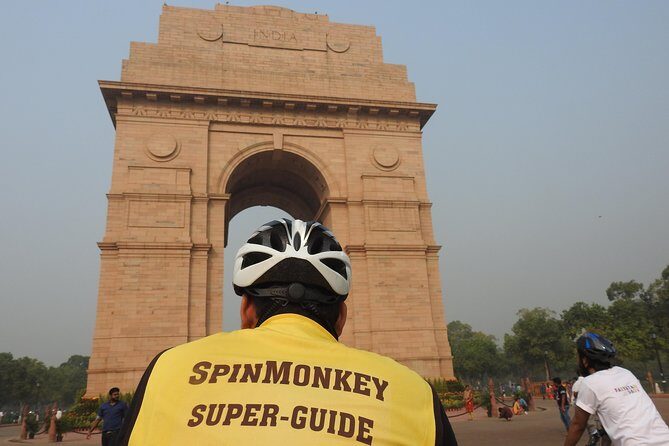
Then you follow the lawns of India Gate toward the war memorial. India Gate’s surrounding space helps you slow down. It’s a good moment to recalibrate your mind after traffic and temple service scenes. And it sets up the next stop in a way that feels connected, not random.






India Gate Lawns to the War Memorial Shaped Like Paris
The war memorial stop is described as being built in the shape of an Arch de Triomphoe-like form from Paris. That kind of reference is more than trivia. It shows you how Delhi has absorbed global design ideas, especially when nations commemorate shared stories of conflict and memory.
The practical value for you: this tour doesn’t only show “things to photograph.” It gives you a clue about why shapes and symbols appear where they do, so your morning ends with meaning, not just a checklist.
Also, because it’s still early, the light and the mood are gentler than they are later in the day. You can take your time here without feeling like you’re constantly dodging crowds.
Stepwell and Dhobi Ghats: Seeing Delhi’s Daily Work at Dawn
Next comes the ancient stepwell. Stepwells were used to store water for travelers, which makes the stop feel less like a monument and more like infrastructure. The note in the description is that not much water remains there now, but you still get the idea: people once depended on these structures to survive long journeys.
Then you head to Dhobi Ghats, the famous washing areas known across India. Delhi also has its own versions, and the tour focuses on the early morning operation. You’ll see hands-on washing setups and watch how clothes get cleaned before the city settles into full speed.
Here’s what makes this stop special for your brain: it’s Delhi you don’t usually see from a car or a single viewpoint. You get to understand that the city’s systems keep moving at dawn. And because it’s part of a bike route, it fits naturally into the early schedule rather than becoming an extra detour.
Breakfast at the End: Real Fuel for Your Day
The tour finishes with an exciting Indian breakfast at a famous café. It’s not described as a single-bite tasting, but as a proper breakfast stop—plus you’ve already had beverages earlier.
From the feedback pattern, the breakfast includes South Indian cuisine elements, and the included food tasting plus coffee or tea adds variety. That matters because early mornings can make you cranky if you only get a light snack. With breakfast handled for you, you end the ride ready to keep exploring Delhi (or at least ready to face the rest of your day).
If you’re vegetarian, the tour says a vegetarian option is available, so plan ahead when booking and mention your preference.
Price and Value: What $35 Buys You in Real Terms
The price is listed at $35, and for a half-day tour in central Delhi, that’s not just “cheap”—it’s structured value.
What you get included:
- Bike use, helmet, and safety jacket
- Water bottle
- Breakfast plus morning tea and beverages
- Food tasting, coffee or tea
- Local guide (English-speaking) and a co-guide for local support
- GST
- Certificate
What you don’t get:
- Hotel pickup/drop-off
- Camera tickets (if applicable at certain monuments)
So the value question becomes: do you want a guided route with equipment and food baked in, delivered in about four hours? If yes, $35 is the kind of deal that lets you spend your time exploring instead of negotiating transport, meal planning, and route building.
One practical way to think about it: you’re paying to replace multiple small costs and decisions—plus you’re getting context. A bike doesn’t automatically teach you the city. The guide does, and the stops are selected to connect culture, architecture, and daily life.
Who Should Book This Bike Tour (and Who Might Skip It)
This is a strong fit if:
- You can ride a bike and want an easy pace
- You like early starts when the city feels calmer
- You want a guided overview that connects Old Delhi and New Delhi
- You’re interested in Sikh culture, temple community service, and morning daily routines
- You want included breakfast and beverages so you’re not chasing food afterward
It’s also described as suitable for most travelers, with kids allowed if accompanied by an adult. That’s a good sign if you’re bringing a family that can handle early mornings and modest clothing expectations.
You might consider skipping if:
- You hate religious-site etiquette and dressing more modestly
- You aren’t comfortable cycling in any traffic environment at all
- You need hotel pickup (since none is included)
Should You Book the New Delhi Cycle Tour with SpinMonkey?
If you’re trying to do Delhi in short time, I’d book this. The route makes sense: it starts with a major central landmark, moves into Sikh religious culture and community service, then shifts into planned New Delhi, and finally lands on daily-life scenes like stepwells and Dhobi Ghats. The day ends with breakfast, so you’re not left hungry and scrambling.
The best reason to choose it is simple: you get a safe, guided bike experience that covers a lot of ground while still slowing down at meaningful stops. It’s not only about movement; it’s about understanding what you’re seeing.
If you can handle an early wake-up, respect the dress code, and follow the guide’s instructions closely, this tour is an efficient, human-scale way to meet Delhi at morning pace.
FAQ
What time does the New Delhi Cycle Tour run?
The tour runs about 5:30am–9:30am from March to September, and about 6:30am–10:30am from September to February.
How long is the tour?
It’s listed as about 4 hours.
Is it for expert cyclists only?
No. The pace is described as leisurely, and the tour is by no means only for experts or skilled cyclists. If you can ride a bike, you can join.
What bike and safety gear is included?
You get a mountain bike with disc brakes, plus a helmet and a safety jacket. A water bottle is also provided.
Is breakfast included, and is there a vegetarian option?
Yes. Breakfast is included, and a vegetarian option is available if you ask when booking.
Do I need to avoid shorts?
You’re advised to wear clothes in keeping with Indian traditions and to avoid shorts if possible, since some religious places are part of the route.
Is hotel pickup and drop-off included?
No. Hotel pickup and drop-off is not included.
Can I cancel for a full refund?
Yes, free cancellation is available. You must cancel at least 24 hours before the experience’s start time for a full refund.