REVIEW · HYDERABAD
Hussain Sagar Lake Private Walking Tour in Hyderabad
Book on Viator →Operated by Hyderabad by locals · Bookable on Viator
Hussain Sagar glows at dusk. On this private evening walk, you follow the lake’s heart-shaped shoreline while your guide ties together stories of Golconda’s Qutb Shahi kings and Sufi Saint Hussain Shah Wali, credited as the architect behind the lake. It’s an easy way to read Hyderabad’s skyline like a storybook, one landmark at a time.
I especially like how the route mixes major monuments with local street energy—think the 125-ft B.R. Ambedkar statue and the Telangana State Secretariat lit up at night—without making it feel like a museum trip. One consideration: it’s mostly outdoors along the waterfront and parks, so wear grippy shoes and plan for evening temperatures and some uneven ground.
In This Review
- Key highlights you’ll actually feel
- Why start at 6:00 pm on Hussain Sagar
- Necklace Road: the lake’s “pearl necklace” vibe and heart-shape views
- The 125-ft B.R. Ambedkar statue: monument scale you can feel up close
- NTR Ghat: the memorial park at the water’s edge
- Telangana State Secretariat lights: architecture that changes at night
- Telangana Martyrs’ Memorial (Amaraveerula Stupam): 369 students remembered
- Tank Bund: the 33 statues, Hyderabad–Secunderabad link, and the giant cricket bat
- Buddha statue and Lumbini Park: monolith scale and a calm counterpoint
- Price and value: what $45.33 buys you in real terms
- Who this tour fits best (and who might want a different plan)
- A quick note on your guide: Srinu’s style
- Should you book this Hussain Sagar private walking tour?
- FAQ
- FAQ
- How long is the Hussain Sagar Lake private walking tour?
- What time does the tour start?
- What does the tour cost?
- Is this a private tour?
- Where does the tour start and end?
- Do I need an entrance ticket for the stops?
- What is included in the price?
- Is a mobile ticket used?
- What fitness level do I need?
- What if I need to cancel?
Key highlights you’ll actually feel
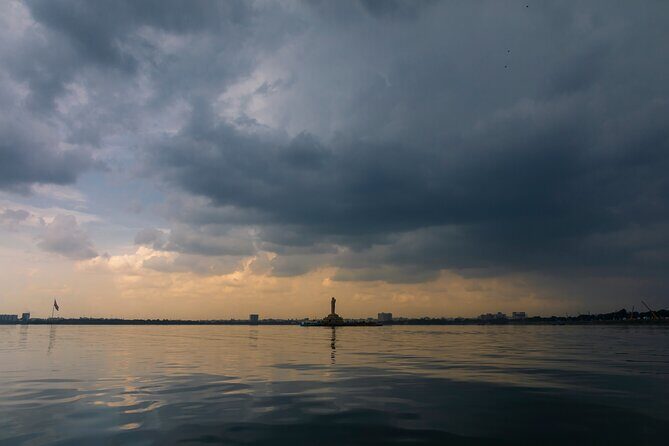
- Heart-shaped lake views from Necklace Road timed for evening strolls
- India’s tallest Dr. B.R. Ambedkar statue (125 ft) as a real city landmark
- Telangana Martyrs Memorial for 369 students of the 1969 agitation, also called Amaraveerula Stupam
- Tank Bund’s 33 statues plus the world’s largest cricket bat as your final photo stop
- Buddha statue and Lumbini Park connected to Buddha Purnima themes
Why start at 6:00 pm on Hussain Sagar
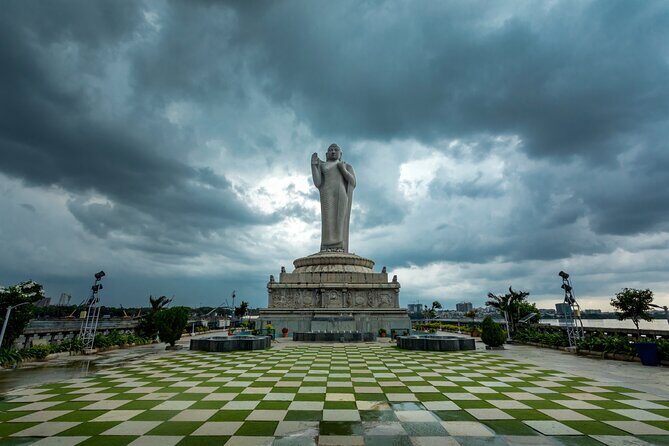
That 6:00 pm start time matters more than you might think. Hussain Sagar looks great in daylight, but the lake’s best trick is evening light—street reflections, glowing waterfront paths, and that relaxed “everyone’s out for a walk” mood. Necklace Road in particular is described as wide and bright, and it’s exactly the kind of place where the night turns ordinary sights into something memorable.
This also keeps the walk comfortable. You’re doing a 2 hours 30 minutes route (approx.), and splitting it across late afternoon to early night helps you avoid the harshest heat while still getting good lighting for photos of statues, fountains, and monuments.
Best part: because it’s private, the pacing can fit your group. If you want more time to stand, point, and ask questions, you can. If you’re the type who prefers to keep moving and soak it in quickly, you can do that too.
You can also read our reviews of more walking tours in Hyderabad


Necklace Road: the lake’s “pearl necklace” vibe and heart-shape views
The walk begins at the Love Hyderabad Sculpture area on/near Hussain Sagar, then heads to Necklace Road—one of the lake’s signature promenades. The description is vivid for a reason: the street lighting and the waterfront make it feel like Hyderabad is giving you a wearable light show, not just a view from a distance.
You’ll also get the heart-shape angle of Hussain Sagar, especially when the shoreline is framed by evening activity. Local walkers, hawkers, and ice cream carts are part of the scene. This is one of those stops where you’ll see how the city uses its public space every day—not just on holidays or for sightseeing checklists.
What’s valuable here is context. Your guide doesn’t just point at shapes. They connect what you’re seeing to the stories behind the lake—Golconda’s Qutb Shahi kings and the Sufi Saint Hussain Shah Wali, often credited as the architect behind the lake. Even if the exact origin details are the kind of topic that different people explain in different ways, the guided storytelling helps you understand why locals still talk about the lake like it has a personality.
Practical tip: since this is a waterfront promenade, hold onto water-proof layers if rain shows up, and bring shoes that can handle damp pavement.
The 125-ft B.R. Ambedkar statue: monument scale you can feel up close
A short hop from Necklace Road brings you to the Dr. B.R. Ambedkar statue—tall at 125 feet, and described as the largest tall Ambedkar statue in India. It’s positioned as a new city icon, and that’s the right way to think about it: this isn’t a small memorial you pass by. It’s a skyline statement you’ll notice immediately.
Because you’re on foot, you experience the scale differently. Instead of seeing the statue as a far-off object, you get to feel how it dominates the space around it. That matters for monuments, because your brain reads size and positioning as meaning.
Your guide also connects Ambedkar to broader national context—the statue is tied to his role as the architect of India’s Constitution. Even if you’ve read about him before, seeing him in this public, city-centered setting changes the meaning. It feels less like textbook history and more like a living piece of civic identity.
One small downside: since this is such a major landmark, it can attract attention. If you want quieter photos, you’ll likely get better results a few minutes before or after the busiest moments. A private walk gives you the flexibility to time your best shots.
NTR Ghat: the memorial park at the water’s edge
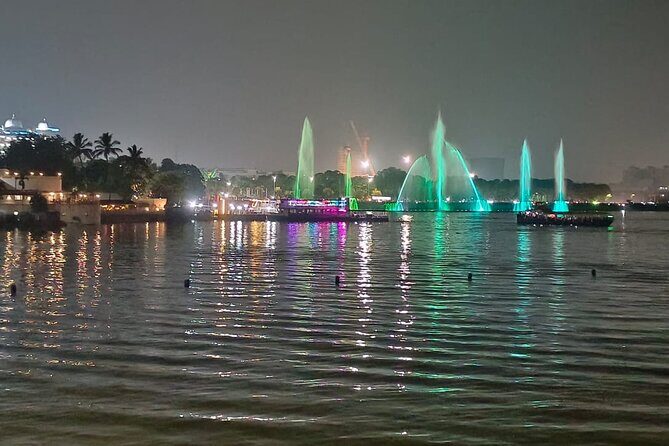
Next is NTR Ghat, set along the lake and described as spanning 55 acres. You’re not just looking at a plaque here—you’re walking through a park space created as a memorial for Late N.T. Rama Rao. Your guide frames it as a government project with a lavish budget, which helps you understand why this is more than a small memorial spot. It’s a planned, long-lasting public space.
Why this stop works during a walking tour: it adds variety. After statue scale at Ambedkar, NTR Ghat shifts you into green space and open approaches. It’s a good moment to take a breath before the more formal government buildings and monuments farther along.
If you care about how cities honor political figures, you’ll appreciate the comparison between NTR Ghat’s park setting and the next stops’ architecture and monuments. The lake is acting like a corridor connecting different “ways of remembering.”
Telangana State Secretariat lights: architecture that changes at night

Then the route brings you to the Telangana Secretariat, described as a state-of-the-art integrated complex with facilities like seamless connectivity and spacious conference halls. Even with limited time, you’ll notice the main idea: this is modern governance, placed right by the lake.
It’s especially striking at night. The Secretariat’s lighting is a big part of why this stop often feels like a highlight. Lit buildings do something that daytime photos don’t always capture: they show the building’s form and rhythm. It’s also a reminder that the lake isn’t only religious or historical space. It’s a civic backbone.
Your guide’s stories help link the physical complex to the broader idea of Telangana’s identity and political evolution. When you understand that these structures are part of a continuing story—not a static “thing to see”—the walk feels more meaningful.
You can also read our reviews of more private tours in Hyderabad





Telangana Martyrs’ Memorial (Amaraveerula Stupam): 369 students remembered
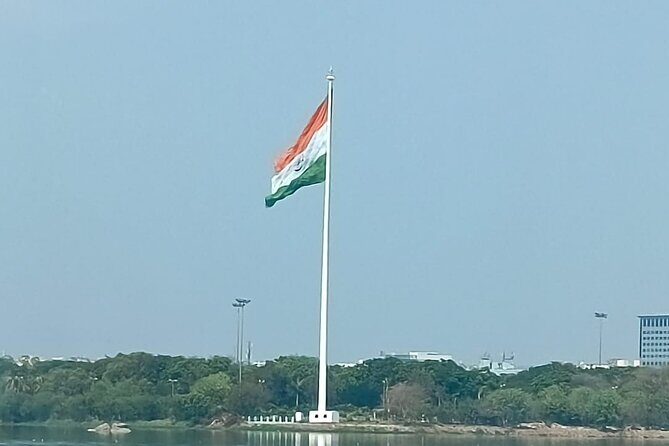
The Telangana Martyrs Memorial is also known as Telangana Amara Jyothi or Amaraveerula Stupam. It’s built for 369 students who died during the 1969 agitation for a separate Telangana state. That detail is the key. This stop isn’t about ornate design first; it’s about commemoration.
Walking up to a memorial like this gives you a different rhythm than you get at a monument with lots of photo angles. Your attention shifts. You naturally slow down to take in the meaning. That’s true even if you’re not deeply familiar with the events. Your guide’s explanation helps you place the memorial in time and understand why it carries emotional weight for the region.
If you’re the kind of traveler who likes to understand what people in the place care about, this is one of the most powerful stops on the route. The lake gives you a scenic backdrop, but the message is human and specific.
Tank Bund: the 33 statues, Hyderabad–Secunderabad link, and the giant cricket bat
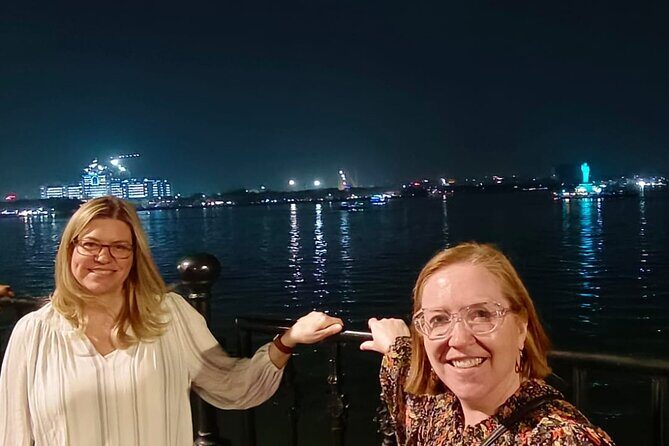
Tank Bund is the connecting embankment that links Hyderabad and Secunderabad. It’s more than a walkway; it’s an urban connector shaped into a promenade. Your tour includes Tank Bund’s 33 statues of great leaders from the Telugu-speaking area, which turns this stretch into a political and cultural gallery you can walk through slowly.
Then there’s the world’s largest cricket bat. You finish the tour near it, and it makes a fun, slightly quirky end point. Not every city gives you a massive sports prop at the end of a history-and-stories walk, so it helps the experience land with a smile.
There’s also a historical note tied to the north side of the lake: Secunderabad is described as the first British garrison in India, starting with 5000 troops and later becoming the largest in India. You don’t have to go down a rabbit hole here. The takeaway is that this area has layers—local identity, colonial-era footprints, and post-independence urban growth—stacked along the same waterline.
Practical tip: Tank Bund can be a great place for photos, but it also tends to be a place where people stop, talk, and wander. If you want clean shots, let your guide point out the best angles rather than fighting the crowd yourself.
Buddha statue and Lumbini Park: monolith scale and a calm counterpoint
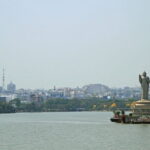
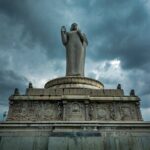
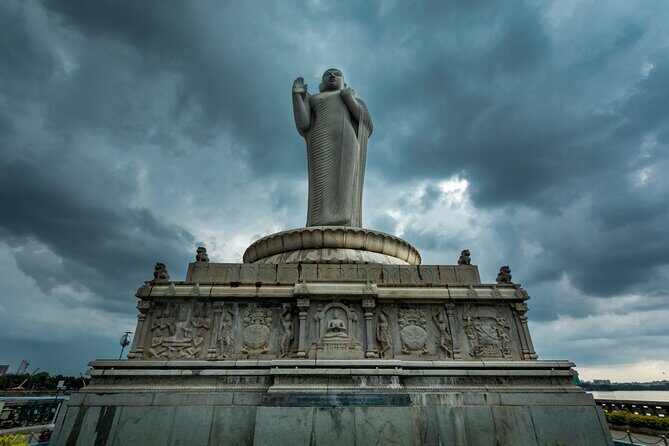
On the later part of the walk, you’ll reach the famous Buddha statue in the middle of the lake area. It’s described as 58 feet (18 m) tall and weighing 350 tons, built on a concrete platform. It’s noted as the world’s tallest monolithic statue of the Buddha.
This is one of those facts you hear and think, okay, big statue. But when you stand there on a lakeside walk route, the size registers differently. Your frame of reference changes. You start noticing how the statue sits within the broader space of the lake and embankment—how it becomes a focal point for the whole area.
Just after that, you move to Lumbini Park, described as related to Buddha Purnima as part of the Hussain Sagar Lake area. This is the calming counterpoint to the heavy monument scale. Where the monolithic statue commands attention, the park offers you a slower pace and a chance to reset.
If you’re traveling with someone who likes both big-ticket landmarks and quieter moments, this pairing works well: one stop for awe, one stop for reflection.
Price and value: what $45.33 buys you in real terms
At $45.33 per person for about 2.5 hours, you’re not paying for entrance tickets. The tour is built around outdoor, public sights—many stops are marked as admission ticket free. So most of what you’re buying is your guide’s time and their ability to connect each stop into a story you can actually remember.
You also get a private setup: only your group participates. That’s a big value driver. On a route like this, private time means you can ask follow-up questions, pause for photos at the right moments, and move at a pace that suits your energy level.
One more practical value point: you get a mobile ticket, which makes the experience easy to manage on your phone instead of juggling paper.
What you should factor in yourself: snacks aren’t included, and you may want water. Also, the overall tour description notes that entrances and other items beyond what’s mentioned aren’t included. In practice, you’re mostly outdoors, but it’s smart to plan for small personal costs.
Who this tour fits best (and who might want a different plan)
This works best if you want a guided walk with real context. If you enjoy monuments, city planning, and political memory—especially linked to Telangana—you’ll likely find the stories useful, not just decorative.
It also suits anyone who likes night views. Starting at 6:00 pm is a hint that the tour is designed for evening atmosphere: lit buildings, reflections on water, and the lake becoming a social space.
If you’re traveling with mobility limitations, you should consider the note about moderate physical fitness. The tour is a walking route with multiple stops, so it’s not the right pick if you need mostly indoor time or lots of long sit-down breaks.
A quick note on your guide: Srinu’s style
One of the best practical things about this tour is the guidance approach. The guide’s name that shows up is Srinu, and the feedback emphasizes how well he handles the route—especially the Telangana Secretariat at night. That tells me the experience isn’t just a script. It’s delivered in a way that helps you notice what matters: lighting, scale, and the meaning behind why these places were placed exactly here.
You’ll get more out of this tour if you lean into questions. Asking why something is positioned on the lake edge or how a memorial relates to the region’s identity can turn a photo stop into a learning moment.
Should you book this Hussain Sagar private walking tour?
If your goal is to see the highlights of Hussain Sagar without bouncing between places on your own, I think this is a smart booking. The price is reasonable for a private guide, and the route is timed for evening lighting at a comfortable walking pace.
Book it if you want:
- an easy-to-follow evening route with multiple iconic landmarks
- guided context about Golconda-era and Telangana-era stories
- the flexibility of a private group
Consider passing or adjusting expectations if you’re looking for a short, purely scenic walk with minimal talking. This tour is designed to connect scenery to meaning, and that takes a bit of attention.
FAQ
FAQ
How long is the Hussain Sagar Lake private walking tour?
It’s about 2 hours 30 minutes.
What time does the tour start?
The start time is 6:00 pm.
What does the tour cost?
It costs $45.33 per person.
Is this a private tour?
Yes. It’s private, and only your group participates.
Where does the tour start and end?
It starts at the Love Hyderabad Sculpture area (Hussain Sagar, Khairtabad) and ends near the largest cricket bat on Lower Tank Bund (Kavadiguda).
Do I need an entrance ticket for the stops?
The stops listed on the tour are marked as Admission Ticket Free, but the tour also notes that entrances are not included beyond what’s mentioned.
What is included in the price?
The tour guide fee is included.
Is a mobile ticket used?
Yes, the tour uses a mobile ticket.
What fitness level do I need?
The tour suggests a moderate physical fitness level.
What if I need to cancel?
You can cancel for free up to 24 hours in advance for a full refund. If you cancel within 24 hours of the start time, you won’t get a refund.