Sunrise in Agra feels like a different world. This private Golden Triangle route strings together Mughal monuments and major houses of worship with a live historian guide riding shotgun so the sites make sense fast.
I especially liked the safe, organized feel (including an attentive, patient driver) and the way the stops focus on how people actually live and worship, not just what’s photographed.
The comfort side is handled too: you’re in an air-conditioned vehicle with 3-star hotels, breakfast each morning, and bottled water daily. You’ll also get a pickup and a mobile ticket, which cuts down on hassle right when you’re landing.
One thing to plan for: entrance fees are extra, and some of the key sights (Taj Mahal, Qutub Minar, Humayun’s Tomb) cost real money. Also, with a lot packed into 5 days, you’ll spend serious hours on the road between cities.
In This Review
- Key things to know before you go
- The private Golden Triangle pacing that actually works
- Delhi starts big: Jama Masjid Mosque, Akshardham, Lotus Temple
- Humayun’s Tomb, India Gate, and Gurudwara Bangla Sahib
- A green break: Khan Market and Lodi Gardens
- Qutub Minar and the drive to Jaipur: Pink City foundations
- Jaipur palaces and Jal Mahal: royal rooms and a water “floating” palace
- City Palace Jaipur: where power lived
- Jantar Mantar: Jaipur’s astronomy playground
- Chand Baori, Buland Darwaza, and Mehtab Bagh in one push
- Buland Darwaza: a Door of victory
- Mehtab Bagh: a Mughal garden aligned with Taj Mahal
- Sunrise Taj Mahal plus Akshardham again
- Price and entrance fees: what $267 covers and what adds up
- Safety, comfort, and why the driver matters here
- Practical tips so the days don’t run you over
- Who should book this private tour?
- Should you book the Golden Triangle Private Tour?
- FAQ
- What’s included in the tour price?
- Do I get pickup?
- Is this a private tour?
- Are entrance tickets included?
- Which breakfast days are covered?
- What’s the price and duration?
- What can I use as the admission ticket?
- What’s the cancellation policy?
- Is it suitable for most travelers?
Key things to know before you go
- Live historian guide: you’ll get context as you move, not just facts at the door
- Private group means your pace: your group goes together, with time managed around your route
- Entrance fees add up: you’ll pay separate ticket prices for major sites like the Taj Mahal
- Early start for Taj Mahal: the day begins at sunrise for the marble moment
- Delhi to Jaipur to Agra-area stops: you’ll see the Golden Triangle core landmarks plus a few standout detours
- Comfort basics included: air-conditioned vehicle, 3-star hotel stays, daily breakfast, and water
The private Golden Triangle pacing that actually works

This tour is set up for people who want the classic Golden Triangle highlights without feeling like a blur of bus windows. You start in New Delhi with a tight mix of sacred and historic landmarks, then shift into Jaipur’s royal and scientific world, and finish with sunrise views of Agra’s crown jewel.
What makes the flow feel practical is the way the day themes change. You’re not just hopping from one monument to the next—you shift from mosque architecture to Hindu temple complexes, from Sikh worship spaces to Mughal garden tombs, and later from palace rooms to an open-air astronomy lab.
And because it’s private, you’re not stuck in the loud rhythm of a giant group. Your guide and driver can keep timing realistic, which matters on long travel days when heat, traffic, and crowds can steal energy fast.
You can also read our reviews of more private tours in New Delhi


Delhi starts big: Jama Masjid Mosque, Akshardham, Lotus Temple
Delhi Day One is a good example of how this tour balances size and variety. You’ll begin at Jama Masjid Mosque, one of India’s largest mosques, built in red sandstone with white marble. The vibe here is all about scale and atmosphere—big archways, marble surfaces, and a sense of how central this place is to daily life.
Next up is Swaminarayan Akshardham, a massive temple complex that’s more than a single shrine. You’ll have time to take in features like the abhishek mandap, the Sahaj Anand water show, a thematic garden, and exhibition halls that explain the life and work of Swaminarayan. If you like learning through visual displays, this stop is a strong match.
Then comes Lotus Temple, the Bahai House of Worship known for its flowerlike design. The building uses 27 free-standing marble-clad petals arranged in clusters of three to form nine sides, with nine doors opening into a central hall. It’s designed so people of all religions can attend, and the capacity is about 1,300—so yes, it’s built for crowds, but it still feels calm inside.
A key benefit here: you’ll see three different spiritual design languages in one stretch. Mosques emphasize grand entry and prayer halls, Akshardham leans into storytelling and exhibitions, and Lotus Temple uses symmetry and light as its message. That pattern helps you understand Delhi beyond politics and skyline.
Humayun’s Tomb, India Gate, and Gurudwara Bangla Sahib
After the temple-and-worship intensity, you move into Mughal and national memory. Humayun’s Tomb is especially worth your time: it’s described as the first garden tomb in the Indian subcontinent, set in an ornate Mughal garden. The architecture here helps you see how Mughal ideas about space and symmetry became a template for later monuments.
India Gate follows, and it’s a shift in mood. This towering arch is a war memorial for Indian soldiers who lost their lives fighting for the British Army in World War I. It’s not a museum stop in the usual sense, but it’s powerful if you take a minute to read the names and notice how the monument anchors the city.
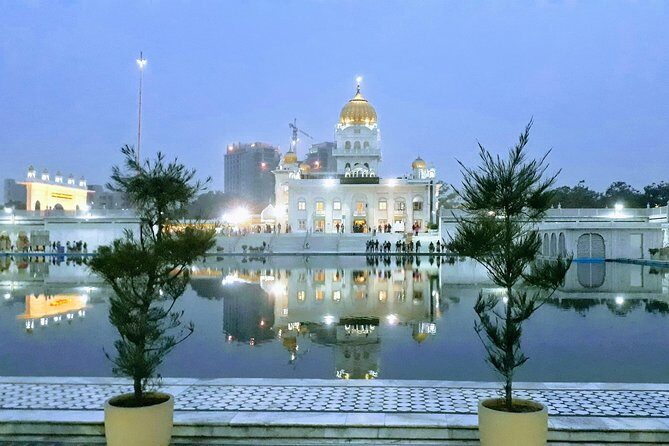
You wrap the Delhi day at Gurudwara Bangla Sahib, one of Delhi’s prominent Sikh gurdwaras. The highlight is the pool inside the complex, called the Sarovar, along with its connection to Guru Har Krishan. If you’re curious about how Sikh worship spaces function beyond the main hall—this place gives you that.
A green break: Khan Market and Lodi Gardens
Between major monuments, you get Lodi Gardens, a city park spread over about 90 acres. It protects tombs from the Lodi period, including Mohammed Shah’s Tomb and the Tomb of Sikandar Lodi, plus structures like the Shisha Gumbad and Bara Gumbad. It’s a good reset if you feel your brain is starting to overheat from architecture overload.
If you’re shopping-minded, Khan Market is the casual counterbalance. Even if you don’t buy much, it’s useful to see how locals move through the city outside the monument circuit.
Qutub Minar and the drive to Jaipur: Pink City foundations
The second day transitions from Delhi into Rajasthan, and that change isn’t just geographic—it’s visual. Jaipur is the capital of Rajasthan, founded in 1727, and it’s known as the Pink City because of the trademark color on many buildings in the old area. Even before you hit big palaces, the city’s planning and the general tone of the streets start to feel different.
Qutub Minar is the key stop in Delhi on this day. This 73-meter-tall tower is made of red sandstone and marble, and it’s known as one of the most famous historical landmarks in India. It’s also UNESCO-listed, and you can spot it from different parts of the city, which helps you orient yourself once you start moving around Jaipur later.
The practical takeaway: Qutub Minar is one of those landmarks that rewards time and angle. If you rush, you miss the layers and texture that make it feel real, not just postcard-perfect.





Jaipur palaces and Jal Mahal: royal rooms and a water “floating” palace
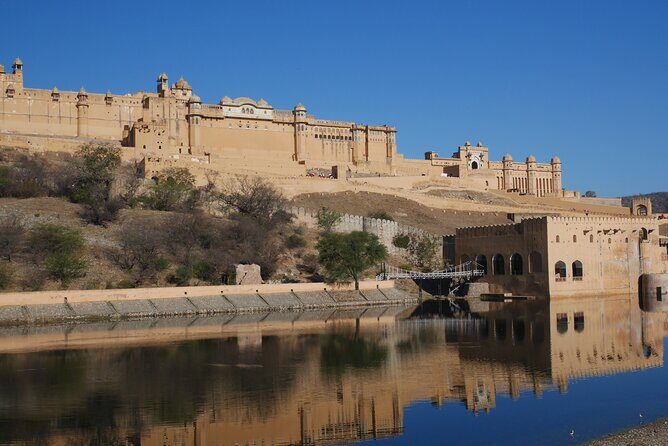
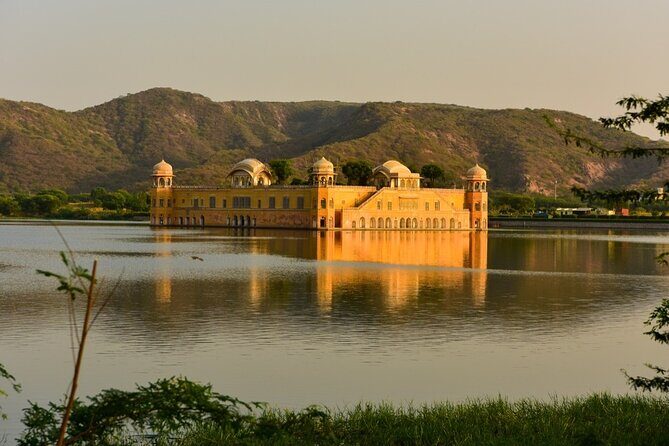
The next stretch gives you classic Jaipur atmosphere: royal architecture, strong geometry, and a lot of texture in stone. Jal Mahal is the first surprise. Known as the floating palace or Water Palace, it’s a Mughal-Rajput style structure built in 1699, and the key feature is how it sits on water. Four levels are submerged, while the fifth level with a terrace garden is visible above.
That “floating” effect is more than a view—it changes how you experience the architecture. Instead of a fortress on a hill, you get a palace that looks like it belongs to the lake, which makes the whole stop feel like a scene rather than a quick photo.
City Palace Jaipur: where power lived
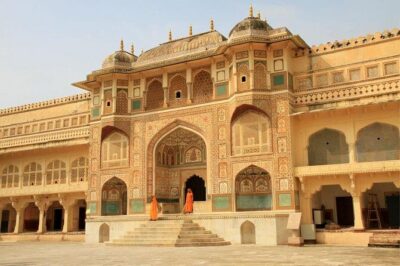
City Palace is the royal anchor in the Pink City. You’ll spend about an hour here, with access to highlights described as part of the palace complex such as Mubarak Mahal, Diwan-e-am, Diwan-e-khas, Pritam Niwas, and Chandra Mahal. The complex includes a blend of Hindu, Mughal, and European architectural influences.
What’s practical for you: this is where the tour shifts from “pretty building” to “museum-style understanding.” There’s mention of collections tied to textiles and costumes of the royal family, plus an arms and weapons museum. If you want to understand how royal life looked behind ceremonial facades, this stop helps.
Jantar Mantar: Jaipur’s astronomy playground
Then you head into Jantar Mantar, an astronomical observatory built in 1728 by Maharaja Sawai Jai Singh II. This is one of my favorite kinds of stops because it’s not just ceremonial. It’s science made visible—an open-air set of instruments for measuring the sky.
You’ll encounter items described in the program like the largest sun dial, plus tools such as Dhruv Patika and Yantra Raj. The details matter here: the instruments are different shapes for different measurements, which turns the visit into a “walk and look” experience instead of a sit-and-listen one.
If you like history that explains how people thought, Jantar Mantar gives you that. It’s also a good counterweight to palace-heavy days.
Chand Baori, Buland Darwaza, and Mehtab Bagh in one push
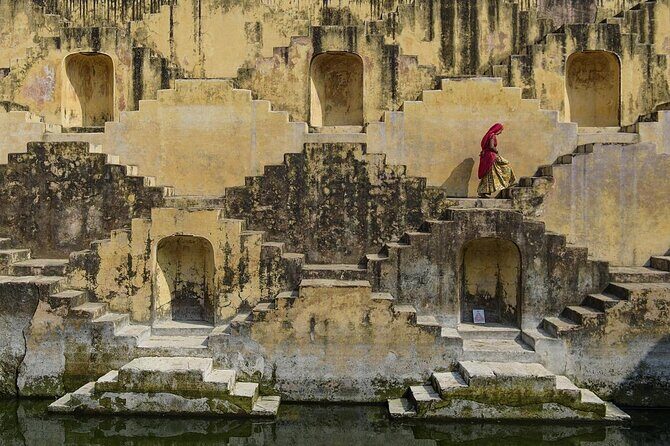
Day Four is where the tour gets a bit more adventurous. Chand Baori is a stepwell in Abhaneri with a deep, dramatic visual. It’s one of the oldest and best preserved step wells in India, built between the 8th and 9th century A.D. King Chandra is credited with building it, and it’s described as having about 3,500 steps across multiple levels.
The numbers are part of the experience: it has around 13 stories and is about 35 meters deep from the sides. It’s also described as multipurpose—used as a shrine, a summer resort, and even tied to wedding rituals, with water access built into the structure. Even if you’re not counting steps, the architecture communicates effort and community life.
Buland Darwaza: a Door of victory
Next is Buland Darwaza, known as the Door of victory. It’s a Mughal-style grand gateway built by Akber after a victory linked to Gujarat in 1575. You’re looking at a 54-meter-high gate, with 42 steps leading toward the gateway and mosque, made from red sandstone, yellow sandstone, and white marble.
This stop can feel like a history lesson in stone. There’s even mention of a Persian inscription that records conquest achievements. If you enjoy monuments that double as written power statements, you’ll get a lot from this one.
Mehtab Bagh: a Mughal garden aligned with Taj Mahal
Mehtab Bagh rounds out the day. It’s described as one of the 11 Mughal gardens, described as the last Mughal garden, built by Babur in 1530. Later, Shahjahan wanted to align it with the Taj Mahal—there’s also mention of a story about a planned Black Taj Mahal idea, plus a French traveler, Jean Baptist Tavernier, mentioning those ambitions in the 17th century.
This is your decompression stop after gates and stepwells. The garden is associated with a large pond and fountains and is part of a Garden of paradise complex (described as about 300 x 300 meters). Even with partial ruins and changes over time, the alignment concept helps you understand the broader Taj Mahal “world.”
Sunrise Taj Mahal plus Akshardham again
The tour’s final day is designed around the Taj Mahal at sunrise. You get about 2 hours there, and because this is the marble icon of India, sunrise timing is the whole point. Early light tends to soften hard shadows, and the atmosphere makes the scene feel quieter than daytime rush.
One practical tip: Taj Mahal is an easy place to overestimate your stamina. You’ll likely do a lot of walking and standing in sun, even if the start is cool. Plan for a slower pace and bring water if you’re able, even though bottled water is part of the tour.
After Taj Mahal, you return to Swaminarayan Akshardham for around 2 hours, and yes, it’s a second appearance on the same tour. If you loved it the first time, this works out well because you can explore exhibition areas and gardens with less stress. If you didn’t, this is the one stop where you might wonder about trade-offs—but it’s included as part of the experience set.
Price and entrance fees: what $267 covers and what adds up
At $267 per person, this is a value-forward private tour if you want logistics handled end-to-end. What you get includes:
- Air-conditioned vehicle throughout
- 3-star hotels for all the included stays
- Live historian guide
- Daily mineral water
- Breakfast each morning (5 breakfasts)
- Road taxes, parking, fuel, and driver overnight charges as part of the program
That’s the big money saver: you’re not just paying for sightseeing. You’re paying for transport, guidance, and the cost of keeping the driver and car ready day after day.
What’s not included is where you’ll feel the budget impact: entrance tickets. Based on the listed prices in INR, the extra fees include things like Jama Masjid Mosque (300), Humayun’s Tomb (600), Qutub Minar (600), City Palace (700), Jantar Mantar (200), Chand Baori (500), Buland Darwaza (500), Mehtab Bagh (250), and the Taj Mahal (1250). If you add those all up, it totals about 4,900 INR per person in listed entry fees, before any possible changes in the rates.
The best way to handle it: treat the $267 as the “everything but entry tickets” price, then mentally budget for monuments you care most about—especially the Taj Mahal.
Safety, comfort, and why the driver matters here

This kind of trip lives or dies on driving and timing. The positive experiences around this company’s drivers are consistent: an attentive, patient approach, and a sense of being safe on the road. One driver name that came up is Amit, described as kind and available for questions, and another name is Vinod in a separate account of similar service.
Even if you’re not big on chatting, it helps when your driver knows when to keep conversation light and when to focus on calm, smooth driving. On route-heavy days between cities, that balance helps you stay relaxed instead of mentally tired.
Comfort details aren’t fancy, but they’re practical: you’re in an air-conditioned vehicle, you get bottled water daily, and you start each day with breakfast. Those basics matter because it’s easier to enjoy monuments when you’re not fighting thirst and hangry energy.
Practical tips so the days don’t run you over
Because you’re moving fast across three regions, your best strategy is to protect your energy.
Wear shoes you can handle for long walks—especially in places with stairs or uneven ground, like stepwell sites. For sacred spaces (mosques, gurdwaras, temples), plan on dressing modestly and covering shoulders when possible; you’ll feel more comfortable entering.
Also, start thinking “sun schedule,” not “alarm clock schedule.” Taj Mahal at sunrise means an early day. If you’re the type who needs time to wake up, pack a simple routine: sunglasses, water within reach, and something quick for energy.
Finally, keep your bag organized. When you bounce between monuments, you’ll want tickets/IDs and a small bottle-friendly setup ready without rummaging.
Who should book this private tour?
I’d book this if you want a first-timer-friendly Golden Triangle experience that stays guided and organized. It’s a great fit for people who like sacred architecture and want context—Delhi’s mix of mosque, temple, and gurdwara styles is exactly the kind of variety that turns a checklist trip into a real understanding of the region.
If you dislike long drives or hate paying extra for tickets, you might not love it. With packed days and paid entrances, you’ll need the right mindset: this is a “see a lot” tour.
It’s also a solid choice for couples and small groups who want privacy and a more controlled pace than big buses.
Should you book the Golden Triangle Private Tour?
Yes, if you want a private, comfort-included Golden Triangle that focuses on major landmarks with a live historian guide, and you value feeling safe and well handled between stops. The $267 price works best when you treat entrance fees as an extra line item and plan for early starts.
I’d think twice if you’re trying to keep costs ultra-low or you’d rather spend more time in fewer places. The route is dense, and the tour includes a second visit to Akshardham, so it’s best if you’re genuinely interested in that temple complex.
FAQ
What’s included in the tour price?
The price includes an air-conditioned vehicle, 3-star hotel stays, a live historian guide, mineral water daily, road taxes/parking/fuel/driver overnight charges, and breakfast for 5 mornings.
Do I get pickup?
Pickup is offered, and the experience provides a mobile ticket.
Is this a private tour?
Yes. It’s a private tour/activity, so only your group participates.
Are entrance tickets included?
No. Entrance fees are listed as not included for several sites such as Humayun’s Tomb, Qutub Minar, City Palace of Jaipur, Jantar Mantar, Chand Baori, Buland Darwaza, Mehtab Bagh, Taj Mahal, and Jama Masjid Mosque.
Which breakfast days are covered?
Breakfast is included for 5 days.
What’s the price and duration?
The price is $267 per person, and the duration is approximately 5 days.
What can I use as the admission ticket?
You’ll receive a mobile ticket.
What’s the cancellation policy?
Free cancellation is available. You can cancel up to 24 hours in advance for a full refund.
Is it suitable for most travelers?
Most travelers can participate, but it’s a good idea to be ready for substantial walking at major sites.