REVIEW · NEW DELHI
The Indian Dream Tour – Classic North India
Book on Viator →Operated by My Tour Adviser · Bookable on Viator
Ten days through India’s big icons.
This classic North India route links Delhi’s UNESCO highlights with Jaipur’s forts and palaces, the Taj Mahal, and the temple-rich towns of Khajuraho and Gwalior, all with a private car and local guides.
I love how efficiently it’s put together. You’re not stitching together bus legs or guessing schedules, so you can focus on the sights, from Qutub Minar and Jama Masjid to Jantar Mantar and the Khajuraho temple complex. I also like the added texture of meals with local families in Jaipur and Agra—this is where the trip stops feeling like a highlight reel.
One thing to plan around: weather and closure days can affect a few signature moments. The Taj Mahal is closed on Fridays, and in monsoon months Ganga Aarti and even the dawn boat ride on the Ganges may be limited when water levels run high.
In This Review
- Key things to know before you go
- The big-picture route: Delhi, Jaipur, Agra, then far beyond
- Day 1 in Delhi: Qutub Minar, Jama Masjid, and a pedal rickshaw lane-by-lane
- Day 2 to Agra: Taj Mahal first, then Agra Fort up close
- Days 3 and 4: Fatehpur Sikri and Abhaneri Stepwell, then Jaipur’s forts and observatory
- Day 5 and 6: Varanasi at dawn, Ganga Aarti, then Prayagraj’s Sangam
- Days 7 and 8: Khajuraho temples with sculpture, then Orchha’s slower pace
- Days 9 and 10: Orchha’s Jahangir Mahal and Gwalior Fort before you head back
- Price and value: what $1,199 buys you, and what it doesn’t
- Comfort notes: pickup, private car flow, and the dress code reality
- Who should book this tour
- Should you book the Indian Dream Tour – Classic North India?
- FAQ
- How many days is the Classic North India tour?
- Where does the tour start and end?
- Is airport pickup included?
- What kind of transportation and guides are included?
- What meals are included?
- Which major UNESCO sites does the tour include?
- Is the Taj Mahal always visitable?
- What about Ganga Aarti and the dawn boat ride?
- What is the dress code?
- Can I cancel and get a full refund?
Key things to know before you go
- Private, guided pace across multiple cities so you don’t lose time figuring out logistics.
- UNESCO World Heritage coverage including Qutub Minar, the Taj Mahal, and Khajuraho.
- Early mornings for India’s spiritual side, including Ganges ghats and Aarti, with monsoon caveats.
- Hotel tiers from standard to premium so you can match comfort to budget.
- Small group size (up to 8) which usually makes the day feel smoother and less chaotic.
- Many entrance tickets are included for major monuments, so your wallet breathes easier.
The big-picture route: Delhi, Jaipur, Agra, then far beyond
This tour is built like a great road trip plan—start with the Golden Triangle, then keep going instead of turning around after Agra. You’ll move through New Delhi, Jaipur, Agra, then fly to Varanasi, continue to Prayagraj (Allahabad), travel onward to Khajuraho, and finish in Orchha and Gwalior before returning to Delhi by train.
That structure matters for you because the famous India sites are spread out. A private, guided flow helps you actually see them instead of spending half your trip on transfers and timing puzzles. And because you’re with a guide, you get context while you’re still standing in front of the monument—not days later when the photos have blurred together.
You also get a mix that’s not always paired on the same itinerary: palace architecture in Rajasthan, Mughal landmarks around Agra, and then temple sculpture in central India, followed by the spiritual gravity of Varanasi. It’s a lot of moving parts, but it’s also one of the best ways to get a broad feel for the country without living out of transit.
You can also read our reviews of more tours and experiences in New Delhi.



Day 1 in Delhi: Qutub Minar, Jama Masjid, and a pedal rickshaw lane-by-lane
Your day starts in the morning in Delhi with hotel or airport pickup, and sightseeing that’s designed to get your bearings fast. The UNESCO stop at Qutub Minar is a strong opener: it’s iconic, photo-friendly, and it sets a historical tone right away.
Next comes Jama Masjid, the grand Friday mosque in Old Delhi. The scale is a big deal—this complex can host up to 20,000 worshippers. After the mosque, you’ll take a pedal rickshaw ride through the narrow alleys of Chandni Chowk. That part is practical fun: it moves you through the market lanes at a pace that works for photos and people-watching without you navigating alone.
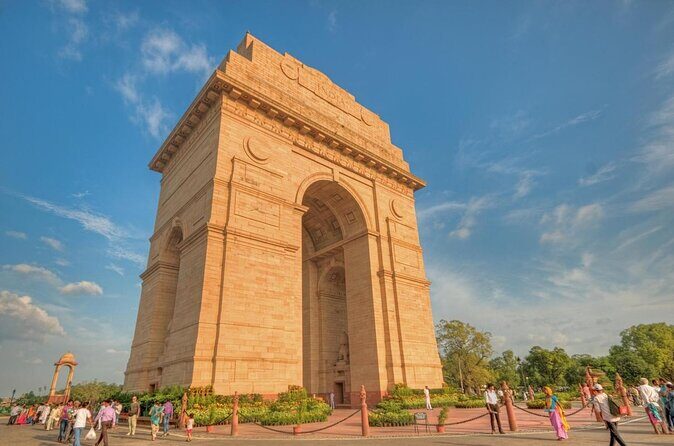
Then you’ll pass by Raj Ghat, the memorial for Mahatma Gandhi (admission is free on the program). After that, India Gate and a drive past key colonial-era government landmarks along Rajpath rounds out the day.
How this works for you: Delhi day one is packed, but it’s packed with variety. Old Delhi’s street energy plus UNESCO monuments plus a political-photo drive. The one watch-out is simple: you’ll want comfortable shoes. The streets can be uneven, and you’ll be on your feet more than you’d think.
Day 2 to Agra: Taj Mahal first, then Agra Fort up close
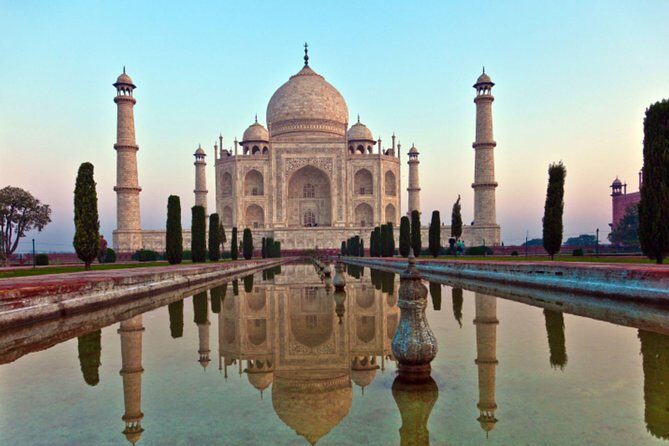
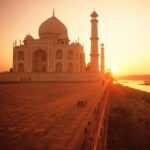
Agra is where the trip starts to feel cinematic. You drive in, arrive, and head straight to the Taj Mahal, a UNESCO masterpiece of Mughal architecture in white marble and inlaid semi-precious stones. The visit is scheduled for about two hours, which is usually the right length to see the main view, walk the grounds, and still have time to breathe instead of rushing.
Two practical notes you should take seriously:
- The Taj Mahal is closed on Fridays, so your visit can shift if your dates land there.
- It’s a major monument, so your best photos often come from managing your time around crowds.
After the Taj Mahal, you’ll move to Agra Fort, another UNESCO-style stop on any serious Mughal itinerary. The fort rises near the river and served as the power base for Mughal rulers for years. You’ll get about an hour here—enough to appreciate the architecture and the way the fort connects to royal life and gardens.
This day is valuable because you get both extremes: the romantic symbol of Shah Jahan’s memory and the harder, more strategic reality of imperial fort life. If you like history that’s visible in stone, it works.
Days 3 and 4: Fatehpur Sikri and Abhaneri Stepwell, then Jaipur’s forts and observatory
The itinerary makes a smart choice here: it doesn’t push you straight to Jaipur and stop. Instead, you detour through two sites that most people skip because they’re off the main flow.
Fatehpur Sikri is your first stop on the way to Jaipur. It’s described as a ghost city—Akbar built it in red sandstone, then it was abandoned after about twelve years. Walking through it feels like looking at a city that paused mid-story. You get roughly two hours, which is a good match for this kind of site: enough time to explore without feeling dragged.
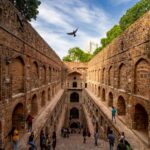
Then comes Abhaneri and Chand Baori, the massive stepwell built in sandstone. Here’s a small but important consideration: the program notes that there aren’t too many guides in the area, so a guided sightseeing experience may be harder. Even so, the structure is visually dramatic, and the short visit (around 30 minutes) is usually the right length unless you’re a serious architecture nerd.
Then you settle into Jaipur with a full day of monuments:
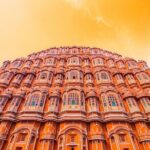
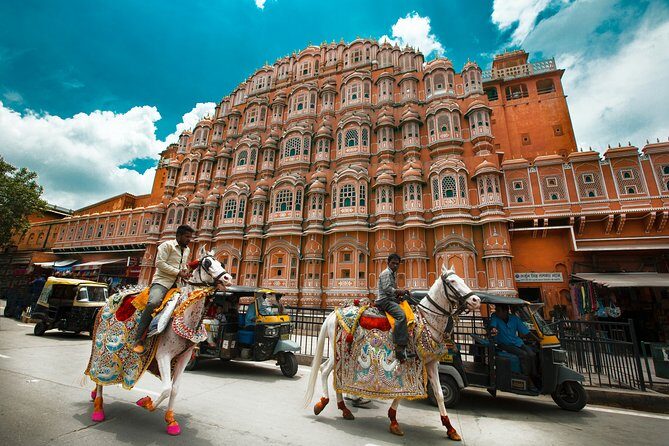
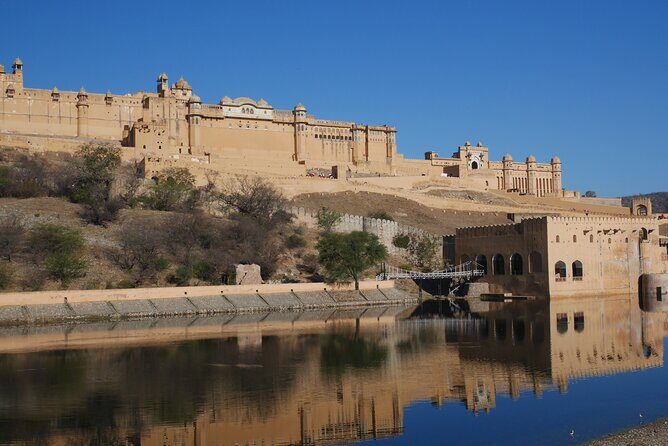
- Amber Palace (Fort of Man Singh) in the morning, with an added photo stop at Hawa Mahal on the way.
- City Palace of Jaipur, including the Maharaja’s private apartments and a museum section with carpets and miniatures.
- Jantar Mantar, Jaipur’s 17th-century astronomical observatory, including the tall central sundial.
For you, the pairing here makes sense. Amber and City Palace show royal power and design. Jantar Mantar adds the science side: it’s built for astronomical calculation, including tools for eclipses and detecting stars. If you’ve ever wondered how people measured time before phones, this is your answer, in stone.
One more practical tip: entrances are included for these stops on the program, which helps you avoid last-minute ticket confusion. You’ll still want to follow the dress rules at worship sites and selected museums—more on that below.
Day 5 and 6: Varanasi at dawn, Ganga Aarti, then Prayagraj’s Sangam
This is the “human India” portion of the trip, and it has two very different energies—Varanasi’s ghats and Prayagraj’s river meeting point.
After transferring early to the airport and flying to Varanasi, you start with a guided orientation to the city and its sacred role. Varanasi is one of the seven holy cities of Hinduism and is strongly tied to the Ganges in legend and daily ritual. The program schedules a one-hour guided visit.
In the evening, you’ll attend Ganga Aarti, a ceremony of light on the ghats with chants and music. This is one of those moments where context matters because you’re watching tradition in action, not just sightseeing. But the tour flags a key limitation: visiting Ganga Aarti is not possible during monsoon season when the river water level is high.
Day 6 starts before dawn with a Ganges river boat ride. You’ll see devotees plunging into the river as part of spiritual practice. Again, there’s a weather caveat: in August and monsoon months, the boat ride may not be permitted due to high water levels.
Then you drive to Prayagraj (Allahabad) and visit Triveni Sangam, the confluence where the Ganga meets its tributaries Yamuna and Saraswati (described as Hidden). After that, you’ll see Anand Bhavan, the paternal house of Jawaharlal Nehru now turned into a museum, and Khusro Bagh, the tomb of Amir Khusro.
Why this works for you: the trip doesn’t treat spirituality as a photo op only. It pairs it with education through sites like Anand Bhavan, so your understanding doesn’t stop at emotion. The trade-off is that early mornings and weather dependencies are real here. If you book this, plan to be flexible.



Days 7 and 8: Khajuraho temples with sculpture, then Orchha’s slower pace
Khajuraho is a different kind of India. You arrive, check in, and get some time to relax or do optional activities. That reset matters because previous days are full on.
The next day is temple focus. You’ll visit the Khajuraho temples built between the 9th and 11th centuries, including the western group dedicated to Hindu deities. The tour highlights the erotic sculpture and the way many carvings reflect mudra linked to Tantra. It also notes that there were originally around 84 temples, with many destroyed over time, leaving about 33 standing today.
After the western temples, you’ll visit the eastern area dedicated to Jain religious themes and tirthankara.
Later, you transfer to Orchha, described as a former feudal state in Bundelkhand. The program says you’ll find a small village full of colors and temples with Shikhara-style towers (called chattris locally).
If you’re worried about “too much sculpture,” don’t. The point of Khajuraho here is variety in design and religious expression. Even if you don’t know every symbol, your guide can help you read what you’re looking at.
This stretch is also a nice pacing change. Instead of running city to city nonstop, Orchha slows things down just enough to let the day feel less exhausting.
Days 9 and 10: Orchha’s Jahangir Mahal and Gwalior Fort before you head back
Orchha continues on Day 9 with a morning visit to Jahangir Mahal and other 16th-century monuments. Jahangir Mahal gives you that blend of Mughal-era patronage with regional architecture, and the program keeps the timing reasonable before moving you onward.
You then transfer to Gwalior, another city with serious fort-and-temple appeal. On Day 10, you visit Gwalior Fort, known for Hindu architectural elements and temples near the fort. The downhill stop includes Gopachal Parvat, where you can take photos of giant statues of Jain saints carved into rock.
The program then moves you to the railway station for the train back to Delhi, followed by airport transfer.
This ending is smart because it closes the loop. You’re not stuck in one city for the last day, and you don’t have to invent your own return plan. The main thing to watch is that Day 10 is active. Forts take time, even with a guide and set routes.
Price and value: what $1,199 buys you, and what it doesn’t
At $1,199 per person for about 10 days, the value depends on what you’d otherwise pay for if you did it independently. Here, you’re paying for:
- Private transport and a guide across a multi-city route
- Accommodation on a twin-sharing basis with breakfast (9 breakfasts)
- Bottled water (two bottles per day per person)
- Local assistance and the sightseeing plan
- Included entrance tickets for many major monuments and memorials
Your money also buys you time. The route is intense: Delhi, Agra, Jaipur, flights, then Varanasi and beyond. A private flow means you don’t lose days negotiating taxis, figuring out train schedules, or trying to coordinate guides city-by-city.
What’s not included is also clear: flights, visa, and insurance are not included, and tips or personal expenses are extra. Entrance tickets aren’t included for everything in every city, but the program lists lots of admissions as included, which is helpful for budgeting.
One extra value signal: the tour notes you can choose accommodation tiers (standard, deluxe, premium). In one of the tour’s positive writeups, the person upgraded to 4-star and 5-star hotels and was glad they did. That makes sense here because comfort matters when you’re moving often.
Comfort notes: pickup, private car flow, and the dress code reality
A few practical details can make or break your day.
Pickup and meeting: You’ll have hotel pickup options, and if you arrive early on the tour start date, a representative may meet you at the airport. The meeting point described for airport arrivals is outside Gate number 5 with a name placard. That’s the sort of detail you’ll appreciate when you’re tired after a flight.
Group size: The max group size is 8. Smaller groups tend to mean fewer delays and less negotiating when you want to step aside for photos.
Dress code: This one is non-negotiable. You need smart casual for the overall program, and for places of worship and selected museums, you must cover knees and shoulders. Shorts and sleeveless tops risk refusal entry. If you’re coming with a wardrobe that leans casual in the Western sense, pack light layers or a shawl.
Weather: The tour runs in all weather, but key experiences tied to water and outdoor operations can change in monsoon months—especially Ganga Aarti and the Ganges boat ride in August.
Who should book this tour
This is a great fit if you want:
- A guided North India sweep that includes big name monuments plus Khajuraho and river cities
- A private pace without the stress of planning each city’s transport and tickets
- A chance to mix heritage sites with daily-life moments like meals with local families in Jaipur and Agra
If you hate early mornings, this can be challenging because Varanasi includes dawn activity. If you’re traveling right during monsoon season, you need to accept that some signature water-based moments may be limited.
Should you book the Indian Dream Tour – Classic North India?
I’d book it if you want a structured, private route that hits the major UNESCO landmarks and also keeps going to Khajuraho, Orchha, and Gwalior. The biggest selling points are the efficiency (private transport plus guide time) and the strong organization reflected in the tour’s high ratings, including praise for guides who are patient and genuinely helpful.
I would think twice only if your travel dates land on a Friday and Taj Mahal closure would wreck your expectations, or if you’re extremely sensitive to schedule changes during monsoon months around Varanasi.
If you’re flexible and you like seeing India through guided context—history, architecture, and living traditions—this route is a very solid deal for your time.
FAQ
How many days is the Classic North India tour?
The tour is listed as 10 days approximately.
Where does the tour start and end?
It starts at Indira Gandhi International Airport in New Delhi and ends back at the meeting point.
Is airport pickup included?
The tour offers pickup, including options that may include meeting you at the airport if you arrive on the start date.
What kind of transportation and guides are included?
You get transfers and sightseeing in an AC vehicle, plus a local English-speaking guide for the sightseeing.
What meals are included?
Breakfast is included for 9 days. The tour overview also mentions meals with local families in Jaipur and Agra, and vegetarian options are available if you request them.
Which major UNESCO sites does the tour include?
The tour includes Qutub Minar, the Taj Mahal, and the Khajuraho temple complex.
Is the Taj Mahal always visitable?
No. Taj Mahal remains closed on Fridays, so your visit can be affected if your day falls on a Friday.
What about Ganga Aarti and the dawn boat ride?
Ganga Aarti is scheduled for the evening, but visiting it is not possible during monsoon season when the water level is high. The dawn boat ride may also not be permitted during August and monsoon months due to high water levels.
What is the dress code?
You should wear smart casual. For places of worship and selected museums, you must cover knees and shoulders. Shorts and sleeveless tops may result in refused entry.
Can I cancel and get a full refund?
Yes. You can cancel up to 24 hours in advance for a full refund, based on the experience’s local time.