REVIEW · JAIPUR
Explore Jaipur Like Never Before
Book on Viator →Operated by Sair with Shristi · Bookable on Viator
Jaipur can feel like a color postcard. This tour turns that look into a working city story, walking you past famous sights with an eye for the logic, art, and daily meaning behind them. You also get to hear why Jaipur’s pink is more specific than you expect, plus how the city balances old forms with contemporary life.
I especially loved the way the guide, Shristi, uses storytelling to connect the landmarks to human decisions, not just facts. I also liked that the itinerary includes markets and by-lanes, so you see Jaipur beyond the usual fort-and-funicular vibe. One thing to consider: this is a walking-focused route, so you’ll want comfortable shoes and patience for short moves between spots.
The best part is the thinking behind the visuals. Hawa Mahal isn’t presented as a single famous facade; it’s treated like a clue to how people planned space, movement, and views. Then you shift to the streets where color, craft, and commerce meet—exactly where Jaipur starts to feel like a living place instead of a museum.
If you’re after a sit-down, super relaxed tour with long breaks, this one may feel a bit tighter. Still, the schedule is short enough that you can roll right into your next Jaipur adventure after it ends.
In This Review
- Key Highlights You’ll Notice Fast
- A Jaipur Walk That Connects Color, Craft, and City Logic
- Meeting at Tripolia Gate and How the 3-Hour Plan Fits Together
- Hawa Mahal: Palace of Wind Windows and the Meaning Behind the Views
- Pink City Reality Check: Terracotta Pink and Why It Matters
- Tripolia Bazar By-Lanes: Craft Culture Where You Can Still See the Process
- Jalebi Chowk: Soldier and Royal Family Stories With a Spiritual Thread
- Price and Value: Why $39.69 Makes Sense for This Route
- Who Should Book This Jaipur Walk (and Who Might Skip It)
- Should You Book This Jaipur Experience?
- FAQ
- How long is the Jaipur experience?
- Where does the tour start?
- What are the main stops?
- Is a mobile ticket provided?
- How much does it cost?
- How big is the group?
- Is there an admission fee for the listed stops?
- What’s the cancellation policy?
- Is public transportation nearby?
- FAQ
- Is confirmation received after booking?
- Can service animals join?
Key Highlights You’ll Notice Fast
- Shristi’s storytelling style makes each stop feel intentional, not repetitive sightseeing
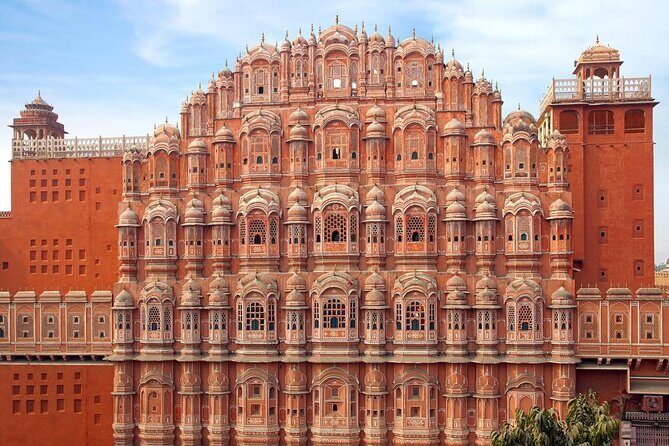
- Hawa Mahal + Pink City are explained with a logic-and-art lens, including the real shade behind the pink
- Tripolia Bazar by-lanes give you craft culture right where it happens, including block printing and silver-making areas
- Jalebi Chowk is framed through soldier and royal family stories with a spiritual thread
- Small group size (max 7) keeps the pace walkable and questions actually welcome
- Admission Ticket Free stops mean your money stays focused on the guide experience, not extra line-item fees
A Jaipur Walk That Connects Color, Craft, and City Logic
Most Jaipur tours point at big monuments and ask you to admire. This one does admire, but it also explains why the city looks the way it does and how it operates at street level. That shift matters. When you understand the pattern—how design supports life, how color signals identity, how markets cluster—you remember more than a photo.
I like the tone because it feels practical. The narration moves through history, science, and art-style thinking without turning into a lecture you have to study. You’re walking, watching, and getting a framework for what you’re seeing. And yes, the emphasis on the color theme isn’t just a gimmick. Jaipur’s famous pink reputation gets corrected with a more accurate look at what’s actually happening on the streets.
You can also read our reviews of more tours and experiences in Jaipur.


Meeting at Tripolia Gate and How the 3-Hour Plan Fits Together
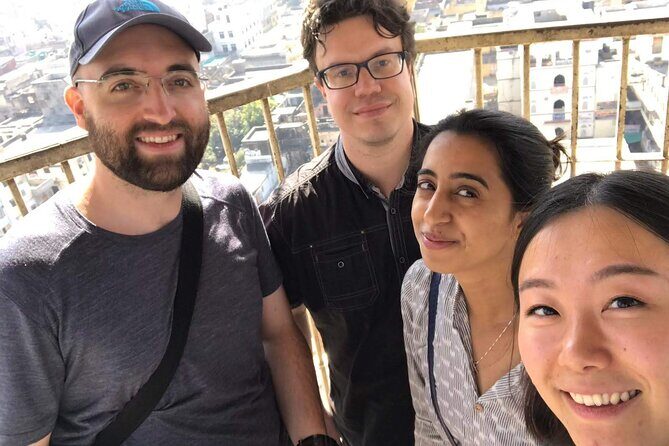
You’ll start at Tripolia Gate near Tripolia Bazar (the broader Pink City area). The walk ends back at the meeting point, so you don’t have to solve transit logistics at the end of your day.
The route is built for a 3-hour rhythm:
- Stop 1 (about 30 minutes): Hawa Mahal
- Stop 2 (about 1 hour): Pink City streets
- Stop 3 (about 45 minutes): Tripolia Bazar by-lanes
- Stop 4 (about 45 minutes): Jalebi Chowk
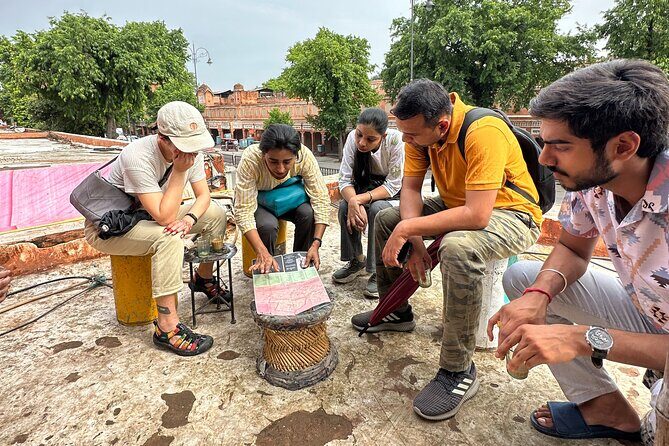
That timing is a sweet spot. You get enough time to look closely and ask questions, but not so much time that you lose energy. It also helps that the group is capped at 7 travelers. In a small group, the guide can slow down for details and won’t have to keep you moving like a conveyor belt.
Also, the tour is set up to work with real movement around the area. It’s near public transportation, and service animals are allowed. If you like planning your day without complicated logistics, this one is refreshingly straightforward.
Hawa Mahal: Palace of Wind Windows and the Meaning Behind the Views
Hawa Mahal is the kind of place you can spot from far away. But this tour helps you notice it differently—less as a decorative front, more as a window system with a purpose. You’ll spend around 30 minutes here, and the narration focuses on perspective, including the idea that different viewers see different meanings in the same structure.
One of the most interesting angles is how the guide brings a point of view into the discussion. The tour frames Hawa Mahal as something you can read with logic: why windows exist, why views matter, and how a palace can be designed for observation and presence at street level.
The experience benefit for you is simple: you’ll stop repeating the same caption in your head. Instead, you’ll look at the building and start seeing it as a system. That makes your photos better, too, because you know what to look for.
Potential drawback: because it’s a quick stop, you won’t get a long deep architectural walk-through. If you’re the type who wants hours inside and around every detail, plan to return on your own after this tour for extra time.
Pink City Reality Check: Terracotta Pink and Why It Matters
Then comes the real shift: you leave landmark viewing behind and walk the Pink City streets. The tour is explicit about the correction you’re likely not expecting—this isn’t simple, uniform Barbie-pink. You’ll hear why Jaipur’s pink is tied to materials and shade, described as terracotta pink.
Spending about 1 hour walking here is the best way to understand color. Up close, you see how light changes it. You notice how different surfaces react. You also start to understand why Jaipur is famous for pink without treating it like paint applied once and finished forever.
What you’ll like most is the explanation style. It’s not just color trivia. The narration connects the color to identity and how the city is read by locals and visitors. And the tour keeps repeating a deeper idea: Jaipur isn’t only “old.” It’s the balance of contemporary and old—and that balance shows up in how streets function as much as how buildings look.
Tip for you: if you’re planning photos, set aside a moment when you slow down. Don’t just walk through the pink—pause and watch how the shade changes with your angle. You’ll walk away with better images and a clearer sense of what people mean when they say Pink City.
Tripolia Bazar By-Lanes: Craft Culture Where You Can Still See the Process
Markets are where Jaipur breathes. This part of the tour leans hard into that truth. You’ll spend around 45 minutes exploring Tripolia Bazar, with time in the by-lanes and a focus on craft areas.
The tour highlights lanes associated with:
- Silver making market
- Stone cutting market
- Block-printing by-lane
Even if you don’t buy anything, this is valuable because you get a feel for how production fits into city life. You’re not just passing shops—you’re seeing how craft categories cluster in a way that makes the city efficient. It’s part of how Jaipur maintains its identity while still moving forward.
The practical upside: bazaars are also great for orientation. After you walk these lanes with a guide explaining what’s around you, your self-guided exploring later gets easier. You’ll recognize neighborhood patterns instead of feeling lost.
Possible consideration: bazaars can be visually busy. If you prefer quiet, this stop might feel stimulating. But that energy is the point, and the guide’s storytelling helps you stay grounded instead of overwhelmed.






Jalebi Chowk: Soldier and Royal Family Stories With a Spiritual Thread

Jalebi Chowk is a quieter-feeling stop than the bazaar, but it’s full of meaning. You’ll spend about 45 minutes here, and the tour frames the area through stories linked to soldiers and royal families.
That narrative choice changes how you read a street corner. Instead of seeing a meeting point or a landmark, you start thinking about who gathered here, what they needed, and how royal living connected with everyday life. The tour also mentions a special feeling of bonding with spirituality, which gives the stop a reflective tone.
For you, this is a strong way to close the loop. Earlier you learned about architecture and markets. Now you connect it to people, power, and belief. You leave with a sense that Jaipur isn’t only built with stone. It’s also built with stories that help people explain the world they live in.
If you’re tired by this stage, it can still work. Jalebi Chowk is a solid final act because it doesn’t require constant scanning for visual clues. You can focus on listening and letting the images settle.
Price and Value: Why $39.69 Makes Sense for This Route
At $39.69 per person for roughly 3 hours, the value comes from a few concrete things:
- A small group capped at 7
- A guide who uses storytelling to connect stops, not just point them out
- A route with four major areas (Hawa Mahal, Pink City streets, Tripolia Bazar, Jalebi Chowk)
- The tour notes Admission Ticket Free for the listed stops, which matters because it reduces surprise costs
A lot of city tours charge more, then fill the time with long transitions or filler. Here, the structure is compact and human-scaled. You’re paying for guided interpretation—how to see the city—and for time in key places that are hard to connect on your own without a good explanation.
Is it cheap? In a global sense, not always. But for Jaipur, this kind of route with a strong guide and a small group usually feels fair. The best part is that you end with your mental map of the Pink City, not just a list of sights.
Who Should Book This Jaipur Walk (and Who Might Skip It)

This tour fits you well if you like:
- walking through the Pink City streets instead of only standing at photo points
- learning how markets work, especially craft-focused areas like block printing
- a guide who tells stories in a way that makes history feel logical
- a short, doable tour that sets you up for the rest of your day
It might not be your ideal match if you want:
- a long, museum-style visit with extended inside time
- a very silent, low-stimulation experience with minimal walking
Because the group is small and the route is clear, you can also use this as a first taste of Jaipur. After you finish, you’ll understand what kind of Jaipur you’re actually dealing with: practical, colorful, and designed for people moving through it daily.
Should You Book This Jaipur Experience?
Yes, if you want a guided walk that turns Jaipur from a set of icons into a place with reasoning behind it. The biggest reason to book is the combination of a tight route and a guide like Shristi, whose storytelling is passionate and turns sights into something you can picture and remember.
I’d book it if you’re heading to Jaipur for a limited amount of time and want value in the form of perspective, not just stamps on a ticket. And if you love the idea of Jaipur’s pink being more than a rumor, this tour gives you the correction and the walk to support it.
FAQ
How long is the Jaipur experience?
It’s about 3 hours in total.
Where does the tour start?
You start at Tripolia Gate in the Tripolia Bazar/Pink City area.
What are the main stops?
The tour includes Hawa Mahal, Pink City, Tripolia Bazar, and Jalebi Chowk.
Is a mobile ticket provided?
Yes, the experience includes a mobile ticket.
How much does it cost?
The price is $39.69 per person.
How big is the group?
The tour has a maximum of 7 travelers.
Is there an admission fee for the listed stops?
The tour information lists Admission Ticket Free for the stops included.
What’s the cancellation policy?
You can cancel for a full refund up to 24 hours before the experience’s start time.
Is public transportation nearby?
Yes, it’s described as being near public transportation.
FAQ
Is confirmation received after booking?
Confirmation is received at the time of booking.
Can service animals join?
Yes, service animals are allowed.