REVIEW · PUSHKAR
Evening Walking tour with Fire Ceremony – The Pushkar Route
Book on Viator →Operated by THE PUSHKAR ROUTE · Bookable on Viator
Pushkar changes after dark. This evening walking tour turns the town’s calm, golden daytime mood into something more spiritual, with temple stops and the Maha Aarti fire ceremony at Brahma Ghat. You also get the feeling of walking through Pushkar’s living traditions, not just sightseeing from the sidewalk.
I love two things in particular: the no-shopping approach keeps the evening focused, and the small group (up to 6) makes it easier to hear your guide and ask questions. Guides such as Manish and Kapil are known for being friendly and for explaining what you’re seeing in plain terms, including the customs around Hindu temples and rituals.
The main thing to consider is pacing and footing. You’ll be walking near ghats and temple steps, and the final aarti area can get busy, so comfortable shoes and a calm, flexible attitude help a lot.
In This Review
- Key highlights worth knowing before you go
- Why this 5 pm Pushkar walk feels calmer than daytime
- Brahma Ghat and the Maha Aarti: the moment you plan around
- Brahma Temple: seeing one of India’s rare Brahma shrines
- Varaha Temple and Old Rangji: Vishnu sites with different vibes
- Gurudwara Sahib beside the lake: seeing Pushkar’s religious mix at human pace
- Strolling the 52 Ghats around Pushkar Lake (photo stop pointers)
- Price and what you actually get for $8
- Who this walking tour suits best
- Practical tips for a smooth evening in Pushkar
- Should you book the Pushkar Route evening walk?
- FAQ
- How long is the Evening Walking tour with Fire Ceremony – The Pushkar Route?
- What time does the tour start?
- Is pickup available?
- Is there shopping on this tour?
- Are admission tickets included?
- What is the cancellation policy?
Key highlights worth knowing before you go

- Maha Aarti at Brahma Ghat: the evening fire ceremony is the core event of the walk.
- Shopping-free by design: no detours into markets or sales stops.
- Rare temple mix in one circuit: Brahma Temple, Varaha Temple, Rangji Temple, and more.
- Pushkar Lake loop with photo time: a walk around the 52 ghats with scenic viewpoints.
- Small group (max 6): better flow, easier conversation, less crowd crush.
Why this 5 pm Pushkar walk feels calmer than daytime
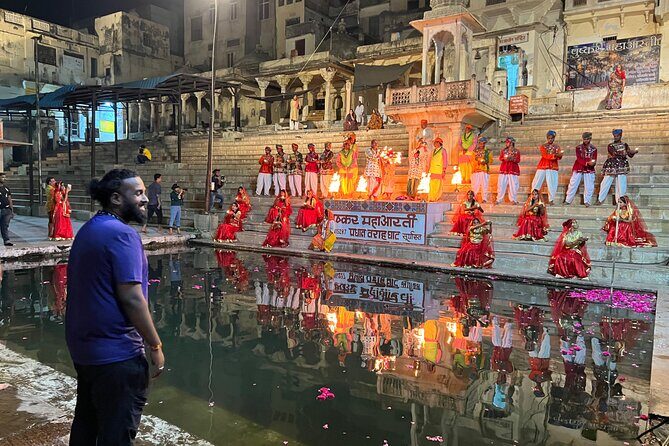
Pushkar is pretty in the daylight, but evenings change the “what” and the “why.” At night, the town slows down and the lake takes center stage. This tour is timed for that shift, starting at 5:00 pm, so you’re walking while the light is softening and the rituals are preparing to begin.
The route is built around temples and ghats, but it isn’t a frantic sprint. Expect a steady walking pace plus short stays at each stop, roughly 3 hours total. That time window is long enough to see the key sights, but short enough that you’re not trapped in late-night fatigue.
If you’re the type of traveler who likes meaning behind the scenes, this kind of evening format works well. You’ll see how Pushkar’s spirituality shows up in daily life—bells, firelight, crowd energy, and quiet corners near the water.
You can also read our reviews of more walking tours in Pushkar



Brahma Ghat and the Maha Aarti: the moment you plan around
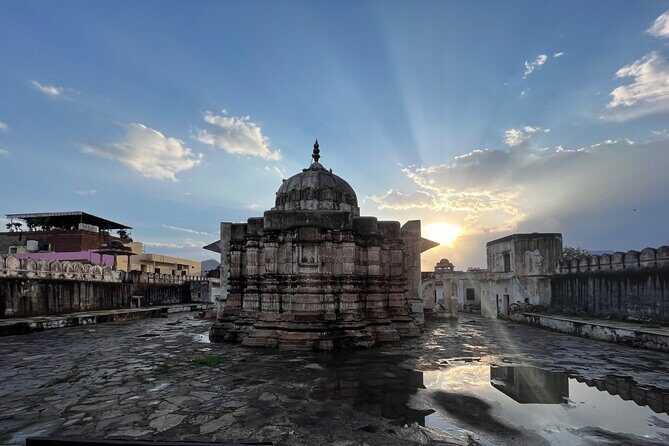
Stop one is Brahma Ghat, one of the important ghats on Pushkar Lake. It’s also directly linked to Maha Arti, so it’s not just a scenic spot—it’s a front-row-style entry point to what happens after sunset. The atmosphere here matters, because the best part of the evening is tied to timing, not just location.
At Brahma Ghat you also see a reference to a Shankaracharya temple built at the entrance of the ghat by Shri Jayendra Saraswati. Even if you don’t catch every detail, having your guide point out these connections helps you understand why this exact edge of the lake matters.
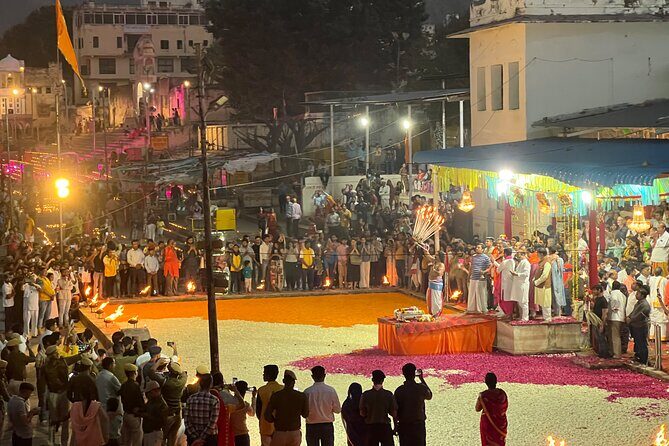
Then you return to Brahma Ghat again for the actual evening Aarti, which is where the ritual becomes the experience. The fire ceremony is the main event on this route, and it’s easy to see why: you’re watching Hindu worship unfold with the lake as the stage, and you’re surrounded by the soundscape of bells and temple activity.
Practical tip: stand where your guide instructs you. In aarti moments, moving around can disrupt the flow and can also push you out of the good sightline.
Brahma Temple: seeing one of India’s rare Brahma shrines
After Brahma Ghat, you head to the Brahma Temple, one of the few remaining temples dedicated to Brahma in India. This is a big deal because Brahma temples aren’t something you’ll stumble across everywhere. The structure is said to date to the 14th century, with later partial work and additions over time.
The temple stop is timed for about 30 minutes, so you get enough time to look closely without feeling rushed. Your guide’s job here is important: Brahma worship can feel confusing if you only see it as a name on a sign. When someone explains how Brahma fits into the broader Hindu tradition, the visit becomes easier to read.
One drawback to be aware of: temples are still temples, even during a tour. You might need to follow local rules on where to stand, how to behave, and what areas you can photograph. When you respect that, the experience stays smoother for everyone.
Varaha Temple and Old Rangji: Vishnu sites with different vibes
Two of the standout temple stops on this walk connect you to Vishnu through different forms and neighborhoods.
First is Varaha Temple, dedicated to Lord Vishnu. It’s considered one of the eight Swayambhu Kshetra of Vishnu, and the temple is associated with a 12th-century origin attributed to King Anaji Chouha. That “ancient but specific” feeling is exactly what makes this route worthwhile: it doesn’t treat temples like interchangeable stops.
Varaha Temple is scheduled for around 25 minutes. You’ll have time to notice details and get context, but not so much that you’re stuck in one place while the rest of the group waits. That’s a good balance for an evening schedule.
Later comes Old Rangji Temple, a roughly 200-year-old temple dedicated to Vishnu, located near Varaha Ghat in the middle of town. It’s on the shorter side (about 15 minutes), so treat it as a focused look rather than an extended visit. If you’re the kind of person who likes comparing temple styles and locations, this quick stop is useful because it shows how Vishnu devotion is expressed in more than one physical setting.
Gurudwara Sahib beside the lake: seeing Pushkar’s religious mix at human pace
One of the nicest surprises in Pushkar is that it isn’t only Hindu. The route includes Gurudwara Sahib—a Sikh temple known for beauty and tranquility.
You’ll typically spend about 30 minutes here, and this is where the tone of the evening can soften. The tour highlights Pushkar as a place of diversity, and Gurudwara Sahib is a practical way to experience that without needing a separate plan.
Even if you don’t follow every religious detail, the setting communicates something clear: people gather for worship, prayer, and community. That’s also why the tour’s structure matters. By the time you reach the Gurudwara, you’ve already been through Brahma and Vishnu-linked temples, so the shift feels like a meaningful contrast rather than a random add-on.
You can also read our reviews of more evening experiences in Pushkar


Strolling the 52 Ghats around Pushkar Lake (photo stop pointers)
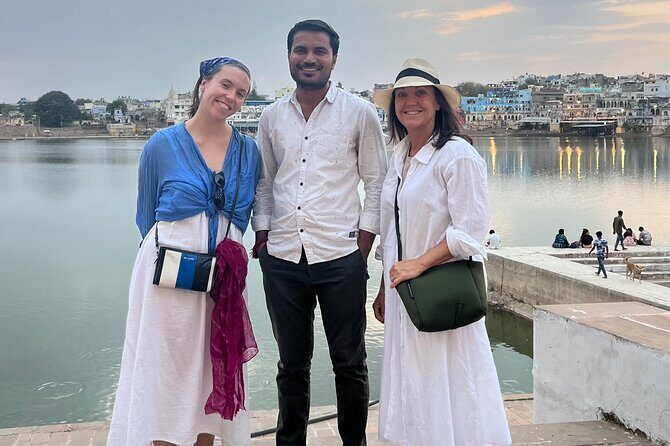
The tour includes time specifically for the lake itself. You’ll head to Pushkar Lake for a spiritual walk around the 52 ghats, with spots intended for photography and time to view some of the smallest and oldest temples along the water’s edge.
This stop is around 25 minutes, which means it’s not a long shoreline hike. It’s more like a guided circuit that gives you the best “read” of the lake’s layout without swallowing the entire evening.
What makes this valuable isn’t just pictures. It’s that the ghats form the connective tissue between places of worship. In Pushkar, the lake isn’t background scenery; it’s part of how people practice devotion.
Photo tip: evening light can be tricky with firelight and bright temple surfaces. If you want clean shots, aim for steadier compositions near calmer angles rather than trying to photograph right inside the heaviest action.
Price and what you actually get for $8
At $8 per person, this tour is priced like a budget-friendly cultural evening, and the value comes from what’s included. You get a guided walk for about 3 hours, a mobile ticket, and admission tickets included at the listed temple/ghat stops.
You also get a small-group format. When the group is capped at 6 travelers, it makes a difference during tight passages and crowded ritual areas. It’s easier to move as a unit, easier to hear explanations, and less likely that you’ll get separated in the dark.
One more value point: the tour is shopping-free. That matters more than it sounds. A shopping stop can turn an evening ritual into a sales schedule. Here, the time stays with the temples and the lake.
If you like planning ahead, note that this experience is often booked about 19 days in advance on average. That’s a hint that it’s popular, especially for travelers who want the evening’s main event without doing the route alone.
Who this walking tour suits best
This is a great fit if you want:
- A spiritual and cultural walk, not just landmarks.
- Temple visits with clear context so you’re not standing in front of doors wondering what you’re supposed to notice.
- An evening format where the Maha Aarti is the highlight rather than an optional add-on.
It’s also a smart choice if you prefer local guidance for places you might struggle to find on your own. Pushkar’s layout can feel like a maze, and even a short guided loop can save you time and frustration.
You might not love it if you’re expecting a relaxed, quiet stroll with lots of free time to wander independently. The tour is structured around specific stops and the aarti timing, so you’ll follow the route closely.
Practical tips for a smooth evening in Pushkar
A few simple things make this kind of evening tour work better:
1) Wear shoes you trust. Ghats and temple steps can be uneven. You’ll be happier with grippy soles than with soft, slippery footwear.
2) Dress respectfully. Temple areas typically expect modest behavior. Loose, covered clothing helps, and it also keeps you comfortable during standing moments.
3) Plan for sound and crowds near the aarti. The fire ceremony draws attention, and you’ll be part of that energy. You don’t need to push forward—just find the spot your guide indicates.
4) Bring a camera mindset, not a camera obsession. Firelight and moving rituals can make perfect photos hard. Some of the best memories here are the moments you watch without trying to freeze everything into a single image.
5) If you have questions, ask them early. The guide’s explanations are part of the value, especially for understanding Hindu customs and what different sites represent. Friendly questions tend to get better answers when you ask before you’re exhausted.
Should you book the Pushkar Route evening walk?
If you’re in Pushkar and you want the town’s evening side—temples plus the lake and the Maha Aarti—this is one of the easiest ways to make that happen. The $8 price feels fair for a guided, structured evening that includes admission at the key stops and doesn’t waste time on shopping detours.
Book it if you want a guided route that helps the ritual make sense and keeps you moving at a manageable pace. Skip it only if you strongly prefer independent sightseeing with no structure, or if you know you’ll have trouble with uneven walking near ghats.
Either way, this is the kind of evening that leaves you with more than photos. You walk away understanding the places in a more personal, practical way.
FAQ
How long is the Evening Walking tour with Fire Ceremony – The Pushkar Route?
It runs for about 3 hours (approx.).
What time does the tour start?
The start time is 5:00 pm.
Is pickup available?
Yes, pickup is offered.
Is there shopping on this tour?
No. It is described as shopping-free, with no shopping stops.
Are admission tickets included?
Admission tickets are included for the listed stops.
What is the cancellation policy?
You can cancel for a full refund up to 24 hours before the experience starts. Changes within 24 hours of the start time are not accepted, and cancellations inside that window are not refunded.