REVIEW · NEW DELHI
Delhi Sight Seeing By Private Car
Book on Viator →Operated by Maheshwaram Travels · Bookable on Viator
Delhi in one long, comfortable sweep. This private car day trip strings together Mughal-era walls, Sikh worship, and Gandhi-era monuments, starting with pickup in Paharganj.
What I like most is the value: you get an air-conditioned vehicle plus bottled water, and a big chunk of the route uses free entry stops. It also feels like a smart first-day plan if you want a broad overview without thinking about traffic or parking.
One caution: the rating is low and there are serious complaints about booking risk and reported price increases. Before you commit, double-check your confirmation and keep any ticket details you receive.
In This Review
- Key highlights you should notice before you go
- How the 9-hour Delhi loop works from Paharganj
- Birla Mandir, Gurdwara Bangla Sahib, and Gyarah Murti: faith and freedom
- Indira Gandhi’s memorial home, then Rashtrapati Bhavan and Parliament House
- India Gate to Qutub Minar: classic Delhi monument time
- Lotus Temple, Raj Ghat, and Shanti Van for the quieter meaning
- Old Delhi’s Red Fort: the one paid ticket on the loop
- Price and value at around $11: what you actually get
- The booking reality: fast confirmation, low ratings, stay sharp
- Who this private car Delhi sightseeing day fits best
- Should you book this Delhi sightseeing day trip?
- FAQ
- FAQ
- How long is the Delhi sightseeing private car tour?
- What time does the tour start?
- Where is the meeting point?
- Will I have pickup included?
- Is the vehicle air-conditioned?
- What’s included in the price?
- Are tickets for all sights included?
- Is the tour ticket delivered electronically?
- Is this tour private or shared?
- What happens if the weather is poor?
- Can I cancel and get a refund?
Key highlights you should notice before you go
- Private, car-based touring that saves you from Delhi’s chaos for a full day
- A mostly free-entry route, with just two major ticketed sights called out
- Faith meets independence: Birla Mandir, Gurdwara Bangla Sahib, and Gyarah Murti in the same arc
- New Delhi power landmarks in short stops: Rashtrapati Bhavan and Parliament House
- A classic monuments stretch: India Gate to Qutub Minar, then on to Lotus Temple
- Gandhi and Nehru memorials that slow the pace for reflection
How the 9-hour Delhi loop works from Paharganj
This day trip runs about 9 hours, with a 9:00 am start. Your meeting point is on Rama Krishna Ashram Marg 1682, Main Bazar Rd, in Chuna Mandi, Paharganj (near Aram Bagh). The plan ends back at the same meeting point, so you’re not stuck figuring out transport later.
You’ll ride in an air-conditioned vehicle, which matters in Delhi. Even when the sights are close on a map, the drive time can be unpredictable. Having AC turns the long day into something you can actually manage.
This is a private tour, meaning it’s just your group. That usually helps with pacing—your guide can time photo stops, handle quick ticket needs, and keep the day moving.
One more practical note: the tour uses a mobile ticket, and you should receive confirmation at booking. If your schedule is tight, that confirmation timing is important. If anything feels unclear, it’s worth following up right away.
You can also read our reviews of more private tours in New Delhi


Birla Mandir, Gurdwara Bangla Sahib, and Gyarah Murti: faith and freedom
Your morning includes a trio of stops that cover two big themes of Delhi: religion and the push for independence.
First is Birla Mandir (Lakshmi Narayan). It’s a Hindu temple dedicated to Laxminarayan, meaning Vishnu with his consort Lakshmi. A detail I love here is the Gandhi connection: Mahatma Gandhi inaugurated the temple, and he made sure members of all castes would be allowed in. That makes the visit more than just architecture—it connects a modern political moment to a sacred space. You get about 30 minutes, and entry is listed as free.
Next comes Gurdwara Bangla Sahib. This Sikh gurdwara is well known for its association with the eighth Sikh Guru, Guru Har Krishan, and for the holy pond inside the complex called Sarovar. Even if you’re not a history person, this stop gives you a strong sense of lived religion—people come here to pray, and that routine stays steady.
Then there’s Gyarah Murti, a monument built to commemorate India’s independence struggle under Mahatma Gandhi’s leadership. The sculptor credited for it is Devi Prasad Roy Choudhury. The monument is an ensemble of eleven statues: ten represent people from diverse sociocultural, religious, and economic backgrounds following Gandhi in the lead. There’s also a popular belief it depicts the Dandi March. If you’ve seen the old 500-rupee note with Gandhi imagery, this connection may click fast.
One practical consideration: some of these memorials and places of worship work best when you keep your expectations realistic. Many stops are about getting in, seeing the key parts, and moving on.
Indira Gandhi’s memorial home, then Rashtrapati Bhavan and Parliament House
After the faith and freedom stops, the route shifts into government landmarks—short looks, high-impact views.
Stop two is the Indira Gandhi Memorial Museum. The time here is about 35 minutes, and admission is not included. What makes this museum stand out is that it’s housed in the building where Indira Gandhi lived with her family during her premiership and where she was assassinated. So you’re not just looking at exhibits; you’re seeing the place tied to a major turning point in modern Indian politics.
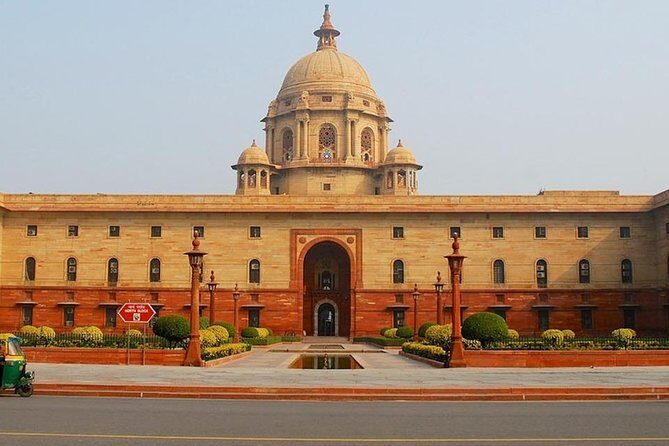
Then you’ll head to Rashtrapati Bhavan, the official residence of the President of India, located at the western end of Rajpath on Raisina Hill. This building used to be called the Viceroy’s House and was constructed during the zenith of the British Empire. Admission is listed as free, and you’ll have about 15 minutes—so treat this as a quick orientation stop. In a long day, the goal is to see the setting and do basic photos, not try to absorb everything in one rush.
After that, the route includes the Parliament House (Samsad Bhavan). It’s the seat of India’s Parliament, with the Lok Sabha and Rajya Sabha in the building. The time is listed only as a stop (no detailed minutes provided), so you’ll likely want your focus sharp: photos from the outside or nearby viewpoints, then move on.
These New Delhi stops are valuable because they anchor the day in the city’s current political identity. If you only visited temples and monuments, Delhi would feel incomplete. If you only looked at government buildings, Delhi would feel cold. This mix helps you balance both sides.
India Gate to Qutub Minar: classic Delhi monument time
Now you hit the postcard core—wide spaces, memorial symbolism, and one of Delhi’s most famous complexes.
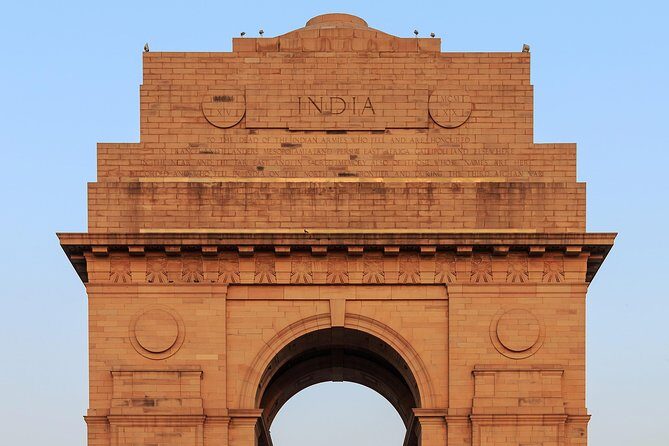
First is India Gate. It’s a war memorial near Kartavya Path on the eastern edge of the ceremonial axis of New Delhi, formerly called Rajpath. You’ll have about 30 minutes, and entry is free. I like India Gate because it’s simple to understand: you walk, you look, you get the scale quickly. It’s also a good place to reset your energy before the next leg.
Next comes Mehrauli/Qutub Minar. This stop centers on Qutb Minar, also spelled Qutub Minar, a minaret and victory tower that forms part of the Qutb complex. The complex sits at the site of Delhi’s oldest fortified city, Lal Kot, founded by the Tomar Rajputs. You’ll spend about 45 minutes, and entry is free.
This is the part of the day where you’ll want to slow your pace for a few minutes. In a fast route, it’s easy to treat a monument like a checkbox. Qutb Minar is the kind of place where a little extra looking pays off—details in stone, the shape of the tower, and the sense of being in a layered complex.
Lotus Temple, Raj Ghat, and Shanti Van for the quieter meaning
The mid-to-late day shifts again, and that change is one of the tour’s best features. The route includes places where silence and meaning matter more than photos.
First is Lotus Temple, with about 40 minutes and free admission listed. You won’t get extra commentary details on the spot from the information provided, so I suggest you treat this as a reset. Arrive ready to just look and breathe for a bit.
Then you visit Gandhi Memorial Hall (Raj Ghat). Raj Ghat is the memorial complex marking Mahatma Gandhi’s cremation. The memorial includes a black marble platform raised to mark the spot of his cremation on 31 January 1948, plus an eternal flame at one end. You get about 30 minutes, and entry is free.
After Raj Ghat, your route includes Shanti Van, described as the place where India’s first Prime Minister Pandit Jawaharlal Nehru was cremated. You’ll have about 30 minutes, and entry is free.
This section works especially well if you’re visiting Delhi for the first time. Delhi can feel like speed—traffic, noise, crowds—so having two memorial stops with clear emotional weight makes the day feel human. It’s also a smart way to avoid only sightseeing in the bright, loud areas.
A few more New Delhi tours and experiences worth a look






Old Delhi’s Red Fort: the one paid ticket on the loop
The final big anchor is Red Fort (Lal Qila) in Old Delhi. It’s a historic fort that served as the main residence of the Mughal emperors. Construction was commissioned by Emperor Shah Jahan on 12 May 1639, when he decided to shift his capital from Agra to Delhi. Entry is listed as not included, and you’ll spend about 30 minutes.
This is the most expensive-feeling part of the day, not because the fort is overpriced, but because admission is on you here. If you’re planning tightly, budget for that ticket in advance so you don’t lose time at the gate.
Also, Red Fort is Old Delhi. That means you might feel a stronger contrast with the more formal New Delhi areas earlier in the route. Expect it to feel more crowded and more alive around the fort approach.
If you can, use your time inside with purpose: walk the perimeter areas you’re interested in most, take a few key photos, and don’t try to do everything in 30 minutes. That’s how you keep the day enjoyable instead of exhausting.
Price and value at around $11: what you actually get
At $11 for about 9 hours with an air-conditioned vehicle, it’s clearly priced to feel like a bargain. The included items are air-conditioned vehicle and bottled water. Most of your major stops also list free admission, including Birla Mandir, Rashtrapati Bhavan, India Gate, Qutub Minar, Lotus Temple, Raj Ghat, and Shanti Van.
The trade-off is that the two stops explicitly marked not included are Indira Gandhi Memorial Museum and Red Fort. Admission details for Gurdwara Bangla Sahib, Gyarah Murti, and Parliament House aren’t listed as paid or free in the information provided, so you should be ready for the possibility of small on-site costs. Having a little cash or card flexibility helps.
Also, airport/departure tax is not included, though that likely matters only if your plan connects to flights. Here, the main thing is that the sightseeing itself is covered in the low-cost base—transport and guide time.
My take on value: this is a strong pick if you want a guided, structured overview and you’re comfortable with short visits. It’s less ideal if you want long, deep time at one location.
The booking reality: fast confirmation, low ratings, stay sharp
This is where you should be extra practical.
The overall rating is 2.3 based on 3 reviews, and the negative comments are serious. The complaints include claims about tickets being cancelled, being rebooked at a higher price, and accusations of the company not having its own buses. There are also statements calling it a fake company. I can’t verify those claims, but you should take them seriously because they directly affect your money and your plans.
On the other hand, at least one review called the experience superb and praised the staff as polite while describing it as a good budget day for exploring Delhi with family. That’s a signal that not every booking goes sideways.
So how do you handle this risk without stress?
- When confirmation arrives, save screenshots of your booking details and ticket info.
- If messages come by mobile, keep them documented so you can resolve issues quickly.
- If the provider asks for ticket details on WhatsApp, respond promptly. In the response shown, they apologized and asked for ticket details on WhatsApp at 9971063049.
If weather turns bad, the tour data says it can be cancelled due to poor weather with an option for a different date or a full refund. Delhi weather can change fast, so keep an eye on forecasts, especially if you’re traveling in hotter months or monsoon season.
Who this private car Delhi sightseeing day fits best
This tour fits best when you match its strengths:
- You’re a first-time visitor who wants a big picture of Delhi in one day.
- You prefer a private car setup so you’re not wrestling with transit between far-flung areas.
- You like variety: temples, a major Sikh gurdwara, Gandhi monuments, government buildings, and two major Old and New Delhi landmarks.
- You’re okay with short stops (often 15–45 minutes) and don’t need hours at every site.
If you’re the type who likes slow travel, linger over details, and plan multiple museum hours, you may feel rushed. If you’re traveling with family and want a structured day that’s hard to mess up logistically, the format makes sense.
Should you book this Delhi sightseeing day trip?
If your priority is maximum landmarks for minimum hassle, and you’re comfortable paying any listed extra admissions for Red Fort and the Indira Gandhi museum, this day trip can be a very efficient way to see Delhi’s main threads.
My recommendation comes down to one point: because the rating and complaints are so negative, I’d book only if you can confirm your details clearly and quickly. If anything seems unclear after booking, follow up fast and keep your documentation.
Done right, you’ll come away with a clean overview: Gandhi’s influence in stone, Sikh worship at Sarovar, New Delhi’s official face at Raisina Hill, and the dramatic Mughal centerpiece of Red Fort.
FAQ
FAQ
How long is the Delhi sightseeing private car tour?
It runs for about 9 hours.
What time does the tour start?
The start time is 9:00 am.
Where is the meeting point?
The meeting point is at Rama Krishna Ashram Marg 1682, Main Bazar Rd, Chuna Mandi, Main Bazar, Aram Bagh, Paharganj, New Delhi, Delhi 110055, India.
Will I have pickup included?
Yes, pickup is offered.
Is the vehicle air-conditioned?
Yes, the tour includes an air-conditioned vehicle.
What’s included in the price?
Included items are an air-conditioned vehicle and bottled water.
Are tickets for all sights included?
No. The Indira Gandhi Memorial Museum and the Red Fort have admission listed as not included. Other stops show free admission, but admission details for some stops are not specified.
Is the tour ticket delivered electronically?
Yes, you get a mobile ticket.
Is this tour private or shared?
It’s private. Only your group participates.
What happens if the weather is poor?
It requires good weather. If it’s cancelled due to poor weather, you’ll be offered a different date or a full refund.
Can I cancel and get a refund?
Yes. You can cancel up to 24 hours in advance for a full refund, and cancellations within 24 hours are not refunded.