REVIEW · NEW DELHI
All Inclusive Old & New Delhi Sightseeing Tour
Book on Viator →Operated by Delhi in a Day · Bookable on Viator
Delhi is a lot to fit in.
That’s why I like this full-day private format: you get Old Delhi street time plus New Delhi monument stops, guided in English so you’re not just wandering around big names. The route also includes two UNESCO-protected sights, so the day feels structured, not random.
I especially love the logistics. You’ll get door-to-door pickup from Delhi, Noida, Gurugram, Ghaziabad, or Faridabad in an A/C car, with mineral water for the day. And in Old Delhi, you’re not stuck in one vehicle either—you’ll ride in a tuk-tuk and take a rickshaw through the lanes around Jama Masjid and Chandni Chowk.
One drawback to plan for: the Humayun’s Tomb ticket is not included, so you’ll want to budget a bit extra there. Also, the tour does not include food or drinks, so you’ll be stopping for your own breaks.
In This Review
- Key things that make this tour work well
- A/C pickup, private touring, and why the route matters
- Old Delhi start: Jama Masjid courtyard and the red-sandstone scale
- Chandni Chowk by rickshaw: markets, spices, and wedding-street shopping
- Red Fort views without the full-day fortress trap
- Bangla Sahib: gurudwara tour plus Langar kitchen experience
- India Gate and New Delhi’s big-stone memorial style
- Rashtrapati Bhavan and Parliament: what you can see (and what you can’t)
- UNESCO stop: Humayun’s Tomb basics and why tickets are a planning point
- Lotus Temple: free entry, calm design, and a place to reset
- Swaminarayan Akshardham: temple scale with a modern feel
- Qutub Minar: the tall UNESCO signature you’ll remember
- Price and value: what you get for about $65 per person
- Timing, dress, and what to carry for an 8–9 hour city day
- Should you book this Old and New Delhi tour?
- FAQ
- Where is pickup available for this tour?
- How long is the tour?
- What’s included in the price?
- Are all monument tickets included?
- Will I be able to visit Parliament House inside?
- Are food and drinks included?
- What is the cancellation timeline?
- Is this tour private or shared?
Key things that make this tour work well
- Old + New Delhi in a single organized loop so you don’t waste time crisscrossing the city
- Tuk-tuk and rickshaw rides that actually get you into the feel of Old Delhi
- Chandni Chowk lanes you can navigate with a plan including Parathe Vali Gali and Cham Cham Gali
- UNESCO pair: Humayun’s Tomb (ticket extra) and Qutub Minar (ticket included)
- Bangla Sahib’s Langar tradition with a guided visit to the kitchen area
- Big New Delhi monuments with context including India Gate and government buildings you can see from outside
A/C pickup, private touring, and why the route matters
This is a private tour, so you’re not sharing your guide’s time with strangers. You can be picked up from essentially anywhere in the wider Delhi region—Delhi, Noida, Gurugram, Ghaziabad, or Faridabad—and you pick the pickup time that fits your day. That flexibility is a big deal in Delhi, where everything can run behind schedule due to traffic.
The car is air-conditioned, and you’ll have mineral water (2 bottles for the day). That doesn’t sound glamorous, but on an 8 to 9 hour day it can be the difference between enjoying the stops and just surviving the drive.
Also, this tour mixes transport modes on purpose. You move efficiently in the car between far-flung areas, then you slow down when it counts: tuk-tuk and rickshaw in Old Delhi. That’s how you get both efficiency and atmosphere.
You can also read our reviews of more tours and experiences in New Delhi.



Old Delhi start: Jama Masjid courtyard and the red-sandstone scale
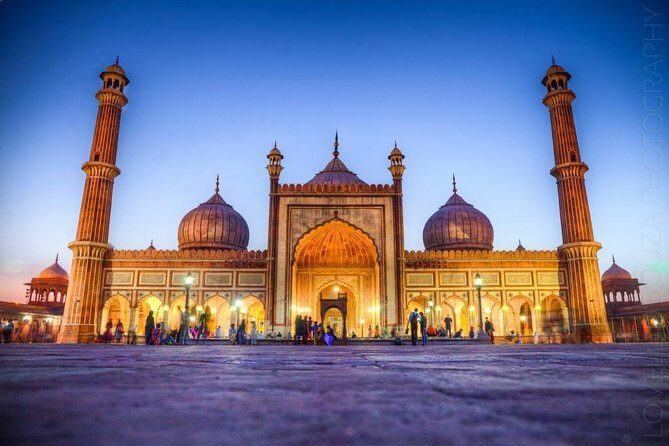
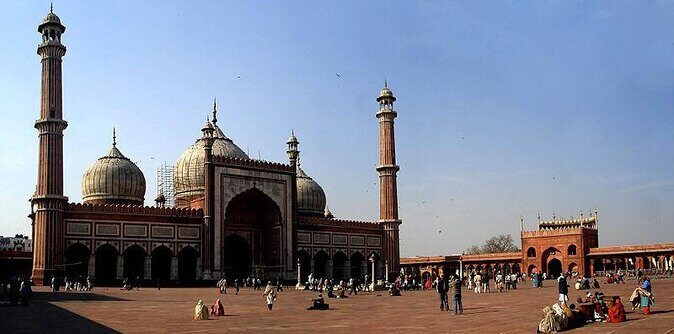
You begin at Jama Masjid, the huge mosque in India. It’s the kind of place where the architecture hits you before the guide even starts talking. The courtyard is made of red sandstone, and the complex was built in 1656 with the help of about 5,000 workers. It sits directly in the Chandni Chowk area, facing the Red Fort zone—so you’re set up to see how the Mughal-era power centers connect.
Plan on about an hour here, including the time to walk around the courtyard. Even if you’re not a temple-and-mosque person, this stop works because the scale is hard to fake. It’s also a good place to ask your guide questions before you get pulled into the market chaos later.
Small practical tip: go in with comfortable clothes and shoes you can manage easily. Courtyard spaces can be uneven, and you’ll likely do more standing and walking than you expect.
Chandni Chowk by rickshaw: markets, spices, and wedding-street shopping
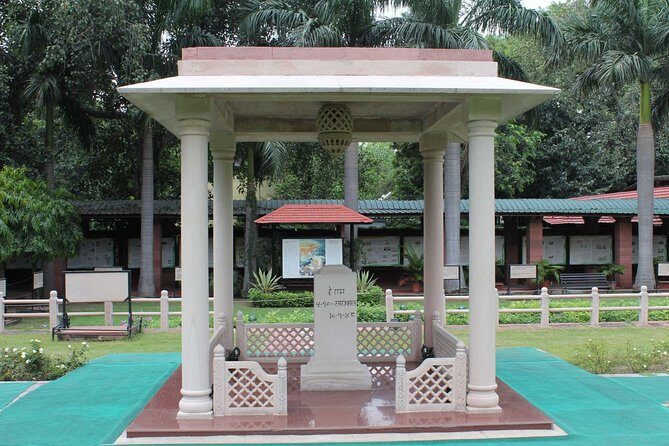
After Jama Masjid, you hop on a rickshaw for Chandni Chowk. This is where the tour becomes more than sightseeing and starts feeling like a day in the city.
You get time in major lanes, including:
- Cham Cham Gali, known for shopping for weddings
- Parathe Vali Gali, famous for street food
- A spice market area where you’ll see people shopping in their own local rhythm
You’ll only spend about 30 minutes in this first market block, so treat it like orientation-plus-snacks-if-you-want, not a full shopping spree.
Here’s what makes this stop valuable with a guide: you’re not trying to decode every turn in a crowded maze. You can focus on what you came for—food smells, spice colors, the shopping vibe—while someone else handles the “where do we go next” part.
Also, this is exactly the kind of stop that shows why a guide matters. One of the most praised moments connected to this kind of Delhi day was the spice market experience paired with thoughtful explanation.
Red Fort views without the full-day fortress trap
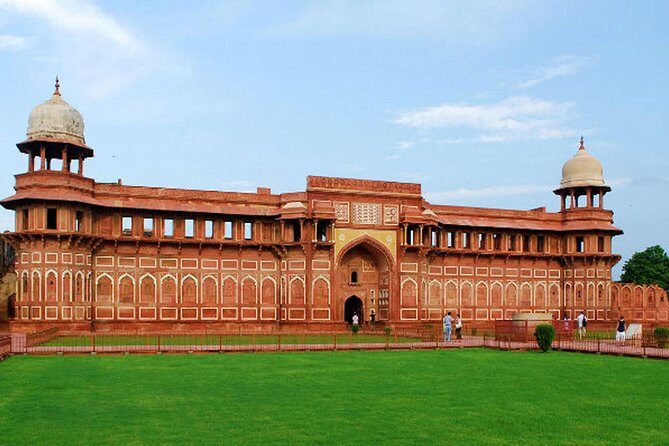
You’ll also stop in the Red Fort area. Shah Jahan built it between 1639 and 1648, and it was home to important Mughal emperors. The fort’s architecture reflects Indian-Islamic and Mughal styles, and the complex includes a very long wall—about 2 kilometers.
The key point for your planning: the tour description frames this as a stop connected to the main Old Delhi flow rather than a full, ticket-based fortress deep dive. That’s useful. If you tried to add the full Red Fort experience on top of everything else in an 8 to 9 hour day, you’d risk running out of time for the UNESCO sights later.
So think of this as a “see it, understand it, move on” moment that keeps the schedule sane.
Bangla Sahib: gurudwara tour plus Langar kitchen experience
Next up is Gurudwara Bangla Sahib. This is one of the best cultural stops in Delhi because it combines spiritual space with a very human daily practice. You’ll learn the significance and history of the gurudwara, and you’ll also visit the Langar kitchen.
Langar is the free meal tradition—open to everyone. The guide walks you through the place and explains the principles behind it, including community service and equality in Sikhism. Even if you don’t eat, the idea is powerful: you’re seeing a working system of welcome.
This is also a stop that has gotten strong praise in the past for how well guides connect the architecture and rituals to real life. In at least one German-language praised experience, the guide’s communication and professionalism helped make the Langar part feel clear, not just ceremonial.
Practical consideration: you may want to keep your hands and feet comfortable for entry areas, and if you plan to eat later, you’ll want to coordinate timing with the rest of the day (since food isn’t included).




India Gate and New Delhi’s big-stone memorial style

Moving into New Delhi, you’ll see India Gate—an impressive stone monument with an arched feel. It was designed by Edwin Lutyens in 1921 and functions as a memorial for roughly 90,000 Indian Army soldiers connected to World War I and later conflicts, including the Northwest Frontier operations and the 1919 Anglo-Afghan War.
This stop is short on paper, but it’s meaningful if your guide gives the context. India Gate isn’t just “a photo spot.” It’s a map of the era—names, dates, and the scale of sacrifice—translated into stone.
Why I like it on this itinerary: it bridges the mood shift from Old Delhi. One minute you’re riding rickshaws through markets; the next you’re learning how New Delhi carries memory in monumental forms.
Rashtrapati Bhavan and Parliament: what you can see (and what you can’t)
You’ll pass major government sites around Rashtrapati Bhavan (the President’s House). The complex includes long hallways, 340 rooms, a round Durbar Hall, a library for the president, and an Ashoka Hall. It’s the kind of building that feels designed for grandeur from every angle—even when you’re just viewing it from outside.
You’ll also see Sansad Bhavan (Parliament House). Here’s the honest part: people can’t go inside to see it. But the exterior stop still matters because it frames the idea of independence and modern governance in the same district.
Practical note: since you can’t go inside, keep expectations focused on photo angles and context rather than tours.
UNESCO stop: Humayun’s Tomb basics and why tickets are a planning point

Then you reach Humayun’s Tomb, a UNESCO-protected site and considered the first Garden Tomb of India. It was built after Humayun passed away, with his wife’s wish to create a lasting memorial in a garden setting.
This is an important stop for two reasons:
- The design helps you understand how tomb architecture developed in the region.
- It’s one of the few places on this day where you’ll likely feel the urge to slow down.
But here’s the scheduling reality: the admission ticket for Humayun’s Tomb is not included. So when you’re budgeting for this tour, treat that as the one likely extra cost tied to UNESCO time.
Also, plan on about an hour at the site. That’s usually enough for key views and a guided walkthrough, without turning your day into a half-day museum marathon.
Lotus Temple: free entry, calm design, and a place to reset
Next comes the Lotus Temple, also known as the Bahai House of Worship. It was built in 1986 by Fariborz Sahba and designed as a place where people of different beliefs can pray together.
You can enter to pray or sit quietly and meditate if you want. Tickets are free, and this stop is short—about 30 minutes.
This is a great “mental break” between the heavier civic and UNESCO sites. If Delhi’s energy starts to feel like too much, Lotus Temple is where you get a pause button.
Swaminarayan Akshardham: temple scale with a modern feel
Then you’ll visit Swaminarayan Akshardham. The complex is connected to modern construction (built in 2005), but visually it looks much older—because of the way the design and detailing are executed.
Admission is free on this tour, and you’ll spend about an hour. Even if you’re not deeply religious, Akshardham can still land well because the architecture communicates order and detail. It’s a contrast stop that helps your brain digest the day.
Practical tip: expect crowds at major temple sites. Your guide can help with where to go first so you don’t spend your hour wandering.
Qutub Minar: the tall UNESCO signature you’ll remember
Finally, you arrive at Qutub Minar. This is the tall stone tower you can’t miss. It was built under Sultan Qutb-ud-din to display authority, and it has five parts and projecting balconies. The tower also carries sandstone carvings and inscriptions with verses from the Quran.
Admission for Qutub Minar is included here, and you’ll have about an hour.
Why it’s the perfect capstone: by the time you reach Qutub Minar, you’ve already seen Mughal and other eras of Delhi. The minaret gives you a clear vertical “signature” of another chapter of the city.
This is also one of the stops that shows up strongly in positive experiences—people often specifically mention Qutub Minar as a highlight when they think back on the day.
Price and value: what you get for about $65 per person
At $65 per person, this tour can be good value if you want:
- Private guidance through Old and New Delhi
- AC transport with pickup and drop-off included across the broader region
- Entry tickets for certain monuments (Jama Masjid and Qutub Minar are included; Humayun’s Tomb is not)
- Old Delhi transport experiences like tuk-tuk and rickshaw riding
- Mineral water, plus parking/tolls/fuel/taxes covered
Where value can get tricky is the extra you should plan for. Since Humayun’s Tomb admission isn’t included, you may spend a bit more once you arrive there. And because drinks and food aren’t included, you’ll likely buy at least one meal or snack during the day.
So I’d say this tour is a strong choice if you want a guided route that covers a lot without you managing tickets, directions, and the day’s pacing. If you love independent walking and already know exactly where you’re going, you might spend less by DIY-ing—but you’ll also spend more energy figuring it out.
Timing, dress, and what to carry for an 8–9 hour city day
This is a long day. You’ll move through multiple neighborhoods, do mosque and temple courtyard time, and handle market lanes that can be crowded and busy.
I recommend:
- Comfortable walking shoes (you’ll be on your feet)
- Lightweight layers for temperature swings
- A scarf or shawl if you want something simple for mosque/temple entry areas
- Some cash or card for snacks and drinks (since they’re not included)
- Your own water backup too, especially if you tend to drink more than average
And one more thought: Delhi traffic can stretch your timetable. The private format helps because your guide can adjust the pacing, but you still need a flexible mindset.
Should you book this Old and New Delhi tour?
I’d book it if you want one day that hits the big Delhi contrasts: Old Delhi street life, New Delhi memorial architecture, and UNESCO sites with guided context. The combination of door-to-door pickup, AC comfort, and hands-on Old Delhi riding (tuk-tuk and rickshaw) is what makes it feel worth doing rather than just checking boxes.
Skip it (or at least plan differently) if you’re trying to keep total spending ultra-low, because Humayun’s Tomb ticket is extra and meals aren’t included. Also, if you love slow, unstructured wandering more than guided pacing, you might feel the day is tightly scheduled.
Overall: this is a solid “first Delhi day” plan.
FAQ
Where is pickup available for this tour?
You can be picked up from any location in Delhi, Noida, Gurugram, Ghaziabad, or Faridabad.
How long is the tour?
It runs about 8 to 9 hours.
What’s included in the price?
The tour includes a private A/C vehicle with driver, an English-speaking guide, parking/tolls/fuel/taxes, mineral water (2 bottles), entry tickets for selected monuments, and transport experiences in Old Delhi including tuk-tuk and a rickshaw ride. Mobile tickets are also provided.
Are all monument tickets included?
No. Admission is included for Jama Masjid and Qutub Minar. Humayun’s Tomb admission is not included on this tour.
Will I be able to visit Parliament House inside?
No. People cannot go inside Parliament House (Sansad Bhavan).
Are food and drinks included?
No. Drinks and food are not included, so you’ll need to plan for your own breaks.
What is the cancellation timeline?
You can cancel for a full refund up to 24 hours before the experience starts. If you cancel within 24 hours of the start time, it isn’t refundable.
Is this tour private or shared?
It’s private. Only your group will participate.
If you tell me how many people are in your group and your preferred pickup time window, I can help you map a practical start time so the day doesn’t feel rushed.