REVIEW · NEW DELHI
Private Golden Triangle Tour with Guide for 5 Night 6 days
Book on Viator →Operated by Discovery Taj · Bookable on Viator
Golden Triangle, planned down to the morning. This private 5-night trip pairs sunrise Taj Mahal with a guided day-by-day route through Delhi, Agra, and Jaipur, so you spend less time figuring things out and more time seeing. I also really like the professional English-speaking guide, which makes the Mughal-era stops easier to understand and photograph. One thing to consider: it’s a lot of road time between cities, and monument entrance fees and meals aren’t included.
If you want comfort without losing the feeling of a real trip, this works well. You get an air-conditioned vehicle, mineral water, evening tea, and airport transfers (meet at Indira Gandhi International Airport and get dropped back at your flight time). It’s private, too, so the pace can actually fit your questions and your photo stops.
In This Review
- Key highlights worth marking on your map
- From Indira Gandhi Airport to Delhi hotel: your trip starts with a name sign
- Delhi’s big contrasts: Red Fort, Qutb Minar, Humayun’s Tomb, and Lotus Temple
- Red Fort: Mughal power in a fortified shell
- Qutub Minar: an older Delhi landmark with built-in drama
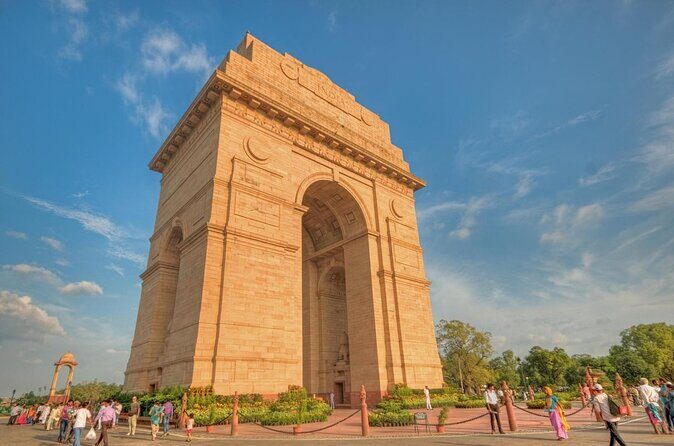
- India Gate: a quick pause near the ceremonial axis
- Humayun’s Tomb: Mughal grandeur with a calmer feel
- Rashtrapati Bhavan and Lotus Temple: official Delhi and spiritual calm
- Agra without the rush: Fort visits plus Mehtab Bagh timing
- Agra Fort: a better-preserved Mughal fort choice
- Mehtab Bagh: the Taj viewpoint garden across the river
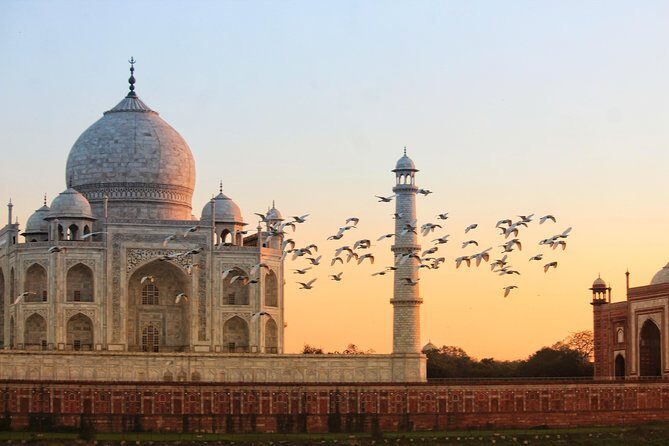
- Taj Mahal at 6:00 am, then Fatehpur Sikri to Jaipur: one day, two big payoffs
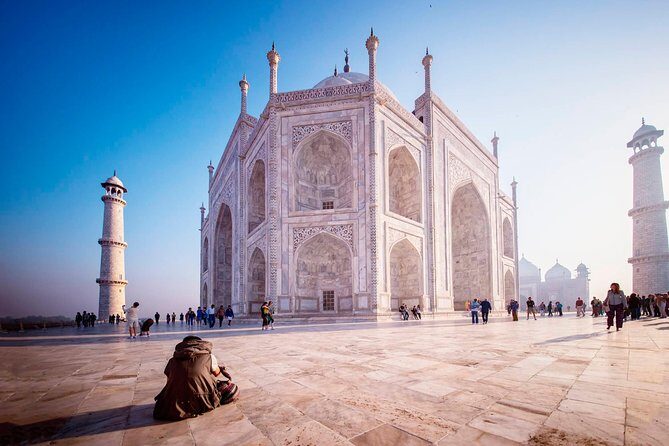
- The Taj Mahal sunrise run
- Back to the road at 10:00 am, then Fatehpur Sikri en route
- Arrive Jaipur in the evening
- Amer Fort, City Palace, and Jantar Mantar: Jaipur’s power trio
- Amber/Amer Fort: the hilltop wow factor
- City Palace: royal spaces with a timeline you can grasp
- Jantar Mantar: science-as-architecture
- Hawa Mahal and Jal Mahal: iconic quick stops that still feel worth it
- Hawa Mahal: Palace of Wind in just 30 minutes
- Jal Mahal: the palace on the lake (about 20 minutes)
- Price and logistics: what $480 covers, and what you’ll still need to pay
- The guide factor: why a good English-speaking guide changes everything
- Leaving Delhi: final morning transfer back to your flight
- Should you book this Private Golden Triangle Tour?
- FAQ
- FAQ
- What cities does the Golden Triangle tour include?
- How long is the tour?
- Is airport pickup and drop-off included?
- Are monument entrance fees included in the price?
- What’s included during the tour?
- What is the cancellation policy?
Key highlights worth marking on your map
- Sunrise Taj Mahal timing at 6:00 am for the best shot opportunities and a calmer start
- A guide who answers questions in plain English, with entertaining, practical explanations
- Air-conditioned travel plus mineral water and evening tea to keep long days bearable
- A strong mix of Delhi sights from Mughal forts to Qutb Minar and Bahá’í Lotus Temple
- Agra Fort and Mehtab Bagh pairing for classic views and a better-rested afternoon rhythm
- Jaipur hits in one day: Amer Fort, City Palace, Jantar Mantar, plus quick stops at Hawa Mahal and Jal Mahal
From Indira Gandhi Airport to Delhi hotel: your trip starts with a name sign
The tour kicks off at Indira Gandhi International Airport, where your executive meets you holding a board with your name. That little detail matters in a big airport—less confusion, fewer phone calls, and you start moving right away.
From there, you’re transferred to your Delhi hotel and overnight in the city. This first day is intentionally light: it gives you time to land, catch your bearings, and adjust to the pace before you start sightseeing.
What I like for first-timers: the airport meet-and-transfer removes a common headache. You don’t need to figure out vehicles, currency timing, or where to stand while you’re still jet-lagged.
What to plan for: since monument tickets and meals aren’t included, you’ll likely want a simple plan for lunch on sightseeing days and a buffer for entrance fees.
You can also read our reviews of more guided tours in New Delhi



Delhi’s big contrasts: Red Fort, Qutb Minar, Humayun’s Tomb, and Lotus Temple
Delhi here isn’t one style. It’s layered—Mughal power, older fortified Delhi at Qutb, and modern monuments around the ceremonial axis. The best part is the way the day moves through eras without you feeling like you’re repeating the same kind of sight.
Red Fort: Mughal power in a fortified shell
You spend about 2 hours at Red Fort (Lal Qila). The fort was commissioned by Shah Jahan in 1639 when he shifted the capital from Agra to Delhi. You’ll get time to take in the scale and the Mughal architectural feel—without rushing through.
Tip for your visit: wear shoes you can walk in comfortably. Forts like this are easiest when you’re not worried about footing.
Qutub Minar: an older Delhi landmark with built-in drama
Next is Qutub Minar, also part of the Qutb complex. You’re allotted about 2 hours. This is an easy stop to enjoy even if you’re not a deep history reader, because the monument itself does most of the talking.
India Gate: a quick pause near the ceremonial axis
India Gate is shorter—around 20 minutes—but it’s a good break. It’s also a free stop on this route, which helps your budget while still giving you that classic New Delhi postcard view.
You can also read our reviews of more private tours in New Delhi






Humayun’s Tomb: Mughal grandeur with a calmer feel
Humayun’s Tomb takes about 2 hours. It’s the tomb of the Mughal emperor Mirza Nasir al-Din Muhammad, known as Humayun. If Red Fort feels like pure strength, this one tends to feel more like a place to slow down and look.
Rashtrapati Bhavan and Lotus Temple: official Delhi and spiritual calm
There’s a stop at Rashtrapati Bhavan, the President of India’s official residence, at the western end of Rajpath. You’ll likely treat this as a viewing stop rather than something you’re paying to enter, since admission details aren’t listed.
Then you end at the Lotus Temple for about 1 hour. Admission is free here, and the building’s lotus-like shape is a visual breather after forts and tombs. It’s open to everyone, regardless of religion, which adds to its friendly, everyday feel.
Potential drawback on this Delhi day: it’s a dense schedule. Even with a guide and vehicle, you’ll want to pace yourself—bring water, and don’t feel like you have to absorb every detail at once.
Agra without the rush: Fort visits plus Mehtab Bagh timing
After breakfast, your driver meets you in Delhi and you transfer to Agra (about 4 hours by road). You arrive in the afternoon, check in, and then you’ve got a break until around 3:00 pm before the guiding tour begins.
That afternoon pause is smart. It helps you avoid the classic mistake of arriving in a new city and trying to sprint through the highlights immediately.
Agra Fort: a better-preserved Mughal fort choice
You spend about 2 hours at Agra Fort. The tour framing suggests it’s often more accessible than Delhi’s Red Fort because parts of the Delhi fort are held by the Indian Army, while Agra Fort is better preserved. In practice, that usually means you can enjoy more of the structure without feeling blocked.
Why this stop is worth it: Agra Fort pairs nicely with what you’ll see later in the trip. It gives you Mughal architectural context before you hit the full Taj Mahal spectacle.
Mehtab Bagh: the Taj viewpoint garden across the river
Then comes Mehtab Bagh, a charbagh garden complex north of the Taj Mahal across the Yamuna River. You get about 30 minutes here, and it’s described as perfectly aligned with the Taj Mahal.
This is the kind of stop you’ll appreciate more when you’ve already started thinking about sightlines. It’s not just scenery—it’s placement.
Budget reality: Agra Fort and Mehtab Bagh list monument fees as not included, so plan for ticket costs here.
Taj Mahal at 6:00 am, then Fatehpur Sikri to Jaipur: one day, two big payoffs
This is the day most people remember—and it’s also scheduled in a way that makes sense. You leave early for Taj Mahal at 6:00 am, specifically timed for sunrise. The plan then brings you back for breakfast after the visit, which helps you avoid the burnout spiral.
The Taj Mahal sunrise run
You’ll have around 3 hours total for the Taj visit block. Admission isn’t included, so this is a day to check your budget and keep the tickets ready.
How to make it enjoyable: sunrise means you’ll want to dress for cool morning air and keep your phone/camera charged. Also, don’t overpack your schedule with side goals. Let the place do its job.
Back to the road at 10:00 am, then Fatehpur Sikri en route
At 10:00 am, you check out and transfer to Jaipur. Along the way, you stop at Fatehpur Sikri for about 2 hours.
Fatehpur Sikri is described as a small city founded by a 16th-century Mughal emperor. The buildings cluster around the center in red sandstone. You’ll see the entrance gate Buland Darwaza, the nearby marble tomb of Salim Chishti, Diwan-E-Khas with its carved central pillar, and Jodha Bai’s Palace blending Hindu and Mughal styles. You’ll also pass the five-story Panch Mahal, which overlooks the site.
Admission is listed as free for this stop, which is a nice bonus on a day with a lot going on.
Arrive Jaipur in the evening
You reach Jaipur in the evening, check in, and overnight in the city. This matters because it gives you enough time to reset before you start stacking major sights the next day.
Possible consideration: this is a long, high-energy day. If you’re the type who needs downtime, plan for a slower evening after you arrive.
Amer Fort, City Palace, and Jantar Mantar: Jaipur’s power trio
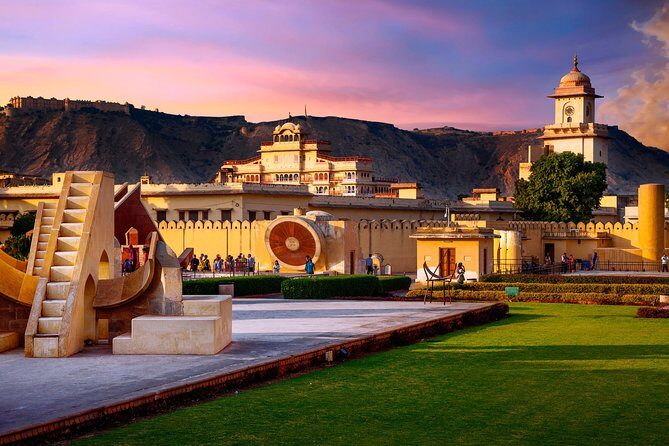
Jaipur day is built around three anchor stops: Amer Fort, City Palace, and Jantar Mantar. Then you add shorter iconic viewpoints like Hawa Mahal and Jal Mahal.
Amber/Amer Fort: the hilltop wow factor
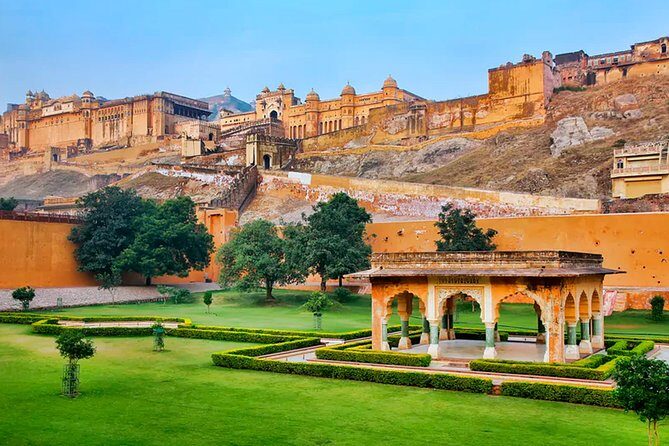
You spend about 2 hours at Amber Palace (Amer Fort). Amer is located about 11 km from Jaipur, and the fort is up on a hill. The tour frames it as the principal tourist attraction in Jaipur, and the schedule gives you enough time to walk through and take it in without rushing.
Admission isn’t included, so add this to your ticket budget.
City Palace: royal spaces with a timeline you can grasp
Next is the City Palace of Jaipur, around 2 hours. It was established around the time Jaipur was founded, by Maharaja Sawai Jai Singh II, who moved his court from Amber to Jaipur. That connection helps you understand the layout: this isn’t just a palace, it’s the seat of a shifting capital.
Again, monument fees aren’t included on this stop.
Jantar Mantar: science-as-architecture
Then you get Jantar Mantar for about 1 hour. It’s a collection of nineteen astronomical instruments built by Sawai Jai Singh II, and the monument completion date is listed as 1734. It’s also noted as a UNESCO World Heritage site and includes the world’s largest stone sundial.
Even if you’re not a science person, this kind of stop works because it’s hands-on in your mind: you can see how people measured time and sky using stone.
Practical note: keep an eye on your watch today, because you’re going to want to pace your photos and your questions.
Hawa Mahal and Jal Mahal: iconic quick stops that still feel worth it
After the heavier three stops, the tour adds shorter sights that still make your Jaipur photos pop.
Hawa Mahal: Palace of Wind in just 30 minutes
Hawa Mahal takes about 30 minutes. It’s built from red and pink sandstone, sits at the edge of the City Palace, and extends toward the Zenana, the women’s chambers. Admission is listed as free here.
This is one of those places where you can do a lot with a little time—especially if you focus on angles and façade details instead of trying to treat it like a museum.
Jal Mahal: the palace on the lake (about 20 minutes)
Finally, you stop at Jal Mahal for about 20 minutes. It’s located in the middle of Man Sagar Lake. The palace was originally constructed around 1699, and later renovated and enlarged in the early 18th century by Maharaja Jai Singh II of Amber.
Admission is listed as free, which helps. Also, because the stop is short, it’s easier to enjoy without feeling rushed.
Price and logistics: what $480 covers, and what you’ll still need to pay

At $480 per person, you’re paying for a private, guided Golden Triangle experience over about 6 days with hotel transfers and city-to-city driving. Included basics are solid: air-conditioned vehicle, mineral water, a professional English-speaking guide, and evening tea.
What isn’t included is equally important:
- Lunch and dinner
- Monument fees
That means the trip can feel like great value if you budget entrance tickets and meals ahead of time, rather than being surprised later. Since multiple major sights here list fees as not included, I’d plan a separate daily spend for tickets and simple meals.
Also, the tour includes pickup, and you’ll start at the airport with a clear meet point and end with a driver drop to the airport around your flight time. That “door-to-door” rhythm is a big part of what you’re buying.
The guide factor: why a good English-speaking guide changes everything
The tour leans on one key ingredient: the guide. Professional English-speaking guidance makes a huge difference on Mughal and Rajput sites, where names and details can blur if you’re trying to read labels while walking.
In particular, one guide named Pratik has been highlighted for being professional, well-versed, and entertaining, and for answering questions clearly. That kind of guide doesn’t just tell you what you’re looking at. They help you connect the dots fast, and they keep the day from turning into a blur of stops.
If you care about understanding what you’re seeing—why a fort was built, what’s special about a tomb layout, how a science structure works—this type of private guidance is where your money starts to feel worth it.
Leaving Delhi: final morning transfer back to your flight
On the last day, after breakfast, the driver meets you and you head back to Delhi. The transfer is about 5 hours, and you’re scheduled to arrive around 4:00 pm for your flight.
That timing keeps the ending stress low. You’re not scrambling last-minute through traffic with bags, which is honestly where these trips can fall apart.
Should you book this Private Golden Triangle Tour?
Book it if you want:
- A private Golden Triangle route focused on major highlights without self-planning the logistics
- A guided experience with an English-speaking professional and clear stop structure
- A special start to Agra with sunrise Taj Mahal at 6:00 am
- Comfort extras like an air-conditioned vehicle, mineral water, and evening tea
Skip or rethink if:
- You hate road time and long driving days between Delhi, Agra, and Jaipur
- You’d rather handle monument tickets and city guiding yourself (because entrance fees and meals aren’t included)
FAQ
FAQ
What cities does the Golden Triangle tour include?
It covers three cities: Delhi, Agra, and Jaipur.
How long is the tour?
It runs for 6 days (about 5 nights / 6 days).
Is airport pickup and drop-off included?
Yes. You meet the executive at Indira Gandhi International Airport on arrival, and on the final day the driver transfers you back to the airport based on your flight schedule.
Are monument entrance fees included in the price?
No. Monument fees are not included, so you’ll need to budget separately for tickets.
What’s included during the tour?
The tour includes an air-conditioned vehicle, mineral water, a professional English-speaking guide, and evening tea. Lunch and dinner aren’t included.
What is the cancellation policy?
There is free cancellation. You can cancel up to 24 hours in advance of the experience start time for a full refund.
If you want, tell me your travel month and what you care about most (photography, architecture, shopping time, or local food), and I’ll suggest a simple budget for tickets and meals around these exact stops.