REVIEW · NEW DELHI
Private Full Day Old and New Delhi City Tour
Book on Viator →Operated by Stic Holidays · Bookable on Viator
Old Delhi feels electric with a guide and vehicle. This private full-day sweep ties together Mughal power, chaotic bazaar energy, and New Delhi’s grand government buildings, with an easy hotel pickup start. You’re not just checking boxes—you’re getting enough context to understand why these places matter, from Shah Jahan’s Mughal imprint to today’s city rhythms.
I also really like how the tour mixes “big monuments” with market-level street life, including a cycle rickshaw ride through Chandni Chowk and built-in entry for major stops. One thing to consider: the schedule is full, so you won’t have hours to wander alone at every site—plan to move, see, and then enjoy a few focused moments instead of long lingering.
In This Review
- Key things to know before you go
- How the day is paced: 9:00 am start, 6–8 hours of momentum
- Jama Masjid: the Mughal scale that hits fast
- Chandni Chowk by cycle rickshaw: street-level Delhi, not a photo stop
- Red Fort: what Shah Jahan built when he moved the capital
- Humayun’s Tomb: the garden-tomb idea in real time
- India Gate, Parliament House, and President House: power with colonial geometry
- Lotus Temple: the calm, circular shape you can feel right away
- Qutub Minar: the UNESCO height factor and the step reality
- Price and value: why $52.53 can work for a first-time Delhi day
- What to pack and how to stay comfortable through the full day
- Who this private tour is best for
- Should you book this private Old and New Delhi tour?
- FAQ
- What is the start time of the tour?
- How long does the tour last?
- Is this tour private?
- Do you get hotel pickup?
- What is included in the price?
- Which stops are included?
- Are entry tickets included for the main monuments?
- Is food included?
- What should I know about cancellations and weather?
- When will I receive confirmation after booking?
Key things to know before you go
- Hotel pickup and an AC vehicle help you beat Delhi’s traffic and heat for much of the day.
- Cycle rickshaw in Chandni Chowk puts you inside the narrow lanes, not just outside them.
- Entry fees for major monuments are included, so you can spend less time figuring out ticket lines.
- A local English-speaking guide keeps the stops meaningful, not random.
- It’s timed well for a first visit, covering both Old and New Delhi in 6–8 hours.
How the day is paced: 9:00 am start, 6–8 hours of momentum
Your day begins at 9:00 am, with pickup from your hotel. That timing matters in Delhi. Morning is usually the best mix of workable weather and lower crowds, especially around Old Delhi’s lanes. You’ll travel in an air-conditioned vehicle between sights, with bottled water provided in the car, so you’re not stuck hunting for basic needs as you hop between neighborhoods.
The tour is designed as a single, continuous loop—Old Delhi sights first, then a shift into New Delhi’s monumental axis of memorials and official buildings. The total duration is about 6 to 8 hours including travel time, so think of it as a “see the essentials, understand the story” day rather than a slow, deep museum marathon.
Because it’s private, it’s also easier to keep your pace. Your guide can steer your attention toward what’s most important, and you’re not competing with a large group for time at the entrances.
You can also read our reviews of more city tours in New Delhi



Jama Masjid: the Mughal scale that hits fast

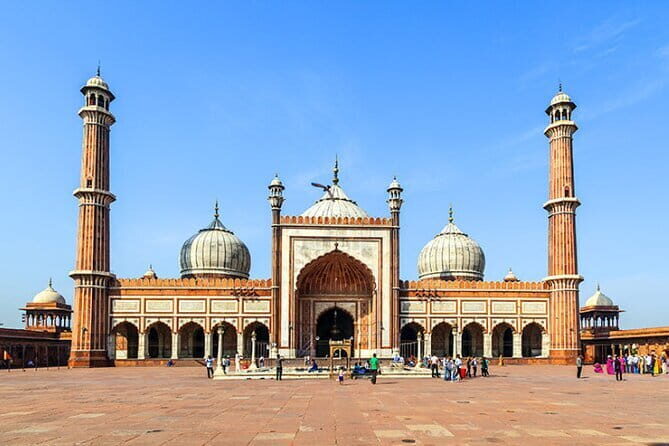
You start with Jama Masjid, one of Shah Jahan’s major Mughal-era statements, built between 1644 and 1656 and inaugurated with the first Imam Syed Abdul Ghafoor Shah Bukhari. The big feeling here is scale. Even in 30 minutes, you can catch the mosque’s commanding presence—minarets, courtyards, and that sense of a planned, imperial vision.
What I like about having a guided stop early is that the guide can help you read what you’re seeing. You’re not just looking at a landmark—you’re learning how the Mughal emperors used grand architecture to project authority. Plus, the admission ticket is included, so you can step in without extra hassle.
A practical note: mosques are active religious spaces. If you plan ahead with modest clothing and respectful behavior, the visit will feel smoother and more comfortable. For many people, this stop sets the tone for the whole day: Delhi’s power isn’t abstract here—it’s built into the stone.
Chandni Chowk by cycle rickshaw: street-level Delhi, not a photo stop
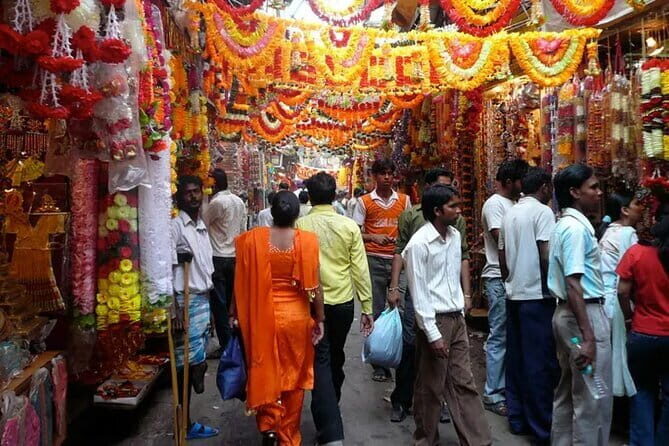
After Jama Masjid, you head into Chandni Chowk, the Old Delhi shopping belt known for everything from spices and dried fruit to silver jewelry and vivid saris. This is one of those places where the details can overwhelm you if you’re alone—streets are narrow, shop displays are stacked high, and the smells and sounds come at you together.
That’s why I like the cycle rickshaw ride included here. It slows the experience just enough to let you notice what you would otherwise miss. You get motion through the lanes, not a stationary “stand and look” moment. The ride also helps you understand why Chandni Chowk feels crowded even when you’re moving: the layout is tight, and the markets pull you inward.
The tour timing gives you about an hour in the area, plus the chance to see the surrounding contrast: Old Delhi bazaars right next to monumental landmarks. Keep an eye out for the side streets where smaller shops cluster—this is where you’ll often find the practical everyday goods like stationery, essential oils, and sweets.
If you’re sensitive to crowds or strong smells, give yourself mental permission to take short breaks. A quick sip of provided water and a few minutes off to the side can reset the experience.
Red Fort: what Shah Jahan built when he moved the capital

Next up is the Red Fort (Lal Qila), historically the main residence of the Mughal emperors. Construction was commissioned by Shah Jahan on 12 May 1639, when he decided to shift his capital from Agra to Delhi. That connection helps the fort make sense. It’s not just a structure—it’s the physical center of a whole imperial plan.
The fort stop is about 30 minutes and includes entry. In that short window, your best move is to focus on the “big picture” elements a good guide can point out: the fort’s role as a seat of power and the way its architecture reinforces that authority.
A realistic expectation helps here. With only half an hour, you won’t absorb every wall, corridor, or exhibit. But you can still get value by paying attention to how the fort’s design expresses control—thick boundaries, clear zones of movement, and the grandeur that comes from symmetry and scale.
If you love photo-heavy sites, you’ll find plenty of angles. If you’d rather avoid nonstop photography, that’s fine too. The guide can keep the focus on meaning, not just views.
Humayun’s Tomb: the garden-tomb idea in real time

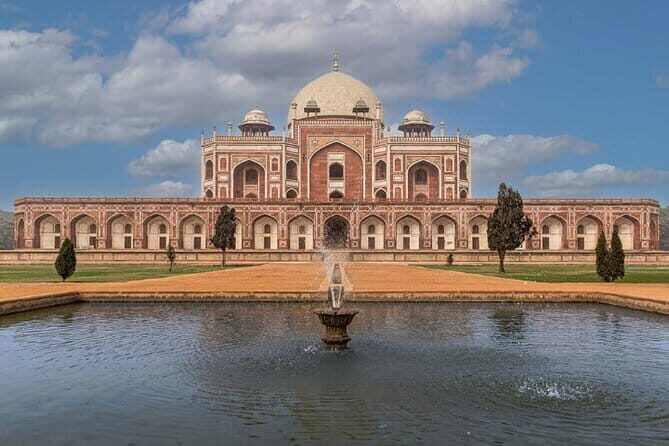
In the afternoon, the tour shifts to Humayun’s Tomb, built in 1570. This stop is special because it’s described as the first garden-tomb on the Indian subcontinent, and it inspired architectural ideas that later led toward the construction of the Taj Mahal. Even if you’ve never studied Mughal architecture, this is a memorable concept to learn: the building isn’t just a tomb, it’s part of a designed landscape.
You’ll spend about 30 minutes, with entry included. What makes the time work is the setting. Garden-tombs aren’t about speed; they’re about proportion and space. In a short visit, you can still catch the intent—how the garden layout, pathways, and the tomb’s placement create a feeling of order.
This stop also helps you break the “fortress only” pattern of the day. After walls and courtyards of power, Humayun’s Tomb brings in a calmer, more human-scaled rhythm: paths, greenery, and a different kind of monumentality.
You can also read our reviews of more private tours in New Delhi





India Gate, Parliament House, and President House: power with colonial geometry

After lunch (not included), you’ll visit major landmarks that reflect Delhi’s modern state and also its colonial-era bones. First is India Gate, counted among the largest war memorials in India. Republic Day details matter here: the Prime Minister visits the gate to pay tributes to the Amar Jawan Jyoti, and the parade starts from there. Even outside that national moment, India Gate is a familiar public space—people gather, and the area is often tied to civic activity.
From there, you’ll head to Parliament House. This is where the experience gets interesting in a different way. The building’s architecture is grand and noticeably colonial in character compared to the drama of Old Delhi’s Mughal monuments. It’s a good contrast stop: different era, different political language, different design priorities.
Then there’s President House (Rashtrapati Bhavan), the official residence of the president of India. It was designed by Sir Edwin Lutyens, constructed 1912–29, and originally known as the Viceroy’s House. Understanding that naming history helps you see the building as part of the long thread of rule and governance that has shaped the city.
These stops are short—around 15 to 30 minutes each—and all are free to enter on the tour. Don’t expect a deep inside-the-building experience here. Instead, use this time to compare visual styles: Mughal stone drama on one side, and straight, ceremonial lines of government architecture on the other.
Lotus Temple: the calm, circular shape you can feel right away
Next comes the Lotus Temple, also known as a Bahá’í house of worship. If you want one break from the intensity of Old Delhi streets, this is the perfect kind of stop. The temple has a distinctive structure: a circular, 9-sided design made from 27 free-standing marble petals, arranged to form the nine sides.
The stop lasts about 30 minutes and is free. What I find useful about a guide here is the structure’s description—it changes how you see the building. From a distance it looks iconic; up close, you start to notice the geometry and the quiet symmetry.
This is also a good moment to slow down mentally. If you’ve been absorbing crowds and stone monuments since morning, Lotus Temple offers a reset without turning your day into a “sit and stare” break.
Qutub Minar: the UNESCO height factor and the step reality

To finish, you’ll visit Qutub Minar, part of the Qutub complex, and a UNESCO World Heritage Site. It’s described as a minaret and victory tower, built at the site of Delhi’s oldest fortified city. The tour highlights the scale in two ways: it’s world-famous for height, and it’s known for 399 steps.
This is a stop where planning your energy matters. You’ll spend about 30 minutes and admission is included, so you can focus on the experience without worrying about tickets. Even if you don’t climb every step, the tower still works as an end-of-day marker. It ties the day together back into Delhi’s layered timeline: older fortified ideas, monumental architecture, and a city that keeps rebuilding in place.
For many people, this is the “last wow.” It closes the loop nicely after Jama Masjid, Red Fort, and Humayun’s Tomb—different periods, same theme of power expressed through stone.
Price and value: why $52.53 can work for a first-time Delhi day
At $52.53 per person for a private 6–8 hour tour, the value depends on what you’d otherwise do on your own. If you’re planning to bounce between Old and New Delhi landmarks, you’ll need reliable transportation, a plan that reduces wasted time, and tickets for several major monuments.
This tour includes:
- Air-conditioned vehicle
- Bottled water in the car
- A local English-speaking tour guide
- Entry fees for major monuments
- All applicable taxes
- Mobile ticket
That “entry fees included” part matters. You’re covering multiple high-profile sites where tickets can add up. Also, having a guide pays off in Delhi because the city changes fast by neighborhood. A good guide helps you connect buildings to timelines, so you don’t just collect photos—you understand what you’re seeing.
The main tradeoff is that you’re paying for structure. If you love wandering completely solo for hours, a tightly guided day might feel a bit scheduled. But if you want a smart first pass through Old and New Delhi, this price can be a practical deal—especially when you factor in the guide and included entries.
What to pack and how to stay comfortable through the full day
Delhi is easiest when you dress and plan for discomfort. Since you’ll be moving between neighborhoods and spending time outdoors at several monuments, pack for heat and sun. I’d suggest:
- Comfortable walking shoes (you’ll cover a lot of ground)
- A hat and sunscreen
- A light layer for indoor/outdoor transitions
- Modest clothing for the mosque stop (you’ll be entering a religious space)
Because the tour provides bottled water in the vehicle, you can count on staying hydrated between stops. Still, bringing your own small refillable option can be handy if you get thirsty during market browsing.
And since the schedule is packed, build in a simple mindset: this is a “good coverage day,” not a “slow and personal” day for every stop.
Who this private tour is best for
This works especially well if:
- It’s your first time in Delhi and you want both Old and New Delhi in one day.
- You prefer a plan with a local English-speaking guide instead of trying to map everything yourself.
- You like getting a structured introduction to Mughal architecture and Delhi’s political landmarks.
- You want a private experience for your group with pickup and transport handled.
It may be less ideal if:
- You hate fixed schedules and want long solo time at each site.
- You’re traveling with limited mobility and want to minimize stairs and walking. (The tour description notes steps at Qutub Minar, so consider that.)
Should you book this private Old and New Delhi tour?
If you want a clean, efficient first-day format—Old Delhi’s monumental Mughal sights plus New Delhi’s memorial and government landmarks—this is a strong choice. The best reasons to book are practical: pickup + AC transport, included major monument entries, and a guide who can connect what you’re seeing to why it exists.
I’d book it when you value guidance and efficiency over lots of free time. For true “wander forever” travelers, you may find the day a little too packed. But if your goal is to understand Delhi quickly and feel confident you hit the essential sites, this one delivers.
One more thing: the operator’s reputation for reliability shows up in past customer feedback—people describe responsive service and strong guiding, with names like Naveen standing out for being a great guide. That’s the kind of detail that matters when you’re trusting someone with your time.
FAQ
What is the start time of the tour?
The tour starts at 9:00 am.
How long does the tour last?
It runs about 6 to 8 hours, including travel time.
Is this tour private?
Yes. It’s a private tour/activity, and only your group participates.
Do you get hotel pickup?
Yes, pickup from your hotel is offered.
What is included in the price?
The tour includes an air-conditioned vehicle, bottled water, a local English-speaking tour guide during sightseeing, all applicable taxes, and entry fees for major monuments.
Which stops are included?
You’ll visit Jama Masjid, Chandni Chowk (with a cycle rickshaw ride), Red Fort, Humayun’s Tomb, India Gate, Parliament House, President House, Lotus Temple, and Qutub Minar.
Are entry tickets included for the main monuments?
Yes. Entry fees for major monuments are included, including Jama Masjid, Red Fort, Humayun’s Tomb, and Qutub Minar.
Is food included?
No. Any type of food or drinks is not included.
What should I know about cancellations and weather?
There is free cancellation up to 24 hours in advance for a full refund. The experience requires good weather; if it’s canceled due to poor weather, you’ll be offered a different date or a full refund.
When will I receive confirmation after booking?
Confirmation is received at the time of booking unless you book within 1 hour of travel. In that case, confirmation is received as soon as possible, subject to availability.