REVIEW · NEW DELHI
Old & New Delhi Private Guided Tour by Car with Options
Book on Viator →Operated by Taj Mirror Tours · Bookable on Viator
Delhi in one day, with a guide who keeps it moving.
This private Old and New Delhi tour is built for comfort and flexibility, with an air-conditioned car and a local guide who explains what you’re seeing as you go. I especially like how it mixes big-photo landmarks with the kind of in-the-streets detail you miss when you travel alone, plus the option to spend more time where you care most.
The main trade-off: you’re packing a lot into one day, so timing and monument closing hours matter. Wear comfortable shoes and keep your expectations realistic about how long you’ll get inside each site.
In This Review
- Key highlights worth marking in your plan
- How this Old and New Delhi car tour saves you time (and decisions)
- Getting picked up in Delhi without the usual headache
- New Delhi stop: start with orientation, then move to the big hitters
- Qutub Minar: the 12th-century minaret you can actually read
- Lotus Temple and the Monday swap plan
- India Gate to Raisina Hill: war memorials and government symbols
- Parliament House exterior: why you visit even without entry
- Chandni Chowk lunch: the market walk where your senses lead
- Red Fort: Mughal power, with the right expectations
- Jama Masjid: where scale hits you fast
- Humayun’s Tomb: the garden tomb that set a template
- Price and options: what you’re really paying for
- Service quality: what the named guides and drivers signal
- Who should book this tour, and who should skip it
- Practical tips that will make the day smoother
- Should you book this Old and New Delhi private car tour?
- FAQ
- How long is the Old and New Delhi private tour by car?
- Is this tour private or shared?
- Does the tour include pickup and drop-off?
- Are monument admission tickets included?
- Will I be able to enter Rashtrapati Bhavan and Parliament House?
- Is lunch included?
- What happens if I’m traveling on a Monday?
- Do I need photo ID?
- Do I need to remove shoes?
- What is the cancellation policy?
Key highlights worth marking in your plan
- Private AC car plus pickup and drop makes the day feel far less stressful
- Qutub Minar, Red Fort, Jama Masjid, and Humayun’s Tomb are scheduled with included admission on the standard flow
- Monday changes are handled for you, with Lotus Temple swapped to ISKCON or Shri KalkaJi, and Red Fort swapped to Humayun’s Tomb
- Rashtrapati Bhavan and Parliament House are exterior-only, so you’ll focus on views from outside
- Chandni Chowk is the lunch centerpiece, with a food-and-market walk baked into the route
- Real-world service shows up in the reviews, including punctual pickup, patient driving, and guides who adjust to your pace
How this Old and New Delhi car tour saves you time (and decisions)
Delhi can feel like three cities glued together: the ceremonial government side, the Mughal-era monuments, and the old bazaars where the sensory volume turns up fast. This tour is useful because it gives you an organized path between them, without you needing to plan transport, parking, or route logic.
You’ll move by private chauffeur in an AC car, which is a big deal in Delhi heat or traffic-heavy hours. And because it’s private (your group only), the guide can shape the pace. If you want photos, you get time. If you’re tired, you can usually slow down.
Value-wise, the headline price is very low, but the real question is what you choose as options. The tour includes the guide and car, and monument entry fees are included only when you pick the entry-ticket option.
You can also read our reviews of more guided tours in New Delhi


Getting picked up in Delhi without the usual headache
The tour offers pickup from Delhi Airport, a railway station, or your preferred location in/around Delhi. In practice, this is what helps a one-day plan actually work—your morning isn’t wasted on finding a meeting point or negotiating transport after a long flight.
The reviews also point to something that matters: punctuality. People singled out drivers like Niraj Sharma and Anil Sharma for being polite, patient, and on time, and that shows up in how smoothly a tight itinerary feels. Another detail I like is that the tour includes all parking fees, tolls, taxes, fuel, and allowances, so you’re not surprised by small add-on charges during the day.
If you choose the option called Only Professional Tour Guide, note the limitation: it covers guide services in Delhi city only. It does not include pickup/drop-off, car/driver, monument fees, or meals. That’s great if you already have transport. If not, select the car-inclusive option.
New Delhi stop: start with orientation, then move to the big hitters

The day begins in New Delhi, and you’ll get a guided intro before jumping into monument-heavy stops. This first stretch is where a good guide helps you build a mental map: where government buildings sit, how the planned avenues relate to older Delhi, and why the architecture styles change from district to district.
At this stage, you’ll also get tips that pay off later—like what to look for in carvings, how to read the buildings from different angles, and how to handle crowds. Since the tour is customized, you can ask for more time here if you’re arriving jet-lagged and need the calm first.
Qutub Minar: the 12th-century minaret you can actually read
Qutub Minar is a UNESCO site and one of the easiest places in Delhi to “get it” visually. The tower rises about 73 meters and is famous as the tallest brick minaret in the world. It was started in the 12th century by Qutb-ud-din Aibak and later completed by Iltutmish, which makes the guide’s story useful rather than decorative.
Why I like this stop: it’s a monument where details matter. You’ll notice intricate carvings and Quranic inscriptions as you move around the complex. If you only do the big exterior photo, you still get the scale. But if you give it time, you get the artistry.
Admission is included in the standard tour flow here, which is also practical. It cuts down on ticket-line hassle and helps keep the day on schedule.
Lotus Temple and the Monday swap plan
The Lotus Temple (also called the Baháʼí House of Worship) is one of those places where the design does half the work for you. The white marble lotus form looks peaceful even when the surrounding city feels intense.
It’s also straightforward conceptually: it welcomes people of all faiths and aims to create a calm space for reflection. The tour notes that it’s closed on Mondays. If you’re traveling on a Monday, you won’t be left scrambling; the guide will take you to ISKCON Temple or Shri KalkaJi Temple instead.
Why this matters: if you plan your day around a landmark you can’t enter, you lose hours. This tour’s built-in alternative helps you keep momentum.
Admission is free at this stop, so it’s a good place to enjoy the atmosphere without worrying about extra fees.
You can also read our reviews of more private tours in New Delhi






India Gate to Raisina Hill: war memorials and government symbols
Next up is India Gate, the 42-meter-high war memorial along Rajpath. It honors 84,000 Indian soldiers who died in World War I and other wars, and there’s an eternal flame called Amar Jawan Jyoti beneath it.
This stop works well as a breathing space between older Delhi chaos and the bigger architecture moments later. You’ll see it in a national-symbol context, but you’ll also have the simple experience of standing there and realizing this is built for remembrance, not just sightseeing. Admission is free here.
Then you’ll shift toward Rashtrapati Bhavan (President House) for an exterior visit. The tour specifically highlights the building’s mix of Western classical elements with Indian motifs, designed by Sir Edwin Lutyens. Since interior access isn’t permitted, you’re there for the façade, domes, and the commanding position on Raisina Hill.
Parliament House exterior: why you visit even without entry

Parliament House (Sansad Bhavan) is another Lutyens-linked sight, with a circular design and grand colonnades. It houses India’s two legislative chambers, but on this tour you view it from outside only.
At first, that might feel like a disappointment. In reality, it’s still worth it because the building’s shape and scale are part of the point. It’s a strong contrast to Mughal-era monuments later in the day. Even from the outside, you’ll get a sense of how the country presents its democracy through architecture.
Admission is free at this stage, and the guided context keeps the visit from feeling like just another photo stop.
Chandni Chowk lunch: the market walk where your senses lead
Old Delhi’s best learning happens in Chandni Chowk, and lunch is placed right inside this neighborhood. The tour frames this as Old Delhi Delights: crisps like jalebis, tangy chaats, stuffed parathas, creamy lassis, and sizzling kebabs, plus time in the bazaar lanes.
Here’s the practical reason this stop is smart: it breaks up the day. After forts and tombs, you need something flexible. A food break also gives you a chance to slow down, ask questions, and reset your energy.
The included details mention a buffet lunch at a 5-star hotel if you choose that option. So if you want more comfort and predictability with seating, you can select that style. If your option favors the neighborhood food experience, you’ll still get a guided walk with cultural and culinary tips.
Either way, this is the part where you should be ready to spend a bit of time deciding what you want to try.
Red Fort: Mughal power, with the right expectations
The tour schedules Red Fort (Lal Qila) as a major Old Delhi anchor. It’s a massive red sandstone fortress built by Emperor Shah Jahan in 1648 as the Mughal dynasty’s main residence.
The itinerary notes that the tour includes an exterior view unless entry is chosen. So your experience here depends on your selected option. Even from outside, the silhouette and scale are iconic. With entry, you can expect the interior grandeur to show up more fully through palatial spaces and marble elements.
The Red Fort is closed on Mondays. If that’s your travel day, the tour swaps it to Humayun’s Tomb instead, which offers similarly strong architectural appeal—plus a calmer garden setting.
Jama Masjid: where scale hits you fast
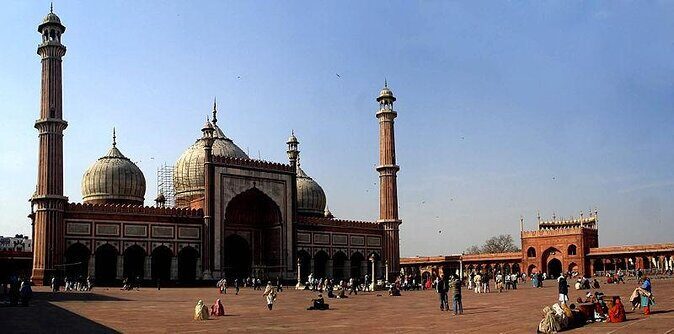
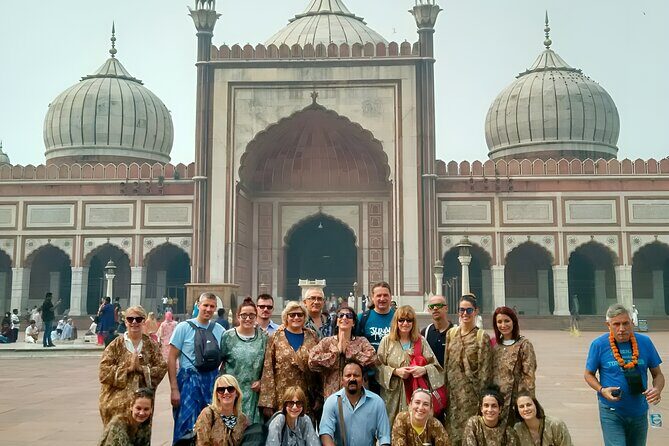
Jama Masjid is one of India’s largest mosques and a major Mughal-era landmark. Commissioned by Shah Jahan in 1650, it’s built from red sandstone and white marble and can accommodate over 25,000 worshippers in the courtyard.
What I like about this stop is how quickly the scale becomes clear once you see it in person. The tour includes admission, so you’ll have time to take in grand minarets, domes, and carved arches. It’s also a good place to experience Old Delhi as a living setting rather than a museum display—this is still a place of devotion, surrounded by real city activity.
The guide can also help you find viewpoints from the southern minaret area, which is a different way to understand the surrounding streets.
Humayun’s Tomb: the garden tomb that set a template
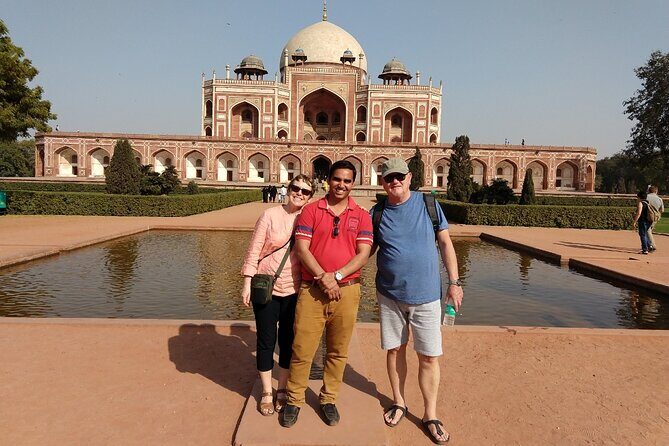
If you want one stop that feels both historical and soothing, Humayun’s Tomb does that job. It’s UNESCO-listed and described as the first garden tomb in the Indian subcontinent. Built in 1570 by Empress Bega Begum for her husband Humayun, it became a design influence later, including the Taj Mahal concept.
This is an architecture-and-gardens stop. You’ll see the Persian-style double domes, red sandstone and white marble, and the symmetry of the charbagh garden layout. The tour notes it offers a peaceful ambiance, which is true once you step away from the more intense market and fortress scenes.
Admission is included in the tour flow here, and it becomes especially important if you’re traveling on a Monday and the plan has to swap around closures.
Price and options: what you’re really paying for
At a listed $5 per person, this tour is likely priced to look like a bargain. Here’s the more honest way to think about it: the tour value comes from the private car, live guide, and handling of transport logistics.
What costs extra depends on your chosen option:
- Monument entry fees are included only if you pick the option that includes admissions
- Lunch style may vary, with a note that a buffet at a 5-star hotel can be included if you choose that lunch option
- The Only Professional Tour Guide option is different. It covers guide services in Delhi city only, not the car/driver or pickup/drop-off
So if you’re trying to make the total work for your budget, choose the option that matches your day style. If you want the smoothest one-day execution, pick the package that includes the car and monument entry. If you already have transport and just want explanation, the guide-only option can make sense.
Service quality: what the named guides and drivers signal
The strongest recurring theme in the reviews is not just friendliness. It’s how well the plan gets handled in real time.
People described guides such as Joseph as responsive and tuned to individual needs, with an enormous amount of background context for the day. Drivers like Niraj Sharma, Dileep, Anil Sharma, and Neeraj Sharma were repeatedly praised for being polite and patient, and for keeping the day moving without chaos.
And the company owner Mr Chand shows up in messages as proactive—constant communication after enquiry and follow-up. That matters because private tours live or die on details like timing, meeting points, and staying aligned on what you want most.
One practical tip also came up: check monument closing times. This tour is well planned, but Delhi’s schedules can still shift how much time you get.
Who should book this tour, and who should skip it
This tour is ideal if you:
- Want Old and New Delhi in one day without wrestling with transport
- Like a guide to explain what you’re seeing as you go
- Prefer a private setup where pace and priorities can adjust
- Are interested in major Delhi architecture, from Mughal forts to modern religious design
I’d skip or rethink it if:
- You hate tight schedules and long days (you’ll be moving between many major sites)
- You mainly want a slow neighborhood stroll without set stops
- You’re hoping for lots of interior access at government buildings (Rashtrapati Bhavan and Parliament are exterior-only)
Practical tips that will make the day smoother
A few small things will help you enjoy the tour more:
- Wear comfortable shoes you can handle with shoe removal at sacred places
- Bring a valid photo ID for monument check-in
- Expect some stops to be more about exterior views unless you’ve chosen entry tickets
- If you’re traveling on a Monday, remember Lotus Temple and Red Fort have swaps (you’ll still tour, just with different stops)
Also, if you’re the kind of person who wants that one perfect shot, tell your guide early. The tour is built to be customized, and this is one of the rare cases where your preferences can actually change the flow.
Should you book this Old and New Delhi private car tour?
If you want a one-day Delhi plan that’s organized, guided, and realistically paced, I’d say yes. The biggest win is simple: private transport plus a local guide plus major monuments without you coordinating details.
Book it if you value comfort, clarity, and seeing the big names—Qutub Minar, Jama Masjid, Humayun’s Tomb, and the core government sights from outside—along with a lunch break in Chandni Chowk.
Hold off if you want deep, unhurried exploration inside every building, especially where interior access isn’t allowed. Also, if your travel day is Monday, plan to embrace the substitutions rather than insisting on a single closed landmark.
FAQ
How long is the Old and New Delhi private tour by car?
It runs about 7 to 8 hours.
Is this tour private or shared?
It’s private. Only your group participates.
Does the tour include pickup and drop-off?
Yes. Pickup and drop-off are available in Delhi, including Delhi Airport, railway stations, or your desired location.
Are monument admission tickets included?
Some stops list admission as included or free depending on the site. Also, admission fees for monuments are included only if you choose the option that includes monument entry.
Will I be able to enter Rashtrapati Bhavan and Parliament House?
You’ll view both from the outside only. Interior access is not permitted.
Is lunch included?
Lunch is part of the Chandni Chowk stop. The info also notes that a buffet lunch at a 5-star hotel is included if you choose that option.
What happens if I’m traveling on a Monday?
Lotus Temple is closed on Mondays, so the tour can take you to ISKCON Temple or Shri KalkaJi Temple instead. Red Fort is also closed on Mondays, and the tour replaces it with Humayun’s Tomb.
Do I need photo ID?
Yes. You need a valid photo ID to check in at the monument.
Do I need to remove shoes?
You should expect to take shoes off before entering temples and other sacred places, so wear comfortable footwear.
What is the cancellation policy?
Free cancellation is available up to 24 hours before the experience start time for a full refund. If you cancel less than 24 hours before, the amount paid isn’t refunded.