REVIEW · JAISALMER
Marvelous 4 Days Golden Triangle India Tour ( Delhi-Agra-Jaipur)
Book on Viator →Operated by Delightful India Holidays · Bookable on Viator
Four days, three icons, one smooth route. This Golden Triangle India Tour is a practical way to see Delhi, Agra, and Jaipur with a private car plan built around the big hitters, especially the sunrise Taj Mahal.
I like the mix of time-tested monuments and smart pacing: you start in New Delhi-style landmarks, move into Mughal-era Delhi, then shift south to Agra’s fort and Taj-area views, and finally finish in Jaipur with forts and observatories.
The one thing to watch is cost creep. Entrance tickets, meals, and tips are not included, and Taj timing can shift if your days land on a Friday—so check your confirmation closely and budget for those add-ons.
In This Review
- Golden Triangle tour highlights you’ll feel fast
- Why this Delhi–Agra–Jaipur route works in just four days
- Day 1 in Delhi: India Gate, Lotus Temple, Qutub Minar, Humayun’s Tomb
- India Gate for quick orientation
- Lotus Temple: marble calm in a busy country
- Qutub Minar and the UNESCO complex
- Humayun’s Tomb: the garden tomb that matters
- Day 2 Agra Fort, Itmad-ud-Daula, and Mehtab Bagh across the Yamuna
- Agra Fort: where imperial power mixed with prison history
- Itmad-ud-Daula: the Taj’s quieter rehearsal
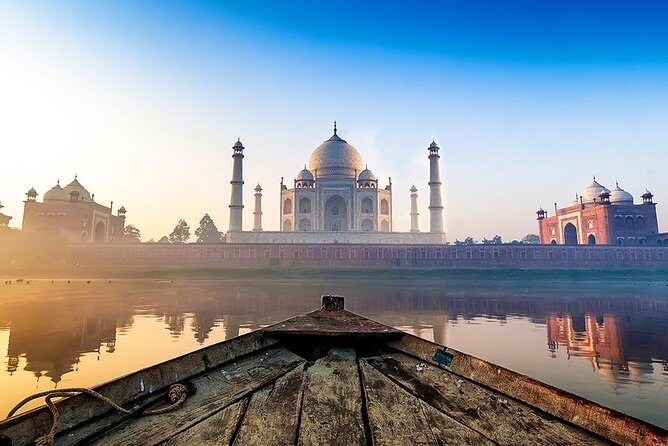
- Mehtab Bagh for Taj views at sunset
- Day 3 sunrise Taj Mahal plus Fatehpur Sikri and Chand Baori
- Taj Mahal at sunrise: when the marble turns from silver to white
- Fatehpur Sikri: Akbar’s planned city, far from the usual track
- Chand Baori stepwell: cool water geometry
- Day 4 Jaipur: Hawa Mahal, Amer, Jal Mahal, City Palace, and Jantar Mantar
- Hawa Mahal: quick exterior impact
- Amer: forts on rugged hills
- Jal Mahal: a lake palace stop for the postcard view
- City Palace: courtyards, gardens, and art-filled rooms
- Jantar Mantar: the big stone sundial that still works
- Private car, mobile tickets, and timing: what you’ll actually manage
- Price and value: why $400 can make sense (and what to budget)
- Who should book this tour, and who should think twice
- Should you book this 4-day Golden Triangle loop?
- FAQ
- What cities does the 4-day Golden Triangle tour cover?
- What time does the tour start?
- Is the Taj Mahal visit included, and what about Fridays?
- What’s included in the price?
- What is not included?
- Can I cancel for a full refund?
Golden Triangle tour highlights you’ll feel fast
- Sunrise Taj Mahal: the plan is built for softer morning light and calmer viewing
- Private AC car + driver: less time negotiating transport, more time looking up at monuments
- Mughal-to-Jaipur contrast: you’ll go from forts and mausoleums to Rajput architecture in just four days
- Fort + garden pairing in Agra: Agra Fort plus Itmad-ud-Daula, then Mehtab Bagh for Taj views across the Yamuna
- Delhi hits in a tight sequence: India Gate, Lotus Temple, Qutub Minar, and Humayun’s Tomb
- Jaipur’s signature sights: Hawa Mahal, Amer, City Palace, and Jantar Mantar on the same day
Why this Delhi–Agra–Jaipur route works in just four days
A Golden Triangle itinerary is popular for a reason: these three cities cluster together, so you can avoid constant flights or complicated transfers. In four days, you’re basically getting a crash course in India’s north—imperial Delhi, Mughal Agra, and Rajput Jaipur—without spending your trip just getting from A to B.
What makes this version feel especially workable is the private, air-conditioned vehicle and driver for all sightseeing and transfers. You’re not planning each leg on your own, and that matters when days start early and you’re moving between cities.
Also, the tour includes fuel, parking, tolls, and interstate taxes. That’s the kind of hidden hassle that usually turns into surprise charges when you book smaller pieces separately.
You can also read our reviews of more tours and experiences in Jaisalmer.


Day 1 in Delhi: India Gate, Lotus Temple, Qutub Minar, Humayun’s Tomb
Day 1 is your Delhi warm-up, and it’s built to cover both the grand-symbol side of the capital and the Mughal side that people come to see.
India Gate for quick orientation
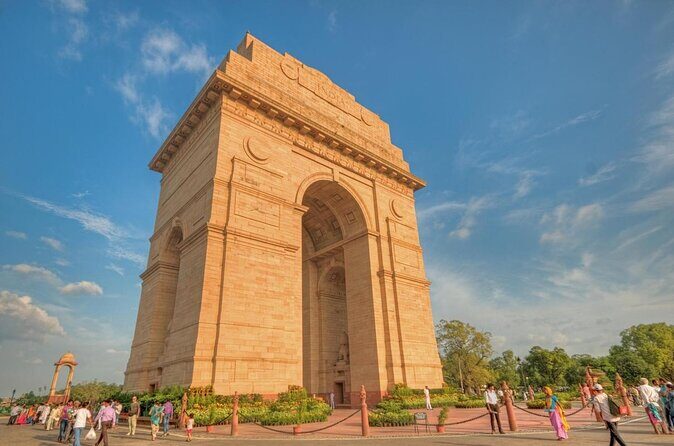
You begin at India Gate, the war memorial near Kartavya Path. With about 30 minutes here, it’s less about staying forever and more about getting your bearings in New Delhi—wide avenues, major monuments, and that sense of scale that only a big capital can deliver.
Tip: If you’re sensitive to morning heat or sun, aim to do photos quickly and then move on. Delhi starts acting like Delhi fast.
Lotus Temple: marble calm in a busy country
Next is the Lotus Temple, the white marble Bahai place of worship shaped like a lotus flower, set in landscaped gardens. It’s designed so people of any faith can visit and pray or meditate, and that openness gives the building a quieter vibe than many major landmarks.
With about an hour allotted, you can slow down. This stop is a nice break before the stone-and-history intensity of the UNESCO sights that come next.
Qutub Minar and the UNESCO complex
Then you head to Qutub Minar, a UNESCO World Heritage site with a tall brick minaret (listed as 73 meters). It’s part of the Qutab complex, and it’s tied to the early period of Delhi’s conquest history—built by Qutb-ud-din Aibak after the defeat of Delhi’s last Hindu kingdom.
With about an hour here, you’ll have enough time to appreciate the tower and the surrounding ruins without feeling dragged through.




Humayun’s Tomb: the garden tomb that matters
You wrap Day 1 at Humayun’s Tomb, the Mughal emperor Humayun’s resting place. This one is described as the first garden tomb in Asia, with the commission credited to Humayun’s first wife, Empress Bega Begum, and the design to Persian architects.
This stop is a standout for people who like architecture details and garden planning. Even if you only spend around an hour, the layout makes it easy to understand why later Mughal tombs took notes from this style.
Day 2 Agra Fort, Itmad-ud-Daula, and Mehtab Bagh across the Yamuna
Agra day is where the tour shifts fully into Mughal glory. You’ll see defenses, tomb artistry, and then a view that’s all about looking back at the Taj from the right angle.
Agra Fort: where imperial power mixed with prison history
Agra Fort is a massive red sandstone complex tied to Mughal emperors. With about an hour, you get a chance to focus on highlights like Diwan-i-Aam and Khas Mahal, plus areas listed as Pearl Mosque and Musamman Burj.
A detail that gives the site extra punch: it’s noted as the place where Aurangzeb imprisoned his father, Shah Jahan. When you’re walking through fort spaces, it helps to know that this wasn’t just ceremonial—it was power, control, and confinement.
Itmad-ud-Daula: the Taj’s quieter rehearsal
Next is Itmad-ud-Daula, often described as a “jewel box” and nicknamed the Baby Taj. It’s a Mughal mausoleum in Agra, and it’s allotted about 30 minutes.
I like this stop because it trains your eye before you reach the Taj. You’ll spot the kind of refined marble and decorative sensibility that later goes full scale at the main monument.
Mehtab Bagh for Taj views at sunset
To close the day, you head to Mehtab Bagh, the Moonlight Garden on the banks of the Yamuna. The tour frames it as a romantic viewing spot for sunset, built as part of a longer garden sequence along the river.
The key idea here is alignment. The garden is described as being perfectly aligned with the Taj’s gardens, which is why it’s often treated as one of the best places to view the monument from across the water. The stop runs about an hour, which is the right amount of time to watch light change without feeling rushed.
Note: If you’re chasing photos, keep an eye on cloud cover. This is a place where lighting can make or break your results.
Day 3 sunrise Taj Mahal plus Fatehpur Sikri and Chand Baori
This is the day you’ll remember, mainly because the Taj is scheduled early. The tour specifically calls for sunrise viewing, and it also notes that the Taj Mahal remains closed on Fridays, with the visit shifted to the next day.
Taj Mahal at sunrise: when the marble turns from silver to white
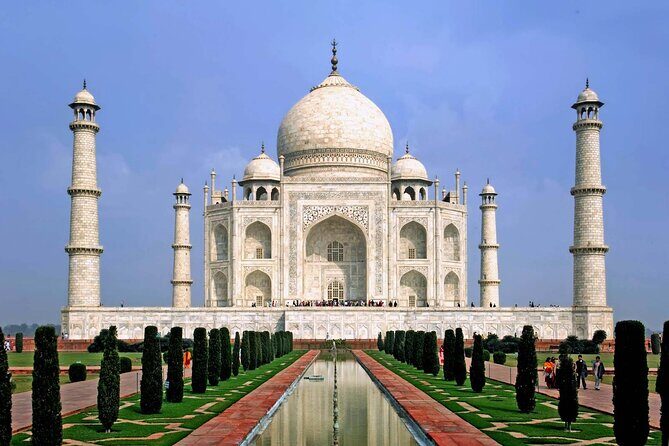
The Taj Mahal is set as the main event, with about two hours allotted. It’s described as a 17th-century monument built by Shah Jahan for his beloved wife, taking 22 years to complete.
The sunrise approach matters. Early morning usually means softer color shifts across the marble—grey and yellow tones can fade into pearly cream and bright white as the sun rises. Add light mist and a relatively quieter feel, and the Taj becomes less like a postcard and more like a living object.
You’ll want to plan for standing and walking, and you’ll likely want a light layer even if the daytime weather looks warm.
Fatehpur Sikri: Akbar’s planned city, far from the usual track
After the Taj, you go to Fatehpur Sikri, about 40 km west of Agra. This place is described as a magnificent fortified ancient city and a short-lived Mughal capital under Akbar.
It’s also noted as the first planned city of the Mughals and an early example of Mughal architecture blending Indian, Persian, and Islamic influences. With about an hour, you’ll get enough time to understand the layout and why it became such a big deal in its time, even if it wasn’t meant to last forever.
Chand Baori stepwell: cool water geometry
Then comes Chand Baori, a step well in Abhaneri known for its massive stepped structure. The tour notes it’s a unique concept of India and explains the practical use: it worked as a cool reservoir in parched days.
There’s also a cultural detail included: it was a ritual to wash hands and feet before visiting the temple next to it. The stop is about 30 minutes, so treat it like a fast, fascinating architecture break.
Day 4 Jaipur: Hawa Mahal, Amer, Jal Mahal, City Palace, and Jantar Mantar
Jaipur day is action packed. The stops are close enough to make it doable, but you’ll still want to keep your energy in check because this is your last big push after three intense days.
Hawa Mahal: quick exterior impact
You start with Hawa Mahal, the Palace of Wind. It’s described as built by Sawai Pratap Singh, planned for royal household visibility while connecting to a site citizens could also use, and famous for its curved latticework arches.
This stop is short—about 15 minutes. Use that time for angles and quick photos, then move on. Don’t try to treat it like a full museum visit.
Amer: forts on rugged hills
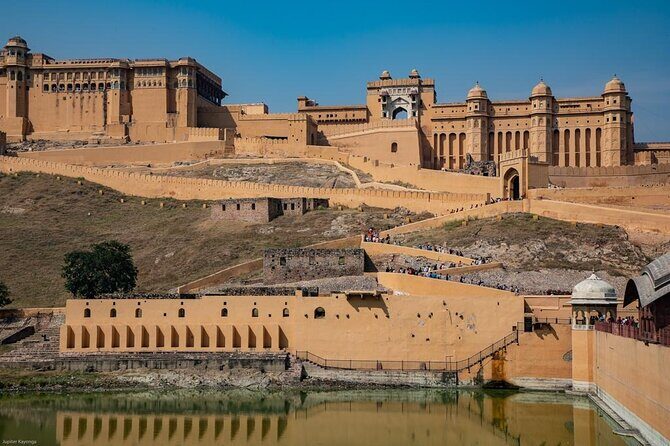
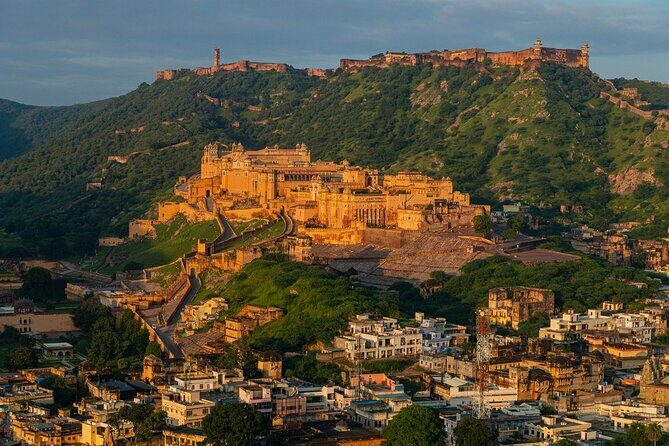
Next is Amer, set on rugged hills outside the city. It’s described as a blend of Hindu and Muslim architecture, built from red sandstone and white marble.
You’ll get about two hours here, which is a good match for Amer’s scale. Even if you just focus on main viewpoints and key structures, you’ll come away with a sense of why Jaipur’s fort style influenced so much of what followed.
Jal Mahal: a lake palace stop for the postcard view
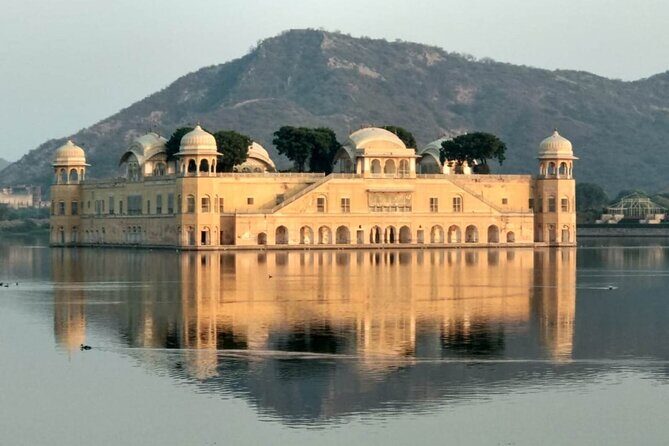
Then you get a short stop at Jal Mahal, the water palace in Man Sagar Lake. The tour describes it as a five-storied building in red sandstone and notes that the palace and lake were renovated and enlarged in the 18th century by Maharaja Jai Singh II of Amber.
This is allotted about 15 minutes—think of it as a breather and a photo moment rather than a long exploration.
City Palace: courtyards, gardens, and art-filled rooms
City Palace is next, with around two hours. It’s described as worth noting for art and structural features, with separated gardens and courtyards across a large area.
This is one of those places where time helps. You’ll enjoy it more if you slow down and wander rather than trying to rush from hall to hall.
Jantar Mantar: the big stone sundial that still works
You finish at Jantar Mantar, described as a UNESCO World Heritage site with the largest stone sundial in the world. The tour also notes it’s still used as an astronomical observatory.
Built by Rajput King Sawai Jai Singh, the place lets you see how architecture and science were tied together. With about an hour, you’ll have time to appreciate the instruments and understand how the site was meant to function.
Private car, mobile tickets, and timing: what you’ll actually manage
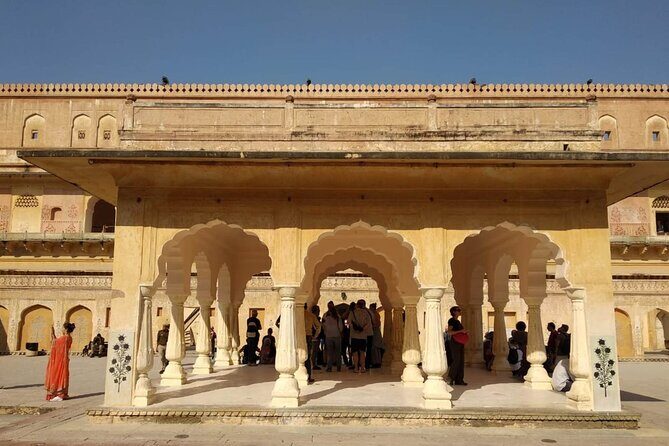
This tour starts at 8:30 am and ends in Jaipur via Agra, using a private AC vehicle throughout. That alone reduces the mental load. You’ll spend less time figuring out local transport and more time watching the sights.
It also includes group discounts and a mobile ticket. Those details matter because they can reduce friction—especially if you’re arriving from another part of India and you just want everything to work on your phone.
One more practical service point: past bookings connected with Delightful India Holidays for logistics help, including arranging travel details like train-ticket questions when normal self-booking wasn’t straightforward. If you’re the type who wants someone to fix the admin side, that’s a real advantage.
Just remember: the tour includes transfers and transportation, but it doesn’t list your meals or monument entrances as included. So you’ll want cash/card ready for those separate purchases.
Price and value: why $400 can make sense (and what to budget)
The price shown is $400 per person for about four days. For that, you’re getting a private, air-conditioned car with fuel, parking charges, tolls, and interstate taxes, plus the driver’s allowance.
That’s where the value comes in. Touring Delhi, Agra, and Jaipur by hiring cars or piecing transfers together can get expensive fast once you factor in fuel, tolls, and time wasted coordinating.
What is not included is equally important. Hotel stays, meals, monument entrance fees, camera fees (if charged), and driver tips are not included. Also, a professional guide is listed as not included.
One practical way to think about it: the $400 covers movement and access logistics, while the on-site experience costs depend on your ticket choices and your comfort level with optional guidance.
Who should book this tour, and who should think twice
This tour is a strong fit if you want a structured Golden Triangle trip without juggling transport between cities. It also suits you if early mornings don’t scare you, because the Taj is scheduled for sunrise.
It may be less ideal if you want everything packaged end-to-end. Because entrance fees, meals, and guide services aren’t included, you’ll need to handle some spending and decisions during the trip.
Also, double-check expectations about guiding. The overall description talks about a friendly, knowledgeable guide, while the pricing list says guide services are not included. If you care about narration inside monuments and historical context throughout, confirm what your booking includes.
Should you book this 4-day Golden Triangle loop?
Yes, if you want major monuments handled for you—with an AC vehicle, a clear day-by-day flow, and the Taj Mahal timed for sunrise. For many first-timers, that combination saves a lot of stress and keeps your trip from feeling like logistics homework.
Skip (or at least confirm details) if you’re counting on a fully packaged deal with meals and monument tickets covered. In that case, you might prefer an option that bundles entrances and guide costs, or you should budget carefully before you go.
If you’re traveling with friends, this setup can also work well because the tour notes group discounts and a private format for your group.
FAQ
What cities does the 4-day Golden Triangle tour cover?
It covers Delhi, Agra, and Jaipur. The trip starts in Delhi and ends in Jaipur, traveling via Agra.
What time does the tour start?
The tour start time is listed as 8:30 am.
Is the Taj Mahal visit included, and what about Fridays?
The Taj Mahal is included and scheduled for sunrise. The tour also notes the Taj Mahal remains closed on Friday, with the visit planned for the next day instead.
What’s included in the price?
Included items are AC car for all sightseeing and transfers, fuel, parking, toll taxes and interstate taxes, private transportation, and driver allowance.
What is not included?
Not included are hotel/accommodation, meals, personal expenses, professional friendly informative tour guide and other activities, driver’s tips, and monument entrance fees/camera fees.
Can I cancel for a full refund?
Yes. The policy listed is free cancellation if you cancel at least 24 hours before the experience start time for a full refund.