REVIEW · JAIPUR
Jaipur Full-Day Guided Tour by Car
Book on Viator →Operated by Jaipur Taxi Cab · Bookable on Viator
Pink City sights, minus the hassle.
This Jaipur full-day car tour is interesting because you stack the big icons in one smooth route: Hawa Mahal, Jantar Mantar, and City Palace, with an English-speaking driver and planned photo stops. I like the convenience of hotel or airport pickup plus bottled water, and I like that lunch is included if you pick that option. One consideration: monument entry fees are not included, so plan extra cash for the ticketed stops.
The pacing is built for real sightseeing, not just driving past things. You get about 45 minutes at Hawa Mahal and Jantar Mantar, around 2 hours at City Palace, then a mix of calmer royal sites and quick photo moments like Jal Mahal on Man Sagar Lake.
You’ll also benefit from the private-car format, especially in busy traffic. Names like Govind/Govinda, Rashid, Sameer, and Mohammed Ali show up in the praise for being patient and helpful with history and practical tips, which is exactly what you want for a first day in town.
In This Review
- Key highlights to expect
- How the Jaipur full-day car plan works in real life
- Hawa Mahal: the Palace of Wind and your best photo window
- Jantar Mantar: UNESCO astronomy that’s actually worth the ticket
- City Palace: courtyards, Mughal-Rajput style, and the main time commitment
- Royal Gaitor Tumbas: a calmer contrast outside the city center
- Jal Mahal and Panna Meena ka Kund: two “quick hit” heritage stops
- Jal Mahal (Water Palace)
- Panna Meena ka Kund (stepwell)
- Amer in the car: fort views, town energy, and easier timing
- Galtaji Monkey Temple: history, springs, and hilltop vibes
- Lunch, local markets, and how to get more than photos
- Price and value: what $43.20 per person really covers
- Who should book this Jaipur car tour (and who should skip it)
- Should you book this Jaipur full-day guided car tour?
- FAQ
- How long is the Jaipur full-day guided tour by car?
- Is hotel or airport pickup included?
- Is this tour private?
- Is there an English-speaking driver?
- Is lunch included?
- Are monument entry fees included?
- Which stops are free on this tour plan?
- What’s included besides the car?
- Is there a mobile ticket?
- Is free cancellation available?
Key highlights to expect
- Hawa Mahal’s 953 windows and the story behind why royal women could watch street life unseen
- UNESCO-listed Jantar Mantar with nineteen stone-and-brass astronomical instruments
- City Palace time on the ground to actually walk courtyards and take in the Mughal-Rajput mix
- Royal Gaitor Tumbas near Nahargarh Hills for a quieter, marble-celebrating break
- Free stops at Jal Mahal, Panna Meena ka Kund, Amer Fort area, and Galtaji Monkey Temple
How the Jaipur full-day car plan works in real life
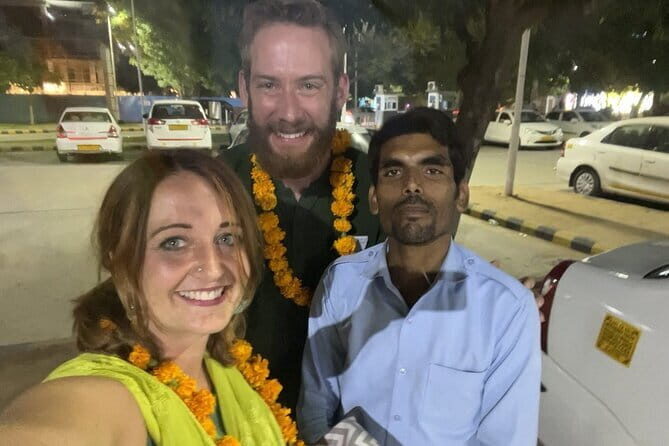
This is an 8-hour style day built around driving efficiently and giving you enough time at the major sights to enjoy them. The private A/C car matters here. Jaipur traffic can be lively, and you don’t want your day to be a constant parking-lot scavenger hunt.
You start with pickup from your hotel or the airport, then move through a sequence that hits landmarks first, then fills in with the “you’re already here” sites that are lighter on entry fees. Along the way, you should expect photo stops and chances to browse local markets for crafts and souvenirs.
One practical tip: decide what you care about most—architecture, photography, or history. If you like architecture and photos, spend extra time at Hawa Mahal and City Palace. If you’re more into how things work, Jantar Mantar will be your favorite hour.
You can also read our reviews of more guided tours in Jaipur


Hawa Mahal: the Palace of Wind and your best photo window
Hawa Mahal is the postcard, but it’s also a functioning design idea. Built in 1799 under Maharaja Sawai Pratap Singh, it’s the iconic pink sandstone facade shaped with 953 small windows. The whole point was ventilation plus privacy: royal women could observe city life without being seen.
You’ll typically get around 45 minutes here. That’s enough time to take your photos, walk along the frontage, and get your head around the layout. Since admission tickets aren’t included in this package, you’ll need to budget for the ticket if you decide to go inside or access any paid areas.
Best way to make this stop work: take photos early, then slow down. The facade looks simple from afar, but up close you’ll notice how the window rhythm creates depth and shade—especially as light shifts across pink stone.
Jantar Mantar: UNESCO astronomy that’s actually worth the ticket
Jantar Mantar in Jaipur is a UNESCO World Heritage site and one of India’s biggest astronomical observatories. It was built by Maharaja Sawai Jai Singh II in the 18th century and includes nineteen massive instruments made of stone and brass.
What I like about this stop is that it’s not a stuffy “museum only” experience. You can walk around, look at the instruments, and understand the purpose: measuring time, predicting eclipses, and tracking stars.
You’ll usually have about 45 minutes. Admission isn’t included here, so factor that in if you plan to enter. If you don’t know what you’re looking at, ask your driver-guide to point out how the instruments relate to the big ideas. It makes the place click fast.
City Palace: courtyards, Mughal-Rajput style, and the main time commitment

City Palace is where Jaipur’s royal story feels tangible. It’s a complex of courtyards, gardens, and buildings that served as the residence of the Jaipur royal family. Built in the early 18th century by Maharaja Sawai Jai Singh II, it reflects a Mughal and Rajput mix that you can actually see in the details.
This stop deserves the longest time in the day, roughly 2 hours. Since entry tickets aren’t included, budget for the paid parts you want to see. If you only have energy for a partial walk, focus on the areas with the most architectural detail and the best courtyard views.
Practical approach: wear comfortable shoes. City Palace is a “walk, stop, look, repeat” kind of place. When you’re in a car all day, it’s easy to underestimate how much walking you’ll do once you’re on-site.
Royal Gaitor Tumbas: a calmer contrast outside the city center
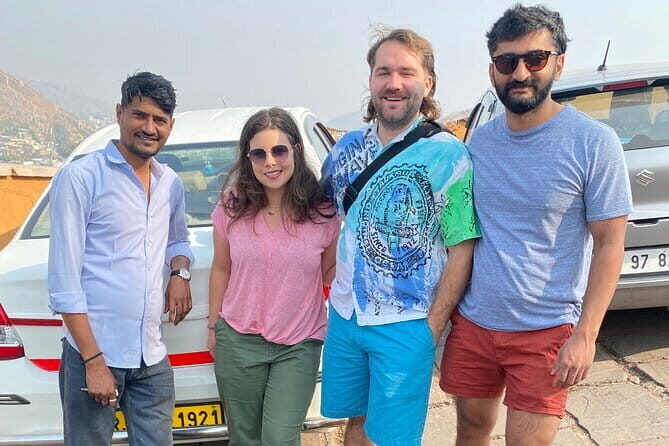
After the major monuments, Royal Gaitor Tumbas gives you a quieter change of pace. It’s located just outside Jaipur near the Nahargarh Hills and is known for marble cenotaphs honoring Jaipur’s former maharajas.
You’ll have about 45 minutes. This is a strong choice if you want craftsmanship without fighting for space at the biggest ticketed sites. Admission tickets aren’t included here either, so again: plan for entry fees if you want full access.
What makes this stop valuable is the atmosphere. Marble and hills work together to create a calmer mood than the city icons. If your day starts feeling rushed, this is the spot to slow down and actually look at the carvings.
A few more Jaipur tours and experiences worth a look




Jal Mahal and Panna Meena ka Kund: two “quick hit” heritage stops
Not every Jaipur sight needs a long ticket line. Two of the lighter stops in the day are Jal Mahal and Panna Meena ka Kund, and both are described as free in this tour plan.
Jal Mahal (Water Palace)
Jal Mahal sits in Man Sagar Lake. It’s a five-story structure built in the 18th century under Maharaja Madho Singh I, designed in Rajput and Mughal style. Since much of it is submerged, you mainly see the upper portion rising from the water.
You’ll usually have about 15 minutes. That’s enough for a few photos and a quick look, especially if you catch the light near sunset. If your guide offers a viewpoint or quick pull-over photo chance, take it. At this time scale, the right angle matters.
Panna Meena ka Kund (stepwell)
Panna Meena Ka Kund is a historic stepwell with symmetrical staircases and intricate design. It dates back to the 16th century and served as a water reservoir and meeting spot.
Plan about 30 minutes. This one is free, which is a big value win. Also, stepwells are one of those Jaipur features that make the city feel more practical and less just “royal postcard.” It’s engineering you can see.
Amer in the car: fort views, town energy, and easier timing

Amer (often written as Amer town and closely linked with the fort area) is the place where many people connect Jaipur to a broader Rajput landscape. You’ll spend about 2 hours here, and admission is listed as free in this tour plan.
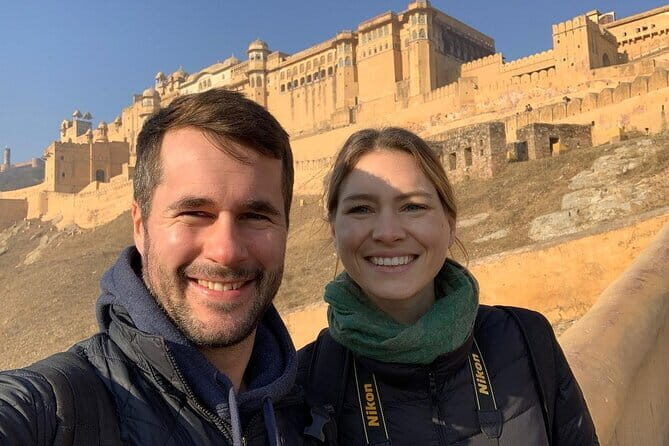
Amer is known for the Rajput Fort overlooking Maota Lake, plus temples and lively market areas. In a car tour, Amer is useful because it takes pressure off navigation. You show up, follow your driver’s pacing, and get time to walk through the parts you’re most curious about.
Quick advice: if you’re here for the fort views, prioritize viewpoint time first. If you’re here for market browsing, build in time after you’ve locked in your photos. Don’t do it the other way around or you’ll feel rushed while the light is best.
Galtaji Monkey Temple: history, springs, and hilltop vibes
The Monkey Temple, also known as Galtaji Temple, is an ancient Hindu pilgrimage site on the hills near Jaipur. The standout feature is the presence of many monkeys, plus natural springs feeding sacred pools (kunds) where pilgrims bathe.
You’ll usually get about 1 hour. Admission is listed as free for this tour plan, which keeps your day flexible. The complex has colorful pavilions and frescos, and the views from the hill area can be a nice payoff after the heavier monuments.
One practical consideration: be mindful around the monkeys and keep your belongings secured. You’re there for a temple visit, and the hill setting brings both wildlife and crowds of different kinds.
Lunch, local markets, and how to get more than photos
Lunch is included only if you select the option for it, but when it is included, it’s described as a delicious, authentic Rajasthani meal. That matters because Jaipur sightseeing can make you forget food planning, and a good lunch is what keeps the afternoon from feeling like survival.
Your day also includes stops at local markets. This is where the tour pays off beyond big monuments. You can browse for traditional crafts and small souvenirs without needing to guess where to go. If you have shopping interests—textiles, jewelry, leather goods—tell your driver what you’re after. The most helpful drivers in this service type seem to match your pace rather than forcing a scripted route.
Photo stops are part of the plan, too. Some guides and drivers who get praised for this kind of day tour are known for taking passengers to viewpoints along the way for better photos. That’s not just convenience; it’s also how you avoid regret when you realize you photographed from the wrong angle.
Price and value: what $43.20 per person really covers
The advertised price is $43.20 per person, and for Jaipur that can be good value when you compare it to paying for transport and then trying to organize a full day yourself.
Here’s what the price is designed to include:
- A private A/C car
- An English-speaking driver
- Hotel or airport pickup and drop-off
- Bottled water
- Fuel, parking, and taxes
- A government-approved tour guide if you pick the guide option
- Lunch only if you select that option
The main thing not included: monument entry fees and food/drinks beyond lunch. In a day like this, that typically means you’ll pay extra at ticketed stops like Hawa Mahal, Jantar Mantar, City Palace, and Royal Gaitor.
My advice: budget a bit extra for tickets and keep your expectations flexible. If you arrive and decide you don’t want to go into a paid section, you lose less money than if you buy every ticket in advance without knowing your energy level.
Who should book this Jaipur car tour (and who should skip it)
This tour is best for you if:
- You want a full day overview of Jaipur with minimal stress
- You’re visiting for the first time and want the classic monuments in a single plan
- You prefer a private car over figuring out routes between far-flung sites
- You like history but don’t want to spend the day reading maps instead of seeing things
You might skip or modify if:
- You’re the type who loves slow, in-depth wandering with lots of unplanned detours
- You hate extra ticket budgeting during a single day
Also, since it’s private and only your group participates, it’s a strong fit for couples, small families, and solo travelers who want control over pacing.
Should you book this Jaipur full-day guided car tour?
I’d book it if your goal is a solid first taste of Jaipur—Hawa Mahal, Jantar Mantar, and City Palace—plus a few stops that make the day feel lived-in, like Jal Mahal, stepwell architecture, Amer, and Galtaji.
What pushes it from good to great is the structure: pickup and drop-off, A/C car comfort, and enough time at each major stop to actually enjoy it. It’s also a straightforward value deal at the listed price, as long as you plan for monument entry fees.
If you want the best day: bring comfortable walking shoes, carry a little cash for entry tickets, and ask your driver to help with photo viewpoints along the way. That small move can turn a checklist day into something that feels like a real tour of the Pink City.
FAQ
How long is the Jaipur full-day guided tour by car?
The tour runs for about 8 hours.
Is hotel or airport pickup included?
Yes. Pickup and drop-off from your hotel or the airport are included.
Is this tour private?
Yes. It’s private, so only your group participates.
Is there an English-speaking driver?
Yes, the car includes an English-speaking driver.
Is lunch included?
Lunch is included if you select the option that includes it.
Are monument entry fees included?
No. Monument entry fees are not included. Bottled water and parking are included, but ticket costs are separate.
Which stops are free on this tour plan?
Jal Mahal, Panna Meena ka Kund, Amer, and Monkey Temple are listed as free (no admission ticket included).
What’s included besides the car?
Bottled water, fuel charge, parking, and all other taxes are included.
Is there a mobile ticket?
Yes. The tour includes a mobile ticket.
Is free cancellation available?
Yes. You can cancel up to 24 hours in advance for a full refund.
If you want, tell me your travel dates and whether you prefer more shopping time or more monument entry time, and I’ll suggest how to balance the ticketed stops versus the free ones during this 8-hour day.